What's inside
- Where to buy these picks
- Quick Picks
- How these picks were chosen
- The retro six compared plainly
- How do you pick a retro toaster that still toasts brilliantly?
- Styling a kitchen around a statement toaster
- Retro dials and the pleasure of analogue mornings
- What retro owners learn in the first month
- Caring for coloured and steel finishes
- A short social history hiding inside your toaster
- Breakfast for guests: the retro toaster as host
- Matching retro toast to the rest of the morning table
- When retro is the wrong answer, honestly stated
- Dialling in each bread: a retro owner’s field notes
- Second-hand wisdom: why retro toasters get inherited
- The dial, the lever and the crumb: a tiny maintenance liturgy
- Common mistakes
- Final recommendation
- Frequently asked questions
As an Amazon Associate I earn from qualifying purchases. This post may contain affiliate links at no extra cost to you.
As an Amazon Associate, cottageverdict.com earns from qualifying purchases.
A retro toaster is bought twice: once for the toast and once for the feeling it lends the room at eight in the morning. The best retro toasters understand that bargain and refuse to trade function for costume, which is why this guide reads their listings as appliances first and ornaments second. Beneath the curved shells and cheerful colours below sit browning ladders from five levels to seven, function trios of reheat, defrost and cancel, extra-wide slots measured at 1.5 inches on two models, and removable crumb trays on nearly every machine in the set.
The six gathered here span the retro spectrum honestly. Nostalgia leans into vintage design in red with five toasting levels and cord storage, MUELLER HOME pairs seven browning levels with stainless steel features, Aigostar offers a cream white extra-wide slot model listing six browning levels, Roter Mond goes boldly orange in retro stainless steel, Keenstone specifies 18/8 food-grade steel with 1.5 inch slots in white, and Hazel Quinn wraps a floral Eduardo Recife design around six levels and three functions. Each one toasts two slices; each one dresses the job differently.
Buyers should decide which half of the bargain leads. If colour and silhouette will be seen by every guest who enters the kitchen, let finish weigh heavily and function break ties. If the machine will work daily for a family with frozen bread and bagel habits, let the function list lead and choose the prettiest among the qualified. The reviews that follow keep both ledgers open for every pick.
One promise governs the pages below: every level, function and finish attributed to a machine appears in that machine’s own listing, and anything the listing leaves out is flagged as missing instead of being politely assumed.
Bread, after all, is patient stuff: it will wait in the bin while you decide properly, and it will forgive a week of deliberation far more readily than it forgives a narrow slot far too narrow for its widest honest slice of the whole long week.
Where to buy these picks
Meet the six, in the order they will be reviewed in full below.
Nostalgia’s Retro Wide in red is the costume drama of the set, vintage design with a crumb tray, cord storage and five toasting levels.
MUELLER HOME counters with the longest browning ladder here, seven levels beside reheat, defrost and cancel in a stainless-featured body.
Aigostar’s cream white model brings an extra-wide retro slot, six browning levels and a removable tray for bagel and waffle households.
Roter Mond turns the saturation up in orange retro stainless steel, with bagel, cancel and defrost functions and six shade settings.
Keenstone specifies its materials proudly, 18/8 food-grade steel in white with 1.5 inch slots and bagel, defrost and reheat modes.
Hazel Quinn closes the parade with a floral collaboration design, six browning levels and 1.5 inch extra-wide slots. A kitchen planned as a whole might extend the vintage mood beyond breakfast, and Best Rustic Bathroom Vanities shows the same rustic instinct at a larger scale.
Quick Picks
| Pick | Best for | Highlight from the listing |
|---|---|---|
| Nostalgia Retro Wide 2-Slice Red | Vintage purists in red kitchens | Vintage design, 5 levels, crumb tray, cord storage |
| MUELLER HOME Retro 2 Slice | Control seekers wanting seven levels | 7 browning levels, 3 functions, stainless features, cord storage |
| Aigostar Retro 2 Slice Cream | Cream kitchens toasting wide slices | Extra-wide slot, 6 browning levels, defrost and cancel, removable tray |
| Roter Mond Retro Orange | Bold colour statements | Orange stainless, bagel and defrost, 6 shade settings, wide slots |
| Keenstone Retro 2 Slice White | Material-conscious retro fans | 18/8 food-grade steel, 1.5 inch slots, 6 levels, three modes |
| Hazel Quinn Retro Floral | Pattern lovers and gift buyers | Floral Recife design, 6 levels, 1.5 inch slots, three functions |
How these picks were chosen
Retro had to mean designed, not merely old-fashioned in a photograph. Each finalist’s title commits to the style in words, vintage design, retro stainless steel or a named design collaboration, and each backs the costume with a working specification of levels, functions and trays. Machines that were simply coloured like the past while hiding a bare-bones control set did not survive the cut.
Browning ladders were recorded as published: five levels on the Nostalgia, six on Aigostar, Roter Mond, Keenstone and Hazel Quinn, and seven on MUELLER HOME. The spread matters less than shoppers assume, because retro dials invite playful adjustment anyway, yet households sharing one machine across strong preferences benefit from the finer ladders exactly as they would on a modern slim model.
Functions cluster tightly around a familiar trio, reheat, defrost and cancel, with bagel modes named on Roter Mond and Keenstone. Slot width becomes a differentiator instead: extra-wide wording on Aigostar and Roter Mond, and a precise 1.5 inch figure on Keenstone and Hazel Quinn, gives thick-slice households something measurable to hold on to.
Housekeeping and storage finished the assessment. Removable crumb trays appear on MUELLER HOME, Aigostar, Roter Mond, Keenstone and Hazel Quinn, while Nostalgia answers with its crumb tray plus cord storage under the base, a feature MUELLER HOME also names. In small kitchens where the toaster travels between cupboard and counter, cord storage is not trivia; it is the difference between a tidy move and a dangling annoyance.
Durability signals were weighed where a listing offered them: a named steel grade on the Keenstone, stainless features on MUELLER HOME and Roter Mond, and tray and cord arrangements that suggest a machine designed to be emptied, moved and kept. Retro styling dates quickly when the object beneath it feels flimsy, so build language mattered in the final ordering.

Nostalgia Retro Wide 2-Slice Red
Nostalgia built its name on appliances that time-travel, and this red two-slice machine is the purest expression of that idea in the group. The listing says vintage design without hedging, pairs it with a wide slot, and finishes the practical side with a crumb tray and cord storage. In a kitchen with cream cabinets, a checkered cloth and enamel on the shelves, this toaster will look less like an appliance placed in the room and more like a resident that belongs to it.
Five toasting levels set the functional ceiling, and honesty about that number serves the buyer well. Five honest steps cover pale, gold, mid-brown, deep and dark for the majority of breads and eaters, yet two housemates whose preferences sit close together may find themselves sharing a step and compromising. Households that treat browning as a precision sport should note MUELLER HOME’s seven levels further down this page.
- Levels: 5 toasting levels
- Slot: wide, two slices
- Tray: crumb tray included
- Storage: cord storage included
- Finish: red, vintage design
Strengths
- Fullest vintage commitment in the group, colour and shape together
- Cord storage keeps a travelling toaster tidy between uses
- Wide slot welcomes generous slices despite the classic silhouette
Trade-offs
- Five levels is the shortest browning ladder here
- Bagel and defrost functions are not named in the title
- Red is a dominant colour that quieter kitchens may tire of
Cord storage is the sleeper feature. Retro toasters are disproportionately bought for caravans, holiday cottages, spare rooms and seasonal kitchens, places where the machine is stored between uses, and a cord that tucks away turns each move into a one-hand carry instead of a trailing trip hazard. The crumb tray likewise suits intermittent use, because a stored toaster should be stored clean.
Functions beyond the levels go unnamed, with no bagel or defrost cycle claimed in the title. Fresh-bread households will shrug; freezer households should verify before buying. Red itself is the final consideration, glorious against the right palette and exhausting against the wrong one, so picture the exact shelf it will occupy rather than falling for the photograph’s kitchen.
As the group’s vintage standard-bearer, the Nostalgia wins whenever atmosphere is the brief and five levels of browning are enough. It is the toaster most likely to be complimented by a guest and the least likely to be chosen by a specification hunter, and both reactions confirm it is doing its job.
Best for: vintage-led kitchens, caravans and holiday cottages wanting red retro theatre with tidy cord storage.
Not suited for: a precision browning household, because five levels leave close preferences sharing a step, and no defrost cycle is named for frozen loaves.
Admire the Nostalgia red retro listing
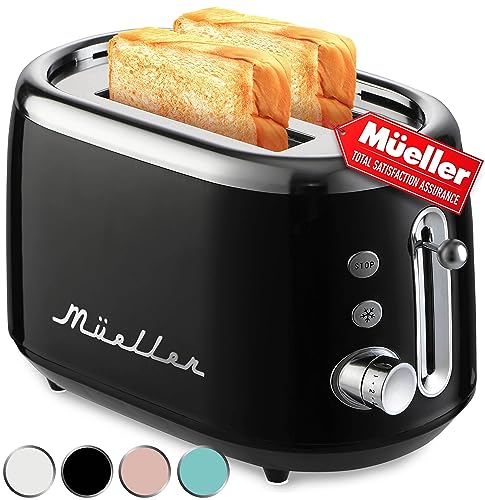
MUELLER HOME Retro 2 Slice
MUELLER HOME dresses a thoroughly modern control set in retro clothing, and the disguise is convincing enough to satisfy both halves of a divided household. Seven browning levels top this group’s ladder, and the function trio of reheat, defrost and cancel is named in full, which means frozen slices, fresh slices and second-chance slices are all covered without a workaround. Stainless steel features give the body a durability story beyond its styling.
The seven-level ladder earns its keep in shared kitchens. Where five levels force neighbours in taste to compromise, seven steps let the pale-toast eater and the dark-toast eater each land closer to home, and the dial becomes a peacekeeping device used twice a day. Defrost, meanwhile, is the function retro buyers most often forget to demand and most often miss by February, when the freezer is full of good bread.
- Levels: 7 browning levels
- Functions: reheat, defrost and cancel
- Build: stainless steel features
- Tray: removable crumb tray
- Storage: under-base cord storage
Strengths
- Seven levels give the finest browning steps in this retro set
- Full function trio covers frozen, fresh and reheated slices
- Removable tray plus cord storage tidy both crumbs and cable
Trade-offs
- Colour is not headlined, so style-led buyers get less theatre
- Bagel mode is not separately named among the functions
- Stainless features will need wiping to keep the retro shine
Housekeeping is properly thought through. A removable crumb tray handles the weekly empty without gymnastics, and under-base cord storage mirrors the Nostalgia’s travel friendliness for households that store the machine between uses. Together they suggest a maker who expects this toaster to be lived with rather than merely photographed, which is the highest compliment a retro appliance can earn.
Style is the concession. The listing headlines stainless features rather than a colour story, so buyers furnishing a red or floral kitchen fantasy will find more theatre elsewhere in this group. Bagel mode also goes unnamed, though the function trio and seven levels give bagel eaters workable control through shade selection alone.
MUELLER HOME is the retro choice for households that refuse to choose between looks and capability. It leads on levels, matches anyone on functions and tidies up after itself, asking only that you accept a quieter costume in exchange for the group’s most complete working brief.
Best for: shared households wanting seven browning levels and a full function trio inside a retro shell.
Not suited for: shoppers decorating around a colour-led vintage scheme, since this listing sells stainless restraint rather than a red, orange or floral statement.
Review the MUELLER HOME seven levels
Aigostar Retro 2 Slice Cream
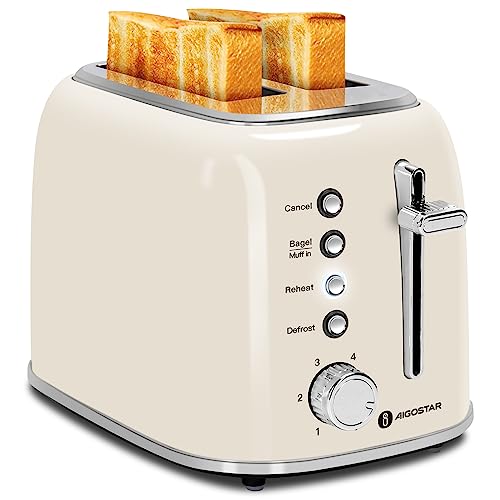
Aigostar’s cream white retro model understands its audience at a glance: households whose kitchens run on pale wood, linen and enamel, and whose bread runs wide. The extra-wide slot is the working headline, with the listing naming bagels, breads and waffles as its intended residents, while six browning levels and a defrost function cover the daily control needs of a family that freezes its loaves.
Six levels sit in the group’s comfortable middle, fine enough for most shared preferences and simple enough for a guest to operate without a tutorial. Cancel and defrost are the named functions; reheat goes unmentioned, so toast that cools during a busy morning would return for a short low pass rather than a dedicated cycle, a minor chore most households will barely register.
- Slot: retro extra-wide slot, two slices
- Levels: 6 browning levels
- Functions: cancel and defrost named
- Tray: removable crumb tray
- Finish: cream white
Strengths
- Extra-wide slot suits bagels, breads and waffles as listed
- Cream white flatters country and cottage palettes
- Defrost named for freezer-led breakfast routines
Trade-offs
- Reheat is not named among its functions
- Listing includes promotional wording shoppers should ignore
- Cream shows scorch marks sooner than darker finishes
Cream white as a finish is a mood decision with a cleaning footnote. It brightens a north-facing kitchen and pairs with almost any accent colour a cottage accumulates over years, yet it will display scorch shadows and jam fingerprints more honestly than red or orange. Owners who wipe a toaster’s shoulders weekly will keep it lovely; owners who never wipe anything should choose a more forgiving colour from this group.
The listing carries a promotional phrase about ratings that this guide deliberately ignores, because applause in a title is not a specification. What remains after that noise is removed is a sound, pretty machine: wide slot, six levels, defrost, removable tray. Judge it on those bones and it stands up well.
Aigostar suits the cream kitchen that toasts generously. It will not out-spec MUELLER HOME or out-shout Roter Mond, yet for bagel-and-waffle households wanting retro softness with an honest function set, it may be the easiest machine here to live with daily.
Best for: cream and country kitchens toasting bagels and waffles from an extra-wide slot with defrost on board.
Not suited for: a household that reheats toast constantly, because no reheat function is named and cooled slices must return on a low manual pass.
Look at the Aigostar cream retro model

Roter Mond Retro Orange
Roter Mond commits to orange the way other brands commit to chrome, and the kitchen that can carry it will be lifted by it every single morning. The body is retro stainless steel wearing that colour, the slots are extra wide, and the function set names bagel, cancel and defrost across six bread shade settings. It is a specification with a personality, aimed at households tired of appliances that apologise for existing.
The named bagel function distinguishes it inside this retro set, where several rivals welcome bagel halves geometrically without dedicating a cycle to them. Daily bagel eaters know the difference between fitting and toasting properly, and Roter Mond addresses the second. Defrost covers the freezer routine, cancel covers the impatient, and six shades give enough ladder for a household’s spread of tastes.
- Build: retro stainless steel
- Functions: bagel, cancel and defrost named
- Shades: 6 bread shade settings
- Slots: extra wide slots
- Tray: removable crumb tray, orange finish
Strengths
- Orange is the boldest, happiest finish in the entire group
- Bagel function named, unlike several retro rivals
- Extra-wide slots and six shades cover thick artisan slices
Trade-offs
- Orange will dominate any palette not planned around it
- Reheat is not named among the functions
- Stainless panels in colour still ask for fingerprint care
Extra-wide slots keep the boldness practical. Thick sourdough and seeded artisan slices go in whole, and the removable crumb tray keeps the aftermath manageable, because a high-traffic toaster in a bright colour will be used more, not less, once the household falls for it. Stainless under the colour promises a body that feels substantial rather than plasticky when lifted.
Reheat is the missing name on the function list, a small gap most owners will bridge with a brief low setting. The larger consideration remains the colour itself. Orange sings against teal, navy, white and warm wood, and argues with red, pink and some greens, so the decision belongs to the room as much as to the toast lover.
For a household building a joyful kitchen deliberately, Roter Mond is the group’s exclamation mark, and a reminder that retro can mean the exuberant end of the era rather than the demure one. Readers extending that energy outdoors could browse Best Two Burner Gas Cooktops once the indoor colour scheme settles.
Best for: bold, joyful kitchens wanting a named bagel function and extra-wide slots in orange stainless.
Not suited for: a renter in a landlord-grey kitchen who cannot plan a palette around orange, because this finish will lead the room whether invited to or not.
See the Roter Mond orange finish

Keenstone Retro 2 Slice White
Keenstone does something unusual in the retro aisle: it publishes its steel. The listing specifies 18/8 food-grade steel for this white two-slice machine, a materials detail most retro rivals leave vague, and pairs it with 1.5 inch slots, six browning levels and a mode set of bagel, defrost and reheat. For buyers who read appliances the way cooks read ingredient labels, that specificity builds trust before the styling is even considered.
The mode trio is the group’s most breakfast-complete alongside MUELLER HOME, and it swaps a named cancel for a named bagel, a trade bagel households will accept gladly. Reheat rescues the slice abandoned during a school-run emergency, defrost handles the freezer loaf, and six levels divide the browning territory into steps most families will find sufficient for their spread of preferences.
- Steel grade: 18/8 food-grade steel, per the listing
- Slots: 1.5 inch slots
- Levels: 6 browning levels
- Modes: bagel, defrost and reheat
- Tray: removable crumb tray, white finish
Strengths
- Steel grade is specified, a rarity worth crediting in this class
- Three modes include bagel and reheat together
- 1.5 inch slots give thick slices a measured welcome
Trade-offs
- White finish will show every scorch shadow and crumb
- Cancel is folded into general use rather than headlined
- Retro decor claim means styling varies by eye of the beholder
Slot width at 1.5 inches is a promise with a number attached, and thick-cut households can plan around it confidently. White, meanwhile, is the finish of a bright, deliberate kitchen: it vanishes pleasantly among pale tiles and steel, and it confesses every crumb and scorch mark in return. Keenstone’s removable tray at least makes the confession easy to clean up.
Retro decor is the maker’s own framing, and in white the retro reads as gentle curves rather than period costume, which may suit buyers who want softness without a theme. Anyone craving the full diner fantasy should look to the red Nostalgia; anyone wanting a calm machine with a serious materials line should stay here.
Keenstone is the thoughtful retro buy: specified steel, measured slots, three useful modes and a finish that brightens rather than performs. It lacks a headline colour, yet households that value substance in retro clothing will rank it near the top of this page.
Best for: material-conscious buyers wanting specified food-grade steel, bagel and reheat modes in a calm white retro body.
Not suited for: a theme-kitchen buyer chasing full period drama, because white retro curves whisper where the red Nostalgia happily shouts.
Inspect the Keenstone steel specification

Hazel Quinn Retro Floral
Hazel Quinn’s collaboration with Eduardo Recife produces the only patterned toaster in this group, a floral two-slice retro machine that treats the appliance as a canvas. In a kitchen of plain surfaces it becomes the single decorative object on the counter, and in a cottage already rich with pattern it joins the conversation. Gifting logic follows naturally: this is the one model here that could be wrapped for a housewarming and land as a present rather than a purchase.
Beneath the artwork, the specification refuses to coast. Six browning levels, a function trio of defrost, reheat and cancel, extra-wide slots measured at 1.5 inches and a removable crumb tray match the practical leaders of this group almost line for line. Bagels are welcomed by the slot’s width and the listing’s breakfast framing, though no dedicated bagel mode is named, a distinction daily bagel devotees should weigh against Roter Mond and Keenstone.
- Design: floral, with Eduardo Recife collaboration
- Levels: 6 browning levels
- Functions: defrost, reheat and cancel
- Slots: 1.5 inches, extra wide
- Tray: removable crumb tray
Strengths
- Floral artwork makes this the group’s only patterned machine
- Full function trio plus 1.5 inch slots match the practical leaders
- Removable tray keeps a display piece easy to maintain
Trade-offs
- Pattern is a strong commitment guests will have opinions about
- Bagel mode is not named despite the wide slots
- Floral finish offers no plain alternative in this listing
Pattern care is the lived reality. A floral finish hides crumbs and light marks better than plain white or cream, a genuine advantage in a working kitchen, while asking its owner to commit to the design through every future repaint of the room. Kitchens evolve around neutral appliances easily; around a floral toaster, the toaster becomes a fixed point the room evolves around, which owners tend to either love or regret within a season.
As a breakfast machine it asks for no apologies, and as decor it asks for a decision. Readers who enjoy coordinating a whole morning, from toast to smoothies for a crowd, might continue to Best Blenders for Crushing Ice after settling this countertop centrepiece.
Hazel Quinn closes the set as its artist: fully equipped, unapologetically decorative and impossible to confuse with anything else on the market. If the floral makes you smile in the listing photographs, trust that reaction, because you will be seeing it at closer range than any reviewer ever will.
Best for: pattern lovers and gift buyers wanting a floral centrepiece with a complete function trio underneath.
Not suited for: a household that redecorates often, because a floral appliance anchors the room’s palette and will argue with the next scheme you fall for.
View the Hazel Quinn floral artwork
The retro six compared plainly
Side by side, the retro field separates into costume leaders and capability leaders, with two models straddling both camps.
| Machine | Levels | Named functions | Signature |
|---|---|---|---|
| Nostalgia Retro Wide 2-Slice Red | 5 | Crumb tray, cord storage | Vintage red design |
| MUELLER HOME Retro 2 Slice | 7 | Reheat, defrost, cancel | Stainless features |
| Aigostar Retro 2 Slice Cream | 6 | Cancel, defrost | Extra-wide slot, cream |
| Roter Mond Retro Orange | 6 shades | Bagel, cancel, defrost | Orange stainless |
| Keenstone Retro 2 Slice White | 6 | Bagel, defrost, reheat | 18/8 food-grade steel |
| Hazel Quinn Retro Floral | 6 | Defrost, reheat, cancel | Floral Recife artwork |
Levels run five to seven, bagel modes appear on two listings, steel is specified on one, and finishes cover red, cream, orange, white, floral and stainless restraint. Read the table by the column your household argues about most.
How do you pick a retro toaster that still toasts brilliantly?
Which matters more at your table, ladder or looks?
Count the preferences in your household before counting the levels on a dial. Two eaters with distant tastes need ladder length, which points to MUELLER HOME’s seven levels, while a household of one settled preference can spend its budget on the finish it will enjoy looking at, which opens the door to Nostalgia’s red or Hazel Quinn’s floral without functional guilt.
Remember that a dial invites play. Retro controls are handled more and admired more than hidden buttons, so a ladder you enjoy turning is worth a step or two of theoretical precision.
What does your freezer say?
Frozen bread is where retro charm meets weekday reality. Defrost is named on MUELLER HOME, Aigostar, Roter Mond, Keenstone and Hazel Quinn, leaving the Nostalgia as the fresh-bread romantic of the group. If your freezer holds the household loaf, let that single word in a listing eliminate more contenders than any colour preference should.
Bagels: fitted or actually catered for?
A wide slot fits a bagel; a bagel mode toasts it as intended. Roter Mond and Keenstone name the mode, while Aigostar and Hazel Quinn welcome bagels through extra-wide slots and Hazel Quinn frames them as breakfast fare. Daily bagel households should buy the named mode; occasional bagel households can happily accept the geometric welcome.
Will it live out or live away?
Storage habits change the right answer. Cord storage on the Nostalgia and MUELLER HOME suits machines that travel between cupboard and counter, while a permanently displayed machine should be chosen by how its finish handles crumbs, fingerprints and sunlight in your exact kitchen. A display piece in white or cream asks for weekly wiping; red, orange and floral forgive a busier household.
What if the kitchen is rented and the palette is fixed?
Renters should weigh finish against walls they cannot paint. In a white or grey rental, a red, orange or floral machine supplies the colour the lease forbids elsewhere, and it leaves with you when you do, which makes a statement toaster one of the safest personality investments in a rented home. In a rental already cursed with clashing tiles, stainless restraint or cream may be the diplomatic choice.
Renters should also prize cord storage and removable trays, because machines that move house often survive better when their cables tuck away and their interiors travel clean. Two models here name cord storage outright, and that line in a listing is worth more to a mobile household than an extra browning level will ever be.
Styling a kitchen around a statement toaster
A retro toaster earns its counter space as decor, so place it like decor. Give it breathing room rather than crowding it between the kettle and the knife block, angle it slightly if the counter allows, and let one or two companions echo its colour at a distance: a tea towel, a enamel canister, a row of jars. Echoing beats matching, because a kitchen where every object shares one colour stops looking curated and starts looking staged.
Lighting decides whether a finish sings. Red deepens under warm evening light and brightens almost to scarlet in morning sun, orange glows in both, and cream and white depend on nearby colour for their character. Before committing, hold the listing photographs against your own kitchen’s light at the hour you actually make toast, because that is the light the machine will live in.
Finally, protect the theatre with tidiness. A statement appliance surrounded by clutter loses its statement, so the crumb tray rhythm and cord discipline described in this guide are, for retro owners, aesthetic duties as much as hygienic ones.
Retro dials and the pleasure of analogue mornings
There is a reason retro toasters keep their dials while modern machines bury settings in touch panels. Turning a dial is a small, satisfying physical act that suits the half-awake state in which toast is made, and it can be operated with buttery fingers that a touch panel would reject. Guests understand a dial instantly, children learn it safely under supervision, and nobody has ever needed a firmware update to brown bread.
Analogue control also ages gracefully. A dial that works on day one works identically in year ten, with no screen to fade and no panel to delaminate in the steam of a busy kitchen. For an appliance bought partly as a long-term furnishing, that durability of interface is a genuine feature, and it explains why the retro format endures beyond fashion cycles that declare it finished every few years.
What retro owners learn in the first month
The first lesson is that the dial’s numbers are a private language. Setting three on a new machine will not equal setting three on the one it replaced, so the household recalibrates with a week of ordinary breakfasts and, ideally, a note of the winning positions for white, wholemeal and the bakery loaf. That small ritual converts a decorative purchase into a known tool, and it is the moment most owners stop describing the toaster as cute and start describing it as theirs.
The second lesson concerns heat soak. Consecutive cycles darken progressively, so the slice for the household’s palest eater should go in first, with the dial nudged down as the relay proceeds. Retro machines, often built around generous elements, demonstrate this effect clearly, and learning it turns a brunch relay from a gradient of accidents into a planned sequence.
The third lesson is affection, which surprises practical buyers. A machine with a face, a colour and a dial becomes a small landmark in the kitchen’s geography, the object directions are given by and the corner guests drift toward. That social role is part of what the price buys, and owners who embrace it stop apologising for choosing with their eyes as well as their heads.
Caring for coloured and steel finishes
Coloured retro bodies ask for gentleness rather than effort. A soft cloth, warm water and immediate attention to jam or butter smears will keep red, orange, cream and floral finishes bright for years, while abrasive pads will dull any of them in a single enthusiastic afternoon. Stainless features prefer a wipe along the grain and a dry buff afterwards, which prevents the water spotting that makes steel look neglected even when it is clean.
Heat and sunlight are the slow enemies. A toaster stored in a shaft of afternoon sun will fade unevenly across seasons, most noticeably on red and floral finishes, so a permanent home out of direct glare preserves the colour you paid for. Cords deserve the same foresight: use the storage provided where fitted, keep the cable clear of the body’s hot shoulders, and a retro machine will look as deliberate in year five as it did on the day it arrived.
A short social history hiding inside your toaster
The retro shapes in this group quote an era when kitchen appliances first became colourful consumer objects rather than grey utilities, when a toaster could be red on purpose and a kitchen could be planned around cheerful machines. That history explains the design language: rounded shoulders, friendly dials, colours chosen for joy. Buying one today is partly an act of interior design and partly a vote for that older idea that everyday tools deserve to be pleasant.
Modern retro machines improve quietly on their ancestors where it counts. Browning control is steadier, functions such as defrost exist at all, crumb trays slide instead of requiring a shake over the sink, and slots have widened to meet breads the original era never imagined, from thick sourdough to the bagel in its modern, generously sized form. The costume is historical; the convenience is contemporary, and that combination is exactly what the six listings here are selling.
That blend also explains why retro buyers should read specifications with modern expectations. Nostalgia for a shape should never excuse a missing defrost cycle in a freezer household, nor should a floral finish excuse a vague slot width in a thick-bread household. The listings in this guide were held to present-day standards precisely because their owners will live present-day mornings with them.
Breakfast for guests: the retro toaster as host
A handsome toaster changes how guests experience breakfast in a small home. Instead of the host vanishing to produce toast in batches, the machine sits in view, guests operate the dial themselves, and the meal becomes participatory in the way a cottage breakfast should feel. Retro designs excel at that social role because nobody is intimidated by a dial, and the machine’s looks invite the interaction instead of merely permitting it.
Set the scene for success: bread sliced and arranged beside the machine, butter softening in its dish, jams opened before anyone sits down, and the household’s preferred settings mentioned aloud once so guests can aim confidently. With those small preparations, a two-slice relay keeps a table of four in fresh toast without the host ever leaving the conversation for long.
Children, supervised, are the surprise beneficiaries. A dial they can turn and a lever they can press make toast the first hot food many youngsters are allowed to produce, and a retro machine’s friendly face turns that lesson into a small ceremony. Households that value those moments will find the retro premium easier to justify than any specification table can explain.
When the guests leave, the same machine returns to weekday duty without ceremony, which is the final test of any statement appliance. Theatre that cannot toast a frozen slice on a dark Monday is merely theatre; every model in this group was required to pass the Monday test before its costume was admired at all.
Matching retro toast to the rest of the morning table
A toaster never works alone, and retro owners tend to build small rituals around theirs. The butter dish that lives within reach, the board reserved for slicing the good loaf, the jam that only appears when guests do: these companions turn a two-slice machine into a breakfast institution. Planning that constellation when the toaster arrives, rather than letting it accumulate by accident, keeps the counter composed and the routine swift.
Drink pairings follow the same instinct. A household that invests in a characterful toaster usually cares about the pot beside it, and the retro corner becomes a natural home for the kettle, the cafetiere or the espresso kit discussed elsewhere in this programme. The point is not to theme the kitchen like a film set; it is to group the morning’s tools where the morning happens, in objects whose company you enjoy before the day has properly begun.
Weekend and weekday modes can coexist around one machine. Weekdays run on the household settings and the freezer loaf; weekends slow down for the bakery loaf, the dial played with, the table set. A retro toaster flatters both modes because its controls invite adjustment and its looks reward lingering, which is more than can be said for a purely utilitarian box.
When retro is the wrong answer, honestly stated
This guide loves the category, yet three households should walk past it. The first needs four slices at once for a large family against the clock; no two-slice machine, however charming, survives that arithmetic, and a wider modern model will serve better. The second needs a toaster oven’s versatility for reheating and melting, which no slot machine replaces. The third simply dislikes visible appliances and stores everything away, wasting the one asset retro machines are bought for.
There is also the matter of taste in the plainest sense. Some cooks want their tools invisible and their counters empty, and for them a colourful dial machine will irritate daily rather than delight. Recognising that temperament in advance is not a failure of retro enthusiasm; it is the same honesty this guide applies to browning levels and defrost cycles, extended to the buyer’s own character.
Everyone else, which is most households reading a page about retro toasters, can buy with confidence that the category’s charm is backed here by complete functions, measured slots and trays that empty without a wrestling match. The six were filtered for exactly that backing.
Dialling in each bread: a retro owner’s field notes
White sandwich bread is the forgiving baseline, browning evenly at a middle setting on every machine here and revealing, by comparison, how a particular dial is spaced. Wholemeal runs a touch slower to colour yet crisps suddenly near the end, so it rewards a watchful final half minute. Seeded and fruit loaves carry sugars and oils that darken fast at the edges, and they teach owners to drop a step and accept a gentler gold in exchange for an unbitter crumb.
Sourdough deserves its own paragraph because its moisture varies by bakery and by day. A fresh, damp slice may need the upper reaches of the ladder, while the same loaf on day three toasts quickly and can scorch while the centre is still deciding. Retro owners learn to toast the first slice of a new loaf attentively and set the dial by evidence, a habit that turns bread buying from different bakeries into a pleasure rather than a gamble.
Waffles and crumpets, both welcomed by the wide slots in this group, ask for lower heat and patience. Their sugars caramelise beautifully and then burn without much warning, so a conservative first attempt followed by a short second pass beats a heroic single cycle. Write the winning settings on the household note, because these occasional foods are exactly the ones whose settings nobody remembers between appearances.
Bagels close the lesson. Where a bagel mode exists, use it and trust its asymmetry; where only width welcomes the bagel, toast the cut side toward the centre elements and accept a softer crust as the trade. Either way, a bagel toasted with intention beats a bagel merely heated, and the wide retro slots here give that intention room to work.
Second-hand wisdom: why retro toasters get inherited
Few small appliances are passed between households the way a handsome toaster is. Students inherit them for first flats, grandparents hand them down when a kitchen is combined, and holiday cottages accumulate them gratefully. That afterlife is a design compliment: an object people bother to move is an object doing more than its function, and it should influence buying, because a machine chosen with a little love is a machine that will be kept, cleaned and repaired rather than discarded at the first fault.
Keeping a retro machine inheritable is mostly housekeeping. Empty the tray before storage, coil the cord using the storage provided where fitted, and keep the finish out of abrasive harm, and the toaster that served your weekday breakfasts will greet a new kitchen looking intentional rather than tired. Simple machines forgive years in a way complex ones rarely do, since a dial and an element have no software to abandon them.
There is a sustainability footnote worth stating plainly. The greenest appliance is the one already made, and a retro-styled machine bought for keeps, in a finish chosen for a room it will live in for years, is a more responsible purchase than a neutral box replaced whenever fashion turns. Buy once, buy fondly, and let the toaster grow old with the kitchen around it.
The dial, the lever and the crumb: a tiny maintenance liturgy
Retro machines reward a liturgy so small it barely deserves the name. Wipe the shoulders when the tray is emptied, because crumbs gather there first and bake into marks that later need scrubbing. Work the dial through its range occasionally while the machine is cold, which keeps its travel smooth and reminds the owner where the household settings sit. Rest the lever gently rather than letting it snap, a kindness to linkages that will be repaid across thousands of breakfasts.
Once a season, give the machine the attention its display role deserves: tray out and washed, exterior buffed, cord inspected along its length for the nicks that travelling and storage inflict. Ten minutes, twice a year, is the entire servicing contract of a well-made slot toaster, and it is a large part of why simple retro machines outlive cleverer appliances in real kitchens.
Common mistakes
Buying the colour before checking the functions. A dreamy finish cannot thaw a frozen loaf. Confirm defrost and any bagel provision your routine needs, then let colour decide among the qualified.
Treating five to seven levels as a quality ranking. Ladder length serves shared households; a single eater with one preference gains nothing from extra steps. Match the dial to the eaters around your table.
Crowding a statement machine into clutter. Retro design needs visual room. A toaster bought to be seen should be given a clear stretch of counter, or its charm is spent on an audience of biscuit tins.
Scrubbing coloured finishes with abrasive pads. One harsh clean can dull a finish permanently. Soft cloths and prompt wipes keep red, orange, cream and floral bodies bright without risk.
Ignoring cord storage on a travelling toaster. Caravan and cottage machines are moved constantly. A dangling cord snags, frays and trips, so the storage feature is a safety feature in disguise.
Parking a hot toaster tight against a wall or curtain. Retro machines sit proudly forward on many counters, yet their slots vent heat upward and outward. Give the body the clearance its manual asks for, and keep paper, cloth and curtains out of the warm zone entirely.
Final recommendation
MUELLER HOME earns the all-round recommendation by refusing the category’s usual compromise: seven browning levels, the full function trio, a removable tray and cord storage, all inside a retro silhouette. Households that want one machine to satisfy the pragmatist and the stylist at the same breakfast table should start and probably finish there.
Around it, the specialists shine in their own lights: Nostalgia for vintage theatre, Aigostar for cream softness and wide slots, Roter Mond for orange joy with a bagel mode, Keenstone for specified steel, and Hazel Quinn for floral art with a complete working brief. Retro buying succeeds when the heart chooses among machines the head has already approved, and all six here pass that approval.
Spend one moment picturing the machine in your kitchen’s actual light before ordering, because retro finishes live or die by that light, and the listing photographs were taken in somebody else’s. The right colour in your light will still be making you smile when the novelty of every other appliance in the room has long since faded.
If two finalists remain tied after the functions are checked, choose the one whose colour you would still pick after seeing it beside your own kettle, your own tiles and your own morning face in the mirror, because that unglamorous context is where the machine will spend its entire working life.
Frequently asked questions
Does retro styling mean weaker toasting?
Not in this group. Browning ladders reach seven levels, function trios are complete on several models, and slots run extra wide with measured 1.5 inch openings on two listings. The costume is a shell; the working specification underneath matches modern machines of the same class.
Which retro pick handles frozen bread best?
Any of the five naming defrost will serve, with MUELLER HOME pairing it to the longest browning ladder and Keenstone adding bagel and reheat beside it. The Nostalgia is the fresh-bread choice, since its listing names no defrost cycle.
Are wide slots useful beyond bagels?
Constantly. Thick bakery slices, seeded artisan cuts, waffles and split muffins all defeat narrow slots, and the extra-wide and 1.5 inch openings here accept them whole, which browns them evenly instead of crushing their structure before heat arrives.
How do coloured finishes cope with daily use?
Well, with gentle care. Wipe smears promptly with a soft cloth, keep abrasive pads away, and site the machine out of harsh direct sun to protect red and floral finishes from uneven fading. The removable trays across this group keep the crumb side of ownership equally manageable.
Which model makes the best gift?
Hazel Quinn’s floral collaboration is the natural present, decorative enough to delight and specified well enough to use daily. For a recipient whose taste runs classic rather than patterned, the red Nostalgia carries the same gift energy in a vintage direction.
Can a retro toaster suit a modern minimalist kitchen?
Yes, when the machine is treated as the room’s single warm accent. A red or floral toaster on an otherwise calm counter reads as a deliberate focal point rather than a theme, especially when its colour is echoed once, lightly, by a textile or a canister. Minimalism objects to clutter, not to one beloved object.
Do retro toasters cost more to run than modern ones?
No meaningful difference follows from the styling alone, because a slot toaster of any era draws power for a few minutes at breakfast and then rests. Running cost follows how often a household toasts and how dark it likes the result, not whether the shell curves in a modern or a vintage direction.
Choose the retro toaster whose face you will enjoy on a grey Tuesday and whose functions you will trust on a frozen one, and breakfast becomes a small daily pleasure instead of a chore.


