What's inside
- Where to buy these six
- The six fans in brief
- How these picks were chosen
- Controls, fit and direction: the six compared
- How to choose a window fan to cool a room?
- Two fans beat one: the cross-flow arrangement
- What window fans cannot do, said plainly
- Security, safety and the open-window question
- Cleaning a window fan so it survives its second summer
- The evening crossover, and how to catch it
- When one room refuses to cool
- Common mistakes
- Final recommendation
- Noise, honestly discussed
- A short history of sleeping cool, for context
- Frequently asked questions
As an Amazon Associate I earn from qualifying purchases. This post may contain affiliate links at no extra cost to you.
As an Amazon Associate, cottageverdict.com earns from qualifying purchases.
A stuffy bedroom at midnight teaches a simple lesson: moving air beats cold air you do not have. Households without air conditioning, or with one overworked unit serving the whole floor, turn to the best window fans to cool a room because a fan seated in the window does something a pedestal fan in the corner cannot — it trades the room’s air for the outdoors. On a mild evening it pulls the day’s heat out and draws dusk-cool air in behind it; on a hot afternoon run in exhaust, it vents cooking heat before that heat settles into the walls. Direction, fit and control decide whether that trade feels like relief or like noise.
Six fans are lined up below, and five of them share a twin-fan silhouette while the sixth, Vornado’s PORTAL, takes a low-profile single-unit approach. Three listings build in a thermostat — Bionaire, Genesis and shinic — and three rely on straightforward manual speeds. Two publish their window widths in the title: Bionaire fits 24 to 36 inches, shinic expands from 23.5 to 37 inches. One publishes its power draw, the Amazon Basics twin at 68W. Every fan here reverses in some fashion, although the mechanisms differ: COMFORT ZONE asks you to flip the unit manually, Bionaire reverses its blades, and several others swap between intake and exhaust modes electronically.
Measuring your window is the unglamorous first step that decides everything downstream, so each review returns to fit from a different angle — sash height, side panels, screens, sills. Cooling claims are kept on a short leash throughout: a window fan moves and exchanges air, and the comfort that follows depends on outdoor temperature, room size and how many other windows you open to feed the flow. What a title promises is quoted as a promise; what it omits, such as a thermostat on the manual models, is named as an omission rather than papered over.
Where to buy these six
Each fan below links to its own listing from inside its review, and these opening notes mark the differences that matter before the long version begins. COMFORT ZONE’s twin is the manual traditionalist: three speeds, expandable width, a removable bug screen, and reversal done by physically turning the fan around. Bionaire counters with the gadget package — programmable thermostat, LED display, remote control, a stated 24-to-36-inch fit and no assembly required. Amazon Basics pares the idea down to two speeds, 9-inch twin fans and a printed 68W draw. Genesis aims at velocity, pairing its adjustable thermostat with Max Cool Technology and LED indicator lights. Vornado’s PORTAL goes low-profile and weather resistant, with three speeds and a reversible exhaust mode. Shinic closes the set by combining a thermostat with the widest stated span, 23.5 to 37 inches, across three speeds and three functions.
The six fans in brief
| Pick | Best for | Standout detail from the title |
|---|---|---|
| COMFORT ZONE Twin 3-Speed Reversible | Screened windows and simple manual control | Removable bug screen; manual reversal; ETL certified |
| Bionaire Window Fan Thermostat Remote | Set-and-forget overnight cooling | Programmable thermostat, remote, fits 24–36 inch windows |
| Amazon Basics Twin Window Fan 9in 2-Speed | Small bedrooms on a simple brief | 9-inch twins, 2 speeds, 68W printed in the title |
| Genesis Twin Fan Thermostat A1WINDOWFAN | Fast air exchange in larger rooms | High velocity wording, adjustable thermostat, Max Cool Technology |
| Vornado PORTAL Window Fan White | Low windows and weather-exposed openings | Low profile, weather resistant, reversible exhaust mode |
| shinic Twin Window Fan Thermostat 9in | Wide windows needing thermostat control | 23.5–37 inch expandable width, 3 speeds, 3 functions |
How these picks were chosen
Eligibility began with a hard filter: the listing had to describe a fan designed to sit in a window opening, not a tower, pedestal or desk fan that could merely be placed near one. Reversibility — the ability to push air out as well as pull it in — was required in the title’s own words, because exhaust duty is half the reason this category exists. Beyond those gates, selection favoured contrast. Thermostat models and manual models both appear, since bedrooms and kitchens reward different kinds of control. Published width ranges were prized wherever a brand offered them, and their absence on the other titles is treated as information a buyer must gather from the listing documents.
Certification mentions were recorded exactly as printed: COMFORT ZONE, Genesis and shinic each carry ETL wording in their titles, while the remaining three do not raise the subject. Power figures were handled the same way — the Amazon Basics 68W stands alone because it is alone in print. No airflow ratings appear in any of the six titles, so none are quoted; velocity language from the Genesis title is reported as the brand’s wording, not converted into invented numbers. Finally, the six had to be six distinct models, with no colour twins and no repeat of the vertical sliding-window fans gathered for the casement-window guide elsewhere in this batch.

COMFORT ZONE Twin 3-Speed Reversible
COMFORT ZONE’s twin fan reverses the old-fashioned way: you lift the unit, turn it around, and seat it again facing the other direction. The title is candid about this — draw cool air in, or manually reverse to pull warm stale air out — and that candour suits the fan’s whole character. Three speeds, expandable width to meet the window frame, a removable bug screen and ETL certification complete a specification that privileges simplicity over automation. Nothing here will switch itself on at dusk or hold a temperature while you sleep; everything here can be understood in one reading and operated in the dark by touch.
- Configuration: twin window fan
- Speeds: 3
- Reversal: manual — the unit is turned around
- Width: expandable; exact range absent from the title
- Screen: removable bug screen included
- Certification: ETL certified, per the title
- Thermostat: no thermostat is mentioned
Strengths
- A removable bug screen answers the oldest objection to sleeping beside an open window fan.
- Manual reversal has no electronics to confuse; the direction is whichever way the fan faces.
- Expandable sides adapt to the window without separate hardware hunts.
Trade-offs
- Changing direction means handling the unit, awkward on a high window.
- Temperature control is entirely the owner’s job, morning and night.
- The title withholds the width range, so measuring and document-checking come first.
Kitchens may be this fan’s happiest posting. Cooking throws heat, steam and odour into a room in bursts, and a fan that exhausts willingly — even if you must flip it at the start of the evening — clears a fry-up’s aftermath faster than a recirculating hood in many older homes. The bug screen earns special mention there too, since kitchen windows near bins and garden doors attract exactly the insects a screen exists to stop, and removability matters because flour dust and grease film clog mesh over a season; a screen that lifts out for washing stays effective, while a fixed one slowly strangles airflow. COMFORT ZONE lists home and kitchen use in its own title, a small alignment between promise and posting.
Bedroom duty is perfectly feasible, with expectations set correctly. Choose your direction before bed — intake on cool nights, exhaust when the room itself is the heat source — accept that the setting will not adapt at 3 a.m., and the fan’s predictability becomes its charm. Three speeds give a genuine low for sleeping and a genuine high for the first hot hour after sunset. Width comes first, before any money moves: Check price on Amazon, and measure your window against the expandability the title promises without publishing its limits.
Seasonal storage flatters this simple design. At summer’s end the whole unit lifts out, the screen comes off for a proper wash, and the fan winters in a cupboard without cords, remotes or settings to lose. Come the first hot week, redeployment takes minutes and nothing needs reprogramming. Households that rotate fans between a kitchen in July and a bedroom in August will find the manual flip less annoying than it sounds on paper, because the fan is already being handled for the move. The honest summary is that COMFORT ZONE trades automation for indestructible clarity about what it is doing at any moment — a trade plenty of practical kitchens accept gladly.
Best for: a kitchen window that vents cooking heat nightly and needs a washable bug screen.
Not suited for: a bedroom window above head height — manual reversal demands lifting the whole unit down and back up.

Bionaire Window Fan Thermostat Remote
Bionaire builds the control room into the fan. Reversible airflow blades change direction without anyone touching the unit, three speed settings sit under a programmable thermostat, an LED display reports the state of things, and a remote control crosses the room so the sleeper never has to. Fit is specified with unusual precision for this category — windows from 24 to 36 inches — and the title closes with a promise renters will appreciate: no assembly required. Among these six listings, this is the one that most plainly imagines itself running a bedroom overnight, unattended.
- Configuration: window fan with reversible airflow blades
- Speeds: 3 settings
- Thermostat: programmable
- Display and control: LED display; remote control included
- Fit: windows 24 to 36 inches, per the title
- Assembly: none required, per the title
- Power draw: the title prints no wattage
Strengths
- Blade reversal from the remote ends the lift-and-flip routine entirely.
- A programmable thermostat can ease the fan off as the night cools.
- Published width limits remove the guesswork that dogs several rivals.
Trade-offs
- Electronics add failure modes a manual fan never faces.
- Windows outside the 24-to-36-inch band are simply excluded.
- No wattage is printed, so running-cost comparisons stop at the title.
Thermostat logic deserves a plain explanation, because it changes how a room feels at 4 a.m. Outdoor air typically reaches its coolest shortly before dawn; a fan left roaring on manual high will overcool a bedroom by then, waking sleepers to hunt for blankets or switches. A programmable thermostat interrupts that arc, throttling or pausing the fan as the target temperature is met, then resuming if the room warms. The sleeper experiences it as nothing happening — which is the highest compliment overnight equipment can earn. Bionaire’s LED display supports the arrangement by making the set temperature visible from the bed, and the remote handles the exceptions: a hotter-than-forecast night, a guest who runs warm, a storm that argues for exhaust instead of intake.
Installation brevity — no assembly required — suits renters and anyone moving fans between rooms seasonally. A unit that travels from a bedroom in June to a home office in August gets used more than one requiring tools and patience at every move. The 24-inch floor of the fit range still deserves respect: narrow bathroom and basement windows below that width will not accept this fan regardless of its charms. Span confirmed, the rest is simple: Check price on Amazon once your window is known to fall inside the stated span.
Guests and children expose the value of the remote in ways a specification sheet cannot. A visitor sleeping in a strange room will not rise at 2 a.m. to decode a fan’s panel, but a remote on the nightstand with a visible temperature display invites exactly the adjustment that keeps them asleep. For children’s rooms, adults can set the programme from the doorway and remove the remote entirely, leaving the fan to its instructions without small fingers reprogramming midnight into a gale. Bionaire’s no-assembly installation completes the hospitality picture: the fan can be fitted when the visit is announced and removed when it ends, leaving the window exactly as it was found.
Best for: a main bedroom where overnight temperature should manage itself until morning.
Not suited for: a 20-inch bathroom window — the title’s fit range starts at 24 inches.

Amazon Basics Twin Window Fan 9in 2-Speed
Two speeds, nine inches, sixty-eight watts: Amazon Basics states its small fan’s essentials with a brevity the rest of the category might study. Twin 9-inch fans sit behind expandable side panels, width adjusts to the frame, airflow reverses, an exhaust mode is named separately, and the whole unit is white. The title aims it at home bedrooms and describes its job as air circulation. Nobody will mistake this for the most powerful or the cleverest fan in the guide; the argument is that a great many rooms need exactly this much fan and no more.
- Build: twin window fan, 9-inch fans
- Speeds: 2
- Modes: reversible airflow; exhaust mode named
- Fit: expandable side panels, width adjustable; range absent from the title
- Power: 68W, the only wattage printed among these six
- Colour: white
- Thermostat: none stated in the listing title
Strengths
- The printed 68W figure lets a buyer estimate running cost honestly.
- Two speeds are genuinely enough for a small bedroom’s night air.
- Expandable panels handle fit without accessories or tools.
Trade-offs
- Large or sun-baked rooms will outrun a 9-inch twin’s capacity.
- No thermostat means the fan runs until somebody stops it.
- The width range hides in the documents rather than the title.
Small rooms change the fan equation in the buyer’s favour. A box bedroom of eight by ten feet holds a modest volume of air; exchanging that volume a few times an hour transforms the feel of the room, and a compact twin achieves those exchanges without the draught violence a high-velocity unit would inflict on a space where the bed sits two metres from the window. The 68W draw, run through a whole night, costs a fraction of any refrigerated cooling — arithmetic worth doing once with your own tariff, using the figure the title actually provides. Guest rooms and children’s rooms, occupied intermittently and cooled opportunistically, match this profile precisely.
Exhaust mode gives the little fan a second career in shoulder seasons: venting a steamed bathroom-adjacent bedroom, clearing paint fumes during a weekend redecoration, or pulling fireplace drift out of a living room in spring. None of those jobs need thermostatic intelligence; they need a fan that fits, reverses and starts without a manual. Modest windows and honestly calibrated expectations suit it exactly: Check price on Amazon.
Energy perspective is where this modest fan quietly shines, and the printed wattage lets the point be made without hand-waving. Sixty-eight watts is roughly a bright old light bulb; run for eight hours it consumes about half a kilowatt-hour. Even at the highest domestic tariffs, a summer of nights costs less than a single afternoon of refrigerated cooling in most homes. That arithmetic explains the enduring popularity of the whole category, and Amazon Basics states its figure where rivals leave the buyer guessing. Two speeds also discipline expectations in a healthy way — nobody torments themselves over which of nine settings suits a Tuesday — and the fan’s white finish disappears against the painted frames of most rental bedrooms.
Best for: a small spare bedroom that hosts guests on warm weekends.
Not suited for: a west-facing loft room baking under a roof all afternoon — a 9-inch, 2-speed twin is outmatched there.
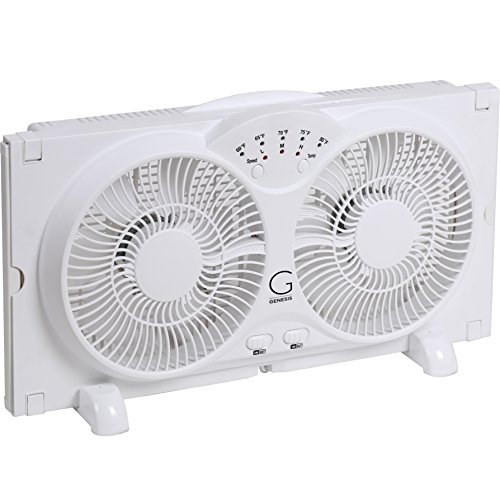
Genesis Twin Fan Thermostat A1WINDOWFAN
Genesis writes its title like a challenge: high velocity, reversible airflow, Max Cool Technology. Behind the adjectives sits a twin fan with LED indicator lights, an adjustable thermostat and ETL certification, finished in white and carrying the model code A1WINDOWFAN. No width range and no wattage are published in the title, which leaves the velocity language doing heavy lifting — this review reports that language as the manufacturer’s claim and builds its case instead on the thermostat pairing, because velocity plus temperature control is a genuinely useful combination for bigger rooms.
- Configuration: twin fan, model A1WINDOWFAN, white
- Airflow: reversible; described by the brand as high velocity
- Thermostat: adjustable
- Indicators: LED indicator lights
- Brand feature named: Max Cool Technology
- Certification: ETL certified, per the title
- Width range and wattage: both missing from the title
Strengths
- Thermostat control pairs with the strongest airflow language in the group.
- LED indicators make the operating state readable at a glance.
- Reversibility covers both the evening purge and the night intake.
Trade-offs
- High velocity is claimed in words, with no airflow figure to verify against.
- Fit dimensions must be sourced from the listing documents before purchase.
- Stronger airflow usually means stronger sound; no noise figure is offered.
Consider the open-plan living space, the room window fans are usually too timid for. Cooking at one end, a sofa at the other, afternoon sun across both: exchanging that volume of air before evening guests arrive is a velocity job, and a thermostat then maintains the result without supervision while the household is in the garden. Genesis’s pitch fits that choreography. LED indicators, mundane as they sound, matter in a shared room where several people operate the fan — the state of the machine is public information rather than a mystery solved by holding a hand in front of it.
Evening purging is the technique that flatters a powerful reversible fan most. Run exhaust for twenty minutes at sunset to eject the day’s accumulated heat from walls and furnishings, then reverse to intake as outdoor air drops below indoor temperature, and the room crosses into comfort an hour earlier than passive open windows manage. A thermostat guards the second phase from overcooling. Buyers should still extract the width range from the full listing before ordering, because a fan this size failing to fit helps nobody. Documents decide the fit question, so read them alongside the listing: Check price on Amazon once your opening is confirmed to accept it.
Workshops and garages attached to the house give the Genesis a second plausible posting. A hobby room that fills with sawdust haze or soldering fumes benefits from a fan whose party trick is moving a roomful of air quickly, and the thermostat prevents the space from chilling below comfort during long sedentary projects in the evening. LED indicators again help, since a fan mounted across a workshop is read from the bench, not inspected up close. The caution is dust discipline: any window fan in a workshop should be wiped down regularly so its own airflow does not redistribute what settled on its blades. Genesis prints no filtration claims, and none are made for it here — ventilation, not purification, is the offer.
Best for: an open-plan living room needing a fast sunset purge followed by supervised intake.
Not suited for: a nursery where the fan must whisper — the title offers velocity language and no quietness figure at all.

Vornado PORTAL Window Fan White
Vornado’s PORTAL argues that a window fan should occupy less of the window. Its title stresses a low profile, weather resistance and a reversible exhaust mode across three speeds, and it names kitchen, bedroom and general home use. No thermostat, no remote and no width range appear — the omissions of a fan betting on placement instead. Openings that defeat deeper twin units, such as windows where the sash travel is short or where a bulky fan would block most of the daylight, are exactly where a low-profile design stops being a compromise and becomes the only sensible fit.
- Configuration: window fan, low profile, white
- Speeds: 3
- Modes: reversible exhaust mode
- Build note: weather resistant, per the title
- Listing’s stated rooms: kitchen, bedroom, home
- Thermostat and width range: the title omits both
- Power draw: no figure is printed
Strengths
- A low profile preserves daylight and suits short-travel sashes.
- Weather resistance suits windows that take driving rain.
- Three speeds cover purge, circulation and night duty.
Trade-offs
- Temperature automation is absent; control stays manual.
- Fit limits are unpublished in the title, so documents decide.
- Single-unit format may move less air than the twin designs here.
Weather resistance sounds like a footnote until a fan lives through its first storm season. Windows on exposed elevations take rain at angles that find every seam, and a fan expected to stay mounted from May to September — rather than being installed nightly — benefits from a build that shrugs off that exposure. The PORTAL’s proposition is permanence within the season: fit it once, leave it, run it in either direction as conditions dictate. Kitchens with a window directly over the sink, where steam rises straight into the unit daily, make the same argument from the inside.
Daylight is the other currency this design protects. A fan filling two-thirds of a small window darkens the room it cools, pushing occupants toward electric light that quietly returns heat to the space. Keeping the obstruction low and slim preserves the window’s day job while the fan does its evening one. Buyers comparing raw power will find no figures here to compare, and should judge the PORTAL on placement logic instead. Short, exposed or daylight-jealous windows make the case by themselves: Check price on Amazon.
Apartment balconies and Juliet windows frame another PORTAL scenario. Openings that exist more for light than for traditional ventilation often have restricted sash travel, and a deep twin fan physically cannot seat where the window barely opens. A low-profile unit respects that architecture instead of fighting it. Renters in listed or lease-restricted buildings, forbidden from drilling or altering frames, will also appreciate a fan whose entire proposition is sitting shallow in an opening and leaving no trace in September. Weather resistance supports the leave-it-mounted routine such households prefer, since a fan that must be fetched indoors at every shower forecast soon stops being used on merely humid nights.
Best for: a short kitchen window over the sink that stays fitted all season.
Not suited for: needing the fan to throttle itself down before dawn — no thermostat is named in this title.

shinic Twin Window Fan Thermostat 9in
Shinic publishes the widest fit in this guide and pairs it with the controls wide-window owners usually want. Twin 9-inch blades reverse their airflow under thermostat control, three speeds and three functions structure the operation, the expandable width runs from 23.5 to 37 inches, and ETL certification is stated outright. The title even carries a small typo — “Exchaust” — which this review mentions only to note that specifications, unlike spelling, check out completely: every number a buyer needs for fit is present except wattage.
- Layout: twin window fan, 9-inch blades
- Airflow: reversible, thermostat controlled
- Speeds: 3; functions: 3, per the title
- Width: expandable 23.5 to 37 inches
- Certification: ETL certified, per the title
- Listing’s stated rooms: home, bedroom
- Wattage: the title leaves it blank
Strengths
- The 37-inch top end accepts windows the Bionaire’s range refuses.
- Thermostat control brings overnight manners to a wide-window fan.
- Fit figures are printed in full, sparing the buyer document archaeology.
Trade-offs
- At maximum extension, side panels on any twin fan seal less positively than at mid-range.
- Power consumption stays unpublished, blocking running-cost maths.
- Three functions are named as a count; their exact menu sits in the documents.
Wide windows concentrate in particular housing stock — mid-century bedrooms, converted porches, the broad front rooms of ranch houses — and their owners learn that many twin fans stop an inch or two short of sealing. Shinic’s extra inch at the top of the range, 37 against Bionaire’s 36, sounds trivial until it is the inch your window needed. Sealing quality matters beyond pride: gaps at the panel edges short-circuit the airflow, letting exhausted air sneak straight back in, so a fan that reaches the frame honestly outperforms a stronger fan wobbling in an opening it cannot close. Felt or foam weatherstripping from the hardware shelf can finish a marginal seal and is worth adding at installation.
Thermostat control on a bedroom fan of this span makes the shinic the natural alternative for anyone whose window outgrew the Bionaire. Set the temperature at bedtime, let the twin blades reverse or rest as the night dictates, and wake in a room that was managed rather than merely ventilated. Openings between 23.5 and 37 inches qualify; all others should keep scrolling: Check price on Amazon.
Installation day deserves a rehearsal for this fan because of its span. Extend the panels gradually, a few centimetres per side, keeping the twin housings level so neither motor bears a tilted load; a spirit level is overkill, but a glance from across the room catches a slope the hands miss. At widths near the 37-inch maximum, the centre of the unit carries the least support, so check that the sash comes down firmly onto the top rail as the maker directs, distributing weight into the frame rather than the glass. Once seated, run each of the three speeds briefly and listen: a rattle at one speed usually means a panel edge is vibrating against the frame, cured by reseating that side rather than by tolerating it all summer.
Best for: a wide ranch-house bedroom window between 36 and 37 inches across.
Not suited for: a narrow 22-inch opening — the expandable width starts at 23.5 inches.
Controls, fit and direction: the six compared
| Fan | Direction change | Temperature control | Width stated in title |
|---|---|---|---|
| COMFORT ZONE Twin | Manual flip of the unit | Not in title | Expandable, range unstated |
| Bionaire | Reversible blades, remote operated | Programmable thermostat | 24–36 inches |
| Amazon Basics Twin | Reversible airflow, exhaust mode | Not in title | Adjustable, range unstated |
| Genesis A1WINDOWFAN | Reversible airflow | Adjustable thermostat | Not in title |
| Vornado PORTAL | Reversible exhaust mode | Not in title | Not in title |
| shinic Twin | Reversible airflow | Thermostat control | 23.5–37 inches |
Two columns decide most purchases: whether the fan minds the temperature for you, and whether its maker will tell you the width before you buy.
How to choose a window fan to cool a room?
Intake, exhaust, or both — which pattern suits your room?
Picture the air’s journey. Intake works when outdoor air is cooler than the room and you open a second window or door so stale air has somewhere to leave. Exhaust works when the room holds the heat — kitchens mid-cooking, bedrooms after a sunlit day — and cooler air can be drawn from a shaded hallway or a north-facing window. Both patterns in one reversible fan cover the daily cycle most homes actually live: purge at sunset, breathe overnight, vent at breakfast. Every fan here reverses somehow; the real choice is whether reversal costs you a remote press, a mode button, or lifting the unit out of the window, as the COMFORT ZONE requires.
Is a thermostat worth having on a window fan?
Overnight, usually yes. A thermostat converts a fan from an appliance you manage into one that manages a boundary: above the set temperature it works, below it the fan rests, and the pre-dawn chill that wakes manual-fan households simply never arrives. Bionaire, Genesis and shinic build that boundary in. Daytime and kitchen users gain less, because cooking and gatherings produce heat in bursts a person responds to faster than a sensor does. Match the feature to the shift the fan will work: nights argue for thermostats, evenings argue for airflow and simplicity.
How should the window itself be measured and prepared?
Measure the opening the fan will occupy — the inside width between frame stops, with the sash raised to its working height — and compare it against the title’s range where one exists: 24 to 36 inches for Bionaire, 23.5 to 37 for shinic. Where no range is printed, the listing documents hold it, and guessing is how fans get returned. Preparation pays compound interest: clean the sill, check the sash stays raised under the fan’s weight or prop it as the maker directs, seat expandable panels snugly, and close gaps with foam strip. A sealed installation can matter as much as a speed setting, because leaked air is air the fan moved twice for nothing.
Two fans beat one: the cross-flow arrangement
A single window fan helps; two arranged deliberately transform a floor. Place one fan exhausting in the warmest room — typically the kitchen or a west bedroom — and open a window in the coolest, shadiest room with a second fan on intake, or even no fan at all. Air then travels a planned route across the whole storey instead of stirring one room’s contents. Doors undercut by a finger’s width keep the route open when closed. This is the arrangement older houses were unconsciously designed for, with their aligned windows and transoms, and it explains why a modest 68W twin in the right window can outperform a brute in the wrong one. When shopping, the cross-flow idea argues for buying the fan that fits the exhaust post first — usually the hotter, trickier window — and letting the intake side be a simpler model or a bare open window on still nights.
What window fans cannot do, said plainly
No fan in this guide refrigerates. When outdoor air sits hotter than indoor air at midday, intake imports heat, and the correct move is exhaust-only or closed windows with curtains drawn until the evening crossover. Humidity sets a second boundary: moving humid air feels better on skin yet does not dry a room, and coastal or storm-season readers should temper expectations accordingly. Room size sets the third — a twin fan exchanging a small bedroom’s air is effective, while the same unit in a double-height living space is a gesture. None of this diminishes the category; it locates it. Window fans own the hours around dawn and dusk, the shoulder seasons, and every home where the alternative is no cooling at all. Judged inside that territory, the six above are honest tools with clearly labelled strengths.
Security, safety and the open-window question
A window occupied by a fan is a window that cannot be locked fully open in the usual way, and ground-floor households should think about that honestly. A seated fan fills the opening and is itself a barrier, yet determined access is a different matter from casual access; rooms at street level may prefer the fan in a first-floor bedroom and a locked, cracked window downstairs. Sash props and the maker’s fitting instructions matter here too, because a fan that cannot fall inward is also a fan that cannot be pushed inward easily. Electrical safety is the quieter half of the same conversation: three of these titles state ETL certification, cords should never be trapped in the sash’s closing path, and extension leads draped across a room to reach a fan are a compromise to fix with furniture rearrangement rather than habit.
Children and pets add their own clauses. A fan mounted at toddler height in a playroom deserves a supervising adult’s judgement whatever its grille spacing, and cats regard a humming window fan as a throne — most will simply sit beside it, but a cat that paws at grilles argues for mounting in a room the cat visits less. None of the six titles speaks to any of this, which is precisely why it belongs in a buying guide: the listing sells the fan, while the household supplies the context that makes the fan safe.
Cleaning a window fan so it survives its second summer
Airflow decays invisibly as dust felts onto blades and grilles; a fan that seemed weaker by August is usually a fan asking for a cloth. The seasonal routine is simple and identical in spirit across all six models, whatever their controls. Unplug, remove the fan to a table, and work with a soft brush and a barely damp cloth on blades and grille, keeping moisture away from motor housings and control panels. COMFORT ZONE’s removable screen washes separately and dries fully before refitting. Panels and seals benefit from a wipe that restores their grip on the frame. Fans stored over winter in a bag or box emerge without the gritty bearing noises that dusty storage invites. Fifteen minutes twice a year protects the purchase better than any extended warranty conversation, and the first warm evening of the new season starts with a fan that performs like the one reviewed here rather than its neglected shadow.
The evening crossover, and how to catch it
Every fan in this guide earns its keep during a daily event many households sleep through: the crossover, when outdoor temperature falls below the temperature stored in the house’s walls and furnishings. In a heatwave that moment may not arrive until ten at night; in a normal summer it comes with the first long shadows. Catching it promptly is a skill. A hand on an outside wall, a glance at a weather app, or simply the feel of air at an open door tells you the balance has tipped, and that is the moment to switch fans from exhaust to intake and open the far windows wide. Households that catch the crossover nightly often find a modest fan sufficient, while households that miss it by three hours conclude — wrongly — that they need a bigger machine. Thermostat models automate the response to the room’s side of the equation; the outdoor side remains the owner’s pleasant evening ritual of walking the house and setting its breathing for the night.
Thermal mass explains why the first night of a hot spell feels easier than the third. Walls, floors and furniture absorb heat by day and release it after dark; one hot day charges them lightly, three charge them deeply, and the fan’s overnight work grows accordingly. This is why a fan praised in June can be cursed in an August heatwave without changing at all — the house around it changed. Managing curtains on sun-facing glass by day reduces the charge more cheaply than any fan upgrade reduces the discharge burden, and pairing the two habits is the closest a fan-only home comes to climate control.
When one room refuses to cool
Most homes have a problem room: the attic conversion under the roof pitch, the nursery over the boiler, the study above the garage. Before blaming a fan, audit that room’s air route. A single window with the door shut gives exchanged air nowhere to go, and the fan pressurises or evacuates a sealed box to little effect. Undercutting the door, adding a transfer grille, or simply sleeping with the door ajar completes the circuit. Roof rooms add a second burden — heat rising through the house collects there — and an exhaust fan in that room serves the whole storey by giving the rising heat an exit, even when its own cooling feels modest. In that posting, direction matters more than size, and a reversible model like the shinic or Bionaire, able to swap roles as seasons turn, justifies itself without winning a single specification contest.
Finally, give any new installation three nights before judging it. The first night measures novelty and noise; the second reveals whether the direction and speed choices suit the room; by the third, the household’s routine has adapted and the fan’s true contribution — usually measured in hours of sleep gained rather than degrees dropped — becomes visible. Returns decided on night one waste more good fans than defects ever will.
Common mistakes
Ordering before measuring the opening. Width ranges differ by inches that decide fit — 36 versus 37 at the top end, 23.5 versus 24 at the bottom. The tape measure comes before the order, every time.
Running intake through a heatwave afternoon. Drawing 35-degree air into a 30-degree room warms it. Exhaust, shade and patience win the afternoon; intake wins the evening.
Sealing the room completely around an intake fan. Air pushed in needs an exit path or the flow stalls to a fraction of its promise. Crack a door or a second window and the same fan suddenly performs.
Ignoring the screen question. An unscreened open window at dusk invites every moth in the parish. COMFORT ZONE’s removable screen exists precisely because this mistake is so common.
Expecting silence from velocity. Air moved quickly makes sound; a fan bought for maximum purge will not whisper at midnight. Light sleepers should favour thermostat models that can rest, and moderate speeds near the bed.
Leaving gaps at the panel edges. Unsealed sides recycle the same air in a loop beside the fan. Five minutes with foam strip converts that loop back into through-flow.
Heat in a home rarely stops at the window, of course — the cooking that warms the kitchen starts with prep, and the countertop machines gathered in Best Food Processors with Spiralizer are the ones generating tomorrow’s exhaust duty.
Final recommendation
Give the overnight vote to Bionaire if your window measures between 24 and 36 inches: programmable thermostat, remote-controlled blade reversal and no assembly make it the most complete bedroom package in this set. Hand the wide-window vote to shinic, whose 23.5-to-37-inch span and thermostat cover openings Bionaire cannot. Choose Genesis when the room is large and the evening purge matters most, accepting that its velocity is claimed in words rather than figures. Take the Amazon Basics twin for small bedrooms and guest rooms, where two speeds and a stated 68W draw match the actual scale of the job. Let COMFORT ZONE run the kitchen window, screen fitted, flipping it by hand as the cooking dictates. And pick the Vornado PORTAL when the window itself is the constraint — low, exposed, or unwilling to surrender its daylight to a deeper machine.
Renters should weigh the no-assembly promise and the panel-fit models most heavily, since both install without altering the frame and leave with you at the end of the lease. Owners planning a permanent summer fixture can afford to optimise for sealing and thermostat behaviour instead.
Noise, honestly discussed
Manufacturers of these six fans chose not to publish noise figures in their titles, so this guide will not invent a ranking dressed up as data. What can be offered is the physics and the habits. Sound rises steeply with speed on every fan ever built, which means a large fan loafing on its lowest setting is frequently quieter than a small fan straining on its highest, even when both move similar air. Twin designs split the work across two motors and two blade sets, and many sleepers find that character easier to ignore than a single fan’s note, though individual sensitivity varies more than any average captures. Vibration is the fixable component: a fan humming against a loose sash or an unseated panel is making frame noise, not fan noise, and reseating plus a strip of foam often halves the perceived volume without touching the dial.
Placement tricks help the light sleeper further. A fan in the window furthest from the pillow, exhausting, with a nearer window cracked for intake, moves the sound source away while keeping the airflow route intact. Thermostat models gain a final advantage after midnight: as the room reaches its target the fan rests, and silence itself becomes part of the cooling cycle. Buyers for whom noise is the deciding issue should treat the absence of published figures as a prompt to read the full listing documents and owner reports for each model rather than as a gap this review can fill — the honest answer is that your ears, in your window, on the third night, deliver the only verdict that counts.
One more consideration belongs to shared walls. In terraced houses and apartment blocks, a window fan’s hum travels to neighbours at hours when goodwill is thin. Lower speeds after midnight, solid seating that kills vibration, and exhausting through a rear window rather than a party-wall-facing one are courtesies that cost the sleeper nothing. The category survives on being the considerate form of cooling — no condenser droning in the garden, no installation vans — and a little care keeps that reputation intact street by street.
A short history of sleeping cool, for context
Before refrigerated air, the window fan was the middle-class answer to the summer bedroom, and the twin-fan format in five of these six listings descends directly from the units fitted into post-war sash windows. The design endured because the problem endured: bedrooms sit upstairs where heat collects, windows there are a standard width, and night air in most climates eventually turns kind. What has changed across the decades is control, not concept — thermostats that rest the fan before dawn, remotes that spare the sleeper a trip across the room, blades that reverse without the unit leaving its seat. Reading the six titles as a timeline is instructive: COMFORT ZONE sells the 1960 version perfected, Amazon Basics sells it simplified, and Bionaire sells it automated. The physics underneath all three is identical, which is why fit and direction, the oldest variables in the category, still dominate this guide’s advice.
That durability also means second-hand wisdom transfers well. Grandparents who slept behind a twin fan in 1975 knew about sealing the sides, catching the evening crossover and exhausting the kitchen first. The modern buyer inherits those lessons free; the only genuinely new questions concern electronics, and those are the questions the thermostat reviews above spend their words on.
Before ordering, run one final audit against the review of your chosen model: width measured, direction method understood, thermostat presence confirmed or its absence accepted, and the room’s second opening identified for the air route. Four checks, two minutes, and the fan that arrives will be the fan the room needed rather than the fan the headline sold.
Households running two fans on the cross-flow plan should buy them in the same week if possible, because the exhaust post’s performance sets the pace for the whole route and a delayed second purchase leaves the system half-built through the hottest fortnight. One strong fan correctly posted outperforms two weak ones arguing with each other across a landing.
Frequently asked questions
Does a window fan really cool a room, or just move warm air?
Both, depending on the hour. A fan exchanges indoor air for outdoor air; when the outdoors is cooler — evenings, nights, mornings — the room genuinely cools. At midday in a heatwave the same intake warms the room, which is why reversible exhaust modes and thermostat control feature so heavily in these listings.
Twin fan or single low-profile unit — which is better?
Twin units generally suit standard sash windows and offer the widest fit ranges here, up to shinic’s 37 inches. The Vornado PORTAL’s low profile suits short or exposed windows where a twin would block the opening or strain the sash. Fit decides first; format follows fit.
How loud will a window fan be at night?
None of these six titles publishes a noise figure, so any specific claim would be invention. As a rule of the category, lower speeds are sleep-compatible for most people and high-velocity settings are not; thermostat models earn an advantage by resting entirely when the room reaches temperature.
Can a window fan stay mounted through rain?
Only one title here claims weather resistance — the Vornado PORTAL. For the other five, the cautious routine is to close the window or remove the fan ahead of driving rain, whatever a neighbour reports doing with theirs.
What should be read alongside this guide?
Bedrooms cooled by a fan still dress for the season, and Best Oversized Cotton King Blankets covers the cotton layer that pairs with a pre-dawn chill. For the counter below the kitchen window, Best Metal Toasters rounds up the stainless models that share these fans’ morning shift.
Measure the window, choose the direction you will use most, set the second opening before the first hot night arrives, and let the evening air do the patient work it has always been willing to do for any household prepared to meet it halfway.


