What's inside
- Key Takeaways
- Quick Picks
- How Did We Choose These Solar Blankets for 24-Foot Round Above-Ground Pools?
- What Should You Expect from a Solar Blanket, Season by Season?
- How Do Blue and Clear Covers Actually Differ on the Water?
- Why Does Evaporation Matter More Than Sunshine in Most Yards?
- Is a Solar Blanket a Safety Cover? (It Is Not)
- What Does a Season of Ownership Actually Look Like?
- How Should You Choose Between 8, 12 and 16 Mil for Your Household?
- Comparison Table
- How Should You Fit, Trim and Store a 24-Foot Solar Cover?
- What Are the Most Common Mistakes with Solar Pool Blankets?
- When Is a Solar Blanket the Wrong Purchase Altogether?
- Final Recommendation
- Frequently Asked Questions
- Related Guides
As an Amazon Associate I earn from qualifying purchases. This post may contain affiliate links at no extra cost to you.
cottageverdict.com is reader-supported. When you buy through links on our site, we may earn an affiliate commission.
Where to buy: every cover and the reel below link to their Amazon listings, where you can check price on Amazon and confirm the diameter, thickness and material before ordering. Measure your pool wall to wall first, because a cover bought for the wrong diameter is the most common and most avoidable disappointment in this whole category.
Anyone shopping for the best 24 ft round above ground pools solar blankets deserves the plain version of what these products do before any brand names appear. A solar blanket is a sheet of bubble plastic that floats on the water. It does not heat a pool the way a gas heater or a heat pump heats a pool. It warms and protects the top layer of water, it slows the overnight cooling that steals the day’s gains, and it cuts evaporation hard, which matters because evaporating water carries heat away with it. Owners who understand that bargain, a warmer surface, a slower cooldown, a cleaner pool and a smaller water bill, tend to love these covers. Owners promised a hot tub tend to leave furious reviews.
The physics are worth thirty seconds. Sunlight passes through or into the bubbles during the day and nudges the surface water warmer. At night, the sheet acts as a lid, and a lid is what a pool most needs after sunset, because an uncovered pool loses the bulk of its heat from the surface upward. Debris stays out as a bonus: leaves, pollen, bugs and the neighbourhood dust land on plastic instead of sinking into your filter. The cover also slows chemical burn-off, since chlorine that is not evaporating or being broken down by direct sun on open water lasts longer in the pool.
What a solar blanket cannot do deserves equal emphasis. It will not rescue a cold pool in a cold week. It will not warm the deep water near the floor to the temperature of the surface layer, and swimmers feel that difference the moment they dive. It will not replace a heater for anyone who wants a guaranteed swimming temperature in spring or autumn. Think of it as insulation and a solar assist combined, the cheapest meaningful upgrade an above-ground pool can get, and judge every pick below against that honest job description.
Sizing for a 24-foot round pool sounds simple and mostly is: the cover should match the pool’s stated diameter, and all five covers here are cut for exactly that. The subtleties live at the edges. A cover can be trimmed with ordinary scissors when a pool’s true inside measurement runs slightly small, and several of these listings say so outright. A cover that arrives a touch large is a nuisance; a cover that arrives small leaves a ring of open water that bleeds heat and invites debris, and no amount of wishing stretches it. When in doubt between trimming down and coming up short, trimming down wins every time.
Thickness, measured in mils, is the second decision, and this guide includes 8-mil, 12-mil and 16-mil covers so the trade-off is visible rather than theoretical. Thin covers are light, cheap to replace and easy for one person to drag on and off, but they tear sooner and their bubbles flatten earlier. Thick covers hold heat a little better, shrug off seasons of handling and resist tearing at the edges, but they are heavy, stubborn to fold and genuinely awkward without a reel. Neither end of that scale is wrong. The right answer depends on your arms, your storage space and whether a reel is part of the plan.
That is why the sixth entry below is not a blanket at all. The Sun2Solar reel system is included deliberately, presented as the accessory it is, because for a 24-foot pool the difference between a cover that gets used daily and a cover that lives in a wet heap beside the deck is usually a reel. A cover draped over a fence or bundled on the grass picks up dirt, tears at fold points and becomes a chore nobody volunteers for. The same cover wound neatly onto a reel takes one person a few minutes at each end of the swim, and that difference in effort decides whether the blanket earns its keep across a whole season.
Key Takeaways
- A solar blanket warms and protects the surface layer; it does not heat the whole pool like a powered heater.
- Cutting evaporation and overnight heat loss is where these covers earn most of their value.
- Match the cover to a true 24-foot diameter, and prefer a cover you can trim over one that might fall short.
- Mil thickness trades durability against handling: 8-mil is light and easy, 16-mil is tough and heavy.
- A reel turns a 24-foot cover from a two-person chore into a one-person routine.
- Blue and clear covers behave slightly differently in sun, but fit and daily use matter far more.
Quick Picks
| Pick | Badge | Why it earned its place |
|---|---|---|
| VEVOR Solar Pool Cover 24 FT 8 Mil | Best Everyday Value | The lightest full-size cover here, easy to trim and easy for one person to handle all season. |
| Sapphire Series 16-Mil Solar Pool Cover 24 ft | Thickest and Toughest | A heavy 16-mil polymer sheet for owners who would rather wrestle weight than replace covers often. |
| Blue Wave 24-ft Solar Cover 8-Mil Blue | Trusted Brand, Light Build | The familiar blue bubble cover in its lightest form, from a name pool owners already know. |
| Blue Wave 24-ft Solar Cover 12-Mil Clear | Best Clear Cover | A clear 12-mil sheet that lets more sunlight reach the water while keeping a midweight feel. |
| VEVOR Solar Pool Cover 24 FT 12 Mil | Midweight Upgrade | Steps up to 12-mil tear-resistant material without jumping to the heaviest class in this roundup. |
| Sun2Solar Solar Cover Reel System | Essential Accessory | Not a blanket but the crank reel that makes a 24-foot blanket practical for one person. |
How Did We Choose These Solar Blankets for 24-Foot Round Above-Ground Pools?
Every cover in this guide had to satisfy the tape measure first. If a listing did not clearly offer a true 24-foot round cut suited to above-ground pools, it was out, no matter how glowing its marketing sounded. Diameter honesty sounds like a low bar, yet pool covers are sold in a thicket of near sizes, and a 24-foot pool wearing an 21-foot cover is just a pool with an expensive raft. The five blankets below all state the size plainly, and the reel states the maximum width it serves just as plainly.
Thickness came next, because mil rating is the one specification in this category that predicts daily life with reasonable accuracy. We deliberately spread the selection across 8, 12 and 16 mils instead of crowding around one weight, so readers can see what each step buys and costs. An 8-mil cover that gets used every single day outperforms a 16-mil cover that stays folded in the shed because nobody wants to haul it, and the choosing notes under each pick say which owner each thickness honestly suits.
Material claims were read with suspicion. All of these covers are polyethylene bubble sheet in one formulation or another; the differences that matter are bubble resilience, edge behaviour and how the sheet tolerates folding, dragging and chlorine. Where a listing emphasised tear resistance or a particular polymer, we noted it as a handling claim rather than a promise of immortality, because no floating plastic sheet survives being dragged across rough decking or stored wet and dirty, whatever the box says.
Finally, we weighted the ownership details that reviews return to again and again: whether one person can manage the cover, whether it trims cleanly, whether it stays put in a breeze and whether removing it is quick enough that swimmers actually bother. A pool cover is a habit product. Its specifications matter less than whether the habit sticks, and the picks below were chosen as much for the routines they encourage as for the plastic they are made from.
What Should You Expect from a Solar Blanket, Season by Season?
Spring is when expectations need the firmest management. The blanket will take the chill off the surface on sunny days and protect overnight gains, but a pool that starts cold warms slowly, and the blanket’s job in April is mostly loss prevention. Summer is its showcase: long days load the surface with warmth, the lid holds it through the night, and the evaporation savings become obvious in how rarely the hose comes out. By early autumn the cover stretches the season at both ends of the day, keeping afternoon swims pleasant after the air has cooled.
Wind deserves a mention because it is the silent thief in this story. Moving air across open water strips heat and water together, and a covered pool simply removes that exchange. On a breezy ridge or an exposed rural lot, owners often report the cover mattering more on windy nights than on sunny days, which surprises people who bought it purely as a solar gadget. The blanket is really two tools sharing one sheet of plastic: a modest solar collector by day and a draught-proof lid around the clock.
There is also a housekeeping rhythm to learn. Debris that lands on the cover should be hosed or swept toward the skimmer before removal, or the first fold dumps it all into the water you were protecting. The cover itself wants a rinse now and then, a dry hour in the shade before storage, and a home off the ground where mower wheels and dog claws cannot find it. None of this is difficult. All of it is the difference between a cover that lasts several seasons and one that looks tired by August.
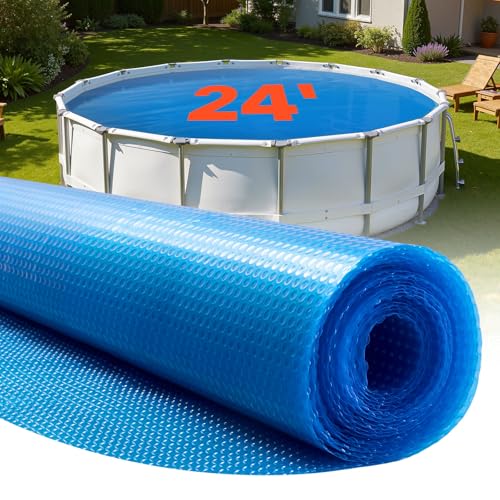
VEVOR Solar Pool Cover 24 FT 8 Mil — Best Everyday Value
The 8-mil VEVOR is the cover for the owner who knows themselves. It is light enough that taking it off is a shrug rather than a workout, which means it actually comes off for a twenty-minute swim and goes back on afterwards, instead of being abandoned after the first fortnight. Its polyethylene bubble sheet is described by the maker as easy to trim, and that matters more than it sounds: above-ground pools are not always perfectly round after a few seasons of settling, and a cover you can shave to fit beats a theoretically superior cover that gaps at one side.
Heat behaviour is the honest middle of this category. The surface warms on sunny days, the night losses shrink, and evaporation drops in the way every intact bubble cover delivers. What the thin sheet will not give you is longevity under rough handling. Drag it across a splintered deck edge a dozen times, store it wet in a ball, or let the dog treat it as a landing pad, and an 8-mil cover will show the abuse sooner than its thicker rivals. Treated as a consumable with a friendly price of admission, replaced when its bubbles finally flatten, it makes complete sense.
- Size: 24 ft round, trimmable to fit
- Thickness: 8 mil
- Material: polyethylene bubble sheet
- Colour: blue
- Suited pools: inground and above-ground
Strengths
- Light enough for genuinely easy one-person handling on and off the water.
- Trims cleanly, which rescues the fit on pools that have settled slightly out of round.
- Delivers the full evaporation and overnight-retention benefit shared by every intact bubble cover.
Trade-offs
- Thin bubbles flatten and tear sooner than the heavier sheets in this guide.
- Flutters and shifts more readily in wind because there is less mass holding it down.
- Rewards gentle storage habits and punishes being bundled wet in a corner.
Best for: solo owners and smaller adults who will handle the cover daily and value ease over lifespan.
Not suited for: rough decks, playful dogs or anyone expecting a fit-and-forget cover for many seasons.
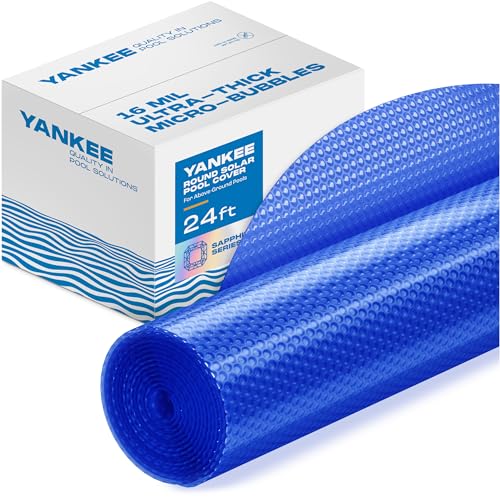
Sapphire Series 16-Mil Solar Pool Cover 24 ft — Thickest and Toughest
Sixteen mils is the heavyweight end of this market, and the Sapphire Series cover wears that description literally. The polymer micro-bubble sheet feels substantial the moment it comes out of the box, and that substance buys real things: edges that resist the little tears which start at fold points, bubbles that keep their shape through seasons of rolling, and a sheet that lies flatter on the water with less wind lift. For a pool in an exposed, breezy yard, that planted behaviour is not a luxury.
The bill arrives in your shoulders. A wet 16-mil cover at 24 feet across is a serious armful, and owners without a reel should think carefully before choosing it. Dragging it off in sections is possible, and plenty of households manage with two people and a system, but the honest summary is that this cover and a reel belong together. Paired with the Sun2Solar system below, its weight stops being a daily argument and becomes background. Without one, expect the cover to spend more time off the pool than its owner intended.
On warmth, thickness helps at the margins rather than transforming the result. The insulation value of a thicker bubble layer is real, and the reduction in evaporation is the same benefit every sealed surface provides. What you are really buying with the extra mils is time: more seasons before the sheet embrittles, more tolerance for imperfect handling, more resistance to the small accidents of pool life. Households that keep equipment for years and maintain it properly will feel the value. Households that treat covers as disposable should save the effort and buy thin.
- Size: 24 ft round, above-ground fit
- Thickness: 16 mil
- Material: polymer micro-bubble sheet
- Colour: blue-toned sapphire series finish
- Handling note: reel strongly recommended
Strengths
- The most tear-resistant and shape-holding sheet among the covers gathered here.
- Sits calmly on the water in breezes that lift and flap thinner covers.
- Built for multi-season service in households that store equipment carefully.
Trade-offs
- Heavy when wet, and genuinely awkward to remove without a reel or a helper.
- Folding for storage takes space and patience compared with the 8-mil options.
- Its durability premium is wasted on owners who replace covers casually anyway.
Best for: reel owners, windy lots and keep-it-for-years households wanting the sturdiest sheet available here.
Not suited for: anyone who must haul a cover off alone by hand every single day.

Blue Wave 24-ft Solar Cover 8-Mil Blue — Trusted Brand, Light Build
Blue Wave is one of the names above-ground pool owners meet early and often, and this is their straightforward light cover: an 8-mil blue thermal bubble blanket in a true 24-foot round. There is no exotic claim attached to it, and that plainness is part of the appeal. It floats, it warms the surface, it slows evaporation, and it keeps the leaf fall out of the skimmer basket. For a household buying its first solar cover, a known brand executing the basics without drama is a reasonable place to land.
Against the VEVOR 8-mil above, the differences are matters of temperament rather than category. Both are light blue bubble sheets that trim and handle easily. The Blue Wave suits buyers who prefer an established pool-equipment brand behind the listing, the kind with a long catalogue of covers, liners and accessories, and who expect sizing to match the pool sizes printed on the box because that is the brand’s whole business. Either 8-mil cover will behave similarly on the water; the choice is about which maker’s consistency you trust.
Expect the standard light-cover lifespan and plan storage accordingly. Off-season, the sheet wants to be clean, dry and rolled rather than folded, stored out of direct sun, because ultraviolet light is quietly eating every bubble cover ever made and a blue sheet in a sunny shed ages even while the pool is closed. Through the swimming months, a quick rinse when the pollen is heavy keeps the surface from turning into a sticky mat that transfers grime to the water at every removal.
- Size: 24 ft round
- Thickness: 8 mil
- Material: thermal bubble sheet
- Colour: blue
- Brand focus: established above-ground pool range
Strengths
- Light, familiar handling that new cover owners master in a single weekend.
- Backed by a brand whose catalogue revolves around above-ground pool sizing.
- Keeps debris and pollen on the plastic instead of in the filter system.
Trade-offs
- Shares the short service life of every thin cover under hard use.
- Blue tint admits less light to the water than the clear option below.
- Needs the same careful off-season storage as any polyethylene sheet.
Best for: first-time cover buyers who want a known pool brand in the lightest, easiest weight class.
Not suited for: owners chasing maximum durability or the extra light transmission of a clear sheet.

Blue Wave 24-ft Solar Cover 12-Mil Clear — Best Clear Cover
The clear version of the Blue Wave sheet exists for one physical reason: a transparent cover lets more of the sun’s energy pass into the water instead of absorbing it at the surface. In practice the difference between blue and clear shows up as a modest edge in daytime warming, most noticeable in spring and autumn when every degree is argued over. During high summer, when the pool is warm anyway, the distinction fades and the retention job, which both colours do equally, takes over.
At 12 mils this cover sits in the handling middle ground. It has enough body to resist casual tearing and to lie with some authority on the water, yet one person can still peel it back in sections without a wrestling match. That balance makes it a sensible default for owners who found 8-mil covers a little flimsy but are not ready to commit to the heavyweight class or to a reel. It is the cover in this lineup with the fewest strong opinions attached, which is its own kind of recommendation.
One clear-cover quirk deserves honesty: transparency shows everything. The waterline, the bubbles’ slow clouding with age, any algae tint beneath, all of it is visible in a way a blue sheet politely hides. Owners who keep water chemistry tight will not care. Owners whose pool sometimes drifts a little green between cleanings may find the clear sheet an unflattering mirror. Ultraviolet exposure also works on clear material without the pigment that gives blue covers a small measure of protection, so shade storage matters even more here.
- Size: 24 ft round
- Thickness: 12 mil
- Material: thermal bubble sheet
- Colour: clear
- Handling note: manageable solo in sections
Strengths
- Lets more sunlight reach the water for a small daytime warming advantage.
- Midweight build balances toughness against one-person handling better than the extremes.
- Retains heat overnight and cuts evaporation just as effectively as its blue siblings.
Trade-offs
- Shows water cloudiness and ageing bubbles that a blue cover would conceal.
- Clear material asks for disciplined shade storage between uses and across winter.
- The warming edge over blue is real but modest, not a different category of heat.
Best for: shoulder-season swimmers who want every spare degree and a cover one person can manage.
Not suited for: owners who prefer their equipment to hide the water’s off days from view.
VEVOR Solar Pool Cover 24 FT 12 Mil — Midweight Upgrade
VEVOR’s 12-mil entry is the natural step up for owners who liked the idea of the 8-mil at the top of this guide but want more tear resistance in the hand. The maker describes the polyethylene sheet as tear resistant, and in daily terms that translates to edges that forgive being pulled, corners that tolerate the skimmer cut-out being trimmed, and a cover that survives being hauled over the pool rail by someone in a hurry. It remains a blue bubble blanket doing the standard solar job; the upgrade is in robustness, not in a new kind of warmth.
The weight difference against the 8-mil is noticeable but not punishing. Most adults can still manage this cover alone, especially using the peel-and-fold method from one side, though a second pair of hands speeds everything and reduces the dragging that wears edges out. On the water it sits flatter than the thin sheet and resists the ripple-chasing that pushes light covers into a corner on breezy afternoons. For pools without a reel, this is about the heaviest class that stays pleasant.
Choosing between this and the Blue Wave clear 12-mil comes down to colour philosophy. Blue absorbs some sunlight at the surface and presents the classic covered-pool look; clear passes more light through. Both retain overnight heat and block evaporation as well as their fit allows. Households replacing a worn blue cover and wanting the same behaviour with more backbone will find this VEVOR the direct descendant of what they owned. Households experimenting for extra spring warmth should look at the clear sheet instead.
- Size: 24 ft round
- Thickness: 12 mil
- Material: polyethylene, described as tear resistant
- Colour: blue
- Suited pools: inground and above-ground
Strengths
- Noticeably tougher edges and corners than the 8-mil covers while staying solo-manageable.
- Lies flatter on the water, resisting the wind-driven bunching of lighter sheets.
- A straightforward durability upgrade for owners replacing a worn thin blue cover.
Trade-offs
- Heavier to fold and store than the light covers, though far easier than 16-mil.
- Blue surface passes less light into the water than the clear alternative offers.
- Still a consumable sheet with a finite life under ultraviolet exposure and chlorine.
Best for: owners upgrading from a thin cover who want more backbone without buying a reel.
Not suited for: anyone expecting heater-level warmth from thickness alone, which no blanket delivers.

Sun2Solar Solar Cover Reel System — Essential Accessory
This pick is not a blanket, and it is included with that label in plain sight because it changes the fate of whichever blanket you choose. The Sun2Solar reel is built for above-ground pools up to 24 feet wide without decking, mounting at the pool’s edge and winding the cover onto a tube with a hand crank designed for one-person operation. Straps connect the sheet to the tube, the crank does the hauling, and the cover comes off in a controlled roll instead of a wet avalanche over the rail.
The daily difference is difficult to overstate. Removing a 24-foot cover by hand means dragging a heavy, dripping sheet somewhere, and that somewhere is usually grass or decking that dirties it and shortens its life. On a reel, the same cover lifts clear of the water, stays clean, and redeploys by unrolling across the surface as you walk the crank backwards or pull the leading edge. Families swim more often when opening the pool takes minutes, and the blanket spends its life on the water doing its job instead of in a heap doing nothing.
Fit and expectations need care. This system suits round and oval above-ground pools up to its stated width, and it assumes a pool without a surrounding deck at reel height, which matches most basic above-ground installations. It also asks for a sensible parking position: on some pools the wound reel sits across one end, slightly narrowing the swimming opening, a compromise most owners accept within a day. Assembly is a one-afternoon project with straps to position evenly, because a cover that winds crooked will fight you all summer.
- Type: cover reel system, accessory only
- Capacity: pools up to 24 ft wide
- Fit: round or oval above-ground pools without decking
- Operation: one-person hand crank
- Cover included: no, pairs with any blanket above
Strengths
- Turns cover removal and replacement into a quick one-person routine that actually happens.
- Keeps the blanket off grass and decking, extending the life of every cover paired with it.
- Makes the heavier, longer-lasting blankets practical for ordinary households to own.
Trade-offs
- Adds an assembly project and a fixture at the pool edge that some owners find visually busy.
- The wound roll can sit across one end of the pool, trimming a little swimming room.
- It solves handling only; it adds no warmth of its own to the water.
Best for: any 24-foot pool household, and close to mandatory if you choose the 16-mil cover.
Not suited for: decked pools needing a different reel style, or minimalists happy hand-hauling an 8-mil sheet.
How Do Blue and Clear Covers Actually Differ on the Water?
The colour argument consumes more forum threads than it deserves, so here is the measured version. A blue cover absorbs a share of sunlight in the sheet itself and warms the very top of the water; a clear cover transmits more energy deeper. Clear tends to win slightly on total heat delivered to the pool on a sunny day. Blue tends to win on looks, on hiding the water’s condition and on slowing algae-friendly light in some owners’ experience. Both, when they cover the whole surface, perform the retention and evaporation work identically, and that work is the larger half of the value either way.
Fit quietly beats colour every time. A blue cover trimmed to seal the full circle will outperform a clear cover with a crescent of open water at one edge, because the gap leaks heat, water vapour and debris around the clock. If you are choosing between spending effort on colour research or on measuring your pool properly and trimming carefully, spend it on the tape measure. The blanket that covers everything, every night, is the warmest blanket, whatever shade it is.
Why Does Evaporation Matter More Than Sunshine in Most Yards?
It surprises new owners that the blanket’s least glamorous job is its most valuable. An uncovered pool in warm, dry, breezy weather can lose a striking amount of water every week, and every gallon that leaves as vapour takes its heat with it. The replacement water from the hose arrives cold, so evaporation taxes the pool twice: once in lost warmth and again in cold refill. A floating sheet interrupts that cycle almost completely wherever it touches, which is why owners in arid regions often describe the cover as a water-saving device first and a warming device second.
The chemical budget follows the same logic. Sunlight breaks down chlorine in open water, and evaporation concentrates and unbalances what remains, so a covered pool typically holds its sanitiser level steadier between doses. Steadier chemistry means fewer corrective additions, fewer surprises before a planned swim and less of the test-dose-test loop that eats Saturday mornings. None of this requires believing any particular brand’s percentages; it follows from the simple fact that a lid limits what the sky can take from the water, hour after hour.
There is a regional honesty to add. In humid climates where the air is already saturated, evaporation slows on its own and the cover’s water savings shrink, though its overnight insulation and debris protection remain. In dry or windy regions the savings dominate the whole calculation. Either way the blanket is doing measurable work; only the headline benefit changes with your weather. Judging the purchase by your own yard’s wind and humidity will predict your satisfaction far better than any national average printed on a box.
Is a Solar Blanket a Safety Cover? (It Is Not)
This needs saying in a guide that families will read: a solar blanket is a floating sheet with no load-bearing ability whatsoever. It will not support a child, a pet or even a curious toddler leaning from the edge, and its presence can make the water’s edge harder for a small child to judge. No one should ever walk on one, lean on one or treat a covered pool as a closed pool. Supervision, fencing and the ordinary rules of pool safety apply exactly as they do to open water, and the blanket changes none of them.
The related habit worth building is removal discipline during swimming. A cover should come fully off and clear of the water before anyone swims, never folded back halfway with swimmers underneath or beside the floating edge, because a drifting sheet can cover a swimmer in a way that is difficult to escape from below. This is another quiet argument for the reel: a system that removes the whole cover in minutes makes the safe routine the easy routine, and routines that are easy are the ones that survive busy households.
Pets deserve their own sentence. Dogs that are allowed near the pool should be kept off the cover entirely, both because claws shred bubble plastic quickly and because an animal that steps onto the sheet expecting ground finds water instead. Cats, being lighter and more cautious, mostly use covers as sunbathing platforms and mostly regret it once. A reel-stored or fenced pool solves the problem; failing that, expect punctures and plan the cover’s budget as the consumable it honestly is.
What Does a Season of Ownership Actually Look Like?
Week one is adjustment: learning how the sheet wants to fold, discovering that it behaves better slightly wet, finding the trimming you should have done on day one. By week three the routine sets in, cover off before the first swim, a shake and a hose-off for debris, cover back on when the towels come out. The owners who reach week three with the routine intact almost always finish the season as cover believers, because the water is simply ready more often, with less topping up and less skimming.
Mid-season brings the small maintenance truths. Pollen and dust bake onto the top surface and should be rinsed toward the skimmer before removal, or they wash in at the edges. The bubbles on the oldest part of the sheet begin to look tired where the cover folds at the same crease daily, which is why varying the fold, or using a reel, spreads the wear. A cover that is rotated occasionally, so the same edge is not always the leading edge, ages more evenly and lasts longer for zero cost.
Closing the pool is the cover’s final exam. It should be the cleanest it has been all year before it goes into storage, because a sheet put away with organic grime and chemical residue ages in the dark all winter. Dry it fully, roll it loosely, and store it somewhere a mouse would find boring. Owners who do this unglamorous work in October are the ones unrolling a supple, intact cover the following May, wondering why their neighbours buy a new blanket every spring.
How Should You Choose Between 8, 12 and 16 Mil for Your Household?
Start with the handler, not the pool. If one adult will manage the cover alone most days, and that adult would describe their patience for pool chores as limited, the honest ceiling is 12 mil, and 8 mil may be the wiser buy even though it wears out sooner. A cover’s benefit only exists on the water. The season is long, the novelty fades by June, and the thickness that survives contact with your real routine beats the thickness that wins a specification comparison in April.
Next, look at the pool’s surroundings. Rough decking, a gravel surround, overhanging trees that drop twigs and seed pods, dogs with pool access, children who treat equipment as playground apparatus: every item on that list argues one step thicker, because punctures and edge tears are how covers actually die in family yards. A sheltered pool on smooth decking in a tidy garden asks far less of its blanket, and a light sheet there can serve respectably for seasons that would destroy it beside a farmhouse dog run.
Then consider the calendar. Households that swim daily from May to September put a cover through hundreds of handling cycles a year, and durability compounds in their favour; the thick sheet’s extra seasons arrive quickly. Households that swim on high-summer weekends may find a light cover outlasts their interest in the pool itself. Neither is a failure of judgement. The mistake is buying the heavyweight specification for a weekend pool and then resenting the hauling, or buying the featherweight for a daily pool and resenting the replacing.
Finally, price the system rather than the sheet. A midweight cover plus a reel frequently costs less across three seasons than a premium cover dragged by hand and replaced early, and it is used more faithfully every single week of those seasons. That is the arithmetic this guide keeps returning to: fit first, handling second, thickness third, colour last. Buyers who follow that order rarely write angry reviews, because the blanket they own matches the life they actually live around their pool.
Comparison Table
| Pick | Thickness / Type | Colour | Handling | Best role |
|---|---|---|---|---|
| VEVOR 24 FT 8 Mil Cover | 8 mil | Blue | Easiest solo | Everyday value |
| Sapphire Series 16-Mil Cover | 16 mil | Blue-toned | Reel advised | Maximum durability |
| Blue Wave 24-ft Solar Cover 8-Mil Blue | 8 mil | Blue | Easiest solo | First cover, known brand |
| Blue Wave 24-ft Solar Cover 12-Mil Clear | 12 mil | Clear | Manageable solo | Extra light to the water |
| VEVOR 24 FT 12 Mil Cover | 12 mil | Blue | Manageable solo | Tougher midweight |
| Sun2Solar Solar Cover Reel System | Reel accessory | — | One-person crank | Makes any cover practical |
How Should You Fit, Trim and Store a 24-Foot Solar Cover?
Start by floating the new cover bubble-side down and letting it rest for a day. Fresh sheets arrive creased and slightly reluctant, and a sunny afternoon on the water relaxes them into their true shape, which is the moment to judge the fit. Walk the perimeter and note where the sheet overlaps the wall and where it pulls short. Mark trim lines with a soft pencil while the cover floats, then cut on a clean flat surface with sharp scissors, taking off less than you think; you can always shave a second pass, and you cannot add material back.
Leave a whisper of overlap rather than a perfect knife-edge fit if your pool sits slightly out of round. A cover that rides a fraction up the wall at its widest point still seals the surface, while a cover cut to the narrowest measurement leaves a gap at the widest. Around the skimmer, cut conservatively and check the opening twice, because that notch is where hurried owners lose the most material. After trimming, run your hand along the cut edge; a smooth edge resists tearing far better than a ragged one.
Storage decides lifespan more than any other habit. In season, a removed cover belongs on its reel or folded loosely in shade, never baked on hot decking. At season’s end, wash it with plain water, let it dry completely in the shade, then roll it around a tube or fold it with soft padding at the creases and store it indoors away from rodents, which find bubble plastic inexplicably attractive as nesting material. A cover stored clean, dry and dark routinely outlives a neglected premium sheet, which is the cheapest durability upgrade in this entire guide.
What Are the Most Common Mistakes with Solar Pool Blankets?
The first mistake is buying the blanket as a heater and judging it as one. Owners who expect powered-heater temperatures conclude the product failed, when in fact it performed its real job, retention, perfectly well. Read the job description on the way in: warmer surface, slower losses, less evaporation, cleaner water. The second mistake is sizing by the pool’s marketing name rather than its measured diameter, especially on older pools whose walls have shifted. Measure across the water at two angles and buy for the larger number.
Third comes the storage heap: cover dragged onto grass, folded wet, left in the sun. That single habit accounts for more early cover deaths than chlorine and weather combined. Fourth is leaving the blanket on through heavy chemical shocking without checking the maker’s guidance, since strong chemical exposure with the sheet sealed on the surface can age the plastic quickly; many owners remove the cover while shock treatments circulate. Fifth is skipping the reel conversation until the second season, after a year of hauling has already taught everyone in the house to avoid opening the pool.
A quieter mistake is partial coverage as a lifestyle. Some owners drape the cover over half the pool on busy days and call it good. Half a cover delivers roughly half the evaporation benefit and rather less than half the retention, because warm surface water circulates to the open side and gives its heat to the sky anyway. If time is short, a smaller habit done fully, cover on completely for the nights you manage it, beats a daily half-measure. The blanket rewards all-or-nothing use more than most pool equipment does.
When Is a Solar Blanket the Wrong Purchase Altogether?
Honesty cuts both ways, and there are yards where this product simply does not fit. If your pool sits under dense tree canopy, the solar gain shrinks toward nothing while the debris load on the cover becomes a daily shovelling exercise; a plain debris cover or diligent skimming may serve better. If the pool is primarily a children’s splash zone used in short bursts all day, the cover will spend its life off the water and deliver almost none of its retention value. And if nobody in the household will own the routine, no thickness or colour will rescue the purchase.
It is also the wrong purchase as a substitute for repairs. A pool losing water to a leak will not be saved by reduced evaporation, and the cover can mask the loss rate long enough to turn a small liner problem into a structural one. Similarly, chronically cloudy water needs chemistry and filtration attention, not a lid; covering a struggling pool hides the symptom while the cause continues underneath. Fix the pool first, then let the blanket protect a healthy system, which is the only arrangement in which it truly shines.
Final Recommendation
Most 24-foot above-ground pools should start with a midweight sheet and an honest plan for handling it. The Blue Wave 12-mil clear and the VEVOR 12-mil blue are the balanced defaults: choose clear if shoulder-season warmth tempts you, blue if you prefer the classic look and a slightly tougher-feeling sheet. Go down to 8-mil if you know a heavier cover would simply stop being used, and go up to the Sapphire 16-mil only with the Sun2Solar reel in the same basket, because that pairing converts brute durability into a routine one person can sustain. Whatever thickness lands in your yard, measure twice, trim patiently and store the sheet like you intend to own it for years. A blanket that seals the whole circle on a cool October night, while the last swimmer of the season finds the surface still kind, has done everything this category ever promised.
Frequently Asked Questions
Will a solar blanket make my pool warm enough on its own?
It will make the surface noticeably warmer on sunny days and keep the pool from surrendering that warmth overnight, which together can extend comfortable swimming at both ends of the season. It will not hold a set temperature through a cold, cloudy week, and it will not warm the deep water to surface temperature. Households wanting guaranteed heat still need a heater; the blanket then becomes the heater’s best friend by keeping the warmth it makes.
Should the bubbles face up or down?
Down, into the water. The bubbles are meant to sit against the surface, trapping air pockets that insulate and letting the smooth side face the sky for easier cleaning and handling. A cover floated smooth-side down still blocks evaporation, but it gives up some of the insulating behaviour the bubble layer exists to provide, and it tends to slide around more in a breeze.
Can I cut a solar cover to fit my pool?
Yes, and for above-ground pools that have settled slightly out of round it is often the right move. Let the sheet relax on the water first, mark while it floats, cut less than you think on a clean surface, and keep the edge smooth. Remember that trimming cannot fix a cover that is too small, so start from the correct 24-foot size and only ever remove surplus.
How long should a solar blanket last?
Lifespan tracks thickness and treatment more than brand. A thin cover handled roughly and stored wet may look tired within a couple of seasons, while a midweight or heavy sheet that is rinsed, dried and stored in the dark serves considerably longer. Flattened bubbles are the usual retirement signal: once the air layer is gone, the insulation and much of the benefit go with it.
Do I really need a reel for a 24-foot pool?
Need is a strong word, but at 24 feet the cover is large enough that hand removal becomes the main reason blankets fall out of use. Light 8-mil sheets can be managed by hand with a folding routine. Anything thicker, or any household where one person opens the pool alone, benefits so much from a reel that we treat it as part of the purchase rather than an optional extra.
Does a solar blanket help with a heater, or replace one?
It helps a heater enormously and replaces one never. A heater warms the whole body of water; the blanket stops the surface from handing that warmth straight back to the night sky, which shortens heater run time and steadies the temperature between swims. Owners who pair the two routinely describe the blanket as the purchase that made the heater affordable to run, which is the correct way to think about the relationship between them.
Can the cover stay on while the pump runs?
Generally yes; normal filtration with the cover floating is routine practice, and the skimmer continues to draw from the surface opening. The cautions are chemical rather than mechanical: follow the cover maker’s guidance around shock treatments and very high chlorine, and give the water time to circulate after dosing before sealing the sheet back over it for the night.
What should I do with the cover during a storm?
Leave it on for ordinary rain, since it keeps wind-blown debris out of the water, but secure loose edges if your yard funnels strong gusts, because a lifted corner can fold the sheet and stress its seams. After severe weather, skim what collected on top before removing the cover, check the edges for new tears while the sheet is spread out, and rinse away the grit that storms deposit before it gets ground into the bubbles during the next roll or fold.
Related Guides
Blankets are only one corner of the pool-and-home comfort shelf we keep testing. If the satin-trimmed end of the blanket world appeals to you, start with Best Acrylic Blankets with Satin Binding, and for the smallest sleepers in the house there is Best Baby Alpaca Blankets. Summer sleepers who like their layers feather-light should read Best Muslin Swaddle Blankets, while anyone maintaining the pool itself will find the natural companion to this guide in Best Battery-Operated Pool Vacuums.


