What's inside
- Key Takeaways
- Quick Picks
- How Did We Choose These Small Refrigerators?
- The Best 3.0 Small Refrigerators, Reviewed One by One
- How Do the Six Compare Side by Side?
- Where Does a Small Fridge Actually Belong in a Room?
- What Can the Freezer Compartment Honestly Do?
- How Much Does Noise Matter, Really?
- How Should You Set and Check the Temperature?
- How Do You Organise 3.2 Cu. Ft. So It Serves Like More?
- What Does a Mini Fridge Do to a Shared Electricity Bill?
- How Should You Defrost and Care for a Compartment Fridge?
- What Should a Dorm Buyer Check Beyond the Fridge Itself?
- How Cold Should Drinks Actually Be?
- How Long Should a Mini Fridge Last, and Where Do They Go Next?
- What Changes When the Fridge Shares a Room With Its Owner?
- When Should You Size Up Instead?
- How Do You Move a Mini Fridge Without Hurting It?
- What Is the Right Way to Buy One as a Gift?
- How Should an Office Choose Among These Six?
- What Should Happen in the First Twenty-Four Hours?
- Why Does the Reversible Door Matter So Much at This Size?
- What Are the Most Common Mistakes When Buying a Small Fridge?
- Final Recommendation
- Frequently Asked Questions
- Related Guides
As an Amazon Associate I earn from qualifying purchases. This post may contain affiliate links at no extra cost to you.
cottageverdict.com is reader-supported. When you buy through links on our site, we may earn an affiliate commission.
A small refrigerator earns its floor space differently from a big one: it is bought for a room that was never meant to have a kitchen in it — the dorm, the bedroom, the office, the studio corner, the guest suite. The best 3.0 small refrigerators are the ones that make that room feel complete without overwhelming it, and a note of honesty belongs at the top: the models actually selling in this class today cluster at 3.2 to 3.3 cu. ft., a notch above the 3.0 in the search, because that is where a useful freezer compartment and a crisper’s worth of fresh space fit inside one small door. All six picks below live in that honest band.
Where to buy: every model here is sold through Amazon, and the names in the Quick Picks table, the review headings and the comparison table link to the matching listing, where you can check price on Amazon and confirm the current colour and configuration. Small fridges are the most returned appliances in the category, usually for one reason — the buyer never measured the space or thought about the door’s swing — so pace out the footprint and the swing before anything else in this guide asks for your attention.
Five of the six are 3.2 cu. ft. single-door models with a small freezer compartment inside; one Midea steps up to 3.3 with an Energy Star certificate. Two are Upstreman twins divided by finish, one Feelfunn argues for precise temperature control, one Igloo for glass shelves, and one Frestec for all-round balance. At this size the differences are small in litres and large in daily feel, and the reviews treat them with the seriousness that a fridge you will live three feet from deserves.
Key Takeaways
- The live class is 3.2 to 3.3 cu. ft.; every pick here sits in that band, a notch above the 3.0 searched for.
- All six are single-door models with an internal freezer compartment — enough for ice and a few frozen essentials, not a weekly frozen shop.
- The Feelfunn offers the finest temperature control: seven settings across a 23 to 44 degree Fahrenheit range, with quiet running as its other claim.
- The two Upstremans are one fridge in stainless or black; the Midea is the only Energy Star pick and the largest at 3.3.
- Reversible doors appear across the class and matter enormously in rooms where the fridge must open toward the bed, desk or wall it can reach.
- Noise is a first-order feature here: these fridges sleep in the same room as their owners.
Quick Picks
| Pick | Badge | Why it earns its place |
|---|---|---|
| Frestec 3.2 Cu Ft Mini Fridge with Freezer | Best Overall Mini Fridge | A balanced 3.2 cu. ft. black mini fridge with adjustable thermostat and shelves, low noise and a reversible door. |
| Feelfunn 3.2 Cu Ft Mini Fridge with Freezer | Best Temperature Control | Seven temperature settings spanning 23 to 44 degrees Fahrenheit, quiet running under 38 decibels, and frugal daily energy use. |
| Upstreman 3.2 Cu Ft Mini Fridge with Freezer SR321 | Best Stainless Look | Upstreman’s 3.2 cu. ft. mini fridge in stainless steel, with an adjustable thermostat and energy-saving, low-noise design. |
| Upstreman 3.2 Cu Ft Mini Fridge with Freezer BR321 | Best Black Twin | The same Upstreman 3.2 cu. ft. fridge in black, for rooms where the stainless face would be the loudest thing in them. |
| Igloo 3.2 Cu Ft Mini Fridge with Freezer | Best Glass Shelves | A 3.2 cu. ft. single-door Igloo with glass shelves and temperature control, from a name the category has known for generations. |
| Midea 3.3 Cu Ft Mini Fridge Energy Star | Best Energy Star Pick | The largest here at 3.3 cu. ft., Energy Star certified and low-noise, with a reversible door in stainless steel. |
How Did We Choose These Small Refrigerators?
We began with the class as it is actually sold — the 3.2 to 3.3 cu. ft. band — rather than hunting for a literal 3.0 model that the market has largely retired, and we said so in the introduction because a guide that fudges its own premise will fudge anything. Within the band, every pick had to be a real refrigerator with a real freezer compartment: not a drinks cooler, not a thermoelectric box that chills relative to the room, but a compressor fridge that can keep ice cream honest in August.
The second filter was the room. A small fridge lives within earshot and eyesight of its owner, so noise claims, door reversibility and finish all counted as heavily as capacity. Models whose listings hid their dimensions or blurred the freezer compartment’s existence were set aside; at this size, the difference between a freezer compartment and a freezer shelf is the difference between a fridge and a disappointment.
Finally, we kept the twins and said why. The two Upstremans are one fridge in two finishes, listed as two picks because a bedroom’s scheme is a legitimate deciding vote and because pretending they are different machines would be the kind of invention this guide refuses. Everything else here differs in a way a hand or an ear can verify: control range, shelf material, certification, capacity.
The Best 3.0 Small Refrigerators, Reviewed One by One

Frestec 3.2 Cu Ft Mini Fridge with Freezer — Best Overall Mini Fridge
The Frestec is the pick for the buyer who wants the class’s standard virtues without a speciality: 3.2 cu. ft. behind a single black door, an adjustable thermostat, adjustable shelves that let the interior be rearranged around a tall bottle or a leftover pan, low-noise running, and a reversible door for rooms whose layout is already decided. It is the mini fridge as a solved problem, and in a category where most purchases are for a specific room with a specific occupant, solved is a high compliment.
Its balance shows in the details a dorm or office actually tests. The freezer compartment takes ice trays and a few frozen staples without pretending to be a chest freezer. The shelves adjust because a mini fridge’s contents change weekly — drinks this week, meal prep the next — and a fixed interior would fight that rhythm. The black finish suits the rooms these fridges serve: it recedes in a bedroom, looks intentional in an office, and hides the scuffs of a shared space.
Choose the Frestec when no single feature dominates your brief and you want the class’s centre of gravity from a maker whose name is built on compact refrigeration. Its honest limit is that it wins no single category outright — the Feelfunn controls temperature more finely, the Midea certifies its efficiency — but a fridge that is second-best at everything and first at balance is, for most rooms, the right fridge.
It is also the natural gift purchase in this guide, which is a real role for mini fridges: the student leaving for a dorm, the parent equipping a first flat, the office manager solving the shared-kitchen problem. A gift fridge should be the one that needs no explanation and suits any room it lands in, and the Frestec’s unremarkable excellence is precisely that quality.
- Capacity: 3.2 cu. ft. total
- Layout: single door with freezer compartment
- Controls: adjustable thermostat
- Shelving: adjustable shelves
- Running: low-noise design
- Door: reversible; finish black
Strengths
- The class’s best balance of size, quiet and flexibility.
- Adjustable shelves follow a mini fridge’s changing contents.
- Reversible door fits the room instead of arguing with it.
Trade-offs
- Wins no single speciality category outright.
- Freezer compartment is for essentials, not a frozen shop.
- Black is the finish on offer in this listing.
Best for: dorms, offices and first flats that want the class’s all-round answer.
Not suited for: buyers whose brief is dominated by one demand — silence, efficiency or control — better served by the specialists below.

Feelfunn 3.2 Cu Ft Mini Fridge with Freezer — Best Temperature Control
The Feelfunn’s argument is precision, stated in numbers a buyer can hold it to: seven temperature settings spanning 23 to 44 degrees Fahrenheit, quiet running rated under 38 decibels, and daily energy use of about half a kilowatt-hour. In a category where most listings say “adjustable thermostat” and change the subject, that specificity is the product. A household storing medicines that like it cold, drinks that like it precise, or skincare with opinions will feel the difference between seven considered settings and a dial marked 1 to 5 in hope.
The low end of that range deserves a word, because 23 degrees is genuinely freezing territory for a compartment in a mini fridge — the Feelfunn can treat its freezer section as a freezer rather than as the coldest shelf. Paired with the quiet claim, the picture is of a fridge designed for the bedroom and the study, where it will be heard all night and judged on its manners. Half a kilowatt-hour a day, meanwhile, makes it a polite guest on a shared electricity bill or a dorm’s allowance.
Its honest cautions are the class’s own: 3.2 cu. ft. is 3.2 cu. ft., and the freezer compartment remains a compartment. But among equals in size, the Feelfunn is the one that treats temperature as a discipline rather than a suggestion, and for the rooms where a mini fridge is really a small appliance of precision — the nursery, the clinic-adjacent home office, the serious drinks corner — that discipline is the whole purchase.
There is also a temperament match worth naming: this is the fridge for the owner who will actually use seven settings. Households that set a dial once and forget it for a decade will get a fine fridge and an unused feature; households that adjust for the seasons, the contents and the occasion will get the small, steady satisfaction of an appliance that answers precisely. Know which household is yours and the Feelfunn either becomes the obvious pick or an honourable pass.
- Capacity: 3.2 cu. ft. total
- Temperature: 7 settings, 23 to 44 degrees Fahrenheit
- Noise: rated under 38 decibels
- Energy: about 0.5 kilowatt-hours per day
- Door: reversible, single door
- Finish: black
Strengths
- Finest temperature control in the class, stated in real numbers.
- Quiet enough for bedrooms and studies by its maker’s rating.
- Frugal daily energy use suits shared bills and dorms.
Trade-offs
- Precision is wasted on set-and-forget households.
- Freezer remains a compartment, however cold it can run.
- Black finish only in this listing.
Best for: bedrooms, nurseries, home offices and drinks corners where temperature and quiet are the brief.
Not suited for: buyers who want a certified efficiency badge or a stainless face — the Midea and Upstreman answer those.
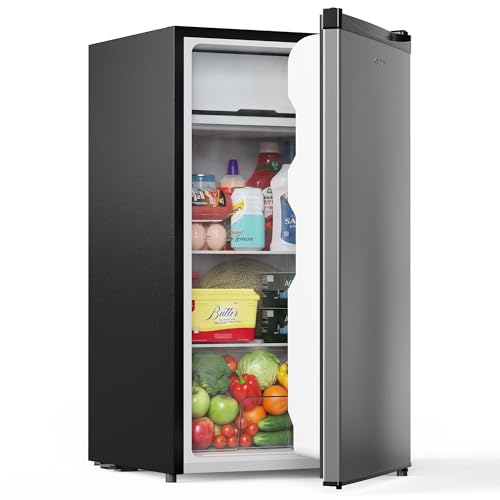
Upstreman 3.2 Cu Ft Mini Fridge with Freezer SR321 — Best Stainless Look
The Upstreman SR321 is the class’s stainless answer: a 3.2 cu. ft. mini fridge whose face lets a small room look finished. Upstreman has made compact refrigeration its whole business, and the SR321 shows the specialisation in the expected places — an adjustable thermostat, an energy-saving and low-noise brief, a reversible door — wrapped in the finish that offices, guest suites and modern bedrooms ask for when the fridge will be seen all day.
Seen is the operative word. A mini fridge in a dorm can be any colour; a mini fridge in a guest suite, a studio flat or an executive office is furniture, and stainless is furniture’s dialect. The SR321 lets those rooms have their cold drinks and their medicines and their midnight snacks without a black box announcing itself in the corner. Its interior is the class’s standard honest arrangement — a freezer compartment above, shelves and door storage below — executed without surprises.
Buy it for the rooms where appearance is part of function, and pair the decision with its twin below: the BR321 is this fridge in black, and the choice between them should be made standing in the room, not from the spec sheet. Where the room is modern and the fridge is on show, the SR321 is the class’s most presentable resident.
It also ages well as rooms change around it. A stainless mini fridge moves from dorm to first flat to guest room without ever looking like it escaped from an earlier life, which matters in a category where the appliance often serves three households in a decade. Finishes are shallow considerations for big fridges hidden in kitchens; for a small fridge that lives in the open, they are half the product.
- Capacity: 3.2 cu. ft. total
- Model: SR321
- Finish: stainless steel
- Controls: adjustable thermostat
- Running: energy saving, low noise
- Door: reversible, single door with freezer compartment
Strengths
- Stainless face suits guest suites, studios and offices.
- Specialist compact maker with the class’s standard virtues.
- Quiet, frugal running for rooms it shares with people.
Trade-offs
- Stainless shows fingerprints in a way its black twin does not.
- No certification or fine-control headline to rival the specialists.
- Identical to the BR321 in everything but finish.
Best for: visible placements — guest suites, studios, offices — where the fridge is furniture.
Not suited for: rooms where a black appliance disappears better; take the twin below.

Upstreman 3.2 Cu Ft Mini Fridge with Freezer BR321 — Best Black Twin
The BR321 is the SR321 in black — the same 3.2 cu. ft., the same adjustable thermostat, the same energy-saving, low-noise, reversible-door specification — and the guide’s honesty about that is the review. What black buys a small fridge is disappearance: in a bedroom corner, a media room, a dorm or a home office with dark furniture, a black mini fridge stops being an appliance on display and becomes part of the room’s shadow, which for many owners is exactly the ambition.
Black also forgives the life a small fridge actually leads. It hides the scuffs of a shared dorm, the fingerprints of a household that opens it hourly, and the small marks of being moved between rooms and homes as its owner graduates from one life to the next. The SR321’s stainless is the better face for a room that wants to look at its fridge; the BR321 is the better skin for a room that wants to forget it has one.
Everything else about the pair is shared, including their honest limits: a freezer compartment rather than a freezer, a capacity sized for one or two people’s cold essentials, and no certification headline. If the debate in your household is between these two Upstremans, settle it with the lights on in the room where the fridge will live, and do not let anyone pretend the spec sheet can help — it has already said everything it knows, and it says: same fridge.
The black twin has one more constituency worth naming: the second-fridge role in a utility space or garage corner, where a stainless face would be wasted and a black box among the tools looks like it was always there. Bought for that duty, the BR321’s discretion is not a compromise but the entire point.
- Capacity: 3.2 cu. ft. total
- Model: BR321
- Finish: black
- Controls: adjustable thermostat
- Running: energy saving, low noise
- Door: reversible, single door with freezer compartment
Strengths
- Disappears into bedrooms, media rooms and dark schemes.
- Hides scuffs and fingerprints through a shared-space life.
- Same specialist specification as its stainless twin.
Trade-offs
- No feature separates it from the twin — finish is the decision.
- Black can feel heavy in a small, pale room.
- Freezer compartment limits apply as with the whole class.
Best for: bedrooms, dorms, media rooms and utility corners where the fridge should disappear.
Not suited for: bright, modern rooms that want the fridge on show — the SR321 is the same machine dressed for them.

Igloo 3.2 Cu Ft Mini Fridge with Freezer — Best Glass Shelves
Igloo’s name has been on cold boxes longer than most buyers have been alive, and its 3.2 cu. ft. mini fridge carries that heritage into the single-door class with one detail the guide wants to single out: glass shelves. In a small fridge, shelf material matters out of proportion — glass contains the spills that a mini fridge’s crowded interior guarantees, wipes clean in seconds, and lets the light fall through so the bottom shelf is not a cave. Wire shelves in this class drip, rattle and hide small items in their grid; glass is simply the civilised answer.
The rest of the proposition is the class’s honest standard, from a maker households recognise: a freezer compartment for the ice and the essentials, temperature control to set and forget, and an interior arranged for the dorm, home and office roles the listing names. Igloo’s proposition is trust at small scale — the fridge a parent buys for a student’s room with the feeling that the badge has done this before.
Its cautions are the familiar ones, plus a small one of its own: glass shelves are heavier and less adjustable in spirit than the Frestec’s rearrangeable set, so households that reconfigure weekly should weigh that. For everyone else — and especially for the spill-prone shared spaces where mini fridges earn their keep — the Igloo’s cleanability is a daily virtue disguised as a shelf.
There is also the matter of the long game. A mini fridge often serves a decade of rooms, and a glass-shelved interior ages gracefully through all of them: no rusting wire, no sagging plastic, just surfaces that wipe back to new. In a category bought quickly and used hard, that quiet durability is worth more than a feature list.
- Capacity: 3.2 cu. ft. total
- Layout: single door with freezer compartment
- Shelving: glass shelves
- Controls: temperature control
- Roles: homes, dorms and offices, per the listing
- Maker: Igloo, a long-established name in cooling
Strengths
- Glass shelves contain spills and wipe clean in seconds.
- Light falls through glass, keeping lower shelves legible.
- A heritage name that reassures gift buyers and parents.
Trade-offs
- Shelves are less reconfigurable than the Frestec’s adjustable set.
- No fine temperature range or certification headline.
- Freezer compartment, as throughout this class.
Best for: shared spaces and spill-prone rooms where cleanability is the daily feature.
Not suited for: households that rearrange their fridge’s interior weekly around changing contents.

Midea 3.3 Cu Ft Mini Fridge Energy Star — Best Energy Star Pick
The Midea closes the guide with the two claims that matter most in a room that never switches its fridge off: it is the largest pick here at 3.3 cu. ft., and it is Energy Star certified, with low-noise running for the office and dorm roles its listing names. That extra tenth of a cubic foot is not a rounding error at this scale — it is a shelf’s edge of extra room, the tall bottle that fits, the lunch that does not need negotiating — and the certification means the slightly bigger box is also the class’s most disciplined drinker of electricity.
Midea is one of the world’s great appliance makers, and its compact line carries the same engineering seriousness as its full-size fridges: an adjustable thermostat, a reversible door, a stainless steel finish that suits the office it will likely live in. The low-noise brief matters doubly in the Midea’s stated habitats, because an office fridge is heard by a roomful of people trying to think, and a dorm fridge by a student trying to sleep three feet away.
Choose the Midea when the fridge will run for years in a metered or shared-bill setting, or when the class’s maximum room is the deciding vote. Its trade-offs are the gentlest in the guide: no seven-setting precision to rival the Feelfunn, no glass shelves to rival the Igloo — just the biggest, certified, quiet cabinet in the class, from a maker whose scale is its own argument.
For the buyer furnishing several rooms at once — the small office, the guest floor, the landlord’s pair of studios — the Midea is also the easiest pick to multiply: one model, certified, quiet, presentable, and identical in every room, so that maintenance and expectations stay as simple as the fridge itself. Consistency is a feature when you own more than one of a thing, and this is the class’s most ownable-in-multiples machine.
- Capacity: 3.3 cu. ft. total — the largest in this guide
- Efficiency: Energy Star certified
- Running: low noise, for office and dorm
- Controls: adjustable thermostat
- Door: reversible
- Finish: stainless steel
Strengths
- Class-leading capacity with certified efficiency.
- Quiet running suits offices and dorms alike.
- A major maker’s engineering at compact scale.
Trade-offs
- No fine-grained temperature settings like the Feelfunn’s seven.
- Shelves are not the Igloo’s glass.
- The extra capacity is a tenth of a cubic foot — real, but not a transformation.
Best for: offices, dorms and meter-conscious households that want the class’s biggest, certified cabinet.
Not suited for: precision storers who need the Feelfunn’s temperature range more than efficiency.
How Do the Six Compare Side by Side?
| Pick | Capacity | Finish | Signature point |
|---|---|---|---|
| Frestec Mini Fridge | 3.2 cu. ft. | Black | Adjustable shelves, all-round balance |
| Feelfunn Mini Fridge | 3.2 cu. ft. | Black | Seven settings, 23 to 44 degrees, under 38 decibels |
| Upstreman SR321 | 3.2 cu. ft. | Stainless steel | The presentable face for visible rooms |
| Upstreman BR321 | 3.2 cu. ft. | Black | The twin that disappears into dark rooms |
| Igloo Mini Fridge | 3.2 cu. ft. | See listing | Glass shelves, heritage name |
| Midea Mini Fridge | 3.3 cu. ft. | Stainless steel | Energy Star certified, largest here |
At this scale the table’s honest message is how close the class is: five picks share a capacity, and the decision lives entirely in the signature column. Control, finish, shelf material, certification — pick the one your room will actually feel, because the litres will not distinguish themselves in daily life nearly as much as those qualities will.
Where Does a Small Fridge Actually Belong in a Room?
On a hard floor or a sturdy stand, away from the radiator and out of the sun’s daily path, with its maker’s clearance at the back and sides honoured even though the cabinet is small. Small fridges are often wedged — under desks, into wardrobe alcoves, onto carpet — and each of those placements taxes the machine: carpet smothers the base’s airflow, a tight alcove traps its heat, and a wobbling stand turns every compressor start into a small announcement. Give it a level, ventilated, unglamorous spot and it will repay you in quiet.
Think about the door’s swing as part of the placement, not after it. In a bedroom the door should open toward the room’s traffic, not toward the wall it stands against; in an office it should not open into a colleague’s chair. The reversible doors across this class exist because small rooms rarely forgive a wrong hinge — set the swing before the fridge is loaded, while the decision is still a screwdriver’s work.
What Can the Freezer Compartment Honestly Do?
Less than its name suggests and more than its critics admit. A mini fridge’s freezer compartment is a small, very cold box inside the main cabinet: it keeps ice trays frozen, holds a few portions and a bag of peas, and keeps ice cream at a scoopable firmness in most of these models. What it will not do is serve as a household’s frozen store — a week’s frozen dinners, a whole chicken, a preserving session’s output all exceed its geometry and its ambitions.
The Feelfunn’s 23-degree low end is the honourable exception that proves the rule: a compartment that can run genuinely cold stretches what the format can promise. For every model here, the right mental model is a fridge with a very cold drawer, bought for fresh food and drinks first. Households that need real freezing at small scale should look at a compact with a separate freezer door — a different category, honestly labelled.
How Much Does Noise Matter, Really?
More than any other specification in this guide, because of where these fridges sleep. A kitchen fridge’s hum competes with a household’s daytime; a bedroom fridge’s hum competes with silence itself, at 3 a.m., three feet from the bed. Compressor starts, fan whispers and the occasional gurgle of refrigerant are the soundtrack, and a model designed for low noise — several here make that claim, and the Feelfunn quantifies it — is not a luxury in a dorm or a studio but the difference between an appliance and a roommate.
Placement is the household’s half of the bargain: level the cabinet so it does not buzz against the floor, keep it off shared walls where a neighbour’s bedroom listens on the other side, and do not wedge it against furniture that will resonate. A quiet fridge badly placed is a loud fridge; a merely average fridge well placed can pass unnoticed for years.
How Should You Set and Check the Temperature?
Start at the maker’s recommended middle setting, give the cabinet a full day to settle, and then check with a cheap fridge thermometer rather than by feel — the difference between a safe cold and a merely cool interior is invisible to a hand. Drinks and dairy want the colder end of the fresh range; the freezer compartment should be judged by the ice tray’s verdict, not by the dial’s optimism. Adjust one step at a time, with a day between steps, because a small cabinet’s temperature is a system that settles slowly and overshoots cheerfully.
The Feelfunn’s seven settings make this discipline easier to practise, since its range is stated in degrees rather than in folklore. For the dial models, the thermometer is the translation. Either way, the household that checks once, properly, in the first week will eat safer food for the life of the fridge than the household that trusts the factory setting forever.
How Do You Organise 3.2 Cu. Ft. So It Serves Like More?
By editing ruthlessly and storing by frequency. The top shelf and the door’s eye-level row belong to the daily citizens — drinks, breakfast, the current leftovers — while the back corners take the weekly ones. A mini fridge has no room for a maybe: every item in it should be there because it will be used within days, and the household that treats the little cabinet as a edited selection rather than a shrunken supermarket will find 3.2 cu. ft. surprisingly ample.
Small containers are the format’s secret weapon. Decanting into uniform small boxes turns the interior from a pile into a filing system, and a single shallow tray for the small, losable things — the mustard sachets, the single yoghurt, the half lemon — prevents the archaeological layer that forms at the back of every unedited mini fridge by October. The fridge is small; the discipline is the capacity.
What Does a Mini Fridge Do to a Shared Electricity Bill?
Less than its reputation suggests, and the numbers in this guide make the point concretely: the Feelfunn states about half a kilowatt-hour a day, and the Midea carries Energy Star certification precisely because its appetite is disciplined. In a dorm or a house-share, that frugality is social as much as financial — a fridge that sips is a fridge nobody resents, and resentment is the true running cost of shared appliances.
The household’s contribution is placement and loading. A mini fridge wedged against a radiator or baking in a sunlit window works against its own thermostat all day; one standing in cool shade with its vents breathing runs to its rating. And a cabinet loaded moderately cycles calmly, while one stuffed to the door’s seal — or left nearly empty in a hot room — spends its energy fighting physics instead of keeping lunch cold.
How Should You Defrost and Care for a Compartment Fridge?
On a schedule, briefly, and before the frost becomes the architecture. When the freezer compartment’s frost thickens beyond a few millimetres, empty the fridge into a cool bag, switch it off, leave the door open with a towel at its foot, and let the ice surrender on its own — never under a knife, because a punctured compartment wall is the one injury a mini fridge cannot survive. An hour later, wipe, dry, restart, and reload once the cabinet is cold again.
Between defrosts, the care is a minute’s worth: the door seal wiped so it grips, the interior wiped when something spills rather than at the weekend, and the back’s vents kept free of the dust that bedrooms generate in industrial quantities. A small fridge has no service schedule to hide behind; its whole maintenance regime is these small kindnesses, and it repays them with a decade of unremarkable service.
What Should a Dorm Buyer Check Beyond the Fridge Itself?
The rules, first: many dormitories cap a fridge’s size, require a safety certification, or ban the appliance outright in favour of a rented unit, and the time to learn which is before the order, not at the door with a porter shaking his head. The room’s socket situation comes second — a mini fridge wants its own outlet or at least a honest share of one, not a daisy-chain of adapters behind a desk. And the journey comes third: a fridge that must climb four floors in September should be chosen with its weight and its box in mind.
Parents buying at a distance should also decide the finish and the swing by asking the room’s future occupant, because a dorm fridge is a piece of someone else’s daily life for three or four years. The picks here were chosen to make that conversation easy: all are the class’s standard size, all reverse their doors, and none will embarrass a student by being the loudest thing in a shared room.
How Cold Should Drinks Actually Be?
Colder than the fresh-food ideal, which is the small fridge’s quiet dilemma: one cabinet, one thermostat, and contents with different wishes. The practical settlement most households reach is to run the cabinet at the cold end of the food-safe range and let the door’s warmest row take the drinks that forgive it, keeping the most perishable fresh food in the cabinet’s cold heart. The Feelfunn’s stated range — down to 23 degrees at its freezer end and up to 44 at its warmest — exists to let a household strike that settlement deliberately rather than by folklore.
The thermometer remains the honest broker. Set the fridge for the food, check the drinks’ row with your hand, and adjust the loading before you adjust the dial: moving the milk to the cold zone and the cans to the door often solves what a colder cabinet would solve at the price of frozen lettuce. Small fridges reward arrangement over brute cold, which is another way of saying they reward attention — the resource their owners usually have in place of space.
How Long Should a Mini Fridge Last, and Where Do They Go Next?
A compressor mini fridge should serve the better part of a decade, and the interesting thing about this class is how rarely one owner uses all of it. The dorm fridge becomes the first flat’s fridge, then the guest room’s, then the office’s or the garage’s, passing down a household’s own generations like furniture. That itinerary is an argument for buying the class properly the first time: a well-made, quiet, reversible-door model fits every room on the list, while a bought-in-a-hurry special fits only the first.
The failures that end these itineraries early are usually injuries rather than old age — a door seal torn by a careless move, a compartment wall punctured by an impatient defrost, a compressor cooked by years in an unventilated alcove. All three are preventable by the small disciplines this guide keeps repeating, which is why it repeats them: at this size, care is not a chapter of ownership; it is most of it.
What Changes When the Fridge Shares a Room With Its Owner?
Everything about how it is judged. A kitchen fridge is judged at arm’s length, in daylight, among other appliances; a bedroom or studio fridge is judged at 3 a.m., in silence, by an audience of one who did not choose to be awake. Its compressor’s start, its fan’s note, the click of its thermostat — these become features as real as its capacity, and a model that treats quiet as a headline, as several here do, is designing for the room as it actually is.
The same intimacy applies to its light and its manners: an interior light that blazes at midnight, a door that must be persuaded, a handle at shin height in a dark room. None of these appear on a spec sheet, and all of them decide whether the fridge is loved. Buy for the room’s worst hour, not its best photograph, and a small fridge will be a pleasure out of all proportion to its size.
When Should You Size Up Instead?
When the honest inventory says so. Lay out a week of the cold life the fridge must hold — drinks, dairy, fresh food, the freezer essentials — and if it plainly defeats 3.3 cu. ft. with the door unable to close in your imagination, the answer is a larger compact or a two-door model, not optimism. Couples sharing one mini fridge, households meal-prepping in bulk, and anyone storing medicines in quantity alongside food should all hear that verdict early.
Sizing up has its own honesty, though: a bigger fridge in a small room is a bigger presence, a bigger hum, a bigger claim on the floor. The class in this guide exists because millions of rooms have voted that 3.2 cu. ft., well chosen, is the right amount of cold for the life lived around it. Let the inventory vote, count it fairly, and abide by the result in either direction.
How Do You Move a Mini Fridge Without Hurting It?
Upright, rested, and with more patience than the move itself takes. A compressor fridge that has travelled on its side needs to stand upright for several hours before it is switched on, so the oil can find its way home; one that travelled upright still deserves an hour’s rest to let everything settle. Tape the door shut, remove or secure the shelves — glass ones especially, as the Igloo’s owners should note — and carry it by its body, never by its door or handle.
At the new room, the rituals repeat in miniature: level it, honour its clearances, set the swing while it is empty, and let it pull down to temperature before the first load goes in. Mini fridges change rooms more often than any other appliance in the house, and the ones that survive a decade of graduations and moves are the ones whose owners treated each move as a small installation rather than as furniture wrestling.
What Is the Right Way to Buy One as a Gift?
Conservatively, and with the room in mind rather than the giver’s taste. The safest gift in this guide is the balanced pick — the Frestec, or the Midea where the meter matters — in the finish that suits the most rooms, with the receipt kept and the box retained until the recipient’s room has voted. A mini fridge is a large gift physically and a personal one practically: it will sit in someone else’s room, humming, for years, and the giver’s best move is to choose the model that asks the least of its new home.
Ask, if asking is possible, about the two things a giver cannot guess: the door’s required swing and the room’s rules. A fridge that opens the wrong way in a dorm, or exceeds a residence’s size cap, is a generous gift converted into a logistics problem. The questions take two minutes; the fridge will be there for years, and it should arrive as a pleasure rather than as homework.
How Should an Office Choose Among These Six?
By imagining the office kitchen’s actual day: a dozen lunches at noon, a milk economy with strong opinions, a birthday cake twice a month, and a cleaner who should not need a manual. Capacity per person is smaller than households assume — the class’s 3.2 to 3.3 cu. ft. serves a small team’s lunches and drinks honestly — but the freezer compartment will be claimed by someone’s frozen meals within a week, and the glass-shelved Igloo or the certified Midea will earn their keep in a shared space faster than in a private one.
The office-specific virtues are quiet, cleanability and a door that opens the way the room’s traffic flows. Add a small house rule — a Friday wipe, a name-and-date label on everything — and a mini fridge becomes the office’s most civilised appliance. Skip the rule, and no capacity in this guide will save the office fridge from becoming a legend of the wrong kind.
What Should Happen in the First Twenty-Four Hours?
Rest, levelling and a thermometer — in that order, and resisting the urge to fill the cabinet the moment it hums. Let the fridge stand after its journey, level it so the door closes by its own gentle weight, set the thermostat to its middle mark, and give it the better part of a day to reach a steady cold. Then check the temperature with a thermometer, load the food in order of perishability, and set the door’s swing if the room’s verdict differs from the factory’s.
That unhurried first day is the foundation of the fridge’s whole life in the room: a cabinet levelled and loaded calmly runs quietly and seals properly from the start, while one slammed into service on moving day carries its small misalignments for years. The room will forget the day entirely, which is exactly what a good first day is for.
Why Does the Reversible Door Matter So Much at This Size?
Because a small fridge is placed, not installed — it goes where the room allows, against walls and beside furniture that a kitchen designer never consulted — and the wall it stands against decides which hinge the room needs. A door that opens against its wall loses its last inches of swing to the skirting; a door that opens into the room’s traffic becomes a nightly shin-level negotiation. Reversibility, offered across these six, converts that gamble into a choice, and it is the single feature a buyer should refuse to compromise on at this size.
Set it with the room empty and the fridge unloaded, following the maker’s instructions and keeping every screw. Households that postpone the decision discover that a loaded fridge and a free afternoon rarely coincide, and live for years with the wrong swing as a small daily tax on a problem that was solvable in twenty minutes.
What Are the Most Common Mistakes When Buying a Small Fridge?
The first is expecting a freezer where the listing promises a compartment, and discovering the difference with a bag of frozen peas in hand. The second is never measuring the space — a mini fridge is small, but so are dorm rooms, and the swing of its door has ended more placements than its footprint ever has. The third is ignoring noise until the first night, when the fridge’s opinion of 3 a.m. becomes the household’s problem.
Fourth, buyers wedge the cabinet into unventilated alcoves and onto carpet, then blame the machine for working hard. Fifth, they buy a finish for a photograph rather than for the room’s light and life. Sixth — the quietest — they size for a party: a 3.2 cu. ft. fridge serves one or two people’s daily cold honestly, and a household that needs more should buy the next category rather than a heroic opinion of this one.
Final Recommendation
For most rooms, start with the balance: the Frestec 3.2 cu. ft. mini fridge is the class’s all-round answer, adjustable, quiet and reversible-doored. Where temperature precision or silence is the brief, the Feelfunn is the specialist to beat, and where the meter matters, the Midea brings the class’s only certification and its largest cabinet. The Upstreman twins divide the visible rooms by finish, and the Igloo serves the spill-prone shared spaces with its glass shelves. Measure the space, honour the swing and the ventilation, choose the signature your room will feel nightly, and a small fridge stops being a compromise appliance and becomes what the best of them are — a small, cold, quiet completeness, exactly where life needed one.
Frequently Asked Questions
Why are all the picks 3.2 or 3.3 cu. ft. when I searched for 3.0?
Because that is where the class actually lives now. A useful freezer compartment plus a fresh section worth the name fits into 3.2 to 3.3 cu. ft. in current models; literal 3.0 designs have largely left the market. The guide chose the honest band and said so at the top, rather than rounding a 3.2 down in print and hoping nobody measured.
Can these fridges keep ice cream properly frozen?
Their freezer compartments keep ice trays frozen and ice cream firm for ordinary purposes, with the Feelfunn’s 23-degree low setting the strongest claim in the class. For long-term frozen storage in quantity, a separate-door compact freezer design is the honest tool, and households that freeze weekly should shop that category instead of asking a compartment to be something it is not.
Which pick is quietest for a bedroom?
The Feelfunn is the only one that quantifies its quiet — rated under 38 decibels — and pairs it with frugal energy use. The Frestec, Upstremans and Midea all claim low-noise designs; placement on a level, hard surface, away from the bed’s headboard wall, will matter as much as the badge.
Are the two Upstreman models really identical?
In capacity, controls and running character, yes — the SR321 is stainless and the BR321 is black. Choose by the room: stainless where the fridge is on show and wiped often, black where it should disappear into the corner and be forgotten.
Do I need to defrost a mini fridge?
Compartment models like these build frost gradually in the freezer section, and a periodic manual defrost — an hour with the door open and a towel on duty — is part of ownership. Keeping the door seal clean and not overfilling the compartment slows the frost’s return, and defrosting on a calm schedule rather than in a crisis keeps the ritual to that single hour.
Related Guides
From the smallest fridge in the house to the largest decisions beyond it, these guides continue the tour. Best 3 and 4 Door Refrigerators Best 30 Electric Wall Ovens Best 100 Bottle Wine Refrigerators



[…] the narrow kitchen to the rest of the house, these guides carry the same measuring tape with them. Best 3.0 Small Refrigerators Best 30 Inch Double Wall Ovens Best Battery Powered Pressure […]