What's inside
- Key Takeaways
- Quick Picks
- How Did We Choose These Blue Throw Pillow Covers?
- Why Are So Many Blue Throw Pillows Sold as Covers Only?
- What Size Insert Do Blue Throw Pillow Covers Need?
- How Do the Six Blue Cover Sets Compare?
- Which Colours Sit Well Beside Navy Blue Pillows?
- How Do You Arrange Blue Covers on a Sofa Like a Stylist?
- How Should You Wash and Store Chenille Covers?
- How Do You Rotate Covers with the Seasons?
- What Mistakes Do Cover Buyers Make Most Often?
- Which Shade of Blue Works in Which Room?
- How Do Chenille, Velvet and Linen Covers Compare?
- How Many Cover Sets Does a Household Actually Need?
- What Construction Details Separate a Good Cover from a Poor One?
- Final Recommendation
- Frequently Asked Questions
- Related Guides
As an Amazon Associate I earn from qualifying purchases. This post may contain affiliate links at no extra cost to you.
cottageverdict.com is reader-supported. When you buy through links on our site, we may earn an affiliate commission.
Where to buy: the blue throw pillows in this guide are cover sets, and the linked names open each set’s Amazon page, where you can check price on Amazon and confirm the size against the inserts sitting on your sofa right now. Read the next sentence before anything else in this guide, because it governs every pick: all six products below are pillow covers — the decorative blue shell only, with no filling inside — and each set needs inserts of the matching size, which your household may already own.
Shoppers hunting for the best blue throw pillows usually discover, somewhere around the second page of results, that the category has quietly split in two. Half the listings are finished pillows; the other half — including every pick in this guide — are covers, sold as pairs, waiting for an insert to give them shape. That split is not a scam or a shortage. It is the smarter way to buy colour. A cover folds flat in a drawer, washes without a fight, and lets a sofa change from summer linen to winter navy for the price of a takeaway lunch, while the insert underneath stays exactly where it was.
Blue, meanwhile, is doing more work in living rooms than any other accent colour, and navy in particular has become the neutral that isn’t beige. It grounds a pale sofa, deepens a grey one, and holds its own beside wood, leather and brass without demanding that the rest of the room reorganise around it. The six cover sets below were chosen inside that reality: five are chenille in solid navy at three different sizes, one breaks the pattern with an abstract print, and one brings boho texture for farmhouse rooms. Together they cover the ways real households actually use blue — as a matched pair flanking a sofa, as the large anchors behind smaller prints, and as the seasonal swap that makes a familiar room feel newly considered.
Because covers are a system rather than a single object, this guide spends as much time on inserts, sizing and arrangement as on the covers themselves. A beautiful cover on the wrong insert looks like a deflated balloon at a party; the right insert, one size up, makes the same cover look tailored. Get the system right once and every future colour change becomes a five-minute job with a zip.
One more promise about scope: nothing here is a finished pillow, so nothing here will be reviewed as one. Where a pick would behave differently stuffed firmly or softly, the review says which stuffing it assumes. Where a fabric choice trades beauty for practicality, the trade is named rather than smoothed over. Blue covers are a simple product, and this guide’s job is to keep the buying of them equally simple — the right size, the right fabric, the right shade for your light, and no surprises in the parcel.
Key Takeaways
- Every pick is a cover set of two — inserts are a separate purchase unless your sofa already hides some.
- GAWAMAY appears twice because its chenille pair anchors both the 18-inch and the 22-inch arrangements.
- Emvency is the only printed option, an abstract blue-and-grey painting effect for rooms that find solid navy too quiet.
- Cethom’s textured boho weave is the farmhouse choice, trading chenille’s sheen for a matte, woven hand.
- Buy inserts one size larger than the cover for the full, tailored look stylists actually photograph.
- Chenille dominates this list because its soft pile catches light the way velvet does, at an easier care burden.
Quick Picks
| Pick | Badge | Why it earns its place |
|---|---|---|
| GAWAMAY Navy Blue Chenille Covers 18×18 Set of 2 | Best Standard Pair | The classic eighteen-inch chenille pair in deep navy, with a hidden zipper and a hand like soft corduroy. |
| GAWAMAY Navy Blue Chenille Covers 22×22 Set of 2 | Best Large Anchors | The same chenille scaled to twenty-two inches, for the back row of a deep sofa arrangement. |
| Emvency Abstract Blue Throw Pillow Covers Set of 2 | Best Patterned Pair | An abstract blue-grey painting print that gives a plain sofa a focal point solid colours cannot. |
| Cethom Boho Blue Textured Covers 18×18 Set of 2 | Best Boho Texture | A woven, textured blue with farmhouse manners, matte where chenille is plush. |
| EMEMA Chenille Couch Pillow Covers 20×20 Set of 2 | Best Middle Size | Twenty-inch chenille squares that split the difference for sofas where eighteen looks lost and twenty-two crowds. |
| CaliTime Navy Blue Chenille Covers Pack of 2 | Best Established Classic | A long-running chenille cover line with a wide size range, for households standardising on one fabric. |
How Did We Choose These Blue Throw Pillow Covers?
The first decision was to be honest about what this market actually is. When we searched for blue throw pillows, the strongest, best-specified products were covers, and rather than pad the list with mediocre finished pillows we built the guide around the covers and said so at the top. Every pick is a set of two, every pick states its size in its name, and every review below discusses the cover as a cover — its fabric, its zipper, its behaviour in the wash — with inserts treated as the separate, solvable problem they are.
Fabric came next. Chenille earns its dominance here honestly: the yarn’s caterpillar pile gives navy a depth that flat cotton cannot, shifting from near-black in shadow to true blue in daylight, and it does so while remaining a working fabric that tolerates family life. Velvet would offer more lustre and more fuss; linen more air and more wrinkles. Within chenille we looked for even pile, clean seams and a hidden zipper, because the zipper is where cheap covers confess — a visible, flimsy zip on the bottom edge ruins the tailored illusion and snags on everything it touches.
Colour discipline mattered as much as fabric. Navy is a family, not a colour: some navies lean purple, some lean black, some lean teal in daylight. The solid picks here sit in the true-navy middle, which is why they can be mixed across brands on one sofa with a reasonable expectation of harmony — though we still advise ordering one set first when a room’s light is unusual. The two departures, Emvency’s abstract print and Cethom’s textured boho blue, were kept because a guide of six identical navy squares would fail the households whose rooms need pattern or weave to come alive.
Finally, we weighted the unglamorous virtues: sets that wash without drama, zippers that survive being used, and sizes that correspond to the inserts the world actually sells. A cover is a repeat purchase in a way a pillow is not — households return for the next colour — so each pick was judged as the start of a system. The brand you can reorder in a new shade next spring is worth more than a marginally prettier one-off.
Why Are So Many Blue Throw Pillows Sold as Covers Only?
Shipping explains the economics first. A finished pillow is mostly air, and air is expensive to freight and store; a cover is a folded square of fabric that posts in an envelope. That single fact lets cover makers spend their budget on fabric and zippers instead of postage, which is why a modest sum buys noticeably better chenille as a cover than as a whole pillow. The savings compound for buyers too: a household can own six colours of covers for the storage space of one spare pillow.
The second reason is that inserts outlive fashion. A decent insert serves for years while the room around it changes its mind seasonally, and covers let the visible layer keep pace. The third reason is hygiene: a cover comes off and washes, while a finished pillow’s interior accumulates the years in a way its surface never confesses. Once a household has made the switch to the cover system, few go back — the drawer of folded colours becomes one of those small domestic satisfactions, like a spice rack that finally makes sense.
None of this excuses listings that hide their covers-only nature, and the frustration of buyers who expected whole pillows is legitimate. The defence of the system is not a defence of unclear labelling. Our rule in this guide is absolute: the word cover appears wherever a pick is named in a buying context, the insert question is answered in its own section below, and no pick is ever photographed in the reader’s imagination as something it is not.
What Size Insert Do Blue Throw Pillow Covers Need?
The stylist’s rule is simple and slightly counterintuitive: buy the insert one size larger than the cover. An eighteen-inch cover over a twenty-inch insert fills its corners, stands with that gentle plumpness you see in magazines, and resists the sad creasing that makes a room look tired. A same-size insert leaves the corners empty and the faces slack. A smaller insert is a small tragedy in chenille. The picks below are sold at eighteen, twenty and twenty-two inches, and each review names the insert its cover wants.
Insert fill changes the result as much as size. Down and down-alternative fills mould into the famous karate-chop crease and feel luxurious, but they soften over an evening and need refluffing. Firmer synthetic fills hold a square silhouette with no maintenance and suit households that want the arrangement to survive children, dogs and film nights untouched. Neither is wrong; they are different relationships with the same sofa. Households new to the system often start with a firmer fill, because a room that stays arranged teaches you what you actually want before you invest in the squashier option.
If your sofa came with pillows, measure them before ordering anything — the inserts you need may already be sitting inside covers you dislike. Measure the existing insert seam to seam while it is plump, not the flattened cover, and match the cover size to the insert one step down. Many a household has bought a full new set of covers and inserts when the whole problem was a dated floral case over a perfectly good twenty-inch fill.

GAWAMAY Navy Blue Chenille Covers 18×18 Set of 2 — Best Standard Pair
Eighteen inches is the size the throw-pillow world is built around, and GAWAMAY’s chenille pair is the reference version of it in navy. The fabric is the story: a soft chenille with a fine ribbed pile that reads almost like corduroy under the fingers and catches light in bands as you cross the room, so a flat navy square gains the dimension that keeps solid colours from looking like holes in the arrangement. The colour itself is a true, deep navy — the shade that behaves with grey sofas, white sofas and camel leather alike.
The hidden zipper runs discreetly along an edge, which matters more than it sounds: a visible zipper turns a tailored cushion into a bag with ambitions. Seams and corners on this pair are finished to be stuffed firmly, and they reward the one-size-up insert rule generously — over a twenty-inch insert, these covers sit with the plump, squared posture of pillows costing far more as finished goods. As the front pair on a sofa, the middle pair in a five-pillow arrangement, or the matching set on a bed’s front row, this is the blue cover against which the rest of the list is measured.
- Form: chenille pillow covers, set of 2, covers only
- Size: 18 x 18 inches; pair with 20-inch inserts for fullness
- Closure: hidden zipper along one edge
- Colour: solid navy blue with a soft ribbed pile
- Buying note: check price on Amazon; inserts are a separate purchase
Strengths
- Chenille pile gives solid navy genuine depth in changing light.
- Hidden zipper keeps the tailored illusion intact from every angle.
- The standard size fits the deepest pool of available inserts.
Trade-offs
- Solid navy shows pale lint and pet hair more than a print would.
- Needs the oversize insert trick to reach its photographed fullness.
- Two covers dress two pillows; larger arrangements need multiple sets.
Best for: the classic sofa pair and anyone building a first cover system in navy. Not suited for: buyers who want finished pillows in the box, or rooms needing pattern to break up solid upholstery.
GAWAMAY Navy Blue Chenille Covers 22×22 Set of 2 — Best Large Anchors
Deep sofas swallow eighteen-inch pillows whole. The twenty-two-inch version of GAWAMAY’s chenille exists for those sofas — and for sectionals, daybeds and the wide chairs that modern living rooms favour — where a back row of large anchors gives the whole arrangement its architecture. Same fabric, same hidden zipper, same true navy; the difference is presence. A twenty-two-inch square behind two smaller prints creates the layered depth that separates a styled sofa from a sofa with pillows on it.
Scale changes the insert conversation, too. A twenty-four-inch insert inside these covers produces a genuinely luxurious slouch, but households should handle one before committing, because large plump pillows occupy real estate: on a standard three-seat sofa, two anchors plus two front pillows is a full arrangement, and a third row belongs to beds and sectionals. On a bed, this size is the European-sham alternative — the big squares against the headboard that make a bed read as dressed. Bought as the foundation of the system, the large pair lets every smaller, cheaper, more playful cover in front of it change with the seasons while the navy anchors hold the room’s line.
- Form: chenille pillow covers, set of 2, covers only
- Size: 22 x 22 inches; pair with 24-inch inserts for fullness
- Closure: hidden zipper along one edge
- Colour: solid navy blue, matching the 18-inch GAWAMAY pair
- Buying note: check price on Amazon; confirm your sofa’s depth suits the scale
Strengths
- Anchors a deep sofa or sectional the way smaller covers cannot.
- Matches the 18-inch pair exactly for a coordinated two-size system.
- Doubles as Euro-style back squares on a dressed bed.
Trade-offs
- Overwhelms shallow sofas and small armchairs.
- Large inserts cost more and store bulkier than standard sizes.
- Two anchors plus guests can crowd a three-seat sofa quickly.
Best for: sectionals, deep sofas and dressed beds that need a substantial navy back row. Not suited for: compact loveseats or anyone whose storage cannot spare room for large inserts.

Emvency Abstract Blue Throw Pillow Covers Set of 2 — Best Patterned Pair
Every arrangement of solids eventually begs for one voice that is not monotone, and Emvency’s abstract pair is that voice in this guide. The design reads as a modern painting in blues and greys — broad, soft-edged movement rather than a repeating motif — which makes it unusually easy to live with: it supplies the focal point without imposing a theme the rest of the room must obey. On a grey sofa it completes a tonal story; on a navy sofa, placed in front of the solid GAWAMAY anchors, it creates the layered blue-on-blue arrangement that designers reach for when a room needs depth rather than contrast.
The covers are eighteen-inch squares, sold as a set of two, and their printed surface behaves differently from chenille in daily life. Print forgives: crumbs, paw marks and the faint sheen of use disappear into the pattern in a way solid navy never permits, which makes this pair the pragmatic front-row choice for households with pets or small children. The trade is tactile — a printed cover feels flatter under the hand than plush chenille — and rooms chasing a sumptuous, fabric-led look should treat Emvency as the accent it is rather than the foundation. Used as the middle voice between navy anchors and a pale front cushion, it is the pick that makes visitors ask where the pillows came from.
- Form: printed covers sold as a pair, no inserts included
- Size: 18 x 18 inches; pair with 20-inch inserts
- Design: abstract modern painting effect in blue and grey
- Surface: smooth printed face, easy to brush clean
- Buying note: check price on Amazon; pattern placement varies slightly per cover
Strengths
- Abstract print supplies a focal point without dictating a theme.
- Pattern hides the daily evidence of pets and children gracefully.
- Blue-grey palette bridges navy solids and grey upholstery.
Trade-offs
- Flatter hand-feel than the chenille picks in this guide.
- Abstract art is a taste commitment some rooms will not share.
- Printed faces prefer gentler washing to keep colours true.
Best for: grey and navy sofas needing one expressive pair, and busy households that want pattern’s camouflage. Not suited for: rooms built on plush texture, or minimalists who want every surface quiet.
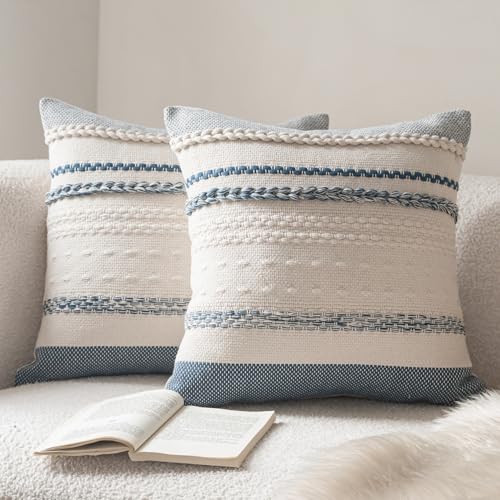
Cethom Boho Blue Textured Covers 18×18 Set of 2 — Best Boho Texture
Cethom takes the eighteen-inch cover somewhere chenille cannot go: into weave. This pair’s blue arrives with a textured, tactile surface — the kind of visible grain that farmhouse and boho rooms are built from — and the effect is matte, earthy and calm where chenille is plush and light-catching. Against linen upholstery, pale wood and woven throws, the texture reads as part of the room’s material story rather than a colour laid on top of it. It is the pick for households whose blue needs to feel handmade.
Texture changes a cover’s behaviour in small, practical ways. A woven surface grips its neighbours, so these covers stay where they are placed on a sofa instead of sliding into the gaps — a minor miracle in homes where arrangements are rebuilt by children hourly. The weave also ages gracefully, softening rather than pilling its way out of respectability. What it will not do is deliver the smooth, tailored face that a formal living room wants; the grain is the point, and in a sleek modern scheme it can read as rustic noise. In its native habitat — the farmhouse sofa, the boho reading chair, the bed layered with quilts — it is the most characterful eighteen-inch cover in this guide.
- Form: textured woven covers in a pack of two, covers only
- Size: 18 x 18 inches; pair with 20-inch inserts
- Design: boho textured weave in blue
- Surface: matte, grippy, visibly grained
- Buying note: check price on Amazon; weave texture is the feature, not a flaw
Strengths
- Woven grain gives farmhouse and boho rooms material depth.
- Textured surface grips upholstery and holds an arrangement’s shape.
- Matte blue pairs naturally with linen, wood and quilted layers.
Trade-offs
- Too rustic in hand and look for sleek, formal schemes.
- Texture can catch on jewellery, zips and rough throws.
- Less light play than chenille, so the blue reads flatter at dusk.
Best for: farmhouse sofas, boho chairs and quilt-layered beds wanting blue with a handmade feel. Not suited for: glossy modern rooms or anyone who wants a smooth, tailored cushion face.

EMEMA Chenille Couch Pillow Covers 20×20 Set of 2 — Best Middle Size
Twenty inches is the size nobody photographs and everybody with a standard sofa eventually wishes they had bought. EMEMA’s chenille pair in navy occupies that sensible middle: large enough to register on a three-seat sofa where eighteen-inch covers can look like samples, small enough to leave room for a second pair and for actual humans. The chenille here is a modern solid with a soft, even pile, and the covers are cut as true squares that hold their geometry over a twenty-two-inch insert without the corners straining.
The middle size earns its keep in mixed arrangements. Between the twenty-two-inch anchors and an eighteen-inch print, a twenty-inch navy pair is the step that makes the staircase look designed rather than accidental — and on its own, as the only pillows on a sofa, two twenty-inch squares in deep navy give a calm, uncluttered finish that suits smaller living rooms. EMEMA’s pair is also the natural first purchase for households converting from finished pillows, because twenty inches is the most common insert size hiding inside the pillows they already own. Measure before ordering and this set may be the only purchase the whole refresh requires.
- Form: chenille pillow covers, set of 2, covers only
- Size: 20 x 20 inches; pair with 22-inch inserts for fullness
- Colour: solid navy blue, modern even pile
- Fit note: matches the insert size inside many existing sofa pillows
- Buying note: check price on Amazon; measure existing inserts first
Strengths
- The in-between scale suits standard sofas better than either extreme.
- Likely to fit inserts already in the house, saving a second purchase.
- Even chenille pile keeps the solid navy calm and contemporary.
Trade-offs
- Less dramatic than the 22-inch anchors on a deep sectional.
- Twenty-inch covers are a less common size for future colour swaps.
- Solid face shares chenille’s honesty about lint and hair.
Best for: standard three-seat sofas and first-time cover buyers reusing their current inserts. Not suited for: very deep sectionals needing maximum anchor scale.

CaliTime Navy Blue Chenille Covers Pack of 2 — Best Established Classic
CaliTime has been selling chenille cushion covers since before the cover system was fashionable, and this eighteen-inch navy pack of two is the line’s workhorse. Longevity in a catalogue is its own kind of evidence: a cover design that survives years of reorders is one whose zippers, seams and colour have been tested by more living rooms than any review programme could assemble. The chenille is cosy in the literal sense — a soft, dense pile with a homely warmth — and the navy sits at the slightly deeper end of the family, which flatters farmhouse and traditional rooms especially.
The strategic reason to choose CaliTime is the range behind the single listing. Households building a system benefit from a maker whose covers come in many sizes and a long colour list, because the second and third purchases — the lumbar for the chair, the lighter blue for spring — can match the first in fabric and hand. A one-off cover from a transient listing leaves you starting the matching problem again each season. CaliTime’s eighteen-inch pair is therefore best understood as an entry ticket: a dependable navy foundation from a line deep enough to furnish the rest of the house’s colour changes without changing fabric families mid-room.
- Form: chenille covers in a two-pack, inserts not included
- Size: 18 x 18 inches; pair with 20-inch inserts
- Colour: deep navy in a cosy, dense chenille pile
- Range note: part of a wide size and colour line for future matching
- Buying note: check price on Amazon for the current pack options
Strengths
- A long-running line with the reorder depth a cover system needs.
- Dense, cosy pile suits traditional and farmhouse rooms warmly.
- Deep navy tone grounds pale upholstery with authority.
Trade-offs
- Deeper navy can read near-black in low evening light.
- Traditional character is less crisp than the GAWAMAY pair’s finish.
- Matching future shades depends on the line’s current colour list.
Best for: households standardising on one fabric family for years of seasonal swaps. Not suited for: buyers who want the lightest, brightest navy or a sharply modern finish.
How Do the Six Blue Cover Sets Compare?
| Pick | Size | Fabric character | Best role |
|---|---|---|---|
| GAWAMAY Navy Blue Chenille Covers 18×18 Set of 2 | 18 x 18 in | Ribbed chenille, light-catching | The standard navy pair |
| GAWAMAY Navy Blue Chenille Covers 22×22 Set of 2 | 22 x 22 in | Ribbed chenille, light-catching | Back-row anchors |
| Emvency Abstract Blue Throw Pillow Covers Set of 2 | 18 x 18 in | Smooth abstract print | Focal pattern pair |
| Cethom Boho Blue Textured Covers 18×18 Set of 2 | 18 x 18 in | Matte woven texture | Boho and farmhouse texture |
| EMEMA Chenille Couch Pillow Covers 20×20 Set of 2 | 20 x 20 in | Even modern chenille | Middle-size all-rounders |
| CaliTime Navy Blue Chenille Covers Pack of 2 | 18 x 18 in | Dense cosy chenille | System foundation, deep navy |
The table’s lesson is that size is a role, not a measurement. Eighteen-inch covers are the voices, twenty-inch covers the sentences, twenty-two-inch covers the paragraphs of a sofa arrangement — and a room that buys all three sizes in one navy can rearrange endlessly without buying anything new. Fabric divides the list by temperament: chenille for plush light-play, print for camouflage and focus, weave for grain. Choose the role first and the pick follows.
Which Colours Sit Well Beside Navy Blue Pillows?
Navy’s oldest partner is white and its crisp derivatives — cream, ivory, natural linen — because the contrast is nautical without being themed when the shapes stay modern. A navy pair against a pale sofa with one cream cushion between them is the arrangement that never dates. Mustard and ochre are navy’s warm counterweight, the combination that makes a grey room feel sunlit; use them in the smaller front cushions and let navy hold the back. Blush and dusty pink soften navy into something romantic enough for bedrooms, while sage and olive pull it toward the garden — a direction the Cethom texture supports beautifully.
The combinations to handle with care are other dark blues. Navy beside royal blue or teal can sing in tonal arrangements — the Emvency print is built on exactly that chord — but two unmatched navies side by side read as a mistake rather than a chord, because the eye catches the difference and assumes accident. Either match navies deliberately within one maker’s range or separate them with a print or a pale cushion. Black beside navy is the other trap: in daylight the pairing is sophisticated, in lamplight the two merge into one dark mass and the arrangement loses its architecture.
Metal and wood tones finish the picture. Brass and warm wood warm navy up; chrome and blackened steel cool it down. A room that feels too cold with navy pillows usually does not need different pillows — it needs the lamp shades, the throw or the side table to answer with warmth. Pillows are the cheapest layer to change and therefore the first blamed, but they are rarely the actual problem.
How Do You Arrange Blue Covers on a Sofa Like a Stylist?
Work from the outside in and the back to the front. Anchors — the twenty-two-inch GAWAMAY pair — go at the sofa’s ends, angled slightly into the corners. The middle rank, if the sofa is wide enough, takes the twenty-inch EMEMA pair standing square. The front belongs to the eighteen-inch voices: the solid GAWAMAY or CaliTime pair for a calm room, the Emvency print when the room wants a focal point, the Cethom weave when texture is the theme. Odd numbers read as designed on most sofas: five pillows arranged two-two-one, with a lumbar or a folded throw breaking the symmetry at one end.
The karate chop — that vertical crease down a plump pillow’s face — is optional theatre. It works on down-filled inserts and looks absurd on firm synthetic ones, which prefer a smooth, squared presentation with the corners pulled gently out. Whichever finish you choose, do it to all the pillows or none; a sofa where one pillow is chopped and its neighbour is not looks like two households sharing furniture. And leave sitting room. An arrangement that must be dismantled before a guest can sit down is a photograph, not a living room — the true test of a styled sofa is that people use it without apologising to the cushions.
How Should You Wash and Store Chenille Covers?
Turn covers inside out before washing, close the zipper, and keep the load’s company gentle — no towels with hooks of terry, no denim with rivets hunting for pile to snag. Cool water and a mild cycle preserve both the chenille’s pile and navy’s depth, since dark blues surrender their richness to hot water and harsh detergents faster than any other colour family in this guide. The Emvency print asks for the same gentleness for a different reason: printed colour sits on the surface, and abrasion is its enemy.
Dry flat or on the lowest heat, and return the cover to its insert while it is the faintest degree damp if it has tightened — chenille relaxes over a plump insert more gracefully than it stretches over a dry one. Between seasons, store covers folded in a drawer or a breathable box, out of direct sun; navy fades where sunlight pools, and a cover stored on a sunny shelf can emerge two-toned. A folded square of tissue between chenille faces prevents pile from imprinting on itself during long storage, a small courtesy that costs nothing.
How Do You Rotate Covers with the Seasons?
Rotation works when it is tied to an existing household ritual rather than to willpower. The bedding change is the natural trigger: when the duvet cover swaps, the sofa covers swap, and the whole house exhales into its new season in one afternoon. Spring asks navy to step back — not out, because a room that loves blue should keep its signature somewhere, but into the supporting rank, with the Emvency print or a paler cushion taking the front while the deep GAWAMAY pair rests in the drawer. Autumn reverses the cast, and the return of deep navy after the pale months has a small ceremony about it, the soft-furnishing equivalent of the first fire of the year.
Keep a written note, even a phone photograph, of each season’s arrangement. It sounds excessive until the second year, when the photograph of last spring’s sofa saves twenty minutes of rearranging and reminds you which combination made visitors compliment the room. Rotation also extends every cover’s life mechanically: a set that rests half the year wears at half the rate, and the drawer of folded blues becomes, over a few years, a wardrobe the house genuinely owns rather than a pile of impulse purchases.
What Mistakes Do Cover Buyers Make Most Often?
Expecting a pillow is the first, and this guide has flagged it from its opening paragraph because it remains the category’s defining disappointment. The second is same-size inserts, which produce the slack, empty-cornered look that convinces buyers covers were a mistake — the cover was fine; the fill was shy. Third is ordering a full multi-set arrangement in one click before seeing a single cover in the room’s own light. Navy is light-sensitive; buy one pair, live with it for a week across mornings and lamplight, then build.
Fourth is ignoring the zipper until it fails. A hidden zipper should glide before the cover is ever stuffed; test it on arrival, because exchanging a stiff-zippered cover is painless on day one and impossible on day ninety. Fifth is washing the insert with the cover still on, or never washing the cover at all — the system’s whole hygiene argument collapses if the removable layer is never actually removed. Put the covers through the laundry with the bedding rhythm of the house and the system delivers what it promised.
Which Shade of Blue Works in Which Room?
Living rooms take the deepest blues because they are seen in the widest range of light and usually contain the room’s largest neutral — the sofa itself. Navy anchors there because the room can absorb its gravity. Bedrooms ask a gentler question: navy against white bedding is crisp and hotel-like, but a bedroom dressed entirely in deep blue can feel like sleeping inside a wave, so the wise pattern is navy at the back — the twenty-two-inch anchors against the headboard — with paler blues, whites or blush in front to let the bed breathe. The Emvency print, with its greys, makes an excellent bridge in a bedroom that wants blue without the full plunge.
Children’s rooms and family dens sit at the forgiving end of the spectrum. Blue there is expected to work for its living, and the practical order reverses: prints first for their camouflage, textures second for their grip and toughness, solids last and darkest where they will show every biscuit crumb. Home offices have quietly become navy territory, because blue reads composed on a video call and a pair of chenille covers on the office chair or the sofa behind the desk does more for the room’s authority than any plant. Guest rooms, finally, want navy in its most classic form — the GAWAMAY pair, freshly laundered, over plump inserts — because a guest reads a well-dressed bed as a sentence about how welcome they are.
Light deserves the last word in this section, because it rewrites every shade. North-facing rooms cool blue further, pushing navy toward black and rewarding the lighter end of the family or the warmth of CaliTime’s deeper, cosier pile played against warm lamps. South-facing rooms bleach blue at midday, which is when chenille’s pile earns its keep, holding shadow in its ribs so the colour survives the glare. Test any cover at the hour the room is most used; a navy chosen at noon for a room that lives by lamplight is a navy chosen blind.
How Do Chenille, Velvet and Linen Covers Compare?
Chenille, the fabric of five picks here, is the middle path: a yarn with a fuzzy pile that imitates velvet’s light-play at a fraction of the fuss, wears evenly, and washes without ceremony. Its hand is soft and slightly ribbed, its look plush rather than lustrous. For family sofas it is usually the correct answer, which is why the market — and this guide — is full of it. Velvet is chenille’s glamorous sibling: deeper colour saturation, a unmistakable sheen that shifts as you move, and a talent for making navy look expensive. Its costs are real — it shows pressure marks, dislikes rough washing, and in dusty houses it displays its collection. Velvet belongs in adult living rooms and bedrooms where its drama is the point and its care burden is accepted.
Linen sits at the opposite pole: matte, breathable, wrinkled by nature and proud of it. A linen navy is a summer colour, pale-hearted and relaxed, and in hot climates it is the only cover that feels cool against a bare arm. Its wrinkles are a character trait that some households read as ease and others as neglect, and knowing which household you are matters more than any property of the fabric. Cotton canvas, the fourth common cover fabric, is the workhorse — flat, tough, printable — and it is the family the Emvency pair’s spirit belongs to: chosen for pattern and practicality rather than for hand-feel. A mature cover drawer often holds all four fabrics in one colour family, rotating by season: linen for summer, chenille for the shoulder months, velvet for the winter holidays, canvas prints whenever the room needs waking up.
How Many Cover Sets Does a Household Actually Need?
Start smaller than enthusiasm suggests. One pair in navy, worn on the sofa for a full month of evenings, teaches a household its size preference, its light and its tolerance for maintenance — information no amount of pre-shopping research can supply. Most households then settle into a rhythm of three colour stories: the everyday set that lives on the sofa, a lighter set for the bright months, and a deeper or richer set for winter and guests. In a blue-committed house that rhythm might run Emvency’s print for everyday, a pale blue or cream for spring, and the deep GAWAMAY or CaliTime navy for the dark months — all over the same inserts, all stored in a single drawer.
Beds multiply the arithmetic pleasantly. A dressed bed wants its own anchors, and sharing inserts between sofa and bed is a false economy that leaves both underdressed on laundry day. The households that make the system sing keep the sofa’s inserts and the bed’s inserts separate, and let covers travel between them freely. Chair cushions — the reading chair, the office chair — take the singles and the lumbar sizes, and they are where an experimental colour earns a trial before it is promoted to the sofa. Buy for the sofa first, the bed second, the chairs with the confidence the first two purchases taught you.
What Construction Details Separate a Good Cover from a Poor One?
Turn any cover inside out and it will tell you its future. Seams should be finished — overlocked or bound — because raw edges inside a cover fray a little with every stuffing, and stuffing is a violent act repeated for years. Corners deserve a squeeze: a well-made corner has fabric enough to form a clean point over a plump insert, while a skimpy corner rounds off and strains. The zipper, already praised in this guide, should be judged by its pull as much as its concealment; a hidden zipper with a fragile pull is a countdown, and the pull is the part your fingers will negotiate weekly.
Fabric weight is the other quiet tell. Chenille that feels substantial between finger and thumb holds its pile and its shape; chenille that feels like a rumour will shine at the pressure points within a season. Hold a cover to the light: an even weave glows evenly, while thin patches announce themselves. None of these checks require expertise — they require thirty seconds and the willingness to return a cover that fails them, which is precisely the willingness the first week of ownership is for. A cover that passes on arrival and is washed gently will look composed for years; the category’s disappointments are almost all visible on day one to anyone who looks.
Final Recommendation
Build the system in the order this guide lists it. Start with the GAWAMAY eighteen-inch pair if your sofa is standard, the twenty-two-inch pair if it is deep, and the EMEMA twenties if your existing inserts measure that way — then add Emvency when the room asks for a voice, Cethom when it asks for grain, and CaliTime when you decide this fabric family is the one your house will standardise on. Measure the inserts you own before spending anything, size the new ones one step up from their covers, and let one navy pair prove itself in your light before the full arrangement follows. A sofa dressed this way can change its mood with the seasons for years, through new babies, new dogs, new paint colours and new tastes, and it all starts with a folded square of blue in a drawer. That drawer, stocked patiently over a few seasons, becomes the room’s quiet advantage: colour on demand, laundry without drama, and a sofa that always looks like somebody meant it.
Frequently Asked Questions
Do these blue throw pillows come with inserts?
No — all six picks are covers only, sold in sets of two, and each review says so in its spec list. You will need inserts of the matching size, ideally one size larger than the cover for a plump finish. Many households already own suitable inserts inside older pillows; measure those first, because the EMEMA twenty-inch pair in particular matches the insert inside a great many existing sofa cushions.
What insert size should I buy for an 18-inch cover?
A twenty-inch insert. The extra two inches fill the corners, give the face its tailored tension, and produce the plump look of the photographs. The same rule scales across this guide: twenty-two-inch inserts for the EMEMA twenty-inch covers, and twenty-four-inch inserts for the GAWAMAY twenty-two-inch anchors. If you prefer a softer, slouchier cushion, a same-size insert is acceptable — just expect a relaxed rather than tailored face.
Can I mix these navy covers with my existing pillows?
Yes, and mixing is the point of the system. Navy chenille pairs calmly with cream, grey, mustard, blush and most prints whose palette includes a true blue. The caution is other navies: unmatched dark blues side by side can look accidental, so either keep to one maker’s navy within an arrangement or separate different navies with a print like the Emvency pair or a pale cushion between them.
How do chenille covers hold up with pets and children?
Better than velvet, worse than a print. Chenille’s pile is resilient and brushes clean for everyday dust and hair, though pale hair shows on navy and a lint roller will become furniture. For the front row in a pet-heavy household, the Emvency abstract pair hides the evidence best. All six covers remove for washing, which is the system’s real defence: a cover that can be laundered survives family life in a way a fixed pillow cannot.
Why do two of the picks come from the same brand?
Because the eighteen-inch and twenty-two-inch GAWAMAY covers do different jobs — voice and anchor — in the same fabric and colour, and a matched two-size system is genuinely more useful than two unrelated covers. The guide keeps them as separate picks so the size decision stays visible; households with a standard sofa may only ever need the smaller pair, while sectional owners will start with the anchors.
How do I stop chenille covers from looking flat and tired?
Flatness is usually an insert problem wearing a cover’s face. Refluff the insert first — a few minutes of shaking and, for synthetic fills, gentle warmth from a dryer cycle on the maker’s instructions restores loft — then re-dress it, working the fill into the corners with your fingers before zipping. If the cover itself has gone limp, a wash and a flat dry often revive the pile’s spring. Rotate pairs between the sofa’s high-traffic ends and its quieter middle so wear evens out, and give the everyday set a rest week when the seasonal set comes out; chenille, like most pile fabrics, recovers some of its posture simply by being left alone.
Should the pillows on my bed match the ones on my sofa?
They should converse, not match. A house where the same navy pair appears in both rooms feels coordinated in a way that identical full arrangements do not — the eye registers the family resemblance and reads it as intention. Let the bed take the larger anchors and the sofa the voices, or run the print in one room and the solid in the other. What should never travel is a dirty cover’s schedule: keep enough sets that laundry day never leaves either room undressed, because a system that collapses every wash day teaches the household to stop bothering with it.
Related Guides
A cover system begins with what goes inside it, and the rest of the pillow shelf branches from there. Best Bolster Sleeping Pillows covers the long cylindrical shapes that pair with square cushions on a dressed bed. The inserts themselves get their own treatment in Best Down Alternative Inserts for Throw Pillows, which compares the fills this guide keeps telling you to size up. When the soft furnishings spread beyond the sofa, Best 2×4 Modern and Transitional Rugs handles the small rugs that anchor an entryway in the same spirit. And for the odd size that tests every arrangement rule, Best 9×7 Rugs explores the seven-by-nine format and the rooms it quietly solves.



[…] of a child’s room connects to the rest of the pillow shelf in a few natural directions. Best Blue Throw Pillows covers the grown-up end of the cushion world, where colour does the work characters do here. For […]