What's inside
- Key Takeaways
- Quick Picks
- How Did We Choose These Backpacking Quilts?
- Comparison Table
- How Warm Does a Backpacking Quilt Actually Need to Be?
- How Do You Stop Drafts in an Open-Back Quilt?
- How Should You Layer a Quilt With the Rest of Your Sleep System?
- What Does Fill Power Change Besides the Price Tag?
- How Do You Decide Between a Trail Quilt and a Blanket Hybrid?
- What Mistakes Do First-Time Quilt Buyers Make?
- How Should You Size a Quilt for Your Body and Pad?
- How Do You Care for a Down Quilt Across a Whole Season?
- How Much Should a Backpacking Quilt Cost, and Where Does the Money Go?
- How Do Quilts Handle Damp, Wind and Other Imperfect Nights?
- Final Recommendation
- Frequently Asked Questions
- Related Guides
As an Amazon Associate I earn from qualifying purchases. This post may contain affiliate links at no extra cost to you.
cottageverdict.com is reader-supported. When you buy through links on our site, we may earn an affiliate commission.
Where to buy: each linked name below opens its Amazon listing, where you can check price on Amazon and confirm the packed weight, dimensions and temperature figures in the maker’s own words before ordering. The best backpacking sleeping quilts reward a particular kind of sleeper: someone who tosses, side-sleeps, camps three seasons out of four and would rather carry insulation only where a body actually loses heat. A quilt leaves the underside open because the part of a sleeping bag you lie on is compressed flat and contributes almost nothing; your pad does that work instead.
That single design decision explains everything else in this guide. Dropping the zipper, the hood and the dead insulation underneath trims real ounces, and ounces are the currency of a long trail. It also changes how you sleep. A quilt drapes rather than cocoons, so knees can bend, feet can wander and a restless sleeper stops fighting the bag at two in the morning. The trade is discipline: drafts punish sloppy edges, and the system only works when the pad underneath is insulated enough for the night you are planning.
Six products earned places here, and they are not six versions of the same idea. Four are genuine open-backed backpacking quilts built around high-loft down. Two, the Wise Owl and the ROSE FEATHER, are blanket-quilt hybrids: flat, rectangular, happy on a car-camping cot or across a hostel bed, and honest about being blankets first. We have labelled them as hybrids throughout rather than pretending they compete gram for gram with the trail quilts, because a blanket that knows what it is will serve you better than one dressed up as something lighter.
None of this makes a quilt automatically better than a bag. It makes a quilt better for a particular sleeper: the one who overheats inside a zipped cocoon, turns often, sleeps on a side and resents carrying insulation that spends the night squashed useless beneath them. If that description sounds like you, the six products below are arranged from the most technical trail tools to the most relaxed travel blankets, so you can stop reading the moment the descriptions stop sounding like your trips.
Every temperature figure and fill power number quoted in this guide is the manufacturer’s published figure from its own listing. Those numbers are not measured on one shared scale across brands, so treat them as each maker’s claim about its own product, useful for sorting within a line and rough orientation across lines, never as laboratory verdicts.
Key Takeaways
- A quilt only insulates the top and sides; the pad beneath you carries the bottom half of the warmth equation.
- Fill power of 800 and above is where down quilts get genuinely light for their loft, and four picks here meet that bar by their makers’ listings.
- The Sierra Designs Cloud is the cold-weather outlier of the six, built around a manufacturer-stated 20 degree rating.
- Wise Owl and ROSE FEATHER are blanket hybrids for camp and travel, not gram-counted trail quilts, and are judged on that basis.
- An open footbox vents on warm nights; a sewn or cinched one matters once frost starts appearing on the tent fly.
- Pad attachment straps look like a fussy extra until your first windy night on an exposed ridge.
Quick Picks
| Pick | Badge | Why it stands out |
|---|---|---|
| WIND HARD Twilight 800FP Ultralight Down Quilt | Best Ultralight Value | An 800 fill power quilt in a featherweight 10D shell at a price tier the cottage brands rarely visit. |
| Sierra Designs Cloud Quilt 20 Degree Down | Best for Cold Nights | The warmest claim in the group, with a hideaway hood and hand pockets borrowed from jacket thinking. |
| Featherstone Moondance 25 Top Quilt | Best for Thru-Hikers | 850 fill power down in a mummy-shaped top quilt shaped for people who measure trips in months. |
| Big Agnes Fly Creek UL Quilt 50 Degree | Best for Summer | A convertible 50 degree design for warm nights when a full bag becomes a sweaty punishment. |
| Wise Owl Outfitters Packable Camping Blanket Quilt | Best Blanket Hybrid | A woobie-style puffy blanket with snap clasps and tie-down loops that moonlights as a poncho. |
| ROSE FEATHER Down Camping Blanket | Best Travel Blanket Hybrid | A full-size down blanket, 55 by 79 inches by its listing, that packs down for planes and picnics alike. |
How Did We Choose These Backpacking Quilts?
We started from the trail outward. A backpacking quilt has one job it cannot delegate: keeping a sleeping person warm while adding as little carried weight as possible. So the first sort was by construction. Products with an open back, a shaped footbox and down fill at 800 fill power or better went into the trail pile. Products that were flat rectangles with snaps went into the hybrid pile, and we judged each pile by its own honest standards instead of forcing one ranking across both.
Manufacturer-stated temperature ratings were the second sort, handled with suspicion. One brand’s comfort figure and another brand’s lower limit figure describe different nights, so we recorded each number exactly as its listing publishes it and flagged the basis wherever the listing gives one. A quilt claiming 20 degrees and a quilt claiming 50 degrees are not rivals; they are tools for different months, and the guide treats them that way.
Shell fabric mattered more than brand heritage. A 10D nylon shell, like the one on the WIND HARD, saves grams and packs small but asks for gentler handling around zippers, sticks and tent-floor grit. Heavier shells forgive more. We also weighed footbox design, because a footbox that opens flat turns one product into both a summer blanket and a shoulder-season quilt, and we looked for pad attachment points, since a quilt that creeps off the pad at night delivers its warmth to the tent air instead of to you.
We also read the fine print on sizing, because quilt dimensions are the least standardised numbers in the category. One maker’s regular is another maker’s long, and width is quoted sometimes at the shoulders, sometimes at the widest point of a taper. Where a listing gave a concrete dimension, like the ROSE FEATHER’s 55 by 79 inches, we printed it; where it did not, we described the cut in words rather than inventing measurements a reader might plan a purchase around.
Finally, we kept two hybrids in the list deliberately. Many readers searching for a backpacking quilt actually camp from a car twice a year and want one warm layer that also works on the sofa in January. Excluding blankets entirely would have answered a question nobody asked. Including them, clearly labelled, answers both questions at once.

WIND HARD Twilight 800FP Ultralight Down Quilt — Best Ultralight Value
The Twilight is the quilt in this guide that makes gram counters sit up. Its listing pairs 800 fill power down with a 10D shell fabric, a combination that used to belong exclusively to boutique cottage makers charging accordingly. The lengthened version listed here suits taller sleepers who usually find budget quilts ending somewhere around their shins, and the whole thing is aimed squarely at backpackers who weigh their kit on a kitchen scale and argue about the results.
What the Twilight understands is that an ultralight quilt is a system component, not a standalone promise. The down provides loft on top; your pad provides insulation below; the open back is a feature precisely because compressed down under a body contributes nothing anyway. Sleepers who curl, sprawl or rotate like a rotisserie chicken will find the drape forgiving. Sleepers who want to be swaddled should read the trade-offs below carefully, because this quilt will not pretend to be a mummy bag.
- Fill: down, manufacturer-stated 800 fill power
- Shell: 10D ultralight fabric per the listing
- Format: open-back backpacking quilt, lengthened version
- Season target: three-season backpacking per the maker
- Carry style: stuff sack packing for pack carry
Strengths
- 800 fill power loft at a weight class most synthetic quilts cannot approach.
- The 10D shell packs down small enough to disappear into a pack corner.
- Lengthened sizing gives tall side sleepers room to bend their knees.
Trade-offs
- Featherweight shell fabric needs care around snags, sparks and rough ground cloths.
- No hood, so a warm hat or balaclava becomes part of your sleep system.
- Drafts creep in at the edges if you skip securing the quilt to your pad.
Best for: weight-conscious backpackers building a three-season kit around an insulated pad. Not suited for: campers who sleep cold and refuse to wear a hat at night.

Sierra Designs Cloud Quilt 20 Degree Down — Best for Cold Nights
Sierra Designs built the Cloud around a manufacturer-stated 20 degree rating, which makes it the cold-weather anchor of this list by a wide margin. Where the other quilts here plan for mild nights, the Cloud plans for the shoulder-season morning when your water bottle has a skin of ice and the tent fly crackles as you fold it. The fill is 800 fill power DriDown per the listing, a treated down intended to resist the loft-killing moisture that builds up inside a tent over consecutive nights.
The details show a design team that actually sleeps outside. A hideaway hood answers the classic quilt complaint about cold heads without bolting a permanent hood onto a product whose whole point is freedom. Insulated hand pockets give your arms somewhere warm to live when you sit up to check the time or reach for a headlamp. These are jacket ideas transplanted into bedding, and on a frosty night they stop feeling like novelties.
Consider who feels the cold first on a mountain night: the hiker who skipped autumn trips for years because a summer-weight bag kept betraying them in September. The Cloud is pitched at that person. Its warmth claim, taken as the maker’s own figure, reaches into territory where frost is a routine expectation rather than a nasty surprise, and the feature set assumes you will sit up, cook, read and live inside the quilt’s warmth rather than merely sleep in it.
The Cloud is not the lightest object here, and it does not try to be. Its argument is different: one quilt that covers the coldest nights most backpackers will voluntarily face, instead of a quiver of two lighter quilts and the guesswork of choosing between them at the trailhead.
- Fill: 800 fill power DriDown, per the listing
- Rating: manufacturer-stated 20 degrees
- Extras: hideaway hood, insulated hand pockets
- Format: backpacking quilt, regular length listed
- Shell approach: built for repeated cold-weather trips
Strengths
- The hideaway hood closes the biggest warmth gap in quilt design.
- DriDown treatment targets the damp-loft problem on multi-night trips.
- Hand pockets make cold evenings in camp noticeably more comfortable.
Trade-offs
- Warmer and heavier than the summer-weight quilts in this guide.
- Overkill, and uncomfortably hot, for July nights at low elevation.
- The hood adds a step to packing compared with a plain open quilt.
Best for: shoulder-season and high-elevation backpackers who camp into genuine frost. Not suited for: warm-weather minimalists counting every gram for summer miles.
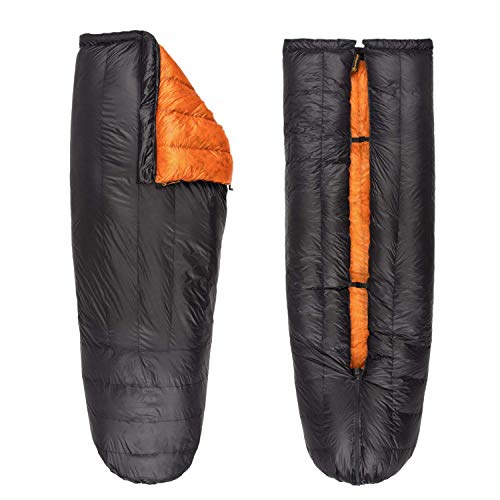
Featherstone Moondance 25 Top Quilt — Best for Thru-Hikers
The Moondance 25 is a top quilt in the strict sense: shaped like the top half of a mummy bag, open underneath, and filled with 850 fill power down according to its listing. That fill figure is the highest in this guide, and high fill power is not a vanity metric. Down that lofts more per ounce means the same warmth at less carried weight and a smaller packed bundle, which is exactly the trade a thru-hiker makes two hundred mornings in a row.
Featherstone positions the Moondance as a mummy bag alternative, and the shape backs that up. The tapered cut follows the body instead of draping in loose folds, so there is less dead air to heat and fewer billowing edges to leak warmth when you turn. Restless sleepers still get more freedom than a zipped bag allows, particularly through the shoulders, but the personality here is closer to a bag than to a blanket, and that is a deliberate choice for people who move through mountain weather systems rather than around them.
The manufacturer-stated 25 in the name signals its intended temperature neighbourhood. Paired with a properly insulated pad and a habit of wearing your puffy to bed on the coldest nights, it is the kind of quilt a long-distance hiker buys once and then defends in trail-town arguments.
- Fill: manufacturer-stated 850 fill power down
- Rating: 25 degree class per the product name and listing
- Cut: tapered mummy-style top quilt
- Format: open underside for pad pairing
- Audience: ultralight backpacking and thru-hiking
Strengths
- 850 fill power delivers serious loft without a serious weight penalty.
- The tapered shape reduces the drafty folds a rectangular quilt creates.
- Packs smaller than its warmth suggests, freeing volume for food carries.
Trade-offs
- The close cut gives sprawlers less room than a wide rectangular quilt.
- Premium fill commands a premium tier compared with the hybrids here.
- Like every quilt, it depends entirely on your pad for insulation below.
Best for: thru-hikers and section hikers who want one quilt for a whole season of miles. Not suited for: campers who toss widely and prefer a loose, blanket-like drape.

Big Agnes Fly Creek UL Quilt 50 Degree — Best for Summer
Every quilt wardrobe has a warm end, and the Fly Creek UL occupies it here. Its listing describes a convertible sleeping bag and quilt rated by the manufacturer at 50 degrees, filled with 850-fill down in an ultralight build. Fifty degrees sounds modest until you remember how many backpacking nights actually happen in that band: summer in the lowlands, desert trips after the heat breaks, and hut-to-hut routes where the building holds half the warmth for you.
The convertible design is the interesting part. Used as a quilt, it drapes open and vents freely, which is what you want when the evening is still warm enough for short sleeves. Closed up, it behaves more like a light bag for the small hours when the temperature finally slides. That flexibility suits trips with wide day-to-night swings, where a dedicated summer quilt feels thin at 4 a.m. and a three-season quilt feels like a sauna at 10 p.m.
Big Agnes built its reputation on sleep systems that integrate the pad rather than ignoring it, and that philosophy shows in a product designed to be one component of a considered setup. Buy it as part of a system and it shines; buy it expecting a standalone winter answer and you have misread the label.
- Fill: manufacturer-stated 850-fill down
- Rating: manufacturer-stated 50 degrees
- Format: convertible between bag and quilt configurations
- Length: regular, per the listing
- Season target: summer and warm shoulder nights
Strengths
- Convertibility covers evenings and cold small hours in one product.
- 850-fill down keeps a summer quilt genuinely light in the pack.
- Vents wide open when a zipped bag would leave you sweating.
Trade-offs
- A 50 degree claim leaves no margin when a forecast turns optimistic.
- Not a three-season answer, whatever the rest of your kit includes.
- Warmth depends heavily on clothing layers on unexpectedly cool nights.
Best for: summer backpackers and warm-climate trekkers who hate sleeping hot. Not suited for: anyone whose trips regularly drop below freezing.
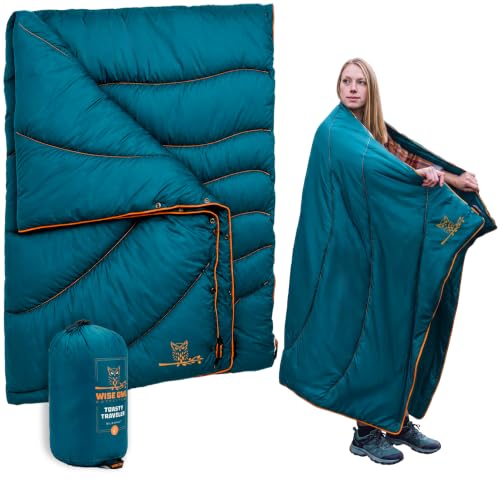
Wise Owl Outfitters Packable Camping Blanket Quilt — Best Blanket Hybrid
Now for the honest labelling. The Wise Owl is a puffy camping blanket in the woobie tradition, and its listing says so: it unfolds to 6.5 by 4.5 feet, carries quick-snap clasps and tie-down loops, and can be worn poncho-style around a campfire. It is not an open-backed trail quilt with a shaped footbox, and we have not scored it as one. What it is, is the layer most casual campers will actually use the most.
The snaps and loops are the whole personality. Snap it around your shoulders on a cold bleacher. Tie it under a hammock as a makeshift underlayer on a mild night. Clip two corners and make a shade. Spread it across a tent floor for a dog who has opinions about comfort. A technical quilt does one job superbly; this blanket does a dozen jobs adequately, and for car campers, festival-goers and backyard astronomers that arithmetic wins.
There is also a social dimension the technical quilts cannot match. A blanket gets passed around a fire circle, draped over a chilly partner, spread for a card game and lent to the friend who underestimated the evening. Nobody lends a precision trail quilt with that kind of cheerful carelessness, nor should they. Gear that invites sharing earns its keep in households and groups in a way the spec sheet never captures, and the Wise Owl’s entire design, from its wipeable shell to its forgiving fill, seems built by people who understood that assignment.
Its fill is synthetic puff rather than high-loft down, so the packed bundle is bulkier than the trail quilts above and the warmth-to-weight ratio is not in their league. Carry it in a car, a canoe or a festival wagon without a thought. Carry it fifteen miles and you will understand exactly why the quilts above cost what they cost.
- Format: flat puffy blanket, quilt-blanket hybrid
- Size: unfolds to 6.5 by 4.5 feet per the listing
- Hardware: quick-snap clasps and tie-down loops
- Shell: water resistant per the maker
- Wearable: poncho-style configuration
Strengths
- Snaps and loops turn one blanket into shelter, wrap and hammock layer.
- Generous flat size covers two people on a picnic or one person completely.
- Synthetic fill shrugs off damp grass and spilled drinks without sulking.
Trade-offs
- Too bulky and heavy to earn a place in a gram-counted backpack.
- No footbox or pad attachment, so drafts win on cold windy nights.
- Warmth is camp-blanket warmth, not a rated sleep system.
Best for: car campers, hammock loungers and anyone who wants one layer for everything outdoors. Not suited for: backpackers measuring base weight in single kilograms.

ROSE FEATHER Down Camping Blanket — Best Travel Blanket Hybrid
The ROSE FEATHER is the second hybrid in this guide, and it splits the difference differently from the Wise Owl. It is a genuine down blanket, sized by its listing at 55 by 79 inches, which is close to a twin bed’s footprint. That makes it a real blanket for a real bed as easily as a camp layer, and its listing leans into travel, aeroplanes, picnics and hiking in one breath. Read it as a down throw with outdoor ambitions rather than a technical quilt.
The distinction from a true backpacking quilt is the shape. There is no open back designed around a pad, no tapered footbox, no strap system. Spread flat, it warms from above only in the loosest sense, and on a cold night outdoors you would wrap it around yourself inside a tent rather than sleep under it as a system. Indoors, in a camper van, in a chilly holiday rental with one thin duvet, none of that matters and the down loft is simply luxurious.
Air travellers will recognise the type immediately: this is the blanket people carry onto long-haul flights because cabin temperatures obey no earthly logic, and a down layer that compresses into a handbag-sized bundle beats the airline’s tissue-thin offering on every measure. The same compressibility serves train journeys, draughty guest rooms and the back seat on winter road trips, which is why we judge this product against a traveller’s calendar rather than a mountaineer’s.
Where it earns its place is versatility per dollar of the six. Down compresses, so the blanket travels smaller than a synthetic equivalent, and the waterproof positioning in its listing suits the picnic-and-festival life. If your backpacking is really bikepacking to a friend’s cabin or van trips with short walks, this may be the most-used item in the whole guide.
- Fill: down, per the listing
- Size: 55 by 79 inches per the listing
- Format: flat rectangular blanket, quilt hybrid
- Shell: waterproof positioning per the maker
- Uses named by maker: camping, travel, flights, picnics
Strengths
- Down fill packs far smaller than a synthetic blanket of equal warmth.
- Full rectangular size works on beds, sofas and tent floors equally.
- A single layer that travels from aeroplane cabin to campsite without fuss.
Trade-offs
- No shaped footbox, so it cannot seal around feet like a trail quilt.
- Down and waterproof claims still mean keeping it dry as a habit.
- Too much blanket for ultralight routes where every litre counts.
Best for: travellers, van campers and anyone wanting one down layer for home and road. Not suited for: technical backpacking where the quilt must integrate with a pad.
Comparison Table
| Pick | Type | Maker-stated rating | Fill per listing |
|---|---|---|---|
| WIND HARD Twilight 800FP Ultralight Down Quilt | Open-back quilt | Three-season class | 800 fill power down |
| Sierra Designs Cloud Quilt 20 Degree Down | Open-back quilt with hood | 20 degrees | 800 fill power DriDown |
| Featherstone Moondance 25 Top Quilt | Tapered top quilt | 25 degree class | 850 fill power down |
| Big Agnes Fly Creek UL Quilt 50 Degree | Convertible bag-quilt | 50 degrees | 850-fill down |
| Wise Owl Outfitters Packable Camping Blanket Quilt | Blanket hybrid | Unrated blanket | Synthetic puff |
| ROSE FEATHER Down Camping Blanket | Blanket hybrid | Unrated blanket | Down |
How Warm Does a Backpacking Quilt Actually Need to Be?
Start with the coldest night you realistically expect, not the coldest night you can imagine. A quilt bought for a once-a-decade cold snap will spend the other nine years making you sweaty and taking up pack room. For most three-season backpacking in temperate ranges, makers’ ratings in the 20 to 30 degree band give margin for a clear, still night at elevation without turning mild evenings into a steam room. Summer specialists can live happily in the 50 degree class, provided they accept that an unusual cold front ends the trip or gets slept through in every layer they own.
Then be honest about yourself. Cold sleepers should treat every manufacturer figure as optimistic and choose one class warmer than the forecast suggests. Warm sleepers can do the opposite. The number on the listing describes the product under the maker’s own test assumptions; your metabolism, your dinner, your exhaustion level and the wind over the ridge all vote as well.
Finally, remember the pad. A high-loft quilt over a thin summer pad is a sports car on bicycle tyres: the expensive half cannot compensate for the neglected half. Insulated pads are rated by R-value, and cold ground will pull heat from below faster than any quilt can replace it from above. Budget for the pair as one purchase, because on the trail they are one product.
Altitude rewrites the arithmetic nightly. A valley campsite at dusk can feel mild enough for shirtsleeves while the pass two thousand feet above it, where tomorrow’s route tops out, is already below freezing. Quilt buyers planning mountain itineraries should shop for the highest campsite on the route rather than the trailhead’s afternoon, because the quilt’s job begins exactly where the day’s warmth ends. This is why the same hiker can honestly need the Fly Creek’s 50 degree class in one range and the Cloud’s colder claim in another, and why owning the rating that matches your mountains matters more than owning the most impressive number in the catalogue.
How Do You Stop Drafts in an Open-Back Quilt?
Drafts are the tax quilts charge for their freedom, and there are four reliable ways to pay less of it. First, width: a quilt that is too narrow for your shoulders will gap every time you roll, so measure yourself in your sleep clothes rather than trusting a size chart drawn for someone else. Second, pad straps: most trail quilts here assume you will clip or strap the edges to the pad on cold nights, turning the open back into a sealed cocoon only when conditions demand it.
Third, the footbox. Cinch it closed and, on genuinely cold nights, stuff a spare layer into the foot end to block the chimney effect that pulls warm air out past your feet. Fourth, site selection, the unglamorous skill that outperforms gear: a sheltered hollow out of the wind is worth several degrees against an exposed saddle, and no strap system compensates for pitching on a ridgeline because the view was pretty at dinner.
Practise at home once. Ten minutes on the living-room floor learning where the straps sit and how the footbox closes is worth more than an hour of frozen fumbling by headlamp, and it tells you honestly whether you are a quilt person at all before the return window and the trip both close.
How Should You Layer a Quilt With the Rest of Your Sleep System?
Think in layers from the ground up. The pad insulates below. The quilt insulates above and around. Your clothing is the adjustable middle: a puffy jacket worn to bed adds meaningful warmth on the coldest night of a trip and costs nothing in pack weight because you were carrying it anyway. A liner adds a few degrees, keeps the quilt cleaner across a long trip, and is far easier to wash in a trail-town laundrette than a down quilt.
Head and feet deserve their own plan because a quilt gives them none. A warm hat or the Cloud’s hideaway hood handles the top end; dedicated down socks are a luxury, but dry spare socks reserved only for sleeping are a discipline every experienced backpacker eventually adopts. Wet socks worn to bed will defeat a very expensive quilt.
Moisture management ties the system together. Down loses loft when damp, and a sleeper exhales and perspires moisture all night. Air the quilt at lunch stops on long trips, keep it in a waterproof stuff sack inside the pack, and never store it compressed at home; the loft you preserve in the cupboard is the warmth you get on the mountain.
What Does Fill Power Change Besides the Price Tag?
Fill power is the most quoted and least explained number in quilt marketing, so it deserves a plain account. The figure describes how many cubic inches one ounce of a down sample expands to fill under standardised conditions, as reported by the maker or its down supplier. An 850 fill power ounce lofts larger than a 650 fill power ounce. Build two quilts to the same warmth and the 850 version needs fewer ounces of down to do it, so it ends up lighter, and because high-loft down also compresses willingly, it packs into a smaller bundle.
That is the entire advantage, and it is a real one on a long trail. What fill power does not measure is total warmth. Warmth comes from loft thickness over your body, which is fill power multiplied, in effect, by how much down the maker actually sewed in. A generously stuffed 650 quilt can be warmer than a stingy 850 one, which is why this guide treats fill power as a weight-and-packability signal and the manufacturer’s temperature figure as the warmth claim, keeping the two ideas in separate columns where they belong.
There is also a durability angle that rarely makes the listing. Premium down clusters are larger and springier, and they tend to recover their loft after thousands of compressions in a stuff sack better than smaller clusters do. A thru-hiker compresses a quilt twice a day for five months. A weekend camper does it forty times a year. Both benefit from high fill power, but only one of them is amortising the cost across enough nights to make the premium feel inevitable rather than indulgent.
Shell fabric rides along with the fill decision. The lightest quilts pair high fill power down with gossamer shells like the 10D fabric on the WIND HARD Twilight, because a heavy shell would hand back the grams the down just saved. The compromise is toughness: thin shells dislike tent zips, Velcro, thorn scrub and being sat on at lunch. If your style is rough on gear, a slightly heavier shell over slightly lower fill can be the wiser engineering, even if the spreadsheet of numbers looks less heroic.
How Do You Decide Between a Trail Quilt and a Blanket Hybrid?
Ask where the product will sleep most often, and answer with your calendar rather than your aspirations. If most nights are on the ground, miles from the car, in weather you did not choose, you need a trail quilt: shaped, strapped, rated by its maker and built around a pad. The Moondance, the Cloud and the Twilight were designed for exactly that life, and their prices reflect insulation engineering you will feel at altitude in October.
If most nights are in a van, a tent pitched six steps from the tailgate, a friend’s spare room or a hammock strung between two garden posts, a hybrid blanket is not a compromise at all; it is the correct tool. The Wise Owl’s snaps make it a wrap, a shade and a ground layer. The ROSE FEATHER’s full rectangular cut makes it a bed blanket that also travels. Neither wastes money on strap systems and tapered footboxes you would never use, and both tolerate the spills, dogs and damp grass of low-stakes camping better than a technical quilt should be asked to.
The expensive mistake is the crossover purchase in either direction. A blanket hybrid carried into real backpacking delivers a cold, heavy lesson. A technical quilt bought for car camping delivers a delicate, draughty blanket that cannot cover two people on a picnic rug and makes its owner nervous around every campfire spark. Match the product to the diary you already keep, not the expedition you browse photographs of, and both categories suddenly look well designed.
One more consideration settles many ties: who else uses it. Trail quilts are personal equipment, sized to one body and one pad. Blankets get shared, lent, dragged to fireworks and claimed by teenagers. Households buying one warm layer for general outdoor life should buy the blanket and stop apologising; solo walkers buying warmth for altitude should buy the quilt and stop improvising.
What Mistakes Do First-Time Quilt Buyers Make?
The classic error is buying the rating instead of the system: a warm quilt, a bargain pad, and a miserable night blamed on the quilt. The second error is sizing by height alone and ignoring shoulder width, which is where drafts actually enter. The third is treating a hybrid blanket as a trail quilt because both products use the word quilt in their names; the Wise Owl and ROSE FEATHER above are excellent blankets and honest products, and neither will keep you warm on a frosty ridge the way the Moondance will.
A fourth mistake is storing any down product stuffed tight between trips, which slowly crushes the very loft you paid for. Hang it or use the large storage sack. A fifth is washing down with ordinary detergent and impatience; down wants its specific soap, a long gentle cycle and a longer, patient dry with breaks to unclump the fill.
How Should You Size a Quilt for Your Body and Pad?
Sizing a quilt is less forgiving than sizing a bag, because a bag’s zipper forgives a narrow cut by sealing you in anyway, while a quilt’s edges must reach the pad and stay there while you move. Start with length: the quilt should reach your chin with the footbox closed and your feet relaxed, not pointed like a dancer’s. Sleepers who stretch out fully often need the lengthened version of a design, as offered in the WIND HARD listing here, even when their height seems to fit the regular on paper.
Width is where most returns are born. Measure around your shoulders and chest in the clothes you sleep in, then add room for elbows, because side sleepers do not sleep as flat silhouettes; they sleep as question marks with arms folded in front. A quilt that wraps to the pad on both sides while you lie in your actual sleeping posture is wide enough. One that only reaches when you lie flat and hold still will leak heat at every turn, all night, in a rhythm perfectly timed to your deepest sleep.
Pad width matters in the same calculation. A wide pad gives the quilt’s edges somewhere to land and the straps something to grip; a narrow pad under a wide quilt leaves the edges flapping into cold air. Many quilt sleepers move up one pad width when they switch from a bag, and count it as part of the quilt purchase, because the two pieces only function as a pair.
Footbox style finishes the fit. A sewn footbox is warmer and lighter, and suits sleepers who never vent their feet. A zippered or drawcord footbox opens flat, which helps tall sleepers, warm nights and anyone who likes one foot out of the covers as a thermostat. Neither is better in the abstract; the right one is the one that matches the way you already sleep at home, because you will sleep that way in the woods too, whatever the gear catalogue promised.
How Do You Care for a Down Quilt Across a Whole Season?
Down care begins with compression discipline. On the trail the quilt lives in its stuff sack only while you are walking; the moment camp is made, it should come out and loft, even if dinner and tent chores come first in every other respect. At home it belongs in a large breathable storage sack or hanging in a wardrobe, never in the tight trail sack, because months of compression between trips quietly crush the clusters you paid a premium for.
Dirt is the second enemy, and it attacks through body oils more than through mud. A liner, or simply sleeping in dedicated base layers, keeps the shell and fill cleaner for longer, stretching the interval between washes from every trip to every season. Spot-clean the inevitable toothpaste and sunscreen marks with a damp cloth rather than laundering the whole quilt for a coin-sized stain.
When a full wash finally comes, treat it as a half-day project rather than a chore squeezed between others. Down soap, a large front-loading drum, an extra rinse and a long, low tumble dry with pauses to tease the clumps apart will restore a sad-looking quilt to something close to its first loft. Storing it even slightly damp undoes all of that work and adds a smell that no amount of airing quite removes.
Field repairs are simpler than most owners fear. A needle and fine thread close a snagged shell seam before it leaks fill; adhesive repair patches handle tent-floor punctures well enough to finish any trip. What down quilts cannot survive is neglect of small holes, because a pea-sized opening sheds feathers for miles and turns a repairable quilt into an underfilled one. Check the shell whenever you pack, and mend on the day you notice, not the month you remember.
How Much Should a Backpacking Quilt Cost, and Where Does the Money Go?
Quilt prices confuse newcomers because two products that look like simple insulated rectangles can sit in entirely different tiers. The money goes to three places. The first is the down itself: high fill power clusters come from mature birds and careful sorting, and the supply is neither large nor cheap. The second is shell fabric, where the lightest nylons cost more per metre precisely because so little material does so much work. The third is construction labour, since baffles, footboxes and strap systems are sewn details that resist automation.
Knowing that anatomy helps you read this list sensibly. The Moondance and the Cloud charge for fill quality and cold-weather engineering. The WIND HARD Twilight charges less by pairing strong fill with a no-frills feature set and a shell you must treat kindly. The two hybrids charge least because synthetic puff and blanket construction are genuinely cheaper to make, and their makers have not pretended otherwise. None of those positions is a trick; each is a different answer to the question of what a night outdoors is worth.
The sensible budget rule is nights-based. A quilt slept in sixty nights a year justifies almost any tier, because the cost per warm night collapses quickly. A quilt slept in four nights a year should be bought for adequacy and durability instead, and the savings redirected to the pad, which beginners chronically underfund. Money spent balancing the system beats money spent maximising one component of it, every single time.
Sales patterns reward patience, too. Last-season colours and superseded versions of established quilts appear at friendlier tiers whenever a line refreshes, and the warmth of a quilt does not expire when its colourway does. A patient buyer with a spring trip can often fund the pad upgrade from the difference, which is the closest thing backpacking offers to a free lunch.
How Do Quilts Handle Damp, Wind and Other Imperfect Nights?
No night outdoors arrives exactly as forecast, and quilts meet imperfect weather with a mixture of vulnerability and adaptability worth understanding before you buy. Damp is the familiar worry: humid air and tent condensation slowly rob down of loft across a long wet trip. Treated fills like the DriDown in the Sierra Designs Cloud exist for precisely this slow siege, resisting moisture longer than untreated down, though no treatment makes down indifferent to a soaking. The defence is routine: a waterproof stuff sack, a liner in persistently wet climates, and ten minutes of airing whenever the sun offers itself.
Wind attacks a quilt differently from a bag, because the open edges that make a quilt comfortable also give moving air somewhere to enter. In a tent this is mostly a non-issue. Under a tarp or a cowboy camp beneath the stars, it becomes the whole story, and the countermeasures are the straps, the tucked edges and the sheltered pitch discussed earlier. Quilt sleepers who love tarp camping learn to pitch low and tight on windy nights and treat the quilt as the inner layer of a two-part shelter system.
Cold spots deserve a mention because they surprise new owners. Shoulders and hips compress the quilt’s loft where they press upward into it, and those are the places sleepers report feeling the night first. A slightly warmer clothing layer at the shoulders, or a quilt with enough width to drape rather than stretch across you, solves most of it. Stretch is the enemy of loft everywhere in sleep gear; a quilt that hangs softly insulates, while a quilt pulled drum-tight merely covers.
The reassuring summary is that every one of these weaknesses has a practiced answer, and the backpacking world has had decades to develop them. Quilts did not become the default choice of long-distance hikers by being fragile novelties. They earned that position by surviving the same weather bags survive, at less weight, for sleepers willing to learn a short list of habits.
Final Recommendation
If your trips are measured in miles and your pack weight matters, the Featherstone Moondance 25 is the quilt we would hand to a friend starting a long trail: the highest fill power here, a shape that respects cold weather, and no gimmicks. If your calendar runs colder than your ambitions are light, the Sierra Designs Cloud buys real margin with its hood and its manufacturer-stated 20 degree rating. The WIND HARD Twilight is the value play for three-season walkers who handle gear gently, and the Big Agnes Fly Creek owns the summer end without apology.
Choose the hybrids with clear eyes and they will delight you: the Wise Owl for campfire versatility, the ROSE FEATHER for travel and van life. Just never ask a blanket to do a quilt’s job on a cold mountain. Pick the product that matches the trips you actually take, pair it with a pad that deserves it, and the first frosty morning you wake up warm will settle the quilt-versus-bag argument for good.
Frequently Asked Questions
Is a quilt warmer than a sleeping bag of the same rating?
Not inherently. A quilt removes insulation from underneath your body, where it was compressed and ineffective, and relies on your pad there instead. With an adequately insulated pad the warmth is comparable and the weight is lower; with a thin pad the bag wins, because the bag’s underside, however flattened, is not nothing.
What do fill power numbers actually tell me?
Fill power describes how much volume one ounce of down occupies when lofted, as measured by the maker or its supplier. Higher fill power means equal warmth at less weight and a smaller packed size. It says nothing by itself about total warmth, which also depends on how much down is inside; a large amount of modest fill can out-warm a small amount of premium fill.
Can I use a backpacking quilt in a hammock?
Yes, with an underquilt or an insulated pad in the hammock, because a hammock exposes your underside to moving air on every side. Top quilts are actually the traditional hammock choice, since getting into a zipped bag inside a hammock is a wrestling match nobody wins gracefully. The quilts here work over a hammock sleeper exactly as they work over a pad sleeper.
How do I wash a down quilt without ruining it?
Use a front-loading machine, down-specific soap, a gentle cycle and patience. Dry it low and long, stopping to break up clumps by hand, until the fill feels completely dry and lofty; damp down stored away will smell and clump. If that sounds daunting, specialist gear-wash services exist and are cheaper than a replacement quilt.
Are the temperature ratings on these listings guaranteed?
No. Every rating quoted in this guide is the manufacturer’s own published figure, and brands do not all test on identical assumptions. Treat ratings as sorting tools, choose a class warmer than your expected coldest night if you sleep cold, and let clothing layers and site choice supply the rest of the margin.
Should I choose a sewn or a zippered footbox?
Choose sewn if your trips run cold and your feet stay put, because a sewn footbox is lighter, warmer and has nothing to fail. Choose a zippered or drawcord design if you camp across a wide temperature range, like to vent your feet, or want the quilt to open fully flat for use as a blanket at home. Sleepers who run hot at the feet almost always prefer the convertible style once they have tried it.
Related Guides
Quilt sleepers still need something under their heads, and our guide to the Best Backpacking Sleeping Pillows covers the inflatable and compressible options that pair with these quilts. If the word quilt means the bed kind in your house, the companion material guide to the Best Batting for Bed Quilts explains the fill layer from the maker’s side of the sewing table. Readers furnishing the home base between trips may also like the Best 9×12 Natural Fiber Rugs for grounding a living room, and the Best Affordable Dining Room Rugs for the table where every route gets planned.



[…] nursery’s quilt has cousins across the house, and the gift table points to most of them. Best Backpacking Sleeping Quilts is the trail-grown branch of the family, for readers whose other baby is a backpack. The wider […]
[…] top insulation across the wider market will find the ground-and-hammock crossover covered in Best Backpacking Sleeping Quilts, where several designs serve both worlds and the same system thinking applies throughout. Readers […]