What's inside
- Key Takeaways
- Quick Picks
- How We Chose These Picks
- Which Baby and Toddler Rugs Should You Look at First?
- How Do These Baby and Toddler Rugs Compare Side by Side?
- What Should You Check Before Buying a Rug for a Baby or Toddler?
- How Do You Set Up and Care for a Baby Play Mat Safely?
- How Does Foam Thickness Change the Way a Baby Plays?
- Which Surface and Colour Should You Choose for Your Household?
- What Mistakes Do Parents Make When Choosing Baby and Toddler Rugs?
- How Can a Play Mat Keep Up as Your Baby Grows Into a Toddler?
- Final Recommendation
- Do You Need a Second Mat for Grandparents, Travel or a Second Room?
- Frequently Asked Questions
- Related Guides
As an Amazon Associate I earn from qualifying purchases. This post may contain affiliate links at no extra cost to you.
cottageverdict.com is reader-supported. When you buy through links on our site, we may earn an affiliate commission.
Where to buy: each linked name below opens its Amazon listing, where you can check price on Amazon and confirm the exact footprint, foam thickness and care notes before you order. Choosing among the best baby and toddler rugs starts with a small act of honesty about what these products actually are. Five of the six picks here are thick foam play mats wearing a soft textile face, and one is a printed classroom-style carpet with letters across it. None of them is a sleep surface. A baby under twelve months should sleep on a firm, flat surface made for sleep, and a plush 1.3-inch foam square, however gentle it feels under your palm during tummy time, belongs to waking hours only, with an adult in the room and eyes on the child.
Once that boundary is clear, the real questions become wonderfully practical. How much floor do you actually have? A 50-by-50-inch mat is a playpen-sized island, made to sit inside a play yard or define one corner of a nursery. A 6-by-9-foot mat is a landscape, the kind of thing that turns a whole living room bay into the baby’s territory. Between those poles sits the odd one out in this group, a 59-by-39-inch ABC carpet that trades deep cushioning for a wipeable printed surface and a floor full of letters to point at. Thickness, footprint and surface texture are the three levers here, and every pick below pulls them in a different combination.
There is also the question of who else uses the floor. In a dedicated nursery, a pale grey foam square can live undisturbed for months. In a shared living room, the same mat will host coffee cups at its edges, a dog who believes all soft rectangles are dog beds, and an older sibling conducting block-tower demolitions. The large cream Huloo mat at the end of this list exists for that second household. The compact playpen mats exist for the first. Reading this guide well means knowing which household is yours before you fall for a photograph.
Cleaning deserves a word early, because baby floors collect a particular archaeology: milk dribbles, puree launches, the occasional heroic spit-up, and a fine drift of cracker dust ground in by crawling knees. Surfaces that wipe clean in seconds will be wiped clean. Surfaces that demand a full wash cycle will be spot-cleaned resentfully and deep-cleaned rarely. Several picks here use coral velvet faces that release spills with a damp cloth, and that single trait may matter more across a year of daily use than any difference in foam density.
A note on vocabulary before the picks, because this category blurs its own terms. Sellers call these products rugs, mats and carpets almost interchangeably, yet the construction underneath the names is what your baby will actually meet. A foam play mat is a cushion with a textile skin, judged by thickness, grip and how its surface handles liquid. A printed carpet like the ABC pick is a textile with a backing, judged by softness of hand, clarity of print and how flat it lies. Neither is a woven nursery rug of the kind older children graduate to, and expecting woven-rug behaviour from foam — or foam behaviour from a thin carpet — is how disappointed reviews are born. This guide judges each product as what it is.
It is also worth deciding, before the photographs seduce you, where this purchase sits in the nursery’s budget of attention. Some families treat the play mat as pure equipment, bought for a season and donated without a backward glance; others treat the floor as the nursery’s largest piece of furniture and choose accordingly. Both approaches appear below, honestly labelled. The squares serve the first family, the large carved-fur Huloo serves the second, and the ABC carpet serves the family that values a floor children can learn from. Knowing your own camp in advance will make the detailed reviews that follow considerably easier to weigh.
Key Takeaways
- Every thick foam mat in this guide is a supervised play surface for tummy time, crawling practice and floor play — never a place for a baby under twelve months to sleep.
- The shared 1.3-inch foam thickness across five picks softens tumbles and insulates small bodies from cold hard floors during long floor sessions.
- Four picks measure 50 by 50 inches, sized to sit inside standard playpens or anchor one nursery corner without swallowing the room.
- The ABC carpet is the only thin, printed option here, trading cushion depth for letters, numbers and a surface that shrugs off classroom-level mess.
- The 6-by-9 Huloo mat is the room-scale choice, with a carved faux-fur face that reads as a living-room rug long after the playpen years end.
- Non-slip backings appear on every pick, yet each mat still deserves a flat, hard floor beneath it and a quick edge check before every session.
Quick Picks
| Pick | Badge | Why it earns its place |
|---|---|---|
| ILPEOD Baby Play Mat Nursery Rug 50×50 | Best Playpen Fit | A grey, grippy 50-inch square with deep foam that drops neatly into a play yard and stays composed under daily crawling traffic. |
| ABC Kids Play Rug Classroom Carpet | Best Learning Surface | Letters and colour blocks turn floor time into early pointing games, on a thin velvet surface that wipes down in moments. |
| Huloo Sleep Ultra Soft Baby Play Mat 50×50 | Softest Tatami Feel | A dark grey, tatami-style square whose plush face invites long, unhurried tummy-time sessions on chilly floors. |
| PAPAMAT Thick Baby Play Mat 50×50 Dark Grey | Easiest to Wipe Clean | Water-repellent coral velvet sheds milk and puree before they soak, so most messes end with one cloth and no drama. |
| Mallify Soft Thick Baby Play Mat 50×50 | Best Living-Room Friendly | Quiet grey styling lets this playpen mat sit in shared space without shouting that a baby runs the household. |
| Huloo Sleep Large Baby Play Mat 6×9 | Best Large Coverage | A cream, room-filling mat with a carved faux-fur face that cushions an entire play zone and still looks intentional. |
How We Chose These Picks
We began by drawing the safety line and refusing to cross it in either direction. Any product marketed as a place for infants to sleep was excluded outright, and every remaining candidate had to present itself honestly as a play surface. From there we looked for meaningful spread rather than six copies of one idea: playpen squares in grey tones, one printed educational carpet, and one genuinely large mat for open-plan rooms. If two products differed only in a stock photo, only one survived.
Foam thickness was the next filter. Babies learning to sit topple sideways with impressive commitment, and babies learning to crawl plant knees and elbows thousands of times a day. A mat around 1.3 inches thick changes both experiences in ways a thin rug cannot, so five picks share that depth while the ABC carpet earns its place on entirely different grounds — print, wipeability and price of entry into floor play for classrooms and grandparents’ houses. Surface material mattered too: coral velvet and crystal velvet faces feel kind against bare baby skin and, crucially, release spills instead of drinking them.
We also paid attention to colour as a long-term commitment rather than a first impression. A play mat occupies the visual centre of a nursery for years, photographed in the background of a thousand family pictures. Shades that soothe adults and forgive marks — the greys that dominate this list — tend to age gracefully alongside changing toys and furniture, while novelty prints earn their place only when, like the ABC carpet, the print itself does developmental work. Where a pick leaned pale and decorative, we said so plainly and weighed the cleaning cost into its verdict.
Finally, we weighed the unglamorous logistics. Does the backing grip hard floors without leaving residue? Can one adult lift, move and store the mat alone? Does the colour forgive the daily evidence of small humans? A mat that fails those tests becomes a folded regret in a cupboard, however lovely its listing photographs look. The six below passed, each for a recognisably different home.
Which Baby and Toddler Rugs Should You Look at First?
Start with your floor plan, not with a favourite colour. Measure the playpen, the nursery corner or the living-room bay where this mat will live, then read the pick that matches those dimensions. Parents building a contained play zone should begin with the four 50-inch squares and choose among them by surface and shade. Parents furnishing a shared room should start at the end, with the 6-by-9 Huloo, and work backwards. Anyone shopping for a playroom, a classroom corner or a grandparent’s house should give the ABC carpet a serious look before dismissing its thinner profile.

ILPEOD Baby Play Mat Nursery Rug 50×50 — Best Playpen Fit
The ILPEOD is the straightforward answer to the most common question in this category: what do I put inside the playpen? Its 50-by-50-inch footprint was plainly designed around standard play yards, so it lands inside the rails with the edges meeting the boundary rather than curling up it. That matters more than it sounds. A mat that bunches at the corners gives a pulling-up toddler a ridge to trip over and gives a crawling baby a fascinating flap to excavate. A mat that lies truly flat simply becomes the floor, which is exactly what you want it to be.
The foam is the elastic type at the full 1.3-inch depth shared by most of this list, and the grey face keeps the mood calm. Grey is a strategic choice in a playpen: it hides the faint shadows of a hundred wiped spills, it photographs softly behind a baby in bright clothes, and it does not compete with the riot of colour that toys bring on their own. The non-slip backing holds position on hard floors during the particular violence of a determined crawler pushing off at full stretch.
Where the ILPEOD asks for compromise is in ambition. It does one job — the contained play square — and declines every other. It will not grow with a sprawling toddler who wants to drive cars across a landscape, and its plain face offers nothing to point at, name or learn from. Buy it as the playpen’s floor and it is close to ideal; buy it hoping it will furnish a playroom and you will be shopping again within the year.
- Size: 50 x 50 inches, square playpen format
- Thickness: 1.3 inches of elastic foam
- Colour: grey
- Backing: non-slip
- Intended use: supervised floor play and tummy time
Strengths
- Drops into standard playpens without bunching, folding or corner ridges for small hands to investigate.
- Deep foam takes the sting out of sideways topples during the wobbly sitting weeks.
- Muted grey hides the ghost marks of everyday spills better than pale cream faces do.
Trade-offs
- Plain surface gives older toddlers nothing visual to engage with during longer play sessions.
- Coverage ends at the playpen rails, so floor play outside the yard needs another solution.
- Thick foam squares store awkwardly, wanting a cupboard corner rather than a slim gap.
Best for: parents furnishing a playpen or a single nursery corner who want deep cushioning in a calm, forgiving colour.
Not suited for: families wanting one large mat to cover an open living-room play zone.

ABC Kids Play Rug Classroom Carpet — Best Learning Surface
Everything else in this guide is a cushion. This one is a conversation. The ABC rug spreads letters and bright colour blocks across a 59-by-39-inch rectangle, and babies who are months from reading still benefit from a floor that gives adults things to point at. Tummy time lasts longer when there is a red A to reach for. Early pointing games, first letter sounds, the toddler ritual of stomping triumphantly on the letter their own name starts with — a printed floor quietly hosts all of it, in nurseries, playrooms and classroom reading corners alike.
The surface is crystal velvet, soft to the touch and, more importantly, shallow. Spills sit on it rather than sinking through it, so a cloth and thirty seconds restore order after the incidents that daycare workers and grandparents know well. The non-slip backing keeps the rectangle honest on hard floors. What you give up is depth: this is a carpet, not a foam pad, and a baby toppling from sitting will feel the floor through it in a way the 1.3-inch mats prevent. On carpeted rooms that hardly matters; on tile or hardwood, younger babies still learning to sit may be happier on one of the thick squares, with this rug graduating into service as they steady.
Its rectangular shape also suits spaces the squares cannot: along a crib, under a small table, defining a reading corner against a wall. Classrooms will appreciate that it reads as educational furniture rather than baby gear, and its thinner build rolls or folds away when the floor needs to be something else by evening.
- Size: 59 x 39.4 inches, rectangular
- Surface: crystal velvet with printed educational pattern
- Pattern: letters and colour blocks
- Backing: non-slip
- Intended use: playrooms, classrooms, reading corners
Strengths
- Printed letters give caregivers endless pointing, naming and early sound games during floor time.
- Shallow velvet surface releases spills quickly instead of absorbing them into foam.
- Rectangle fits along cribs and walls where a 50-inch square would waste or crowd space.
Trade-offs
- Thin profile offers little protection when a new sitter topples onto hard flooring.
- Busy print can overwhelm a small, calmly styled nursery that leans on soft neutrals.
- Smaller coverage than the large mats, so sprawling toddler play outgrows it sooner.
Best for: playrooms, classroom corners and grandparents’ houses where floor time doubles as early learning play.
Not suited for: very young babies doing daily tummy time on tile or hardwood who need deep foam beneath them.
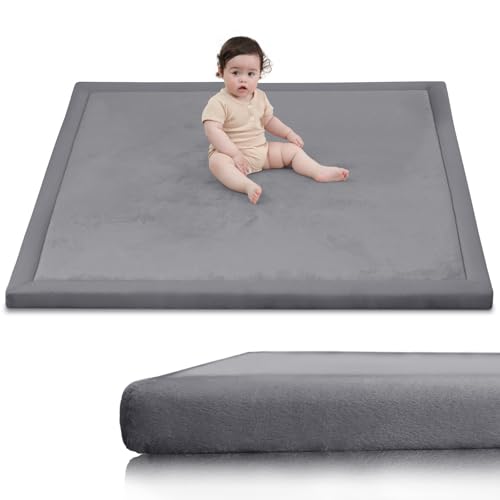
Huloo Sleep Ultra Soft Baby Play Mat 50×50 — Softest Tatami Feel
The Huloo 50-by-50 describes itself with the word tatami, and the comparison earns its keep: this is the mat that feels most like a deliberate floor, a soft room-within-the-room, rather than a piece of baby equipment. The elasti-foam core runs the full 1.3 inches, and the face above it is plush enough that adults end up sitting on it voluntarily, which is the unspoken test every play mat eventually faces. A mat that parents avoid kneeling on gets used less; a mat that invites the whole family down to floor level gets used daily.
Dark grey is doing quiet work here too. It is the shade least likely to show the map of a day’s small accidents, and it grounds a nursery palette that might otherwise float away on pastels. The non-slip backing is listed specifically with crawling and tummy time in mind, and the mat holds its ground when a baby plants both hands and shoves. For cold floors — the basement playroom, the tiled kitchen corner, the old house with draughty boards — the foam’s insulation is a genuine comfort feature, separating a thinly dressed baby from a floor that would otherwise steal warmth all session long.
The compromises mirror the ILPEOD’s, with one addition. The plush face that feels so kind also holds crumbs and pet hair more willingly than the wipe-clean PAPAMAT surface, so this mat asks for regular shaking out and surface cleaning to stay fresh. Households with shedding dogs who share the nursery may find that bargain tiring. Households without them will simply enjoy the softest square in this guide.
- Size: 50 x 50 inches, square playpen format
- Thickness: 1.3 inches of elasti-foam
- Colour: dark grey, tatami style
- Backing: non-slip
- Intended use: tummy time, crawling practice, nursery floor play
Strengths
- Plush face encourages parents and siblings to join floor play instead of perching at its edges.
- Foam insulates babies from cold hard floors during long winter tummy-time sessions.
- Dark grey colourway forgives daily marks and suits calm, modern nursery schemes.
Trade-offs
- Soft pile gathers crumbs and pet hair, asking for more frequent surface attention.
- Playpen-sized footprint will not serve a toddler who ranges widely across a room.
- Deep foam is not a sleep surface, despite the brand name suggesting rest.
Best for: nurseries with cold hard floors where long, cosy, supervised floor sessions are the daily ritual.
Not suited for: homes with heavy-shedding pets sharing the mat, or anyone seeking a mat for infant sleep.

PAPAMAT Thick Baby Play Mat 50×50 Dark Grey — Easiest to Wipe Clean
Some babies are tidy. Most are weather systems. The PAPAMAT is built for the second kind: its coral velvet face carries a water-repellent finish, so milk, water and the early experiments with puree bead on the surface long enough to be lifted away with a cloth instead of soaking down into foam where they would linger. Anyone who has smelled a play mat that absorbed a week of spills before anyone noticed will understand why this single specification might be the most practical one in the entire guide.
Beneath that pragmatic face sits the familiar architecture: 1.3 inches of foam in a 50-inch playpen square, dark grey colouring, non-slip backing. The listing emphasises easy spot cleaning, and that phrase should shape how you think about ownership. This is the mat for the high-traffic corner, the mat that lives under the play yard in the kitchen where bottles are made and snacks are served, the mat whose job description includes being wiped four times a day without complaint or deterioration.
Water-repellent is not waterproof forever, and honesty requires the caveat: a large spill left standing through a nap will eventually find its way in, and the foam beneath any of these mats is not meant to be soaked and wrung. The PAPAMAT buys you time and easy daily maintenance, not immunity. It also shares the storage bulk of all thick squares. But as the daily-driver pick for messy reality, it has the strongest claim in this group.
- Size: 50 x 50 inches, square playpen format
- Thickness: 1.3 inches
- Surface: water-repellent coral velvet, dark grey
- Backing: non-slip
- Care emphasis: easy spot cleaning
Strengths
- Repellent face keeps milk and puree on the surface where one cloth ends the incident.
- Dark grey hides the faint residue lines that repeated spot cleaning leaves on pale mats.
- Full-depth foam protects knees and elbows through months of crawling practice.
Trade-offs
- Standing liquid left unattended will still soak through eventually, so prompt wiping remains necessary.
- Functional styling prioritises maintenance over the plush, lounge-like feel of softer faces.
- Square format serves playpens and corners rather than whole-room coverage.
Best for: busy kitchens and play corners where spills happen daily and cleaning must take seconds, not a laundry cycle.
Not suited for: parents wanting a decorative rug look for a styled nursery photograph.

Mallify Soft Thick Baby Play Mat 50×50 — Best Living-Room Friendly
The Mallify makes an argument the other squares do not: that a play mat can live in the living room without turning the living room into a nursery annex. Its coral velvet face in a quiet tone, its clean square edges and its explicit positioning for living-room use all point the same way. Many families have no dedicated playroom; the playpen stands beside the sofa, and the mat beneath it is on view for every guest. A mat that looks considered rather than clinical changes how that arrangement feels across two years of daily life.
Construction follows the group’s pattern — 1.3 inches of padded elasti-foam at 50 by 50 inches, non-slip underside — so the baby experiences the same deep, warm, grippy surface as on the other squares. The differences are atmospheric rather than structural, and it would be dishonest to invent others. What the Mallify offers is the soft coral velvet hand-feel paired with the most furniture-friendly presentation in the square format, which for design-conscious parents in shared spaces is not a trivial thing at all.
Its limits are the format’s limits. It will not anchor a whole play zone, its pale-friendly styling shows marks sooner than the dark grey picks, and like every foam square it stores as a bulky slab. Choose it when the mat must earn its place visually in a room adults also love, and accept the slightly more attentive cleaning that lighter styling always brings.
- Size: 50 x 50 inches, square playpen format
- Thickness: 1.3 inches of padded elasti-foam
- Surface: soft coral velvet
- Backing: non-slip
- Intended use: playpens in nurseries and shared living rooms
Strengths
- Understated styling sits comfortably beside adult furniture in open-plan rooms.
- Coral velvet face feels gentle against bare legs during extended floor play.
- Deep foam core matches the cushioning of the most protective squares here.
Trade-offs
- Lighter presentation reveals spill shadows sooner than the dark grey alternatives.
- Coverage is confined to the playpen footprint, leaving surrounding floor unprotected.
- Thick square needs dedicated storage space when the playpen comes down.
Best for: open-plan homes where the playpen lives in the living room and the mat must look at home there too.
Not suited for: high-mess feeding zones where a repellent, dark, wipe-first surface would serve better.

Huloo Sleep Large Baby Play Mat 6×9 — Best Large Coverage
Scale changes everything. At 6 by 9 feet, the large Huloo stops being a mat you place and becomes a zone you inhabit: a crawling circuit, a rolling field, later a car track, a picnic-blanket stage and the soft borderland under a first climbing frame. Families with twins, with a toddler and a baby sharing floor time, or with a playroom to furnish in one move should read this pick first. The 1.3-inch foam depth carries across the whole expanse, so the protection does not thin out at the edges of the action.
The face is where this mat separates itself from every foam square. A 3D carved faux rabbit fur surface in cream gives it the visual texture of a genuine area rug, with pattern pressed into the pile rather than printed on it. In a living room it reads as a deliberate, soft, pale rug that happens to be engineered for children, which is precisely the disguise many parents are shopping for. The non-slip backing works across the full footprint, and the sheer size and weight of the mat help it stay where it was laid.
Cream, of course, is a commitment. This surface will record juice, marker adventures and muddy socks with documentary fidelity, and cleaning a 6-by-9 mat is a project rather than a wipe. It also dominates any room it enters; in a small nursery it would leave no floor for furniture. But for the household with the space and the temperament, it is the only pick here that solves the whole room at once, and it will outlast the playpen era as a playroom rug by years.
- Size: 6 x 9 feet, large area format
- Thickness: 1.3 inches, extra thick
- Surface: 3D carved faux rabbit fur, cream
- Backing: non-slip
- Intended use: playrooms and living-room play zones
Strengths
- Room-scale footprint lets siblings share floor play without negotiating for mat space.
- Carved faux-fur face looks like a styled area rug rather than nursery equipment.
- Uniform deep foam protects across the entire zone, including its busy edges.
Trade-offs
- Cream pile records stains faithfully and needs prompt, sometimes laborious, attention.
- Sheer size overwhelms small nurseries and complicates moving or storing the mat.
- Large surface tempts use as a nap spot, which it must never become for infants.
Best for: playrooms, twins and open living spaces needing one large, soft, supervised play landscape.
Not suited for: small nurseries, playpen use, or low-maintenance households wary of pale pile.
How Do These Baby and Toddler Rugs Compare Side by Side?
| Pick | Size | Surface | Defining strength |
|---|---|---|---|
| ILPEOD Baby Play Mat Nursery Rug 50×50 | 50 x 50 in | Foam, grey face | Playpen fit without bunching |
| ABC Kids Play Rug Classroom Carpet | 59 x 39.4 in | Crystal velvet, printed | Letters for pointing games |
| Huloo Sleep Ultra Soft Baby Play Mat 50×50 | 50 x 50 in | Plush tatami style | Softness adults enjoy too |
| PAPAMAT Thick Baby Play Mat 50×50 Dark Grey | 50 x 50 in | Water-repellent coral velvet | Spills wiped in seconds |
| Mallify Soft Thick Baby Play Mat 50×50 | 50 x 50 in | Coral velvet | Living-room friendly looks |
| Huloo Sleep Large Baby Play Mat 6×9 | 6 x 9 ft | Carved faux rabbit fur | Whole-zone coverage |
Read the table as a map of intentions. Four squares share dimensions and depth, so among them you are really choosing a surface philosophy: plain and calm, plush and inviting, repellent and practical, or styled for shared rooms. The ABC carpet stands apart on purpose, thinner and brighter, for spaces where play is also early learning. The large Huloo stands apart by scale. If your shortlist still holds three squares, decide by asking where the mat will live and what will be spilled on it most often; those two answers separate these near-twins more honestly than any specification sheet.
What Should You Check Before Buying a Rug for a Baby or Toddler?
Begin with the sleep question, because it outranks every other consideration. These mats are for awake, watched play. Babies under twelve months sleep safest on a firm, flat, dedicated sleep surface with nothing soft around them, and no play mat in this guide — however thick, however soothing its marketing — changes that. If a listing anywhere suggests a thick foam mat doubles as an infant bed, treat that as a reason to walk away from the listing entirely.
Next, measure honestly. Playpens vary, and a mat even slightly oversized will ride up the rails and create ridges; slightly undersized leaves a hard border where topples land. For room zones, pace out the footprint and mark it with painter’s tape for a day. Families are routinely surprised by how large 6 by 9 feet actually is, and equally surprised by how quickly a crawling baby crosses a 50-inch square and continues onto bare floor. Buy for the movement your child has now plus the movement arriving in the next three months.
Consider the floor beneath. Foam mats belong on hard, flat surfaces where their backings can grip; laid over deep carpet they can shift and mound. Check what sits nearby, too — a mat edge within reach of a radiator, a floor vent blasting hot air onto foam, or a doorway swing path all create daily annoyances or worse. Then think about your own cleaning temperament with the same honesty. The repellent PAPAMAT rewards a wipe-it-now household; the plush Huloo squares reward a shake-and-vacuum household; the cream 6-by-9 rewards a household that treats prompt stain care as a fair price for beauty.
Finally, plan the mat’s second life. Playpen squares become reading nooks, fort floors and under-tent padding for preschoolers. The ABC carpet migrates to classrooms and homework corners. The large Huloo becomes the playroom’s permanent soft centre. A purchase that anticipates its next job rarely feels wasted, even when the baby who inspired it is suddenly, impossibly, four years old.
How Do You Set Up and Care for a Baby Play Mat Safely?
Unbox the mat and let it lie flat in a ventilated room before first use, since foam products can carry a packaging smell that fades with airing. Wash or wipe the surface according to its maker’s guidance before a baby’s skin meets it, and inspect the backing and edges for any damage from shipping. Place it on a clean, dry, hard floor, press out any curl at the corners, and confirm the non-slip backing holds when you push firmly at an edge with your foot — the closest adult simulation of a determined crawler launching sideways.
During use, the routine is simple and non-negotiable: an adult in the room, the mat used for play, and sleep happening elsewhere. Check periodically that the mat has not migrated toward hazards, that older siblings have not dragged hard or small toys onto a young baby’s territory, and that pets with claws are not treating the foam as a scratching opportunity. Small punctures and tears matter because foam fragments and loose pieces have no place near mouthing babies; a damaged mat should be repaired per its maker’s advice or retired.
Cleaning rhythms differ by surface. Wipe the repellent and velvet faces after spills and at the end of heavy-use days; shake crumbs from plush faces outdoors; let any damp mat dry fully before folding or storing it, since trapped moisture invites musty smells that no nursery needs. Store thick squares flat or loosely rolled in a dry cupboard rather than crushed under boxes, and the foam will keep its spring for the next child, the next fort, the next small era of floor life.
How Does Foam Thickness Change the Way a Baby Plays?
It helps to understand what 1.3 inches of foam actually does during a play session, because the number alone sells nothing. When a seven-month-old sits upright and then, inevitably, tips sideways like a felled sapling, the foam compresses under the point of impact and spreads the force across a wider area than a thin rug ever could. The result is fewer tears, faster recoveries and — this is the part parents notice by week two — a baby who attempts the next skill sooner, because the last attempt did not hurt. Confidence compounds on forgiving floors.
Crawling tells a similar story at lower altitude. A crawling baby loads knees, shins and the tops of small feet with every stride, hundreds of strides a day. On bare hardwood those contact points redden; on deep foam they are cushioned stride after stride, and the grippy textile faces in this guide give palms and knees purchase instead of the slide that frustrates early crawlers on polished boards. Several parents describe the same milestone: a baby who would only commando-crawl on slippery floors finds proper hands-and-knees form within days of a textured mat arriving, simply because the surface finally cooperates.
Thickness also governs temperature. Hard floors in older houses run cold for much of the year, and a baby spends floor time with far more skin near that cold than any adult does. A deep foam core is an insulating layer as much as a cushioning one, which is why the Huloo and Mallify squares feel welcoming in a January nursery while a thin printed carpet, for all its charms, asks for warmer rooms or an extra layer of clothing. In summer the same insulation is neutral at worst, and the wipeable faces stay cool to the touch.
There are limits worth naming. Deep foam is a poor surface for the very first pulling-to-stand experiments if it sits inside a playpen without rails to grip, since its give can wobble under a determined foot — which is why these mats pair with playpens, furniture edges and watchful adults rather than replacing them. Wheeled toys also roll reluctantly on plush faces, a frustration toddlers solve by relocating their car games to bare floor. None of this diminishes the foam; it simply defines its season, which is roughly the first year and a half of floor life, the season when falls are frequent and landings should be kind.
Which Surface and Colour Should You Choose for Your Household?
Surface choice is really a prediction about your own behaviour, and it pays to make the prediction honestly. Coral velvet, used by the PAPAMAT and the Mallify, is the diplomat of this group: soft enough for bare baby skin, flat enough to wipe without a fight, and available here in both a repellent dark grey and a calmer living-room tone. Crystal velvet on the ABC carpet is thinner and slicker, chosen for print clarity and quick cleaning rather than plushness. The carved faux fur of the large Huloo is the romantic option, deepest and most decorative, and the one that asks the most of its owner in return.
Think about the traffic that will cross the mat when the baby is not on it. Shoes should never be part of that traffic — establish a socks-only rule from day one and every surface in this guide will live longer and stay cleaner. Pets are the harder negotiation. A cat who adopts the mat as a throne will leave hair that plush faces hold and velvet faces release; a dog who flops onto foam can dent it with claws. Households with free-roaming pets often land on the repellent PAPAMAT precisely because it forgives the most biology per square inch.
Colour psychology plays a smaller but real role. Dark grey squares disappear visually into modern nurseries and hide the evidence of life; they also show pale lint and cracker dust as bright constellations, so they suit households that wipe often and lint-roll rarely. Cream and pale faces brighten rooms and show every spill, suiting households that clean promptly and prefer to see the dirt they are removing. The ABC print sidesteps the dilemma entirely by being gloriously, defiantly busy — on a floor covered in letters, one more mark is just another character in the story.
One last consideration is light. A pale mat in a sunlit nursery can glare during morning play, while a dark mat in a dim corner can make a small room feel heavier. Hold a cushion or blanket of a similar tone in the intended spot at the time of day your baby usually plays, and you will have a fair preview. These small acts of rehearsal — taping footprints, testing tones — sound fussy for a product category built on impulse, yet they are exactly what separates the mat that gets used for years from the mat folded into the cupboard by spring.
What Mistakes Do Parents Make When Choosing Baby and Toddler Rugs?
The gravest mistake is treating any soft mat as a sleep space for a young infant. It bears repeating in this section because it is the one error with consequences beyond disappointment: thick foam is for supervised, awake play, and babies under twelve months need a firm, flat, purpose-made surface for every sleep, naps included.
The second mistake is buying by photograph instead of by footprint. A styled listing image can make a 50-inch square look room-filling and a 6-by-9 look modest. Tape the dimensions on your floor before ordering and the surprise, in either direction, disappears. Third comes underestimating the spill economy: choosing the palest, plushest surface for a mat that will live under a high chair’s splash zone, then resenting the product for recording what it was always going to record. Match the surface to the mess you actually expect.
Fourth, parents sometimes place a grippy mat over thick carpet, where the combination can creep and bunch, or skip the edge check after moving the mat for cleaning, leaving a curled corner as a trip ridge for new walkers. Fifth, they forget the adults: a mat too small for a parent to sit on comfortably becomes a spectator sport, and floor play shrinks to whatever a baby will do alone. The right mat invites everyone down. Choose the one your whole household will actually gather on, at the size your room truly holds, in the surface your cleaning habits can honour.
How Can a Play Mat Keep Up as Your Baby Grows Into a Toddler?
The mat you buy for a four-month-old who can barely lift her head will be asked, within a year, to host a standing, cruising, falling, snacking small person with strong opinions. Planning for that evolution at purchase time is the difference between a mat that serves one stage and a mat that serves a childhood. The playpen squares adapt by relocation: when the playpen comes down, the square moves to the reading corner, then under the toddler table, then into the fort-building supply cupboard. Their modest footprint, a limitation in the playpen era, becomes their portability afterwards.
Toddlers also change what a surface must endure. Crayons arrive, and with them the first experiments in applied art on unintended canvases; the wipeable velvet faces shrug off washable-marker adventures that would live forever in deep plush. Juice cups tip with theatrical regularity, which is where the repellent PAPAMAT quietly justifies itself a second time. And the snack era grinds a steady sediment of crumbs into any pile, rewarding the household that chose a surface it can shake, wipe or vacuum without ceremony.
The ABC carpet grows differently, by becoming more relevant rather than less. The letters a baby once stared at become the letters a two-year-old hunts for, then the letters a three-year-old names, then the backdrop for first spelling games with foam blocks. Few nursery purchases appreciate in usefulness that way. The large Huloo, meanwhile, simply absorbs each new era at scale: crawling circuits become car tracks, car tracks become picnic stages, and the cream faux fur that cushioned first rolls becomes the soft auditorium for a preschooler’s puppet productions.
What should change with age is not the mat but the rules around it. As babies become toddlers, the sleep boundary stays exactly where it was — mats remain play surfaces — while supervision evolves from constant arms-reach hovering to watchful presence as balance and judgment grow. Edges and surfaces deserve a fresh inspection each stage: what a gumming infant could not damage, a determined toddler with a toy screwdriver might. Retire or repair any mat whose foam is exposed or whose surface is peeling, and the guide’s six picks will each repay their purchase across far more months than the crawling season that inspired them.
Final Recommendation
For most families, the decision resolves into one of three doors. Behind the first is the playpen household: choose the PAPAMAT if spills rule your days, the Huloo 50-by-50 if softness and cold floors rule them, the ILPEOD for a calm grey all-rounder, or the Mallify when the playpen shares the living room and appearances matter. Behind the second door is the learning household, where the ABC carpet turns the floor into a first alphabet and wipes clean between activities. Behind the third is the playroom household, where the 6-by-9 Huloo lays down a whole soft country at once and stays useful for years.
Whichever door you take, hold the frame steady: thick foam for watched, waking play; firm and flat for sleep; an adult nearby; a surface matched to your real cleaning life. Get those four things right and the specific square beneath your baby matters far less than the hours of comfortable, cushioned, giggling floor time it makes possible. The best mat is simply the one still being used, happily and safely, long after the box it came in has been recycled.
Do You Need a Second Mat for Grandparents, Travel or a Second Room?
Many families discover, around the third visit to a grandparent’s house, that floor quality is not evenly distributed across a baby’s life. Your nursery may have the perfect cushioned square while Grandma’s charming hardwood, wonderful for dinner parties, offers a crawling baby a cold and unforgiving landscape. A second, simpler mat for that house is not indulgence; it is how tummy time survives the holidays. The ABC carpet suits this role beautifully, since it stores thin, travels in a car boot without complaint and gives grandparents a floor full of conversation starters for the grandchildren they adore.
Second rooms raise the same logic at home. If the playpen lives in the nursery but mornings happen in the kitchen, a baby will spend half her floor life wherever the adults actually are. Rather than dragging one thick square between rooms — a chore that quietly stops happening by week three — consider which space hosts the longer sessions and let the second space make do with the thinner, cheaper, more portable option. The hierarchy is natural: deepest foam where the longest play happens, simpler surfaces where visits are brief.
Travel follows the same pattern. Thick 1.3-inch squares are furniture, not luggage, and attempting to tour with one breeds resentment toward both the mat and the journey. For holidays, the thin carpet or a borrowed blanket arrangement at the destination serves for short, closely watched sessions on carpeted floors, while the serious daily floor work waits at home. What should never travel loosely is the safety frame itself: awake play on the mat, sleep in a proper travel cot, at every address, without exception or improvisation.
Frequently Asked Questions
Can my baby nap on a thick play mat if I am watching?
Supervision does not turn a play mat into a sleep surface. Babies under twelve months should sleep on a firm, flat surface designed for infant sleep, in a clear sleep space. Enjoy the mat for tummy time and play, then move your baby to a proper sleep space when drowsiness arrives — even for short naps, even with you in the room.
Is 1.3 inches of foam really better than a regular nursery rug?
For the sitting and crawling stages, yes, in a specific way: the depth absorbs the sideways topples and repeated knee plants that define those months, and it insulates against cold floors. A regular rug is fine for a steady toddler’s playroom, but during the wobbly months the foam’s forgiveness is felt daily.
Which size should I buy for a standard playpen?
The 50-by-50-inch squares in this guide are built for that job. Measure your playpen’s interior floor rather than trusting the word standard, and aim for a mat that meets the rails without climbing them. Any overlap creates ridges; any large gap leaves hard landing strips.
How do I clean a foam play mat without damaging it?
Wipe spills promptly with a damp cloth, use only cleaners the maker allows, and let the mat dry completely before folding or storing it. Avoid soaking foam cores, which hold water and odours. Plush faces benefit from regular shaking outdoors to release crumbs and hair from the pile.
When will my child outgrow a 50-inch play mat?
As a contained play floor, roughly when confident walking and climbing make the playpen itself obsolete. The mat’s usefulness continues well beyond that as a reading corner base, fort floor or tent padding, so outgrowing the playpen rarely means retiring the square.
Related Guides
For the textiles that wrap the baby rather than cushion the floor, our guide to the Best Baby Quilts covers weights and fabrics for every season. When your toddler graduates from foam squares to a first real rug underfoot, the Best All-Cotton Rugs gather soft natural-fibre options for bedrooms and playrooms. Small-space families will appreciate the Best Apartment Rugs, chosen for rooms that must flex between adult life and child life. And for floors that meet a different kind of traffic, the Best Area Rugs for Bamboo Floors explains how to protect delicate boards while adding softness.


