What's inside
- Key Takeaways
- Quick Picks
- How We Chose These Picks
- Which American-Made Area Rugs Should You Consider First?
- How Do These American-Made Area Rugs Compare Side by Side?
- What Does Made in the USA Actually Mean for a Rug?
- How Do You Care for Printed and Braided American Rugs?
- How Do the Four Maples Pattern Families Suit Different Rooms?
- What Is the Story of Braided Rugs in American Homes?
- How Do You Size These Rugs for Entries, Halls and Living Rooms?
- What Mistakes Do Buyers Make With American-Made Rugs?
- How Do You Style These Rugs With the Furniture You Already Own?
- Final Recommendation
- How Do These Rugs Fit Households With Pets and Children?
- What Should You Check on the Listing Before Ordering?
- Frequently Asked Questions
- Related Guides
As an Amazon Associate I earn from qualifying purchases. This post may contain affiliate links at no extra cost to you.
cottageverdict.com is reader-supported. When you buy through links on our site, we may earn an affiliate commission.
Where to buy: linked names open their Amazon listings, where you can check price on Amazon and confirm the made-in-USA statement, size and pattern before ordering. Shoppers looking for the best American-made area rugs are usually asking two questions at once: where was this rug actually made, and does domestic manufacture still mean something at the level of the object? This guide answers the first question strictly — every linked pick is listed by its maker as made in the USA — and the second question honestly, by looking at what these particular American product lines do well: practical low-pile construction, washable convenience, braided traditions that go back generations, and patterns designed for real American rooms rather than showroom abstractions.
One name dominates the field, and pretending otherwise would waste your time. Maples Rugs, a long-running American manufacturer, supplies four of the six picks — but those four are genuinely different rugs, separated by pattern family, size and job. The Marion is a braided-style bohemian print at living-room scale. The Vivian is a Persian-blue medallion in a small entry size. The Gardena is a grey floral for foyers and kitchens. The Ruby is a red-and-gold oriental for traditional rooms. Reading this guide well means learning to tell those four apart, because choosing among them is really choosing a pattern language for your home.
The remaining two picks widen the lens beyond printed low-pile convenience. The Capel American Heritage is a true braided rug in mossy multi tones, heir to one of the oldest American rug traditions. The Super Area Rugs Roxbury is an oval braided runner rated for indoor and outdoor service, American-made and built for the thresholds and hallways where braided rugs first earned their keep. Between printed practicality and braided heritage, this guide covers the two great streams of American rug-making as they exist in today’s market.
It is also worth setting expectations about range. The American-made market at everyday prices is not a boutique of infinite variety; it is a working market of practical constructions, proven pattern families and a proud braided tradition, and its strengths are durability of design rather than novelty. Readers hunting for avant-garde patterns or hand-knotted luxury will find this guide’s field narrow by design — those hunts lead elsewhere, usually to other continents and other price universes. Readers hunting for a rug that was made in the same country as the room it will furnish, in a pattern their grandparents would recognise and a construction their vacuum will forgive, are standing in exactly the right aisle.
A word about what made in USA does and does not promise. It speaks to where the rug was manufactured, and for many buyers that carries real weight: shorter supply chains, domestic jobs, and makers who answer to familiar consumer standards. It does not automatically promise heirloom construction — several picks here are deliberately affordable, washable, everyday rugs, and their American manufacture is a fact about them rather than a halo. We judge each rug on its own construction and fitness for its job, with its origin stated plainly as the listings state it.
Key Takeaways
- Every linked pick is listed by its maker as made in the USA, from printed low-pile rugs to traditional braided constructions with generations of craft behind them.
- Four Maples picks differ by pattern family — braided-style bohemian, medallion, floral and oriental — not merely by colour or size.
- Maples rugs share a practical modern recipe: low pile, non-slip backing, pet-friendly surfaces and, on the smaller sizes, genuine machine washability.
- The Capel American Heritage represents true braided construction in a round, moss-multi format for traditional rooms.
- The Roxbury oval runner brings American braided craft to indoor-outdoor duty in hallways and thresholds.
- Sizes here range from small entry rugs to 5×7 living-room pieces and an eight-foot runner, so measure your post carefully before falling for a pattern.
Quick Picks
| Pick | Badge | Why it earns its place |
|---|---|---|
| Maples Rugs Marion Braided-Style Rug 5×7 | Best Braided Look at Room Scale | A bohemian braided-style print in multi colours at a full 5×7, with low pile and non-slip practicality. |
| Maples Rugs Vivian Medallion Rug | Best Small Medallion | Persian blue medallion pattern in a washable entry size that brings traditional pattern to small thresholds. |
| Maples Rugs Gardena Floral Rug | Best Floral for Entries | Soft grey florals in a washable, non-slip format sized for foyers, kitchens and bathroom doors. |
| Maples Rugs Ruby Oriental Rug | Best Traditional Oriental | Red and gold oriental patterning at 5×7, giving dining and living rooms a classic, grounded centre. |
| Capel American Heritage Rug 5ft Moss Multi | Best Heritage Braided | Genuine braided construction in mossy multi tones, carrying one of America’s oldest rug crafts into modern rooms. |
| Super Area Rugs Roxbury Braided Rug | Best Indoor-Outdoor Runner | An American-made oval braided runner in taupe and natural multi, rated for porches as well as hallways. |
How We Chose These Picks
Origin came first and was treated as a verifiable claim rather than a vibe, a flag in a photograph or a brand name with a state in it. Each candidate’s listing was checked for an explicit made-in-USA statement from its maker, and rugs whose American connection dissolved into phrases like designed in the USA were set aside. What remained was a field honestly dominated by one manufacturer’s breadth and two braided specialists, and we have presented that field as it is rather than manufacturing diversity that the market does not currently offer at these sizes and purposes.
Within the Maples range, selection turned entirely on pattern and post. We mapped the line’s pattern families against the rooms American households actually assign them: the bohemian braided-style print for relaxed living rooms, the medallion for traditional entries, the floral for kitchens and foyers that want softness, the oriental for dining rooms and studies with dark wood and inherited furniture. Two small rugs and two 5×7 rugs give the guide a working spread of scales, since an entry rug and a living-room rug are different instruments that happen to share a maker.
The braided picks were chosen to represent construction, not print. The Capel carries the heritage of true braiding — fabric worked into continuous braided form — while the Roxbury translates the same tradition into an oval runner that can live outdoors. Together they let readers compare America’s printed present with its braided past, at prices and purposes that overlap enough to make the comparison a real decision.
Which American-Made Area Rugs Should You Consider First?
Start by naming your room’s pattern language, because that decision eliminates most of the list at a stroke and turns a six-rug guide into a one-rug errand. Rooms, like people, have native tongues: some have spoken traditional since the house was built, others are mid-conversation in a relaxed, collected dialect, and a rug that answers in the wrong language will sound foreign no matter how well it is made or how proudly it was manufactured. Traditional rooms with dark wood speak oriental and medallion — read the Ruby and the Vivian first. Relaxed, collected, bohemian rooms speak braided and multi-colour — read the Marion and the Capel. Kitchens, foyers and bathrooms that want softness without fuss speak floral — the Gardena is your first stop. And thresholds, hallways and porches speak runner, which is the Roxbury’s native tongue. Pattern first, size second, and the six resolve into a shortlist of one or two remarkably quickly.
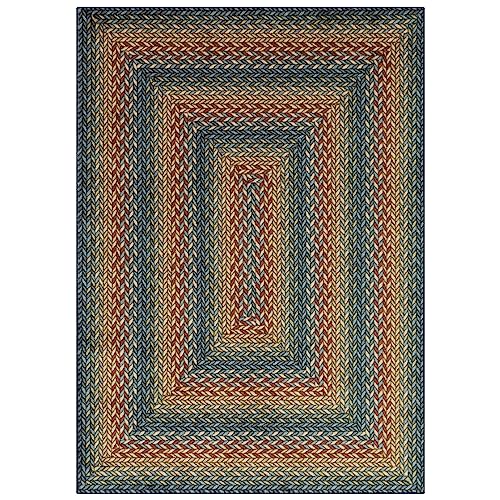
Maples Rugs Marion Braided-Style Rug 5×7 — Best Braided Look at Room Scale
The Marion is best understood as a translation: the visual language of the American braided rug — concentric, multi-coloured, warmly irregular — rendered as a printed low-pile rug at a full 5×7. The bohemian multi-colour pattern carries the braided idea’s generosity, gathering the colours of a collected room into one field where sofas, throws and inherited chairs can all find a thread of themselves reflected. For households that love the braided look but live a low-pile life — doors that must swing, chairs that must glide, pets that must be vacuumed after — the translation is not a compromise but a solution.
Maples builds it to the line’s practical recipe: low pile that sits quietly under furniture, a non-slip backing that keeps a mid-size rug planted on hard floors, and a pet-friendly surface that releases hair to a vacuum instead of weaving it into pile. The 5×7 footprint is the American living room’s most versatile citizen size, large enough to gather a sofa and two chairs by their front legs, small enough to leave a border of floor that makes a modest room breathe.
Honesty requires naming what the Marion is not: it is not a braided rug, and anyone whose heart is set on the real construction’s weight, texture and reversibility should read the Capel below before ordering. Printed pattern also sits on the surface rather than living through the material, so decades of abrasion will show differently than on a true braid. Within its own terms, though — American-made, patterned generously, priced and built for daily life — the Marion is the most liveable large pick in this guide.
- Size: 5 x 7 feet
- Pattern: braided-style print, bohemian multi-colour
- Construction: low pile, non-slip backing
- Origin: made in USA, per maker listing
- Suits: living rooms, bedrooms, offices
Strengths
- Braided-style multi-colour pattern harmonises collected, multi-hued rooms effortlessly.
- Low pile and non-slip backing suit busy family rooms on hard floors.
- Full 5×7 scale anchors real furniture groupings, unlike the guide’s smaller picks.
Trade-offs
- Printed braided effect cannot replicate true braiding’s texture, weight or reversibility.
- Busy bohemian palette will argue with rooms already committed to minimal pattern.
- Surface print wears differently over years than through-constructed braided material.
Best for: relaxed living rooms wanting braided warmth with modern low-pile practicality.
Not suited for: braided-rug purists or pattern-quiet minimalist rooms.

Maples Rugs Vivian Medallion Rug — Best Small Medallion
The Vivian compresses a grand tradition into a small, hardworking rectangle: a Persian-style medallion in Persian blue, at 2 feet 6 inches by 3 feet 10 inches, sized for the thresholds where first impressions are made. Medallion patterns carry centuries of design authority, and at entry scale that authority works like a welcome — the eye reads order, craft and intention before it has even registered the door. Blue is the traditionalist’s safest bold colour, deep enough to hide threshold evidence, classic enough to sit beside any wood tone.
Maples equips the small format with the line’s full practical kit: washable construction, non-slip backing, and a surface intended for kitchens, entryways and living-room edges where traffic concentrates. Washability matters disproportionately at this size and post, because an entry rug lives a spill-and-grit life that a bedroom rug never sees; a rug that can be lifted, washed and returned in an afternoon will simply be cleaner across its life than one awaiting professional attention.
The Vivian’s limit is its scale, stated plainly: it is a threshold instrument, not a room rug, and its medallion — designed to be read whole — wants a post where its full pattern is visible rather than disappearing under furniture. Place it at an entry, before a sink, beside a bed’s landing, and it performs with traditional elegance. Ask it to anchor a living room and it will look like a postage stamp of good intentions on a very large envelope.
- Size: 2’6 x 3’10
- Pattern: medallion, Persian blue
- Construction: washable, non-slip
- Origin: made in USA, per maker listing
- Suits: entryways, kitchens, living-room edges
Strengths
- Classic medallion in deep blue gives small thresholds traditional, welcoming authority.
- Washable build suits the grit and spill reality of entry and kitchen posts.
- Non-slip backing keeps a small rug planted where feet land hardest.
Trade-offs
- Small footprint serves thresholds only, not room anchoring.
- Medallion pattern wants full visibility, limiting placement under furniture.
- Traditional styling may feel formal beside very casual, modern entries.
Best for: entries and kitchens wanting washable practicality in a classic blue medallion.
Not suited for: anchoring living-room furniture or pattern-minimal modern schemes.

Maples Rugs Gardena Floral Rug — Best Floral for Entries
If the Vivian is the entry’s formal welcome, the Gardena is its garden-party one: a floral pattern in soft grey, at the same 2’6 by 3’10 threshold size, made for foyers, kitchens and bathroom doors that want their practicality wearing flowers. Grey is the floral’s moderniser — it takes a pattern family that can read as fussy or dated and renders it calm, tonal and compatible with the white-and-grey kitchens and pale hallways of contemporary American homes. The flowers read as texture at a distance and as pattern up close, a two-register effect that keeps small spaces from feeling busy.
The practical specification matches its sibling’s: washable, non-slip, American-made, built for the wet shoes and kitchen drips of its assigned posts. Bathroom-door duty deserves a specific mention, since that threshold sees bare wet feet daily; a low, grippy, washable rug there is a safety feature wearing a floral disguise, and the Gardena’s grey palette forgives the water spots and lint that bathroom textiles collect between washes.
Choosing between the Gardena and the Vivian is a pure pattern decision, and the guide refuses to make it for you beyond one observation: medallions structure a space, florals soften one. A foyer that feels stark wants the Gardena’s softening; a foyer that feels chaotic wants the Vivian’s order. Either way, the household gains an American-made, washable threshold rug whose pattern was chosen rather than defaulted — which is the entire point of having two.
- Size: 2’6 x 3’10
- Pattern: floral, grey
- Construction: washable, non-slip
- Origin: made in USA, per maker listing
- Suits: entryways, foyers, kitchens, bathrooms
Strengths
- Tonal grey florals soften stark foyers and kitchens without visual fuss.
- Washable, grippy build suits wet bathroom thresholds and busy kitchen posts.
- Pattern reads as gentle texture from a distance, suiting small spaces.
Trade-offs
- Threshold size only; it will not serve as a room rug.
- Floral direction will not suit households committed to geometric or plain styles.
- Pale grey ground shows dark grit readily at a hard-working front door.
Best for: foyers, kitchens and bathroom doors wanting soft pattern with washable practicality.
Not suited for: main living-room anchoring or pattern-free modern interiors.

Maples Rugs Ruby Oriental Rug — Best Traditional Oriental
The Ruby brings the guide’s most formal pattern language to its most versatile size: an oriental design in red and gold at 5×7, made in the USA for the dining rooms, studies and traditional living rooms where such patterns have anchored American furniture for a century. Red is the dining room’s historic colour for good reasons — it flatters wood, glows under evening light, and hides the evidence of a thousand dinners with a grace that pale rugs cannot imagine. Gold detailing lifts the field from sombre to ceremonial, the difference between a rug that grounds a room and a rug that celebrates it.
Construction is the Maples recipe at room scale: low pile that lets dining chairs glide and doors swing, non-slip backing, and a pet-friendly surface brief that suits households whose traditional rooms are lived in rather than preserved. That combination — heirloom pattern language, everyday engineering — is arguably the most American thing in this guide: the old world’s design, rebuilt by a domestic maker for a house with dogs, children and a vacuum schedule.
The Ruby asks for commitment in return. Red and gold will direct the room’s palette for as long as the rug serves, and traditional oriental patterning beside ultra-modern furniture creates a tension that only confident eclectics enjoy. It is also, like the Marion, a printed interpretation rather than a knotted heirloom, priced and built accordingly. For the household that wants its dining room to feel established, warm and faintly ceremonial without heirloom cost or heirloom anxiety, the Ruby is the guide’s clearest answer.
- Size: 5 x 7 feet
- Pattern: oriental, red and gold
- Construction: low pile, non-slip, pet-friendly per listing
- Origin: made in USA, per maker listing
- Suits: dining rooms, living rooms, bedrooms, offices
Strengths
- Red and gold oriental pattern gives traditional rooms warmth, ceremony and history.
- Deep palette forgives dining spills and traffic evidence gracefully.
- Low pile serves dining chairs and doors while anchoring full groupings.
Trade-offs
- Dominant traditional palette will steer the room’s decorating for years.
- Printed pattern cannot match a knotted heirloom’s depth or longevity of detail.
- Formal styling clashes with starkly minimalist or Scandinavian schemes.
Best for: dining rooms and traditional living rooms wanting a warm, established centrepiece.
Not suited for: light, minimal interiors or households that redecorate palettes frequently.

Capel American Heritage Rug 5ft Moss Multi — Best Heritage Braided
The Capel is where this guide’s story stops being about print and starts being about craft. Braided rugs are among the oldest American floor coverings — born of thrift, made from worked fabric, built to be used, repaired and used again — and Capel is a name woven through that tradition’s modern history. The American Heritage, at five feet in moss multi tones, carries the braid’s concentric rhythm and earthy colour blending into rooms that want their American-made rug to be a made thing, with weight and texture that no print can counterfeit.
Moss multi is the braid’s natural palette: greens, earth and muted companions braided together so that no single colour dominates and every colour in the room finds a relative in the rug. The round-leaning five-foot format suits the posts braids have always served — beside beds, under small round tables, in reading corners and entry-adjacent landings where a soft, durable island is wanted. A true braid also offers the construction’s historic virtue of substance: it lies where it is put, feels significant underfoot, and ages by mellowing rather than by wearing a picture away.
Its trade-offs are the tradition’s own. Braided construction is heavier and less suited to machine washing than the Maples small rugs; care is a shake, a vacuum and spot attention. The rustic, concentric look commits a room to a country or traditional direction. And at five feet it is an island, not a foundation — a rug for a corner, a table, a bedside, rather than a full grouping. Buy it for what it authentically is, and it may out-serve every other pick in this guide.
- Size: 5 feet
- Pattern: braided, moss multi
- Construction: true braided rug
- Origin: American heritage line
- Suits: living rooms, bedrooms, dining corners
Strengths
- Genuine braided construction delivers weight, texture and durability prints cannot imitate.
- Moss multi palette blends earthy tones that cooperate with almost any room colour.
- Traditional American craft gives the rug heirloom character at an everyday post.
Trade-offs
- Heavier braided build is not a machine-wash convenience rug.
- Five-foot island scale suits corners and tables, not full furniture groupings.
- Rustic concentric styling commits the room to a country or traditional mood.
Best for: reading corners, bedside landings and round-table posts wanting authentic braided craft.
Not suited for: households wanting washable convenience or full-room coverage.

Super Area Rugs Roxbury Braided Rug — Best Indoor-Outdoor Runner
The Roxbury takes the braided tradition out the front door. An American-made braided runner, oval at 2 by 8 feet, in dark taupe and natural multi, it is rated for indoor and outdoor spaces — which in practice means the hallway, the porch, the mudroom threshold and the kitchen’s long working lane, all the narrow territories where rugs earn their keep by the foot. The oval shape is the braid’s classic silhouette, softening the runner’s geometry and suiting older houses whose doorways and halls were never drawn with right angles in mind.
Braided construction outdoors-adjacent makes material sense: the braid’s dense, worked structure tolerates grit, dries with air around it, and can be shaken out with the satisfying violence that flat rugs resent. Taupe and natural multi is the correct palette for threshold duty, a camouflage of earth tones that lets a runner serve between cleanings without announcing every paw print. Indoors, the same runner warms a hallway’s acoustics and gives bare feet a textile path through the house’s busiest corridor.
Its limits are honest ones. A runner is a specialist: it will not anchor furniture, and its narrow width demands accurate measuring of the hall or porch it will serve, since a runner too short looks marooned and one too long buckles at the ends. Indoor-outdoor rating still means covered, draining posts rather than a life in standing water. Within its lane — literally — the Roxbury is the guide’s most versatile servant, the American braid doing the job it was invented for.
- Size: 2 x 8 feet, oval runner
- Pattern: braided, dark taupe and natural multi
- Construction: braided, indoor-outdoor rated
- Origin: American made, per maker listing
- Suits: hallways, porches, mudrooms, kitchen lanes
Strengths
- Braided runner format serves hallways and thresholds rectangles cannot reach.
- Indoor-outdoor rating extends its duty to covered porches and mudroom lanes.
- Earth-tone multi palette camouflages threshold grit between cleanings.
Trade-offs
- Narrow runner scale anchors nothing; it is a path, not a foundation.
- Length must be measured carefully to avoid a marooned or buckling fit.
- Outdoor rating assumes covered, draining posts, not standing water.
Best for: hallways, covered porches and mudroom lanes wanting braided American durability.
Not suited for: living-room anchoring or fully exposed, unsheltered outdoor use.
How Do These American-Made Area Rugs Compare Side by Side?
| Pick | Size | Pattern or construction | Defining strength |
|---|---|---|---|
| Maples Rugs Marion Braided-Style Rug 5×7 | 5 x 7 ft | Braided-style print, bohemian | Braided look, modern ease |
| Maples Rugs Vivian Medallion Rug | 2’6 x 3’10 | Medallion, Persian blue | Traditional entry welcome |
| Maples Rugs Gardena Floral Rug | 2’6 x 3’10 | Floral, grey | Soft threshold pattern |
| Maples Rugs Ruby Oriental Rug | 5 x 7 ft | Oriental, red and gold | Formal dining warmth |
| Capel American Heritage Rug 5ft Moss Multi | 5 ft | True braided, moss multi | Heritage craft and weight |
| Super Area Rugs Roxbury Braided Rug | 2 x 8 ft oval | Braided, indoor-outdoor | Runner versatility |
The table tells the guide’s story in one view: four printed pattern languages from one American maker, in two scales, plus two true braids carrying the older tradition. Choose first between print and braid — between the convenience of the modern Maples recipe and the substance of worked construction — then between pattern families, then between the small threshold scale and the room scale. Each step halves the field, and the rug that remains is rarely a compromise.
Notice the deliberate absence of an 8×10 or larger room rug in this guide, because it reflects the verified field rather than an editorial preference: at the largest sizes, explicit American manufacture becomes rare enough that a guide insisting on it would have little honest to show. Households needing both a very large rug and a domestic origin may find the answer in commissioning or in accepting the 5×7 scale with a generous border of floor — a look, incidentally, that American rooms wore happily for most of their history, when rugs were islands of warmth on wide boards rather than wall-to-wall seas.
What Does Made in the USA Actually Mean for a Rug?
For the rugs in this guide, it means what their makers’ listings state in plain language: the rug was manufactured in the United States, by that maker, as part of that product line. That statement covers the making — the printing, tufting, braiding, backing and finishing — and it is the claim buyers can verify, repeat and hold a maker to. It does not, by itself, certify where every raw fibre originated, and careful buyers who care about that deeper question should ask makers directly rather than assume an answer in either direction. Treating the claim precisely, as a manufacturing origin, keeps it meaningful.
Why do buyers seek it so deliberately, searching by origin before they search by colour? The reasons are practical as often as they are patriotic. Domestic manufacture usually means shorter, more legible supply chains; makers reachable in the buyer’s own language and legal landscape; designs calibrated to domestic room sizes, door swings and laundry machines; and production that supports the communities where the buyers themselves live. Maples’ pattern families illustrate the design point vividly — medallions, florals and braided looks sized for American entries and 5×7 living rooms are not accidents of a global catalogue but products made by a company furnishing its own country’s houses.
What origin does not guarantee, and should never be asked to guarantee, is a construction class or a quality tier. An American-made rug can be a washable printed convenience rug or a braided heirloom, and this guide contains both, judged by their own merits. The honest way to shop the label is as a filter, not a verdict: let it narrow the field to rugs whose making you can place, then choose among them by pattern, construction and fitness for the room, exactly as the reviews above attempt to do.
How Do You Care for Printed and Braided American Rugs?
The Maples picks ask for the modern routine: vacuum regularly with pile-appropriate settings, blot spills promptly before they set, and wash the smaller sizes as their listings permit, in a machine with the capacity to let the rug move freely rather than pack into a sodden fold. Non-slip backings last longest when they are kept clean and dry and are not subjected to harsh solvents, so treat the underside as part of the rug rather than as packaging. Low piles are forgiving housekeepers — they release hair and grit willingly — which is precisely why these rugs suit pet-owning households.
Braided rugs ask for the older, more physical routine: shake them outdoors with conviction, vacuum with suction that lifts grit from between the braids, spot-clean promptly, and rotate them so sun and traffic share their effects evenly across the whole piece. A true braid’s virtue is that its care is mechanical rather than chemical; it wants air, gravity and attention more than products. Keep braids dry at their posts, since any dense textile held damp against a floor will eventually smell of the experience, indoors or out.
Both families reward the twice-yearly rhythm of lifting, airing and inspecting — backing, edges, stitching and the floor beneath all benefit from being looked at while small issues are still small, cheap and easily forgiven. An American-made rug maintained this way is not a consumable; it is a furnishing with a service life measured in years of daily use, and its domestic origin makes replacement parts of the story — matching sizes, sibling patterns — easier to find when a household grows.
How Do the Four Maples Pattern Families Suit Different Rooms?
Because one maker supplies four picks, the pattern families deserve a slower comparison than brand-versus-brand guides usually give. Begin with the medallion, the Vivian’s language. A medallion is a centred, symmetrical composition — a design with a middle and a hierarchy — and rooms read it as formality and welcome in equal measure. It suits entries because an entry is a room with a middle: a door, a landing, a moment of arrival. In blue, it also suits the American coastal-traditional palette of white woodwork and natural floors, which is why the Vivian can walk into so many houses and look immediately intentional.
The Gardena’s floral speaks a different grammar: all-over, soft-edged, without a centre to obey. Florals forgive asymmetry, which makes them the pattern of kitchens and working foyers where life arranges itself untidily around the rug. The grey tonal rendering matters here — a high-contrast floral would shout in a small threshold, while the Gardena’s muted flowers murmur, providing pattern’s dirt-hiding benefits at a volume small rooms can host. Households torn between pattern and peace usually find the floral is the compromise that is not one.
The Marion’s braided-style bohemian print is the maximalist of the four: many colours, concentric energy, a collected-over-time feeling that suits rooms assembled from travel, inheritance and impulse. Its gift is reconciliation — it can make a red chair and a blue sofa look like relatives — and its demand is that the room’s other patterns step back to supporting roles. The Ruby’s oriental, finally, is the formalist: bordered, symmetrical, historically literate, happiest with wood furniture, books and the rituals of dining. A room with a Ruby in it has declared its allegiances, and everything placed on the rug afterwards is in conversation with that declaration.
None of the four languages is better; each is a different answer to the question of what a floor should say when a guest first looks down. Households that answer that question honestly at the start rarely exchange rugs later — the returns in this category are overwhelmingly pattern regrets, not quality complaints, which is why this guide spends so much of its length on four patterns from one maker.
What Is the Story of Braided Rugs in American Homes?
The braided rug began as an economy: worn clothing and household cloth, cut into strips, braided and stitched into floor coverings that warmed the boards of farmhouses and colonial homes. Nothing was wasted because nothing could be. That origin left permanent marks on the form — concentric ovals and rounds, mixed colours living peaceably together, a repairable construction that could be unstitched, patched and re-stitched across generations. When later American makers industrialised the braid, they kept the silhouette and the mixed-colour soul, and the braided rug became a fixture of country and colonial-revival interiors across the twentieth century.
Capel’s presence in this guide represents that lineage in its modern, manufactured form: the braid as a deliberate craft product rather than a thrift necessity, in composed colourways like moss multi that a farmhouse scrap braid could only achieve by luck. Super Area Rugs’ Roxbury carries the same form into the runner and indoor-outdoor territory, proof that the tradition adapts — new posts, new duties, same concentric patience. Even the Marion’s printed braided style is evidence of the form’s cultural weight: the braid is so recognisably American that a printed evocation of it reads instantly as warmth and heritage to most eyes.
Understanding that history clarifies the choice among this guide’s braided options. Buy the Capel or the Roxbury and you are buying the construction itself, with its weight, texture and repairable nature. Buy the Marion and you are buying the reference — the look and the associations, engineered for a low-pile, non-slip, pet-owning present. Both purchases are legitimate; they are simply purchases of different things that share a silhouette, and a buyer who knows which thing they want will not be disappointed by either.
How Do You Size These Rugs for Entries, Halls and Living Rooms?
Threshold sizing is the small end of the craft and the easiest to get right: a 2’6 by 3’10 rug like the Vivian or Gardena should sit where the door’s swing and the landing’s traffic meet, wide enough that both feet land on it through the doorway, short enough to leave the room beyond feeling open. At a kitchen sink or bathroom door, the same footprint becomes a standing station, and its washable nature matters more than its exact inches. Measure the door’s swing before ordering, since even a low rug plus a high threshold can conspire against a closing door.
Living-room sizing at 5×7, the Marion and Ruby’s territory, follows the front-legs rule in most American rooms: sofa and chairs place their front feet on the rug, the rug’s border shows on all sides, and the arrangement reads as one gathered conversation rather than furniture scattered on boards. In a small room, a 5×7 can go further and host all legs; in a large room it becomes an island that needs a coffee table’s weight to justify it. The Capel’s five-foot round-leaning format plays by island rules everywhere — centre it under something, a table or a reading chair arrangement, and let the floor around it be the frame.
Runners obey the mathematics of passage: the Roxbury’s eight feet should leave a margin of floor at both ends of a hall rather than wall-to-wall ambition, and its two-foot width should leave a hand’s breadth of floor visible on each side in a standard hall. On a porch, centre it on the traffic line between door and steps. In every case, tape the footprint on the floor for a day before ordering; American rooms are full of radiators, vents and door swings that measurements from memory politely omit.
What Mistakes Do Buyers Make With American-Made Rugs?
The first mistake is buying the label instead of the rug: choosing a made-in-USA product whose size, pattern or construction is wrong for the room, out of loyalty to its origin and a flag’s worth of good intentions. Origin is a filter, not a substitute for fit, and a domestic rug in the wrong post will disappoint exactly as thoroughly as an imported one. The second mistake is the mirror image — dismissing printed Maples rugs as lesser because they are not braided heirlooms, when their washable, low-pile practicality is precisely what a kitchen or a dog-owning household needs.
The third mistake is pattern blindness within a single brand. Buyers see four Maples rugs and assume interchangeability, then place the medallion where a floral’s softness was needed or the bohemian Marion where a room wanted the Ruby’s formality. Pattern families are languages; the reviews above separate them deliberately, and five minutes spent choosing the language saves years of faint dissatisfaction. Fourth comes scale error, the eternal rug mistake, in its two local forms: expecting a 2’6 threshold rug to warm a whole entry hall’s floor, or squeezing a 5×7 under furniture sized for an 8×10.
Finally, buyers sometimes neglect the unglamorous backing question — placing a non-slip rug over a delicate floor finish without checking compatibility first, or skipping a pad where a braided rug’s considerable weight would benefit from one on polished boards. Read the maker’s floor guidance, test in a corner, and the rug and the floor will remain friends for the rug’s whole service.
How Do You Style These Rugs With the Furniture You Already Own?
Most American rooms are not designed; they are accumulated — a grandmother’s chair, a wedding-registry sofa, a table found at an estate sale — and a good rug’s real job is to make accumulation look like intention. This is where the guide’s pattern families earn their keep as interior diplomacy. The Marion’s multi-colour field is the great reconciler, able to host a burgundy chair and a sage sofa in one composition because both colours already live in its pattern. The Ruby performs the same diplomacy for wood-heavy rooms, its red and gold flattering every furniture tone from pale oak to dark walnut while giving mismatched pieces a shared, formal ground.
The small rugs style by placement rather than by palette. A Vivian at the entry sets a traditional register that the rest of the house can then honour or deliberately relax; a Gardena in a white kitchen adds the one soft, patterned note that keeps a hard-surfaced room from feeling clinical. The Capel styles by gravity — place it and a reading corner exists, with a chair, a lamp and a small table arranging themselves around its braid almost without instruction. The Roxbury styles by movement, giving a hallway a textile rhythm that makes the walk between rooms feel furnished rather than transitional.
The styling mistake to avoid is pattern competition at equal volume. One patterned rug per sightline is the working rule: if the Ruby commands the dining room, let the hallway’s runner be the Roxbury’s quiet braid rather than another declaration. Rooms, like conversations, need one speaker at a time, and these six rugs — four of them quite ready to speak — reward a household that assigns the floor’s voice deliberately.
Final Recommendation
Let pattern and construction divide the field, and let origin stand as the promise every candidate here has already kept. Traditional rooms: the Ruby at room scale, the Vivian at the threshold. Soft, bright thresholds: the Gardena. Relaxed collected rooms that want braid without braid’s weight: the Marion. Rooms that want the real braid and are willing to care for it traditionally: the Capel for corners and tables, the Roxbury for halls and porches. Every route stays inside the guide’s founding promise — an American-made rug, honestly described, matched to an American room’s actual life.
There is a quiet pleasure in knowing where the object under your furniture was made, and a practical pleasure in patterns designed for the rooms you actually have. Choose the language your house speaks, size it to the post it will serve, care for it by the routine its construction asks for, and let the rug get on with its long, useful service — under dinners, doorbells, dogs and decades, in the manner of American rugs at their best.
How Do These Rugs Fit Households With Pets and Children?
The Maples line was plainly designed with the modern American household census in mind — the listings say pet-friendly, and the construction explains why the claim is credible. Low pile is the pet owner’s first ally: hair sits on the surface where a vacuum can collect it rather than migrating into deep pile where it becomes upholstery. Non-slip backings keep rugs planted when a dog launches from them at the sound of a doorbell. And the smaller sizes’ washability converts the inevitable pet accident from a professional-cleaning invoice into a laundry cycle.
Pattern is the second ally, and this guide’s picks are well armed. The Marion’s multi-colour bohemian field is close to camouflage for the daily evidence of animals and children; the Ruby’s deep red performs the same service in traditional dress; even the Vivian’s blue medallion hides threshold grit within its pattern’s structure. The Gardena’s pale grey floral is the honest exception — beautiful, washable, and best assigned to thresholds where the household’s traffic is more human than canine, or where its owner accepts washing as the price of the prettiness.
Children change the calculation mostly by adding spills and floor time. Low-pile rugs are not play mats, and a toddler’s floor life deserves the cushion discussed in this site’s baby rug guides; but for the family-room floor where children also read, build and snack, the Maples combination of pattern camouflage, grip and washability is a genuinely considered answer. The braided picks serve older children and quieter animals best, in rooms where their weight and texture are features rather than laundry obstacles. Match the rug to the household’s actual species mix, and American practicality will do the rest.
What Should You Check on the Listing Before Ordering?
Three checks protect every purchase in this guide. First, the origin statement: confirm the made-in-USA wording appears on the specific listing and size you are ordering, since large catalogues can mix production across a line’s history. Second, the dimensions: American rug sizes are nominal, and a rug described as 5×7 may measure a few inches shy in either direction — check the exact stated measurements against your taped footprint, especially for the runner, whose usefulness lives and dies by its length. Third, the care instructions for your specific size, because washability often applies to a line’s smaller rugs and quietly stops applying at room scale.
A fourth check belongs to pattern: look at the listing’s room photographs and its close pattern view, and imagine the pattern at your room’s viewing distances. Medallions and orientals reward a whole-pattern view from a doorway; florals and braided styles read at glancing distances. If your post will hide most of the rug under furniture, a centred pattern wastes its composition — choose an all-over design like the Gardena’s or the Marion’s instead, whose pattern survives partial concealment gracefully. Five minutes of this arithmetic at the listing is worth a year of living with the answer.
Frequently Asked Questions
Are all four Maples rugs really made in the USA?
Each of the four is listed by Maples as made in the USA, and that maker statement is the basis on which they appear in this guide. If origin is decisive for you, confirm the statement on the listing at the time you order, since manufacturers’ details can change between production runs.
What is the difference between the Marion’s braided style and the Capel’s braiding?
The Marion prints a braided pattern onto a low-pile rug, giving the look with modern washable practicality. The Capel is actually braided — worked into braided construction with the weight, texture and durability that follow. Choose the Marion for convenience, the Capel for authentic construction.
Which of these rugs can I machine wash?
The smaller Maples rugs, the Vivian and the Gardena, are listed as washable and are the guide’s laundry-friendly picks. The larger Maples rugs and the braided picks belong to vacuum, shake and spot-clean care, with professional cleaning for deep refreshes.
Can the Roxbury runner really live outdoors?
It is listed for indoor and outdoor spaces, which suits covered porches, mudrooms and sheltered thresholds. Like any textile, it will live longest where it can dry out rather than sit in standing water, so give it a draining, covered post and shake it out regularly.
Do these rugs need a separate rug pad?
The Maples picks arrive with non-slip backings designed to work directly on hard floors, and many households use them exactly so. A pad can still add cushion and backing protection on very smooth or delicate floors. The braided picks, which carry no applied backing, benefit most from a thin gripping pad on polished boards, both for safety and to protect the floor from grit trapped beneath the braid.
Why does one maker supply four of the six picks?
Because the verified American-made field at these sizes is genuinely concentrated. Maples manufactures a broad domestic line across pattern families and scales, while most other verified options cluster in braided traditions. Rather than dilute the guide with rugs whose origin claims dissolved on inspection, we present the concentration honestly and differentiate the Maples four by pattern and post.
How do I choose between the Vivian medallion and the Gardena floral?
Both share size, maker and washable practicality, so the choice is purely about pattern language. Medallions add order and traditional formality; florals in grey add softness and calm. Stark rooms usually want the floral’s softening, while busy or traditional entries wear the medallion beautifully.
Related Guides
Pattern lovers will find a wilder branch of the family in our guide to the Best Animal Print Living Room Rugs, where statement patterns take over whole rooms. For the textile that shares wool’s heritage at the other end of the house, the Best Army Surplus Wool Blankets are worth a read. Busy households should compare these picks with the Best Area Rugs for High-Traffic Family Rooms, and smaller-space readers with the Best Area Rugs for College Dorms, where washable practicality rules.



[…] the domestically made branch of the natural family, our guide to the Best American-Made Area Rugs explores the long-running American rug mills in depth. Large-format natural fibres get their own […]