What's inside
- Key Takeaways
- Quick Picks
- How Did We Choose the Best Alarm Clocks for Getting Out of Bed?
- How Do the Six Picks Compare Side by Side?
- Why Does Placement Matter as Much as Volume?
- What Is the Honest Mathematics of the Snooze Button?
- How Much of Getting Up Is Actually the Night Before?
- What Should Happen on the Mornings That Cannot Be Missed?
- How Do Partners, Children and Housemates Change the Strategy?
- How Can Weekends Be Handled Without Undoing the Week?
- What Role Does Morning Light Play After the Alarm Has Done Its Work?
- How Should the System Be Tested and Adjusted in the First Fortnight?
- What About Teenagers, Students and Other Professional Late Risers?
- How Does the Season Change What the Alarm Must Do?
- What Should the First Sixty Seconds After the Alarm Look Like?
- What Are the Most Common Mistakes When Trying to Wake Up Earlier?
- Final Recommendation
- Frequently Asked Questions
- Related Guides
As an Amazon Associate I earn from qualifying purchases. This post may contain affiliate links at no extra cost to you.
cottageverdict.com is reader-supported. When you buy through links on our site, we may earn an affiliate commission.
Where to buy: every clock below links to its Amazon listing, where you can check price on Amazon and confirm its alarm type, shaker arrangement and backup power before ordering.
The best alarm clocks for getting out of bed are not really clocks at all, in the way their owners experience them. They are opponents. Anyone shopping this category has already lost the polite rounds — the gentle phone tone, the radio voice, the good intentions set at midnight — and is now looking for equipment that wins the argument the sleeping brain keeps having with the waking one. This guide takes that fight seriously, and also honestly: it explains what each weapon in the arsenal actually does, where it should be placed to work, and where the honest limits lie, because no clock yet made can want the morning on your behalf.
The physics come first, because physics is what is left when motivation has gone home. A sleeper can negotiate with sound — incorporate it into a dream, snooze it, sleep through it entirely once the brain has classified it as survivable. Vibration is harder to negotiate with, because it arrives through the body. Light works by a third route, changing the room itself so that surfacing feels like a response to morning rather than an interruption of night. And placement is the fourth force, the one most buyers ignore: an alarm that must be silenced by standing up, in another part of the room, has already achieved most of its purpose before it makes a sound.
Habits form the second half of the subject, and this guide will not insult its readers by pretending otherwise. The strongest clock in this list will be defeated, within a month, by a bedtime that keeps sliding and a snooze habit that keeps growing. So the picks below are judged as systems — alarm, placement, backup power, and the routine they make possible — and the surrounding sections deal frankly with sleep debt, snooze mathematics and the mornings when the honest answer is not a louder purchase but a conversation with a doctor.
Six clocks earned their places, spanning the arsenal. Two shake the bed itself through wired pucks, one shakes it wirelessly, one rings with mechanical bells that have ended lie-ins for a century, one floods the room with a simulated dawn, and one is a veteran sonic system built around sheer, adjustable insistence. Between them, they cover every depth of sleep that shopping can reasonably address.
Key Takeaways
- Volume alone loses; vibration, light and placement are the forces that actually move a sleeper.
- Put the clock across the room, so silencing it requires the standing you are trying to achieve.
- Bed shakers win by physics — a shaking mattress cannot be argued with or dreamed away.
- Sunrise light suits sleepers who surface slowly and hate being startled upright.
- Battery backup protects the one morning — exam, flight, first day — that cannot be re-run.
- No clock fixes chronic sleep debt; persistent failure despite enough sleep deserves medical advice.
Quick Picks
| Pick | Badge | Why it made the list |
|---|---|---|
| Sonic Bomb Dual Alarm Clock with Bed Shaker | Strongest overall system | A bed-shaking puck, flashing lights, a very loud alarm and battery backup in one uncompromising unit. |
| Peakeep Twin Bell Alarm Clock | Best mechanical force | A battery-run twin bell whose ring starts the day at full volume with no snooze diplomacy. |
| uscce Loud Dual Alarm Clock with Bed Shaker | Best adjustable shaker | A dual-alarm clock whose bed shaker strength can be tuned to the sleeper and the household. |
| ANJANK Extra Loud Alarm Clock with Wireless Bed Shaker | Best cable-free shake | A wireless shaker with light wake-up, eight sounds and dual alarms for beds a cable cannot serve. |
| JALL Sunrise Alarm Clock | Best light-based rising | A gradual dawn simulation with a deep sound library for sleepers who rise better by brightness. |
| Sonic Alert Sonic Boom Alarm Clock SB1000SS | Best veteran sonic design | A long-established extra-loud alarm clock built for heavy sleepers who need sound with authority. |
How Did We Choose the Best Alarm Clocks for Getting Out of Bed?
We ranked by a single question: what does this device do to a body that has already demonstrated it can sleep through ordinary alarms? Sound-only clocks had to bring exceptional volume and tone authority to be considered at all. Shaker systems were judged on the strength and adjustability of the vibration and on the practicalities of placement — cable length, puck size, whether the arrangement survives a week of real bedding. Light-based waking was assessed as a different tool for a different sleeper, not as a weaker version of noise.
Backup power was treated as a first-order feature rather than a footnote. The mornings that drive this purchase — examinations, early flights, a new job — are precisely the mornings an outage chooses, and a clock without a plan for that event is a gamble wearing a display. We also valued dual alarms, because the serious version of this problem usually involves two different wake times across a week, and a clock that must be reprogrammed nightly will eventually be programmed wrongly.
Finally, we marked down anything whose power depends on the sleeper’s cooperation in the moment: snooze arrangements that invite negotiation, alarms that can be silenced by a half-asleep wave, apps that can be dismissed without standing. The devices that survived are the ones that shift the contest’s ground — from willpower, which is asleep, to physics, which is not.

Sonic Bomb Dual Alarm Clock with Bed Shaker — Strongest overall system
Start with the heavy artillery. The Sonic Bomb attacks on three channels at once: a puck under the mattress shakes the bed itself, lights flash, and an audible alarm of genuine authority backs both up. Any one channel can be slept through by a champion; the combination is a different proposition, because the sleeping brain cannot classify a shaking bed as background noise. This is the clock that households buy after the funerals of lesser clocks, and its reputation among deep sleepers is the closest thing this category has to settled law.
The details support the reputation. Dual alarms cover the two-rhythm week. Battery backup means a power cut cannot grant an accidental lie-in on the morning of the flight. The display dims for the night, and the shaker’s cable is long enough to reach the middle of a real bed from a real nightstand. Placement is the owner’s one responsibility: puck between mattress and base, beneath the shoulders, and the clock itself as far from the pillow as the room allows, so the expedition to silence it completes the waking the shaker began.
Its costs are social and they are real. A partner in the same bed receives a full share of the earthquake, and thin-walled flats will know its name. Deploy it in a solo bed, or with a partner’s informed and cheerful consent, and it is simply the most reliable rising machine in this guide.
- Type: bedside clock with wired bed shaker and dual alarms
- Alerts: bed vibration, flashing light and a very loud tone
- Power: mains operation with battery backup included
- Placement: puck under the mattress, clock across the room
- Best setting: solo beds and the deepest sleepers anywhere
Strengths
- Three simultaneous channels defeat almost any depth of sleep.
- Battery backup protects the mornings that matter most.
- Dual alarms handle workweeks without nightly resetting.
Trade-offs
- A bed partner will be woken as thoroughly as the owner.
- The wired puck fixes the setup to one arranged bed.
- Its full force is far more than ordinary sleepers need.
Best for: champion oversleepers who have defeated sound alone.
Not suited for: shared beds without a partner’s enthusiastic consent.
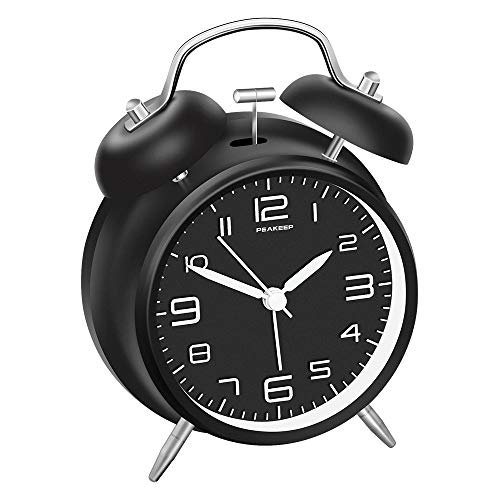
Peakeep Twin Bell Alarm Clock — Best mechanical force
Before electronics, there were bells, and the Peakeep is a reminder that the old technology was never beaten for sheer event-ness. Two metal bells and a hammer produce a ring that does not ramp, negotiate or offer settings; it simply happens, at full commitment, until somebody crosses the room and stops it. For sleepers who surf over electronic tones without surfacing, that analogue violence is frequently the answer — the sound has a physical edge that beeps and buzzers never quite reproduce.
Battery operation is its strategic genius. No socket, no cable, no dependence on a grid that might fail: the Peakeep can live on top of a wardrobe, across the room, in the one position where silencing it requires full verticality and several steps. Its backlight serves a night-time glance, and the four-inch dial with bold numerals can be read without any electronics at all. Setting it is a knob-turn, learnable in five seconds and impossible to perform wrongly in a menu.
What it cannot do is be polite. There is no volume control, no gentle mode, no snooze subtlety, and in shared housing it is a weapon that must be deployed with consent. For a solo sleeper in a house, a cabin, a room of one’s own — it remains the cheapest reliable route out of bed ever manufactured, and it will outlast most of the electronics in this guide.
- Type: battery-operated twin bell analogue alarm clock
- Sound: full mechanical ring with no volume adjustment
- Display: four-inch dial with backlight for night checks
- Power: batteries only, immune to outages and sockets
- Best setting: high across the room, beyond any arm’s reach
Strengths
- The ring cuts through sleep that electronic tones cannot.
- Complete freedom of placement, including across the room.
- Nothing to configure, update or misunderstand at midnight.
Trade-offs
- Utterly unsuited to shared rooms and thin-walled flats.
- No snooze gradations — the day starts at full volume.
- Analogue precision is approximate rather than exact.
Best for: solo sleepers who need an event, not a notification.
Not suited for: anyone whose mornings must respect other sleepers.
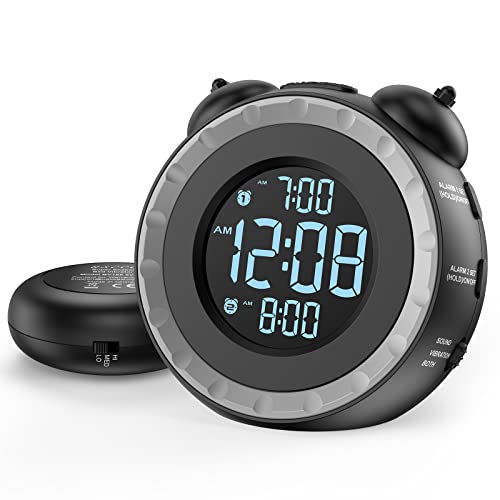
uscce Loud Dual Alarm Clock with Bed Shaker — Best adjustable shaker
The uscce takes the Sonic Bomb’s core idea — shake the bed — and adds the control that makes it livable in a wider range of households. Its bed shaker’s strength adjusts, so the owner can calibrate the morning to the minimum force that reliably works: a firm summons rather than a seismic event, strong enough for a deep sleeper, survivable for a partner. That adjustability is also a diagnostic tool, because a sleeper who needs the maximum setting every day is receiving information about their sleep that a fixed-force clock would hide.
Around the shaker sits a well-mannered dual-alarm clock: a loud audible layer for those who use sound as backup, a display that dims across the full range to darkness, and battery backup guarding the arrangement against outages. Setup rewards a proper calibration session — strengths tested from the pillow, the clock placed beyond arm’s reach, the second alarm reserved for the week’s other rhythm — after which the system runs itself with the minimum of daily thought.
Choose it over the Sonic Bomb when the bed is shared or the sleeper’s depth varies; choose the Bomb when maximum force is the whole requirement. Between them they cover the wired-shaker territory completely, and the uscce is the one most households will find easiest to live with for years.
- Type: dual-alarm clock with adjustable wired bed shaker
- Shaker: selectable strength, puck under the mattress
- Display: full-range dimmer down to complete darkness
- Power: mains operation with battery backup included
- Best setting: shared beds and variable-depth sleepers
Strengths
- Adjustable shake respects both the sleeper and the household.
- Dual alarms and backup cover the ordinary week’s risks.
- Calibration reveals how much force the sleeper truly needs.
Trade-offs
- Peak force sits slightly below the category’s maximum.
- Getting the calibration right takes one deliberate session.
- The wired puck keeps the system at one home bed.
Best for: deep sleepers in shared beds who need control.
Not suited for: travellers or anyone wanting a cable-free setup.

ANJANK Extra Loud Alarm Clock with Wireless Bed Shaker — Best cable-free shake
The ANJANK answers the wired shakers’ one structural weakness: the wire. Its bed shaker connects wirelessly, so the puck can be placed where physics wants it rather than where a cable reaches — the centre of a wide bed, a bed far from any nightstand, a setup in a rented room where trailing leads are not welcome. Around that freedom it builds a layered system: vibration for the body, a light wake-up for the eyes, eight sound options for the ears, dual alarms for the week, and a USB port so the phone charges beside the clock that has replaced it as the morning’s authority.
Layering is this clock’s real strategy for the getting-out-of-bed problem. Light begins the surfacing, vibration delivers the instruction, sound confirms it — a sequence that catches sleepers at different depths on different mornings, where a single channel might catch them on none. The display dims across the full range and offers a night light in nine colours, which should be set once, kindly, and then left alone.
The wireless shaker’s charge is the standing obligation, and it must be treated with the seriousness of a smoke alarm’s battery: a dead puck converts this system into an ordinary loud clock, which is the thing its owner already proved they can sleep through. Build the top-up into the weekly laundry round and the ANJANK delivers the most flexible force in this guide.
- Type: dual-alarm clock with wireless bed shaker
- Alerts: vibration, gradual light and eight sound options
- Display: full-range dimmer with a nine-colour night light
- Extras: USB charging port at the bedside
- Best setting: beds where a shaker cable cannot sensibly run
Strengths
- Cable-free placement follows the bed’s physics exactly.
- Three layered channels catch varying depths of sleep.
- Dual alarms cover the week’s two different mornings.
Trade-offs
- The shaker’s battery is one more thing to keep charged.
- Feature richness lengthens the first setup session.
- Light waking is wasted on mask-wearing sleepers.
Best for: deep sleepers whose beds defeat wired shakers.
Not suited for: anyone who reliably forgets to charge devices.

JALL Sunrise Alarm Clock — Best light-based rising
Not everyone who struggles to rise is a deep sleeper. Some are light sleepers in dark rooms, woken badly by sudden noise into a grogginess that lasts until lunch. The JALL fights that battle with dawn: its light builds gradually before the set time, pulling the sleeper up through the shallow stages so that the final sound — chosen from twenty-five, or the radio, or a Bluetooth playlist — arrives as confirmation rather than assault. On winter mornings, when the alternative is a buzzer in a pitch-black room, the difference is not subtle.
Its versatility serves the wider routine. Dual alarms separate workdays from weekends, the colourful night light can be set as a wind-down cue in the evening, and the sound library doubles as a sleep machine for the night’s other end. Placed across the room, its light spreads as a dawn should, and the walk to silence it finishes the job the brightness started. Sleepers who wear eye masks or face the wall should be honest that light cannot reach them, and choose a shaker instead.
The JALL is also the kindest option for households: it wakes its owner without declaring war on the corridor. For the sleeper whose problem is the quality of waking rather than its depth, it is not the soft option in this list — it is the correct one.
- Type: sunrise wake-up light with dual alarms
- Light: gradual dawn simulation plus colourful night light
- Sound: twenty-five sounds, FM radio and Bluetooth
- Alarms: two settings for different kinds of morning
- Best setting: across the room where its light can spread
Strengths
- Gradual light removes the shock that ruins slow wakers’ mornings.
- Deep sound library covers bedtime as well as waking.
- Household-friendly — no earthquake, no corridor warfare.
Trade-offs
- True deep sleepers may sleep through dawn entirely.
- Eye masks and bright summer rooms defeat its mechanism.
- Menus take longer to master than a simple buzzer clock.
Best for: light sleepers who wake groggy and hate alarms.
Not suited for: champion deep sleepers needing physical force.
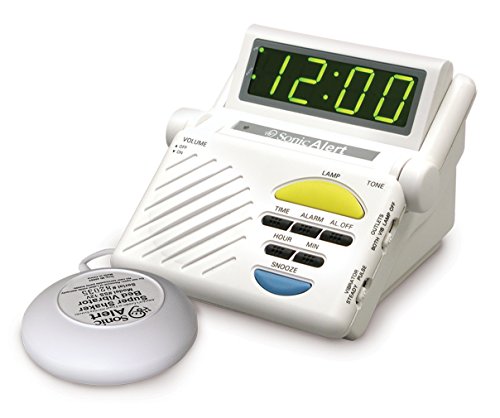
Sonic Alert Sonic Boom Alarm Clock SB1000SS — Best veteran sonic design
The SB1000SS is the elder of this list, a Sonic Alert design that has been waking the unwakeable since long before sunrise simulations were fashionable. Its philosophy is sound with authority: an extra-loud alarm from a maker whose entire business is alerting people who cannot afford to miss the signal. For sleepers whose depth is auditory — who surface for nothing below a certain insistence — that pedigree matters more than novelty, because the design’s behaviour is known, documented by years of other people’s mornings.
It keeps its brief narrow and honours it. This is a bedside alarm clock for heavy sleepers, without the app connections and colour menus that decorate newer rivals, and its simplicity is a reliability strategy: fewer systems, fewer failures, nothing to update. Placed across the room in the manner this guide keeps recommending, its voice has to be answered on foot, which converts its loudness from a disturbance endured in bed into a task completed standing up.
Buyers wanting a shaker should take the Sonic Bomb from the same family of thinking; buyers wanting the distilled, sound-first version — for a spare room, a workshop start, a teenager whose depth is legendary but whose bed is shared with no one — will find the SB1000SS exactly as advertised, which in this category is high praise.
- Type: extra-loud bedside alarm clock for heavy sleepers
- Sound: high-authority alarm from a specialist maker
- Design: long-established, deliberately simple operation
- Focus: sound-first waking without app dependence
- Best setting: across the room in a solo sleeper’s bedroom
Strengths
- A proven design with years of heavy sleepers behind it.
- Simplicity leaves very little to fail or misconfigure.
- Sound authority suits sleepers unmoved by gentler tones.
Trade-offs
- No bed shaker in this sound-first configuration.
- Shared rooms will hear every decibel of its work.
- Fewer comfort features than the layered modern rivals.
Best for: deep sleepers who respond to sound at full authority.
Not suited for: households needing vibration or light instead.
How Do the Six Picks Compare Side by Side?
| Pick | Main force | Backup power | Household impact |
|---|---|---|---|
| Sonic Bomb Dual Alarm Clock with Bed Shaker | Bed shake plus sound | Battery backup | High — wakes the bed |
| Peakeep Twin Bell Alarm Clock | Mechanical ring | Battery only | High — wakes the house |
| uscce Loud Dual Alarm Clock with Bed Shaker | Adjustable bed shake | Battery backup | Moderate, tunable |
| ANJANK Extra Loud Alarm Clock with Wireless Bed Shaker | Wireless shake plus light | Shaker rechargeable | Moderate, layered |
| JALL Sunrise Alarm Clock | Gradual light | Mains powered | Low — the polite option |
| Sonic Alert Sonic Boom Alarm Clock SB1000SS | Extra-loud sound | Check listing configuration | High — sound carries |
Why Does Placement Matter as Much as Volume?
Every failed morning contains the same small scene: a hand leaves the bed, finds the snooze, and returns — all without the sleeper’s eyes opening or their situation improving. The hand is not the enemy; it is simply doing the job it was given by a clock placed within its reach. Move the clock beyond that reach and the entire negotiation changes venue. Silencing the alarm now requires sitting up, standing, and crossing a cold floor, and a person who has done those three things has, in every practical sense, already got out of bed. The alarm’s remaining job is merely to prevent the return journey, which is why the walk back past the bed is the moment of maximum danger and why the clock should stand near the door, the clothes, or the bathroom — wherever the morning’s next action lives.
Placement interacts with each technology differently. Shakers must be positioned for physics: the puck under the mattress where the bed carries its work, the clock unit itself as distant as its cable allows. Bells and sonic clocks want height and distance, a wardrobe top across the room. Sunrise clocks want an unobstructed spread of light, which usually means a dresser facing the bed rather than a nightstand glowing into a pillow. In every case the principle is identical: arrange the room so that the easiest available action, at the alarm’s moment, is the one that continues the morning.
Test placement on a weekend, at full strength, with the household warned. A setup that works in theory but cannot be reached without climbing over furniture will be dismantled by its owner within the week, and a dismantled system wakes nobody.
What Is the Honest Mathematics of the Snooze Button?
A snooze is usually nine or ten minutes, and it purchases nothing. Sleep in nine-minute fragments is not rest; it is a series of interruptions, each ending in the small misery of being woken again. Three snoozes convert half an hour of honest sleep — which would have done real work — into thirty minutes of shallow, broken dozing that leaves the sleeper groggier than either alternative. The arithmetic is brutal and simple: the time spent snoozing would almost always have been better spent asleep, with the alarm set later, once.
The snooze persists because it is a negotiation the waking self offers the sleeping self, and the sleeping self always accepts. Removing the negotiation is therefore a design problem, not a character test. Clocks across the room make snoozing expensive in effort. Shakers make it nearly pointless, since a shaking bed cannot be un-felt by pressing a button and rolling over. And the household rule that works best, where a snooze exists, is a ration agreed in daylight — one press, then feet down — enforced not by willpower at dawn but by the clock’s placement making a second press require a second journey.
If the honest desire is more sleep, take it honestly: move the alarm later where the schedule allows, or move bedtime earlier where it does not. The one option that serves nobody is the daily auction of nine-minute lots, and a household that recognises the pattern has already done the hardest part of ending it.
How Much of Getting Up Is Actually the Night Before?
Most of it, and any guide that pretends otherwise is selling something. An alarm set for six after a bedtime of two is not a wake-up system; it is an appointment with failure that a louder clock merely makes more dramatic. Sleep need varies, but it does not negotiate, and the adult who consistently requires rescue from their own mornings is usually running a debt that no device can refinance. The clock’s honest role in that situation is diagnostic: when a properly placed shaker at full strength starts failing, the message is about the quantity of sleep, not the quality of the equipment.
The practical sequence runs backwards from the alarm. Fix the wake time the day actually requires. Count back the hours of sleep the individual genuinely needs — discovered by experience, not by optimism — and let that arithmetic name the bedtime. Then defend the bedtime with the same equipment-mindedness: a wind-down alarm on the dual settings, the phone charging away from the pillow, the sunrise clock’s evening light doing its dimming work. Households that run this sequence find, usually within a fortnight, that the morning alarm has become oddly easy — because it is landing at the end of a completed sleep rather than in the middle of an interrupted one.
Caffeine, alcohol and screens all write their entries into this ledger, and readers know their own accounts. The clock cannot audit them. What it can do is hold the morning steady while the night is repaired, and report — by succeeding or failing — whether the repair is working.
What Should Happen on the Mornings That Cannot Be Missed?
Examinations, flights, weddings one is actually in, the first day of the job the rent depends on: these mornings deserve a system, not a device. Layer the defences the night before. The primary clock — shaker set, placed across the room — plus an independent second alarm on a different power source, plus, where the stakes justify it, a human arrangement: a friend in the same examination, a partner briefed, a household member who will knock. Redundancy feels excessive exactly until the morning a battery, a breaker or a displaced puck would otherwise have rewritten the day.
Prepare the runway as well as the alarm. Clothes laid out, bag by the door, the route rehearsed in the mind before sleep — because a woken person with a plan moves, while a woken person facing decisions drifts back towards the bed to think about them. Set everything earlier than feels necessary; the buffer is not wasted time but insurance that pays out in calm.
And afterwards, notice what worked, and make it the ordinary system. Most people discover their unmissable-morning arrangement is simply their regular arrangement with the volume of care turned up — which raises the obvious question of why the ordinary mornings were being run on hope.
How Do Partners, Children and Housemates Change the Strategy?
Few people sleep in a vacuum, and a rising strategy that ignores the household will be renegotiated by it, usually at volume. A partner on a different schedule is the most common complication, and the adjustable systems exist precisely for that treaty: the uscce’s tuned shaker, the ANJANK’s layered build, or a sunrise clock whose light wakes one side of the room more than the other. The agreement that works is specific — which mornings, how much force, what the woken partner will do to minimise the shared portion — and it is made in daylight, because nobody negotiates generously at six in the morning.
Children alter the physics in the opposite direction: for many parents, the household’s small people are the alarm, and the clock’s role becomes the earlier, quieter rising that lets a parent be awake, dressed and caffeinated before the children’s day begins. A vibrating or light-based system earns its price in that house purely by not waking the children it precedes. Housemates in shared flats present the student problem in adult dress — thin walls, divergent schedules, goodwill that must not be spent carelessly — and the same courtesies apply: keep the signal personal, place it close, and reserve the bells for houses with nobody on the other side of the wall.
The general rule is that force should be as private as the technology allows. Every decibel and every shake that stays inside the owner’s own bed is a courtesy the household will repay in tolerance on the mornings when a little spillover is unavoidable.
How Can Weekends Be Handled Without Undoing the Week?
The weekend lie-in is where rising systems go to be undermined. Sleeping three hours later on Saturday and Sunday shifts the body’s clock exactly as a short flight west would, so Monday’s alarm lands in what the body insists is the middle of the night — and the cycle of failure that follows gets blamed on the clock, the willpower, anything except the arithmetic. The compromise that actually works is a lie-in with a boundary: an hour beyond the weekday wake time, held by the second of the dual alarms, which buys the pleasure of a slower morning without purchasing Monday’s misery.
Bedtime drift deserves the same boundary. A Friday night that ends two hours late is a withdrawal from the same account, and the shaker will be asked to cover it on Saturday at full strength. None of this requires monastic weekends; it requires treating sleep timing as a rhythm with a tempo, rather than a resource that can be spent wildly and replenished by intention. Athletes protect their sleep schedules through competition weekends for exactly this reason, and a person trying to hold a six o’clock weekday start is running a comparable event.
Where a household’s weekends genuinely differ — shift patterns, children’s sports at dawn on Saturdays, a partner’s lie-in that is sacred — set the two rhythms deliberately on the dual alarms and keep each one consistent. The body adapts to two stable patterns far better than to five improvisations, and the clock, unlike the body, never complains about holding both.
What Role Does Morning Light Play After the Alarm Has Done Its Work?
The alarm’s job ends at verticality; light’s job is to make verticality stick. Bright light in the first minutes — curtains opened, a walk to a window, the JALL’s dawn still glowing across the room — tells the body clock that the day has genuinely begun, and sleepiness retreats measurably faster than it does in a dim room where the bed remains the brightest idea available. This is why the sunrise picks punch above their decibel weight: they begin the light exposure before the waking, so the owner surfaces into a room that already agrees it is morning.
In winter, when the alarm fires hours before any natural dawn, artificial brightness has to substitute, and the household’s ordinary lamps can do the work if they are actually switched on as part of the rising routine rather than left for later. The sequence matters more than the equipment: alarm, stand, light, water, movement. Each step makes the next easier and the bed less plausible, until somewhere around the bathroom door the argument is simply over for another day.
Evening light writes the other half of the same entry. Bright, blue-rich light late at night delays the sleep the morning depends on, which is why this guide keeps recommending dimmed displays and phones charging away from pillows. A person cannot buy their way out of a light pattern that tells their body the wrong story at both ends of the day — but they can arrange the pattern, with the clock as its anchor, until the story and the schedule agree.
How Should the System Be Tested and Adjusted in the First Fortnight?
Treat the first two weeks as calibration, not verdict. Night one proves the equipment fires. The following mornings reveal the truths no specification sheet holds: whether the puck migrates under a restless sleeper, whether the chosen strength is a summons or an assault, whether the walk to the clock crosses a route back to bed that proves too tempting at the crucial moment. Adjust one variable at a time — strength, then placement, then the alarm’s hour — with at least two mornings between changes, because a system adjusted nightly never declares which of its settings actually works.
Keep a brutally simple record. Woke on the first signal, woke on the second, or failed — three categories, noted on the phone or a card by the kettle, alongside the previous night’s bedtime. Patterns announce themselves within a fortnight: failures that cluster after late nights belong to the bedtime column, failures at maximum strength after adequate sleep belong in a conversation with a doctor, and failures that vanish when the clock moved belong to the placement column, which is where most of them live. Data ends arguments that impressions sustain indefinitely.
By the end of the fortnight, the goal is a boring system: same placement, same strength, same hour, succeeding without drama. Boredom is the sound of a morning problem actually solved, and it frees the household’s attention for the rest of life — which was, all along, the entire point of getting out of bed on time.
What About Teenagers, Students and Other Professional Late Risers?
Young sleepers are not lazy adults; their body clocks genuinely run later, which is why a teenager can be simultaneously impossible at seven and luminous at midnight. Equipment choices should respect the biology while serving the obligation. A shaker system in a teenager’s own room — the uscce’s adjustable version suits a family house, where the Sonic Bomb’s full commitment would wake the landing as well — gives the young sleeper a private, physical signal that does not depend on a parent’s voice becoming the enemy. The handover matters as much as the hardware: a teenager who sets and owns their system is building the exact skill the school run is trying to teach.
Students, covered more fully in the college guide on this site, face the same biology plus an irregular timetable, and their answer is the dual alarm used as a rhythm-keeper rather than a recording of chaos. For both groups, the family’s role is to supply the system, agree the consequences, and then step back far enough for ownership to form. A parent who continues to act as the backup alarm indefinitely has not solved the problem; they have merely become its most exhausted component.
The hopeful truth is that rising is a trainable arrangement, not a fixed trait. The young people who leave home able to get themselves up carry a competence that employers, universities and future partners all notice — and it is built, morning by ordinary morning, out of a clock placed properly and a household that let it do its work.
How Does the Season Change What the Alarm Must Do?
Summer and winter present opposite problems to the same sleeper. Summer’s early dawn does half the light work for free — and ruins it for light sleepers by arriving at five, hours before the alarm, fragmenting the last stretch of sleep. Blackout curtains restore the alarm’s authority in that season, letting the chosen system, rather than the sun, decide when morning begins. Winter removes the dawn entirely and asks the equipment to manufacture a morning out of darkness and cold, which is where sunrise simulation stops being a luxury: the JALL’s gradual brightening gives a winter sleeper a physiological on-ramp that no buzzer in a black room can imitate.
Cold itself is an underrated opponent. A warm bed in a cold room is a negotiation the sleeper loses daily, and the honest counters are domestic rather than electronic — heating timed to precede the alarm, clothes waiting somewhere warmer than the floor. The clock’s contribution is to fire into a room that has been made survivable, and households that arrange the heating’s timer with the same care as the alarm’s discover that half the battle was thermal all along.
Seasonal routine changes — school terms, holidays, the clock changes themselves — should trigger the same recalibration as a new mattress does for a shaker: retest the strength, re-place the puck if the bedding changed, and shift the alarm in steps rather than leaps. Systems fail at transitions because transitions are where unexamined assumptions accumulate, and a five-minute seasonal review is cheaper than a week of failed mornings.
What Should the First Sixty Seconds After the Alarm Look Like?
Systems are won or lost in the minute after the signal, and that minute should be choreographed in advance rather than improvised by a half-conscious person. Feet on the floor before the hand reaches for anything else. Light on — curtains, lamp, the sunrise clock still glowing — before the phone is touched. Water, kept by the bed or in the bathroom, because a dry mouth is one of sleep’s last arguments. Then movement with a destination: bathroom, kettle, the clothes laid out the night before. Each step is trivial; the sequence is everything, because a body in motion along a prepared path rarely votes to return to bed, while a body standing undecided beside it usually does.
The phone’s place in that minute is last, deliberately. A phone consulted in bed converts standing time back into horizontal time with an efficiency no snooze button can match, and the clocks in this guide that charge it — the ANJANK at the bedside — should be understood as charging it for later, not presenting it for immediate use. Owners who keep the phone in the kitchen overnight remove the question entirely, and consistently report that the first minute became the easiest part of the system to keep.
Rehearse the sequence once, on a weekend, at full volume and full light. It will feel theatrical. By the fourth weekday it will feel like simply how mornings go, which is the definition of a routine — and routines, not resolutions, are what get people out of bed in February.
What Are the Most Common Mistakes When Trying to Wake Up Earlier?
Buying force before fixing placement leads, reliably: the loudest clock in the shop, installed within arm’s reach of the pillow, snoozed into irrelevance within a month. The second mistake is the heroic leap — shifting the alarm two hours earlier in one step, failing by Friday, and concluding that mornings are a moral quality other people possess. Fifteen-minute steps, held for several days each, move a wake time further in a month than heroism moves it in a week. Third comes ignoring the bedtime arithmetic entirely, as if the morning were a separate country from the night.
Two quieter errors deserve mention. One is the alarm that rings for a life the owner does not currently live — set for a gym session that exists only in intention — which trains its owner, daily, that the clock’s voice can be safely ignored. Set alarms for real obligations only. The other is escalating endlessly: each failed clock replaced by a louder one, the underlying sleep debt growing untouched, until the household owns a museum of defeated devices. When the pattern reaches that point, the next appointment to make is not with a shop but with a doctor, and making it is a success, not a surrender.
Final Recommendation
For the deepest sleepers, the Sonic Bomb is the answer this category exists to give: shake the bed, flash the lights, back it with sound and battery power, and place it across the room. Shared beds should take the uscce’s adjustable version of the same physics, and beds a cable cannot serve should take the ANJANK’s wireless one. Solo sleepers on a budget of space and money will find the Peakeep’s bells as effective as they were a century ago, while the SB1000SS serves those whose sleep yields to sound at full authority. The JALL stands apart for the sleeper whose enemy is grogginess rather than depth — proof that getting out of bed is sometimes a matter of light, not force.
Whichever you choose, install it across the room, test it on a morning that forgives failure, and fix the bedtime that the alarm’s arithmetic demands — because the clock can win the argument at dawn, but only you can stop scheduling it against yourself the night before.
Frequently Asked Questions
Will I just learn to sleep through a louder clock too?
Possibly, if loudness is the only change — the brain habituates to any survivable sound. That is why this guide ranks vibration, light and placement alongside volume: changing the channel is much harder to habituate to than raising the level. Rotate nothing, fix the placement, and address the sleep debt, and most sleepers find the system keeps working. One refinement helps the minority who genuinely do habituate: vary the secondary layer rather than the primary one — a different tone behind the same shaker, a radio station instead of a buzzer — so the morning keeps one novel element while the physical signal that does the real work stays exactly as reliable as it was on the first day.
How far away should the clock be?
Far enough that silencing it requires standing and walking — across the room for most bedrooms, ideally near the door or the clothes so the journey continues into the morning’s next action. If you can reach it from the bed, it is a snooze machine with a display, whatever its specifications claim. Height helps as well as distance: a clock placed on a wardrobe top or a high shelf adds the small indignity of a stretch and a reach to the silencing, and indignities of that size, applied at the decisive second, have ended more lie-ins than any feature printed on a box.
Is a bed shaker safe and suitable for any bed?
Bed shakers are designed to sit between mattress and base and are used in ordinary homes every night; follow the maker’s placement guidance for your bed type, keep cables routed away from feet and pets, and test the strength from the pillow. Anyone with a specific medical device or condition they are unsure about should check with their clinician rather than a shopping guide.
Can a sunrise clock really wake a heavy sleeper?
Alone, usually not — and this guide does not pretend otherwise, however flattering the sunrise photographs on the product packaging may look. Light excels with light and moderate sleepers, and as the first layer of a combined system. The determinedly deep sleeper should buy vibration first and treat light as a comfort added later, not as the mechanism the morning depends on.
What if nothing in this list works for me?
Then the equipment has given you information: with adequate sleep hours, a placed, tested, full-strength system should work, and persistent failure is worth raising with a doctor, who can look for causes no shop sells a remedy for. Treat that appointment as the next step of the same project — getting your mornings back — not as a defeat within it.
Should I set two alarms a few minutes apart?
A second alarm on an independent device is good insurance for important mornings. As a daily habit, staggered alarms mostly rehearse the snooze problem in a grander form. Better one alarm you respect, placed properly, with a backup that exists for genuine failures rather than as a scheduled second chance to stay in bed. If two alarms are used daily, make the second one different in kind — the shaker behind the tone, the bells behind the light — because a backup that merely repeats the first signal inherits exactly the weakness the first signal just demonstrated.
How long should I give a new system before judging it?
A fortnight of honest use, with bedtime held reasonably steady, is a fair trial. Judge by the record, not by the worst morning: a system that succeeds on ordinary weekdays and fails only after exceptional nights is working, and the exceptions belong to the schedule rather than the equipment. If failures are random and frequent despite adequate sleep, change one variable — placement first, then channel — and run another fortnight before changing anything else, because a system adjusted constantly can never be fairly judged at all.
Related Guides
The rest of the home rewards the same practical attention in these companion guides: Best Bath Mats by Color Best Stone Bathroom Sinks Best Lab-Tested Air Purifiers for Allergies Best Affordable Air Purifiers for a Single Room


