What's inside
- Key Takeaways
- Quick Picks
- How Did We Choose These Litter Trapping Mats?
- Comparison Table
- What Actually Makes Litter Travel So Far From the Box?
- Honeycomb Pocket or Coiled Mesh: Which Trapping Style Suits Your Home?
- How Should You Size and Position a Litter Mat?
- How Do You Clean a Litter Mat Without Spreading the Mess?
- What About Accidents, Odour and Cats Who Refuse the Mat?
- How Does a Litter Mat Behave on Different Floor Types?
- What Size Mat Does a Large or Long-Haired Cat Need?
- How Should a Litter Mat Fit Into the Weekly Cleaning Round?
- When Should You Replace a Litter Mat Altogether?
- How Do Covered Boxes, Open Trays and Top-Entry Boxes Change the Mat’s Job?
- What Should Multi-Cat Homes Do Differently?
- How Can You Tell Whether Your Mat Is Actually Working?
- What Mistakes Do Litter Mat Buyers Keep Making?
- Final Recommendation
- Frequently Asked Questions
- Related Guides
As an Amazon Associate I earn from qualifying purchases. This post may contain affiliate links at no extra cost to you.
cottageverdict.com is reader-supported. When you buy through links on our site, we may earn an affiliate commission.
Where to buy: every linked name in this guide opens its Amazon listing, where you can check price on Amazon and confirm the footprint, layer construction and cleaning method before ordering. The best anti-tracking litter rugs or mats are not really rugs at all in the decorative sense. They are working equipment stationed outside a litter box, and their entire purpose is to intercept the granules that cling to a cat’s paws in the first three or four steps after leaving the box, before those granules reach a hallway, a bed or the sole of a bare foot at midnight.
A cat does not scatter litter out of spite. Granules lodge between toe beans and in the fur around the paw, then release gradually as the cat walks, shakes or grooms. That is why tracking spreads so far from the box: the litter leaves on the cat, not on the floor. A good mat attacks the problem at the release point. Its surface has to open the paw slightly, give loose grains somewhere to fall, and hold those grains out of sight and out of the walking path until you empty it.
Two constructions dominate this category, and they behave differently enough that choosing between them matters more than choosing between brands. Honeycomb double-layer mats let grains drop through holes in a top sheet into a pocket below, so the walking surface stays comparatively clean and the trapped litter can be poured straight back into the box. Coiled mesh mats work like a doormat for paws: loops and grooves scrub grains loose and lodge them down in the mesh, and you shake or rinse the whole thing clean outside.
Size is the quiet deciding factor most buyers underestimate. A mat that only covers the box’s exit lip catches the first step and misses the second and third, which is where much of the release actually happens. The six mats below range from a compact 24 by 15 inch honeycomb pad for a single small box to genuinely roomy 47 inch catch zones for multi-cat stations, and the right choice depends on how your cat exits — some cats step out politely, others launch themselves sideways like the box owes them money.
Everything here was judged as functional floor equipment: catch area, layer design, whether the base genuinely protects flooring from accidents outside the box, how the mat feels under feline paws, and how honestly easy it is to empty, rinse and dry. A mat that catches beautifully but takes twenty minutes to clean will be cleaned rarely, and a rarely cleaned mat becomes a litter distribution centre with extra steps.
One more distinction frames the whole guide: these mats are consumable-adjacent equipment, closer to a doormat or a drip tray than to a rug you choose for a decade. Expecting heirloom behaviour from them disappoints; expecting honest, washable, replaceable service delights. The six below were picked in that spirit — each one is good at its job today, easy to live with weekly, and painless to replace when its surface eventually tires.
Key Takeaways
- Grains leave the box on your cat’s paws, so a mat must cover the first several steps, not just the exit lip.
- Honeycomb double-layer designs store trapped litter in a pocket you can pour back into the box.
- Coiled mesh surfaces scrub paws like a doormat and clean up with a shake or a rinse outside.
- Oversized mats around 47 inches suit multi-cat stations and cats that leap out sideways.
- A waterproof base matters wherever an occasional miss outside the box could reach wood or laminate.
- Paw comfort decides whether a cat crosses the mat willingly or simply jumps clean over it.
Quick Picks
| Pick | Badge | Why it stands out |
|---|---|---|
| Cat Litter Trapping Mat XXL 47×36 | Largest Catch Zone | A 47 by 36 inch two-layer catch field that swallows the whole exit zone of a busy litter station. |
| Amazon Basics Less-Mess Litter Trapping Mat | Best Simple Single-Box Mat | A soft, waterproof 24 by 35 inch scatter-control mat that keeps one box’s doorstep tidy without fuss. |
| Pieviev Cat Litter Mat Double-Layer 24×15 | Best Compact Honeycomb | A small 24 by 15 inch honeycomb mat that pours trapped litter back into the box. |
| Cat Litter Mat XL 47×33 Double Layer | Best XL Honeycomb | A 47 by 33 inch double-layer honeycomb mat with a urine-proof base for big stations. |
| LittleTiger Cat Litter Mat XL 46×35 | Softest Oversized Mat | A 46 by 35 inch mat that pairs generous coverage with a paw-soft, phthalate-free surface. |
| GORILLA GRIP Cat Litter Mat 35×23 | Best Coiled Mesh Design | A 35 by 23 inch coiled mesh mat whose deep grooves scrub grains from paws. |
How Did We Choose These Litter Trapping Mats?
Placement came first. We favoured mats whose dimensions create a genuine landing zone in front of or around a standard box, because trapping performance collapses when a cat can clear the mat in one bound. Published footprints were compared against the stride of an average adult cat leaving a box at walking pace, and the compact picks that survived the cut are here for genuinely tight spaces — a box inside a cabinet, a closet station, a small bathroom — rather than as pretend full-coverage options.
Construction was the second filter. For honeycomb mats we looked for a top layer with openings wide enough for common clay and crystal grains to fall through, plus a sealed base layer that keeps both litter and moisture off the floor. For mesh mats the test was groove depth: shallow texture polishes paws without dislodging much, while deep coils flex under weight and flick grains down into the mat where feet no longer touch them.
Cleaning honesty was the third. Every pick here can be emptied without specialist tools: honeycomb pockets open or flex to pour, mesh mats shake out and rinse. We also weighed drying behaviour, since a mat put back damp under a box smells stale within days. Finally, surface kindness mattered throughout, because senior cats and kittens avoid textures that feel sharp, and an avoided mat catches nothing at all.
We also checked each mat’s behaviour at the edges, because corners that curl become trip points for humans and launch ramps for cats. Models that lay flat straight from packaging scored well; any mat can be coaxed flat with a night under the box’s weight, but a design that fights its owner from day one tends to keep fighting. Edge binding and base weight both matter here, quietly, every single day.

Cat Litter Trapping Mat XXL 47×36 — Largest Catch Zone
At 47 by 36 inches, this mat treats the litter station as a small district rather than a doorstep. It slides under the front half of a large box and still leaves a broad working area in front, which means a cat that steps out, turns, shakes a hind leg and strolls off has spent its entire post-box routine standing on the trapping surface. For households running two boxes side by side, one mat can serve both exits, replacing the usual patchwork of undersized pads with gaps between them.
The two-layer build follows the honeycomb logic: grains disturbed from paws drop through the upper surface into the enclosed space beneath, so the top you see stays presentable between emptyings. The base is waterproof, which earns its keep on the morning you find an accident happened beside the box rather than in it. On timber or laminate that sealed underside is the difference between wiping a mat and refinishing a floorboard.
Emptying is a fold-and-pour job. Lift the mat, flex it so the collected grains run to one corner, and tip them back into the box or the bin. Its size cuts both ways, though: a 47 inch mat is awkward to carry through a narrow doorway without spilling, and it will not fit under a box tucked into a small bathroom. Measure the station before falling for the coverage.
Litter type changes how this mat behaves day to day. Fine clay grains fall readily and fill the working surface fastest, so busy households should expect a quicker emptying rhythm than the footprint suggests. Crystal grains, being larger and lighter, tend to bounce once on landing before settling, which rewards the generous border this mat keeps around its main catch area. Either way, a ten-second shake on wash day restores the surface completely, and the mat asks for no special detergents or tools beyond a standard rinse and somewhere flat to dry.
- Footprint: 47 x 36 inches
- Construction: two-layer trapping design
- Base: waterproof, urine-proof underside
- Surface contact: non-slip placement under and around the box
- Care: pour out trapped litter, wipe or rinse, air dry
Strengths
- Coverage swallows the full exit, turn and shake routine of most cats
- Trapped grains collect below the walking surface instead of redepositing on paws
- One mat can serve two adjacent boxes in a multi-cat station
Trade-offs
- Bulky to carry to a bin without flexing grains out along the way
- Too large for cabinet stations and small bathroom floors
- The plain utility look suits a laundry room better than a styled hallway
Best for: multi-cat homes with a dedicated litter corner on hard flooring.
Not suited for: tiny en-suite bathrooms or boxes hidden inside narrow furniture.
Amazon Basics Less-Mess Litter Trapping Mat — Best Simple Single-Box Mat
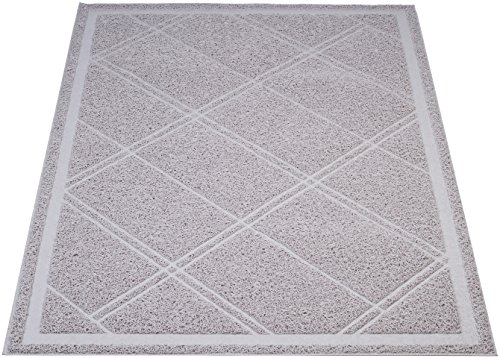
The Amazon Basics mat takes the unfussy route: a single flexible layer, 24 by 35 inches, with a textured surface that slows grains down and a waterproof body that shrugs off the occasional splash or miss. It is sized for the classic one-cat, one-box household, where the traffic pattern is predictable and the mat’s job is to tidy a doorstep rather than police a whole room.
Softness is its distinguishing trait. The surface is gentle under paws, which matters for kittens, elderly cats and any cat that has previously staged a protest against a scratchy mat by leaping theatrically over it. A mat a cat crosses calmly, placing each foot down, traps far more than a technically cleverer mat the cat avoids touching.
Cleanup is shake, vacuum or rinse, and the mat dries quickly because there is no enclosed pocket to hold moisture. The compromise is storage: unlike honeycomb designs, this surface holds grains within its texture rather than in a reservoir, so in a heavy-tracking household it wants attention more often. Think of it as a well-behaved doormat that needs a weekly shake rather than a sealed system you empty monthly.
Renters in particular will appreciate what the waterproof body prevents. Litter dust mixed with the occasional splash becomes a gritty paste that works into grout lines and laminate seams, and landlords notice that kind of wear at inspection time. A mat that contains both the dry scatter and the wet accidents keeps the floor beneath it genuinely unchanged, which is worth more than the mat itself when a deposit is on the line. Roll it up on moving day and the corner looks as if a cat never lived there.
- Footprint: 24 x 35 inches
- Construction: single textured trapping layer
- Base: waterproof body for splash protection
- Feel: soft surface intended to be gentle on paws
- Care: shake out, vacuum or rinse clean
Strengths
- Paw-friendly surface encourages cats to walk across rather than jump over
- Waterproof build protects flooring from splashes beside the box
- Light and flexible, so shaking it out takes seconds
Trade-offs
- Grains sit in the surface texture instead of a hidden pocket
- Modest footprint misses litter from cats that exit at speed
- Needs frequent shaking in homes with enthusiastic diggers
Best for: single-cat households wanting a gentle, low-maintenance doorstep mat.
Not suited for: vigorous diggers whose litter lands well beyond a 35 inch reach.
Pieviev Cat Litter Mat Double-Layer 24×15 — Best Compact Honeycomb
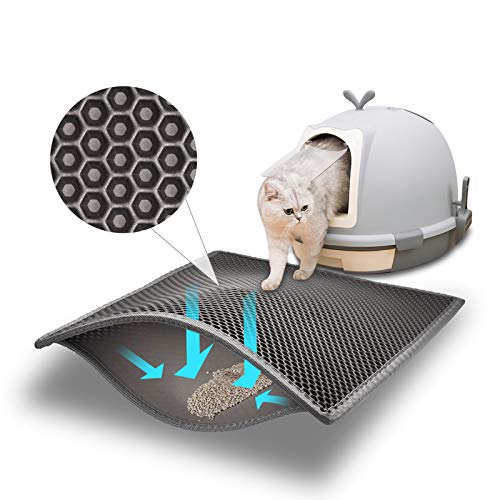
The Pieviev is the honeycomb idea at its most compact: 24 by 15 inches of double-layer mat whose top sheet is pierced with holes sized for litter grains to fall through. What drops lands in the pocket between the layers, hidden from view and, more importantly, off the surface your cat keeps walking on. For a box in a closet, a cabinet or the corner of a small flat, it delivers the pocket system where a full-size mat simply cannot go.
The pour-back routine is this design’s party trick. Pick the mat up, open the layers at the edge, and the collected grains funnel out in a stream you can aim into the box. Clean litter gets reused instead of binned, which quietly offsets the cost of premium litters over a year. The waterproof bottom layer stands guard underneath against the odd puddle escaping the box rim.
Honesty about scale is essential. Fifteen inches of depth catches the first planted step and little else, so a cat that bounds out will still decorate the floor beyond it. Pair it with a covered box whose exit you can aim across the mat, and it performs admirably; leave the exit facing away and you have bought a very small, very tidy island. Placement discipline makes or breaks this pick.
Positioning tip specific to this little mat: because its depth is limited, butt it directly against the box wall so a cat’s front paws land on the honeycomb the moment they clear the rim, rather than giving the animal a bare half-step first. Covered boxes with a single doorway are its ideal partners, since the doorway dictates the exit line. In a pinch it also serves well under a food and water station, where its waterproof base catches drips and its texture slows scattered kibble.
- Footprint: 24 x 15 inches
- Construction: double-layer honeycomb trapping pocket
- Base: waterproof, urine-proof lower layer
- Emptying: open the edge and pour grains back into the box
- Care: rinse the layers and dry fully before replacing
Strengths
- Pocket hides trapped grains so the walking surface stays clean
- Pour-back emptying returns reusable litter to the box
- Compact size fits cabinet and closet litter stations
Trade-offs
- Catches mainly the first step out of the box
- Small pocket fills quickly with a large or busy cat
- Works only when the box exit is aimed across it
Best for: small-space litter stations with a covered box and a calm cat.
Not suited for: open boxes used by cats that launch themselves out sideways.

Cat Litter Mat XL 47×33 Double Layer — Best XL Honeycomb
This XL honeycomb mat pairs the pocket construction with near-room-scale coverage: 47 by 33 inches of two-layer trapping that can run under a jumbo box and still present a long landing strip in front of it. Cats that dig with commitment, bury with ceremony and exit with a shake get their whole performance staged on the mat, and the grains they shed fall through the honeycomb openings instead of skittering across the room.
The urine-proof base is doing quiet, valuable work at this size. Large mats are exactly the ones people hesitate to lift daily, so the sealed underside protects the floor during the longer intervals between full cleanings. When cleaning day comes, the trapped litter pours from the pocket and the surface rinses down; just allow real drying time, because a mat this broad traps moisture underneath if it goes back damp.
Underfoot, the top layer is soft enough for routine crossing, and the mat lies flat rather than curling at the corners, which keeps the honeycomb openings aligned with the pocket below. Its weakness is logistics: rinsing 47 inches of mat needs a shower, a bath or a garden hose, and flats without outdoor space may find the compact picks easier to live with despite the smaller catch zone.
Two of these XL mats side by side can wall off an entire litter room doorway, and some multi-cat homes run exactly that arrangement, creating a checkpoint every cat crosses on the way back to the living areas. The pocket seams align well enough that grains do not pour through the join. It is an unglamorous system, but households that have tried it report the rest of the home stays noticeably cleaner, because the checkpoint works on every single trip rather than only the ones an owner witnesses.
- Footprint: 47 x 33 inches
- Construction: double-layer honeycomb with collection pocket
- Base: urine-proof sealed underside
- Feel: soft top layer for routine paw contact
- Care: pour out pocket, rinse, dry completely flat
Strengths
- Long landing strip suits diggers and ceremonial buriers
- Pocket system keeps the visible surface presentable for days
- Sealed base guards floors between less frequent deep cleans
Trade-offs
- Needs a bath, shower or hose to rinse comfortably
- Slow to dry fully because of its broad double layers
- Dominates the floor visually in a small room
Best for: large boxes and multi-cat stations on washable hard floors.
Not suited for: small flats where rinsing space is limited to a kitchen sink.
LittleTiger Cat Litter Mat XL 46×35 — Softest Oversized Mat
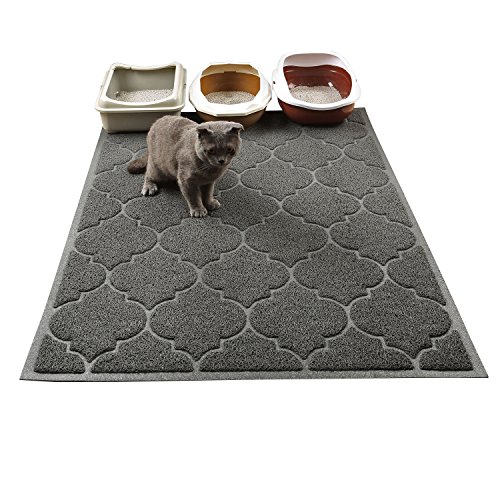
LittleTiger’s XL mat is built around a simple observation: the best trapping surface is the one a cat is willing to stand on. At 46 by 35 inches it offers the same class of coverage as the largest picks here, but its selling point is feel — a soft surface, made without phthalates, that tender paws, kittens and arthritic seniors will cross without the hesitation that defeats stiffer mats.
That willingness translates directly into performance. A cat mincing reluctantly across a mat plants its feet and hurries; a comfortable cat walks normally, pausing to shake a paw or look around, and each planted step works grains loose onto the surface. In practice, comfort is a trapping feature, and this is the pick that understands it best.
Durability is the other half of its brief: the mat is made to be cleaned repeatedly — shaken, vacuumed, washed down — without cracking or shedding its texture. It is a single-surface design rather than a pocket system, so grains rest within the surface until you deal with them, and in a three-cat household that means a standing appointment with the vacuum. Comfort first, capacity second is the honest summary.
Seniors deserve a specific mention here. Older cats often step out of the box slowly and stand for a moment, stiff from crouching, before walking away — and that pause happens wherever the mat is widest on this model. A surface that is kind during the pause matters for an animal managing sore joints, and the soft top layer asks nothing of tender feet while it quietly collects whatever the pause shakes loose. Comfort and capture coincide more often than product design usually admits.
- Footprint: 46 x 35 inches
- Material note: phthalate-free construction
- Surface: soft texture intended for sensitive paws
- Build: durable single trapping surface
- Care: shake, vacuum or wash down and dry
Strengths
- Gentle surface suits kittens, seniors and paw-sensitive cats
- Large footprint covers the wandering exit path of most cats
- Stands up to repeated washing without breaking down
Trade-offs
- No collection pocket, so grains wait on the surface for cleaning
- Needs regular vacuuming in busy multi-cat homes
- Soft texture traps slightly less aggressively than deep coils
Best for: homes with older cats or kittens who refuse scratchy surfaces.
Not suited for: owners hoping to empty a hidden pocket once a fortnight.

GORILLA GRIP Cat Litter Mat 35×23 — Best Coiled Mesh Design
Gorilla Grip takes the opposite approach to honeycomb pockets: a coiled mesh surface with deep catch grooves that works like a boot scraper scaled for paws. As a cat crosses, the coils flex under each foot, the paw spreads slightly, and grains that were riding between the toes drop into the mesh, lodging below the walking line where later steps cannot pick them up again.
At 35 by 23 inches it is a mid-size mat, happiest in front of a standard box in a bathroom or utility room where its tidy rectangle covers the natural exit lane. The mesh is soft enough on paws despite its scrubbing job, and the whole mat rinses clean under a tap or hose — the coils release their catch far more willingly under running water than a pocket releases its load into a bin.
The mesh method has one behavioural footnote: there is nowhere hidden for litter to go, so a heavily loaded mat looks ready for a rinse before it stops working. Owners who prefer out of sight, out of mind should choose a honeycomb pick; owners who like equipment that shows when it needs attention will appreciate the honesty. Either way, a thirty-second rinse restores it completely.
For a single box in a tiled bathroom, the mesh format has one more practical virtue: it tolerates the damp environment without sulking. Bathroom mats live with shower steam and splashed water, and a coiled surface that rinses and dries quickly does not develop the musty underside that thicker mats acquire in humid rooms. Hang it over the tub edge after rinsing and it is dry before the next morning’s routine, ready to be dropped back in front of the box.
- Footprint: 35 x 23 inches
- Construction: coiled mesh with deep catch grooves
- Material note: phthalate-free build
- Feel: soft on paws despite the scrubbing texture
- Care: shake out or rinse under water, air dry
Strengths
- Deep coils actively scrub grains loose as paws cross
- Rinses completely clean in seconds under a tap
- Mid-size footprint fits standard bathroom litter corners
Trade-offs
- Catch stays visible in the mesh until rinsed
- No pocket, so capacity is lower than honeycomb rivals
- Grooves can hold fine dust that needs a firm shake
Best for: bathroom litter corners where a quick rinse is easy.
Not suited for: owners who want trapped litter hidden between cleanings.
Comparison Table
| Pick | Coverage | Trapping style | Cleaning route |
|---|---|---|---|
| Cat Litter Trapping Mat XXL 47×36 | 47 x 36 in, station-wide | Two-layer pocket | Pour out and wipe |
| Amazon Basics Less-Mess Litter Trapping Mat | 24 x 35 in, doorstep | Textured single layer | Shake, vacuum or rinse |
| Pieviev Cat Litter Mat Double-Layer 24×15 | 24 x 15 in, first step | Honeycomb pocket | Open edge and pour back |
| Cat Litter Mat XL 47×33 Double Layer | 47 x 33 in, long landing | Honeycomb pocket | Pour, rinse, dry flat |
| LittleTiger Cat Litter Mat XL 46×35 | 46 x 35 in, station-wide | Soft single surface | Shake, vacuum or wash |
| GORILLA GRIP Cat Litter Mat 35×23 | 35 x 23 in, exit lane | Coiled mesh grooves | Shake or rinse |
What Actually Makes Litter Travel So Far From the Box?
A freshly used paw is a small transport system. Grains wedge between toe beans, stick to the fur at the back of the paw and catch under claws, then release one by one as the cat walks, stretches and settles. The trail thinning out across a room is not carelessness; it is physics, and it explains why litter appears on stairs and bedding far from any box. Any serious anti-tracking setup therefore starts at the paw, within the first metre of travel, while the load is still concentrated enough to intercept.
Digging style multiplies the effect. Some cats excavate with enthusiasm and scatter grains ballistically over the box rim before a paw ever touches the floor, which is why high-sided boxes and mats work as a team: the box contains the airborne share, the mat handles the carried share. Judging a mat for litter it never had a chance to catch is unfair, and several disappointed owners in this category are really describing an uncovered, low-rimmed box.
Grain choice quietly rewrites the problem too. Fine, lightweight litters travel furthest on paws and air currents; heavier pellets barely track but need wider honeycomb openings to fall through a top layer. Match the mat’s openings or groove depth to the litter you actually buy, because a pocket mat with small holes under a pellet household is just a textured rug with ambitions.
Price tiers in this category map closely onto size and construction rather than magic. The compact mats cost little because they contain little; the oversized pocket models cost more because they are, materially, several mats’ worth of layered material with sealed edges. Judged per month of service rather than per purchase, even the largest picks are inexpensive equipment, and the sensible economy is buying the right size once instead of the wrong size twice — the classic false saving of the litter corner, repeated in homes everywhere. Measure twice, order once.
Honeycomb Pocket or Coiled Mesh: Which Trapping Style Suits Your Home?
Choose the honeycomb pocket when appearances between cleanings matter and when your litter is clean enough to reuse. The pocket hides its catch, pours it back into the box in a controlled stream, and suits stations in living areas where guests might see the setup. Its costs are drying time and a certain faith: because the catch is hidden, neglect is easy, and a pocket left for weeks becomes heavy, dusty and unpleasant to open.
Choose coiled mesh when your cleaning style is little and often. The mesh shows its load honestly, rinses clean in seconds and dries fast, which suits bathrooms where the mat can be shaken into the tub daily. It asks slightly more frequent attention and gives slightly less storage in return, a trade most tidy households happily accept.
Homes with both a main station and a secondary box can mix the systems without guilt: a big pocket mat where volume is highest, a mesh mat at the satellite box near a sink. The cats will not notice the inconsistency, and each mat ends up matched to the cleaning rhythm of its room.
How Should You Size and Position a Litter Mat?
Measure the exit, not the box. Watch where your cat’s feet actually land in the three steps after leaving, including the turn most cats make toward the room’s exit, and buy coverage for that path. As a working rule, the mat should extend at least a full cat length in front of the exit and a paw’s width beyond each side of the box, which is why the 47 inch picks exist and why the compact Pieviev only makes sense when a covered box funnels its user across it.
Slide the mat partly under the box so the boundary between box and floor disappears; a visible gap of bare floor at the exit is a landing strip for the first, most loaded step. On hard floors, confirm the mat lies flat with no curled corner, because a raised edge teaches cats to step around the mat entirely, and an avoided mat is merely decor with a cleaning schedule.
In multi-box stations, one continuous large mat outperforms two small ones with a seam between them. Grains migrate toward gaps, feet find the bare strip, and the patchwork ends up protecting everything except the route the cats actually use.
How Do You Clean a Litter Mat Without Spreading the Mess?
Empty little and often, carrying the mat folded inward so its load travels with it rather than raining onto the floor you are protecting. Honeycomb mats should be flexed gently over the box or a bin so the pocket’s contents run to one opening; forcing the layers apart at the middle spills from every edge at once. Mesh mats prefer a firm shake outdoors or into the bath, followed by a rinse that pushes water through the coils rather than across them.
Wash the whole mat periodically, not just its surface. Litter dust carries odour, and a mat that smells of the box will eventually be treated as part of the box by a confused or elderly cat — an outcome nobody wants on a bathroom floor. Mild detergent, a thorough rinse and complete drying before the mat goes back are the whole ritual; a damp underside against wood flooring creates the very moisture problem the waterproof base was meant to prevent.
While the mat dries, vacuum the bare station floor. Grains hide along skirting boards and under the box itself, and returning a clean mat to a gritty floor restarts the tracking cycle with a fresh supply.
What About Accidents, Odour and Cats Who Refuse the Mat?
A waterproof base earns its price the first time a cat misjudges the box rim, digs a corner puddle or, in older cats, simply does not get all the way in. Without that sealed layer, liquid reaches flooring silently and repeatedly, and the damage announces itself months later as a lifted laminate edge. Every pick in this guide carries some form of sealed or waterproof underside for exactly that unglamorous reason.
Refusal is information, not defiance. A cat that leaps the mat is telling you the surface feels wrong, the placement blocks a preferred route, or the mat smells of cleaning product. Try rotating the mat so the exit path crosses its shorter dimension, rinse away detergent residue thoroughly, and give sensitive cats the softest surface — the LittleTiger exists for households where this negotiation has already been lost once.
Odour control lives in routine rather than in the mat itself. Trapped litter left in a warm pocket will smell; litter poured back promptly and a mat washed on the same cycle as the box stays neutral. Coordinate the two chores and the station stops announcing itself to the whole hallway.
How Does a Litter Mat Behave on Different Floor Types?
On tile and sealed stone, any of these mats performs close to its best: grains stay on top of the flooring, the mat lies flat, and a weekly lift-and-vacuum clears whatever escaped. Grout lines are the one trap, since fine litter packs into them and resists a broom; a mat wide enough to keep the scatter off the grout in the first place saves the most scrubbing.
Laminate and luxury vinyl reward the waterproof-backed picks and punish delay. Both floor types tolerate surface moisture briefly but swell or lift when liquid sits at a seam, so the sealed undersides on the honeycomb models are not marketing garnish here — they are the feature that matters. Wipe beneath the mat whenever you empty it, because dust and the odd drip migrate under even a well-fitting base.
Hardwood sits between the two: beautiful, forgiving of dry grains, and quietly damaged by grit walked across its finish. A litter mat on wood is really a finish-protection device, trapping abrasive grains before shoes grind them in. Felt-friendly placement and regular lifting to vacuum beneath keep the protected patch from becoming the only dull rectangle in the room.
What Size Mat Does a Large or Long-Haired Cat Need?
Long-haired cats are litter smugglers of the highest order. Grains ride in the britches, tail feathering and the long fur between the toes, releasing well beyond the three steps a short-haired cat needs. For these animals, buy at the top of the size range — the 46 and 47 inch mats — and accept that the mat is furniture-scale. A dainty pad in front of a Maine Coon is a gesture, not a solution.
Large-framed cats also simply occupy more mat. A big cat turning inside its exit routine needs the catch zone to extend sideways, not just forward, because the turn throws grains laterally off the hind paws. Square-ish large footprints handle the turn better than long narrow runners, which is a point in favour of the two biggest picks here for owners of substantial cats.
Kittens sit at the opposite extreme: tiny paws, enormous enthusiasm, and a habit of treating the box exit as a launchpad. A soft, forgiving surface matters more than raw capture engineering, and the mat will double as a play texture for a few weeks. Choose washable, dry-fast designs and forgive the phase; it passes, and the mat remains.
How Should a Litter Mat Fit Into the Weekly Cleaning Round?
Anchor the mat’s care to chores that already happen. The box gets scooped daily; the mat gets a glance. The box gets a full litter change weekly or fortnightly; the mat gets emptied, rinsed and dried on the same occasion, in the same trip to the sink or garden. Habits that ride on existing habits survive, while standalone chores quietly die by week three.
Keep a small hand brush or a dedicated vacuum pass for the station corner. Grains accumulate along the wall edge where the mat cannot reach and behind the box where nobody looks, and a thirty-second sweep during the weekly round prevents the slow build-up that makes a clean mat seem ineffective. The mat catches the traffic; the brush catches the geography.
Dry the mat fully before it returns, even if that means a night draped over a chair. A spare inexpensive mat for rotation is the luxury version of the same idea, letting one dry properly while the other works. Owners who rotate report the station smells fresher with no extra effort, simply because nothing damp ever sits under the box.
When Should You Replace a Litter Mat Altogether?
A trapping mat is worn out when its surface stops springing back: honeycomb holes that stay stretched open let grains pour straight through onto the floor beneath, and mesh coils that lie flat no longer flex under a paw. Either failure is visible in daylight, and both arrive gradually, which is why owners often blame a sudden increase in tracking on the cat when the equipment retired months earlier.
Cracked or peeling waterproof bases are the second retirement signal. Once the sealed layer splits, moisture reaches the floor silently, and the mat has inverted its purpose. Flex the base toward a window light during a wash; hairline cracks show clearly, and a mat showing them belongs in the bin rather than back under the box.
Odour that survives a proper wash is the third and final sign. Porous surfaces eventually hold smells that detergent cannot reach, and a station that smells of its mat discourages the cat as much as the owner. Replacement at that point is not indulgence; it is maintenance of the whole litter routine, and it typically arrives after years rather than months of service.
How Do Covered Boxes, Open Trays and Top-Entry Boxes Change the Mat’s Job?
An open tray gives the mat the hardest assignment, because the cat chooses its own exit direction and may leave over any rim. Surrounding an open tray on two or three sides with a large mat — or centring the tray on an oversized one — is the only arrangement that respects that freedom. The big two-layer picks earn their floor space here, functioning as a contained apron rather than a doorstep.
A covered box with a doorway simplifies everything: the exit line is fixed, the cat emerges facing one way, and even the compact Pieviev can post a respectable catch rate if the doorway is aimed across it. Swing doors on covered boxes shed a little litter themselves as they brush the cat’s back, so leave a hand’s width of mat directly beneath the door’s arc.
Top-entry boxes nearly solve tracking on their own, since the cat climbs out onto a textured lid that strips the paws before any floor contact. A modest mat beside a top-entry box is then a finishing touch for the jump down, and mid-size mesh like the Gorilla Grip is plenty. Owners upgrading boxes should re-measure the mat’s role rather than automatically rebuying the largest option.
What Should Multi-Cat Homes Do Differently?
Volume changes the arithmetic of every system. A pocket that serves one cat for four days serves three cats for little more than one, so multi-cat homes should either buy the largest pocket capacity or switch a station to mesh, whose honest surface advertises its state and gets rinsed during the daily scoop. Pretending a small mat is coping, while grains accumulate in corners, is how tracking wins.
Territorial habits matter too. Where several cats share one station, the route to and from the box is a social corridor, and a mat that crinkles, slides or feels unpleasant can become a reason for a nervous cat to choose a quieter, carpeted alternative location. Stability and softness are behavioural features in a busy house, not luxuries, and the wide, flat, quiet mats here respect that.
Finally, stagger your deep cleans. Washing every mat on the same morning leaves the whole system damp and the cats suspicious; rotating one station at a time keeps the household’s facilities open and the routine invisible. Cats forgive change in small doses and object to it in bulk, a principle that governs far more than litter mats.
How Can You Tell Whether Your Mat Is Actually Working?
Run the barefoot test at the end of a normal week, not after a fresh clean. Walk the route from the litter station to the kitchen in socks or bare feet at the hour the house is busiest. Grains underfoot beyond the mat’s edge mean the catch zone is too small, the exit is misaligned, or the pocket or mesh is saturated — three different faults with three different fixes, all diagnosable in one walk.
Check the floor beneath the mat when you lift it. A working system leaves that hidden patch cleaner than the surrounding room, because the mat intercepts traffic in both directions. Dust and grains underneath in quantity suggest the mat is sliding as cats cross, pumping debris under its edges, and a heavier base or a repositioned box usually cures it.
Watch the cat, finally, because the animal audits the equipment continuously. A cat that crosses calmly, pauses and grooms on the mat has accepted it as part of the station, and acceptance is the strongest predictor of long-term performance. A cat that detours, leaps or hurries is filing a complaint you should read early, while the fix is still a repositioning rather than a replacement.
What Mistakes Do Litter Mat Buyers Keep Making?
Most disappointing litter mats were defeated by sizing, placement or cleaning habits rather than by their construction, and the recurring errors are easy to sidestep once named.
- Buying the box’s size instead of the exit path. A mat matched to the box footprint leaves the second and third steps — where much of the paw load releases — on bare floor.
- Leaving a bare gap between box and mat. The first planted step carries the most litter, and a gap gives that step a clean launch onto your flooring.
- Choosing tiny honeycomb holes for pellet litter. Pellets that cannot fall through the top layer ride across it and off the far edge, defeating the pocket entirely.
- Letting a pocket mat fill for weeks. Hidden capacity invites neglect, and an overloaded pocket stops accepting new grains long before it looks full.
- Returning a rinsed mat while it is still damp. Moisture trapped against flooring breeds the stale smell owners then blame on the litter itself.
- Expecting a mat to fix a low-rimmed box. Ballistic scatter from enthusiastic digging is a box problem; the mat only handles what paws carry away.
Final Recommendation
Start with your station’s geography. If you have floor space and more than one cat, the oversized two-layer mats — the 47×36 trapping mat or the XL honeycomb — turn the whole exit zone into a catch field and ask the least weekly attention per grain stopped. If your box lives in a bathroom and you clean in quick daily passes, the Gorilla Grip mesh rinses in seconds and never hides its workload.
Whichever construction you choose, give the arrangement a fortnight before judging it. Cats adjust their exit habits to a new surface within days, pockets and meshes settle into the room’s cleaning rhythm within a week, and the true measure — how often you meet litter with bare feet beyond the station — only becomes clear across ordinary life rather than a single inspected morning.
Match softness to the cat in front of you. The LittleTiger is the peace treaty for paw-sensitive animals, the Amazon Basics covers a simple one-box doorstep without ceremony, and the little Pieviev pour-back pocket is the cleverest fifteen inches in the category when a cabinet station leaves no room for anything bigger. In every case, aim the exit across the mat, slide the edge under the box and keep the cleaning rhythm as regular as the box’s own. Do that, and the gritty trail across the hallway becomes a memory your bare feet will not miss.
Frequently Asked Questions
Can I put a litter mat on carpet?
Yes, though it works best on hard flooring where grains cannot slip beneath it. On carpet, choose a larger mat, press its edges down firmly and vacuum under it weekly, because tracked grains migrate through carpet pile and reappear on top long after you thought the problem was solved.
How often should a honeycomb litter mat be emptied?
Empty the pocket every few days in a one-cat home and more often with several cats. The pocket hides its contents, so set the habit by the calendar rather than by appearance; a pocket that feels heavy when lifted has been full for a while.
Will a trapping mat work with pellet litter?
Only if the openings suit the pellets. Large pellets need wide honeycomb holes or an open mesh like the Gorilla Grip’s coils; small-holed mats simply let pellets roll across. Check the match before blaming the mat for a pairing it was never built for.
Why does my cat jump over the litter mat?
Usually the surface feels unpleasant, the mat blocks a favourite route, or detergent scent lingers after washing. Rinse more thoroughly, shift the mat so crossing it is the natural path, and if the protests continue, move to a softer surface such as the LittleTiger.
Can trapped litter really be poured back into the box?
The clean, dry grains collected in a honeycomb pocket can, and returning them reduces waste noticeably over a year. Discard anything damp or soiled rather than recycling it, and give the pocket a proper wash on the same schedule as the box itself.
Do litter mats protect floors from accidents?
Mats with waterproof or urine-proof bases do, which is why every pick here includes a sealed underside. The protection only counts if accidents are wiped up reasonably promptly; a puddle left all weekend will find any material’s limits.
Related Guides
The litter corner is one small working zone in a pet-friendly home; the rest of the house has its own textile decisions, starting with Best Apartment Rugs for washable rugs that survive rented floors and small rooms, while Best Area Rugs for Bamboo Floors covers hard-surface choices that treat delicate flooring gently; for softening a seating area without losing the calm palette, see Best Area Rugs for Living Room Feng Shui, and for the cushions that finish a sofa, our guide to Best Animal Pillows rounds out the pet-friendly picture.


