What's inside
- Key Takeaways
- Quick Picks
- What Makes a Dining Chair “Designed” Rather Than Merely Made?
- How Did We Curate Six Silhouettes Without Repeating Ourselves?
- The Six Designs, Considered One by One
- Six Silhouettes Side by Side
- How Do You Seat a Table With Armchairs Without Crowding It?
- What Mistakes Do Buyers of Design-Led Chairs Make?
- Can Strong Design Survive Family Life?
- How Should You Stage a Room Around One Strong Silhouette?
- What About the Rest of the House?
- Reading a Listing Like a Designer Would
- The Back View: Designing the Side Nobody Photographs
- Era Mixing: Mid-Century Bones in Contemporary Rooms
- What Happens When a Designed Chair Breaks?
- Ordering Pairs Without Losing the Match
- The First Fortnight: Living With a Silhouette
- What Should You Spend Attention on, If Not Money?
- Final Recommendation
- Frequently Asked Questions
- Related Guides
As an Amazon Associate I earn from qualifying purchases. This post may contain affiliate links at no extra cost to you.
cottageverdict.com is reader-supported. When you buy through links on our site, we may earn an affiliate commission.
Where to buy: the six designs below are sold on Amazon as pairs, sets of four, and one set of six; read the set size twice before ordering, because designer forms are often photographed in groups larger than the box contains, then check price on Amazon for the configuration you actually need.
A word first about the title of this guide, because honesty about interpretation matters more here than in most categories. “Designer” can mean a famous name, a licensed collection, or a price with an extra zero, and none of the six sets below claims any of that. We read the phrase the way most buyers mean it when they type it: the best designer dining chairs are chairs whose form leads — sculptural backs, barrel silhouettes, walnut frames, cane webbing — chairs chosen because of how they look from across the room, not merely how they sit at the table. Every pick that follows was selected on that reading, and the guide says so openly rather than borrowing prestige it has not verified.
That reading produces a genuinely varied field. There is a sculptural boucle side chair on a metal frame, sold as a pair. There is a walnut armchair set with gold-toned arms. There are two barrel families — one in velvet on wood legs, one in faux leather on metal legs, and the faux leather is named as faux leather wherever it appears, because a design-led buyer deserves material candour most of all. There is a cane-webbed pair in the Christopher Knight Home line, and a rounded-back walnut pair whose listing even uses the words semi-handmade.
Design-led chairs ask more of a room than plain ones do. They set a direction — mid-century, sculptural, retro — and the table, the lighting, and the wall behind them all have to negotiate with that direction. Buyers who love that negotiation are this guide’s audience. Buyers who want chairs that disappear should buy disappearing chairs and spend the difference on the table; there is no hierarchy of virtue here, only a difference of appetite.
One discipline runs through every review below: a chair’s design is judged in the round, from the doorway and from the seat across the table, not only from the listing’s hero angle. Dining chairs are seen from behind more than from any other direction — a row of backs is the view a room actually lives with — so backs carry unusual weight in these assessments.
Key Takeaways
- “Designer” here means design-led form — sculptural, barrel, walnut, cane — stated openly, not famous names.
- Judge these chairs from behind: a dining room sees chair backs more than any other angle.
- Set sizes vary sharply — pairs, fours, and one six — so count boxes before falling in love.
- The HNY barrel set is faux leather and is described that way throughout this guide.
- Armchairs bring presence and width; side chairs bring flexibility and a lighter ring.
- One strong silhouette repeated is a design decision; six different silhouettes is an argument.
Quick Picks
| Chair | Badge | The design idea in one line |
|---|---|---|
| Huacar Sculptural Dining Chairs Set of 2 Boucle | Best sculptural statement | Cream boucle wrapped over a metal frame with an ergonomic curved backrest — a chair that behaves like a small sculpture. |
| Merax Upholstered Armchair Dining Chairs Walnut Set of 4 | Best walnut armchair set | Fabric-cushioned armchairs in walnut with metal frames and gold arms, in a full set of four. |
| CIMOTA Barrel Dining Chairs Set of 4 Velvet | Best velvet barrel set | Velvet barrel chairs with arms, wood legs, and an open back — the listing itself calls them designer kitchen chairs. |
| HNY Retro Barrel Dining Chairs Set of 6 Faux Leather | Best retro barrel six | Retro barrel armchairs in brown faux leather on metal legs with open backs, in the guide’s only set of six. |
| Christopher Knight Home Yone Dining Chairs Set of 2 | Best cane-webbing pair | Fabric upholstery on a rubberwood frame with cane webbing, in beige and brown — texture as the design event. |
| Furniture of America Nazaen III Side Chairs Walnut Set of 2 | Best rounded-back walnut pair | Rich walnut side chairs, 21.5 inches wide, with rounded backrests and a semi-handmade description in the listing. |
What Makes a Dining Chair “Designed” Rather Than Merely Made?
Intent you can see. A merely made chair solves the sitting problem with the fewest decisions possible; a designed chair keeps making decisions after the sitting is solved — the back curves a particular way, the leg meets the seat at a considered angle, the upholstery is chosen to argue with the frame rather than cover it. The Huacar’s boucle over metal, the Yone’s cane against rubberwood, the Nazaen’s rounded walnut back: each is a decision a buyer can agree or disagree with, and that arguability is the signature of design.
Proportion is the quieter half of the same test. Designer forms usually get the ratios right — back height against seat depth, leg thickness against overall mass — because the maker’s eye, not the cost sheet, had the final word. It is why a well-designed chair can anchor a plain table while a poorly proportioned expensive chair cannot. When you shop this category, shop the silhouette first and the surface second; surfaces can be re-covered in a decade, silhouettes are forever.
Restraint is the third test, and the hardest. A designed chair knows which single idea it is about. The barrel chairs here are about enclosure; the sculptural boucle chair is about softness made architectural; the cane pair is about woven texture. Chairs that try to be about everything — tufted, nailed, carved, swivelled — are not in this guide, however loudly their listings use the vocabulary of design.
How Did We Curate Six Silhouettes Without Repeating Ourselves?
We treated the six places as six different answers to the same question, so the guide could serve six different rooms. Sculptural softness, walnut formality, velvet enclosure, retro faux-leather practicality, cane texture, and rounded mid-century wood: a buyer should be able to read the Quick Picks table and feel one row pull harder than the others. A guide whose six picks are one idea in six colours has failed at curation even if every chair in it is lovely.
We also kept the material record straight with unusual care, because design language is where material honesty goes to die. Velvet is called velvet, boucle is called boucle, walnut is named where listings name it, and the one synthetic in the field — the HNY set’s faux leather — is called faux leather in its heading discussion, its spec list, and this introduction. A chair does not need to be hide to be well designed, and pretending otherwise insults both the chair and the reader.
Finally, we weighed the room each chair creates when multiplied. One sculptural chair is an accent; four are a statement; six are an architecture. Set size therefore appears in every spec list below, and the staging advice later in this guide treats the count as a design variable in its own right — because it is one.
The Six Designs, Considered One by One

Huacar Sculptural Dining Chairs Set of 2 Boucle — Best sculptural statement
The Huacar pair is the boldest object in this guide: modern sculptural dining chairs in cream boucle, upholstered over a metal frame, with an ergonomic curved backrest in the maker’s wording. Boucle’s looped, nubby weave does something no smooth fabric can — it makes a chair read as soft from across the room, so the sculpture is a welcoming one. Set at a table, two of these at the ends or a full ring of pairs around a pale top turns dinner into a gallery that happens to serve food.
The metal frame matters more than it might seem. Sculptural upholstery needs a skeleton that can hold an unusual shape without bulk, and metal allows the slim supports that keep the boucle form floating rather than squatting. The curved backrest keeps the chair honest as furniture: this is a seat designed to be sat in through a meal, not a prop that photographs well and punishes quietly.
Sold as a set of two, the Huacar invites two buying patterns. The accent pattern places one pair at a table of simpler chairs, as the room’s punctuation. The commitment pattern buys three pairs and lets the boucle carry the whole room. Both are legitimate; the mistake is drifting between them and ending with a pair that looks like the start of an abandoned idea.
One more consideration belongs to this pair: cream is a commitment to a kind of household theatre. Guests will comment on these chairs, children will be told about these chairs, and the chairs will repay the attention by making even a weeknight supper feel staged. Buyers who suspect they would rather not have furniture that starts conversations should let that self-knowledge steer them toward the walnut pair at the end of this guide.
The set-of-four completeness deserves emphasis, because armchairs are so often sold singly or in pairs that a matched four feels like a discovery. Four armchairs also change the economics of hosting: every guest receives the same ceremony, and no one is seated in the lesser chair. In a formal room, that equality is not a detail — it is the design.
Khaki velvet also plays a clever trick with daylight: its pile reads almost olive in morning light and warms toward taupe by evening, so the set seems to adjust itself to the meal being served. Few fabrics earn their keep across a whole day of changing light; this is one of the reasons velvet keeps returning to dining rooms despite every practical objection raised against it.
The retro note is worth reading precisely. This is the mid-century barrel filtered through the diner and the lounge — a silhouette that suits record players, low lighting, and rooms that take their pleasures seriously without taking themselves solemnly. Six of them around a dark table make the most atmospheric arrangement in this guide, and the faux-leather surface means the atmosphere survives contact with actual dinners.
Cane also brings a seasonal intelligence to a dining room: its open weave reads cool and breathable in summer, and in winter it layers happily with cushions and throws without turning bulky. A chair that changes its character with the season’s textiles gives a household two dining rooms a year for the price of one set.
There is a discipline test hidden in this pair: a room furnished around unupholstered walnut chairs must get its softness from elsewhere — a rug, curtains, a table runner, the meal itself. Households that enjoy composing a room that way will find the Nazaen the most architecturally satisfying pick here. Households that want the chairs to supply the softness should return to the boucle and velvet above.
- Set size: 2 chairs
- Upholstery: cream boucle, as printed in the listing
- Frame: metal frame
- Back: ergonomic curved backrest, in the maker’s wording
- Style named in listing: mid-century modern accent
- Where to buy: the Huacar Sculptural Dining Chairs Set of 2 Boucle listing on Amazon — check price on Amazon
Strengths
- The strongest single silhouette in this guide — a genuine room-making object.
- Boucle texture softens a sculptural form so it welcomes rather than intimidates.
- A metal frame keeps the supports slim beneath the upholstered shape.
Trade-offs
- Cream boucle and dining spills are natural enemies; this chair wants careful households.
- Pairs multiply quickly if the whole table is to match.
- A form this strong will dominate a table that wanted to lead.
Best for: design-led rooms that want the chairs to be the event. Not suited for: households where chairs must survive unsupervised toddler dinners.

Merax Upholstered Armchair Dining Chairs Walnut Set of 4 — Best walnut armchair set
The Merax set brings the armchair to the dining table in walnut: upholstered armchair dining chairs with fabric cushions, metal frames, and gold arms, in a set of four. The combination is deliberately dressed-up — walnut’s depth, a metallic accent at the arm, cushioning where the sitter lands — and it suits the dining room that hosts in the evening, under warm light, with the good glasses out.
Arms at the table are a genuine design decision, not a default. They give each seat a sense of occasion and each sitter a place to rest between courses, and they cost width at the rim and depth in the tuck. A set of four armchairs wants a table with room to breathe — a long rectangle or a generous round — and a room that will not ask the chairs to squeeze. Bought for the right table, the Merax set delivers the closest thing in this guide to a dining suite: four matched, formal, faintly glamorous seats.
The gold arm detail is the set’s signature and its risk. Metallic accents date faster than wood or cloth, and they ask the room’s other metals — lighting, hardware, the table’s own fittings — to at least nod in their direction. Buyers whose rooms already carry warm metal tones will find the arms land perfectly; buyers in chrome-and-black spaces should look at the walnut pair further down this guide instead.
- Set size: 4 chairs
- Form: upholstered armchair dining chairs
- Finish named in listing: walnut, with gold arms
- Frame: metal frame
- Seat: fabric cushioned
- Where to buy: the Merax Upholstered Armchair Dining Chairs Walnut Set of 4 listing on Amazon — check price on Amazon
Strengths
- A full matched set of four armchairs — rare completeness in a design-led category.
- Walnut plus warm metal reads formal and evening-ready.
- Cushioned seats support the long, hosted dinner these chairs invite.
Trade-offs
- Arms widen each place and shallow the tuck under the tabletop.
- Gold-toned arms must be reconciled with the room’s other metals.
- Four armchairs are a lot of presence for a small dining nook.
Best for: evening dining rooms with a table that can give armchairs their width. A poor fit for: tight breakfast corners where chairs must vanish between meals.

CIMOTA Barrel Dining Chairs Set of 4 Velvet — Best velvet barrel set
The barrel chair is dining’s most sociable silhouette: a continuous curved back that wraps around into arms, enclosing the sitter in a half-hug of upholstery. CIMOTA’s version is velvet fabric in khaki, with wood legs and an open back, in a set of four — and its listing uses the word designer itself, one of the few places in this guide where the maker’s language and ours agree word for word.
The open back is the intelligent detail. A full barrel can sit heavy and hot; opening the back lightens the silhouette, lets air move, and gives the chair a profile that reads designed rather than merely plush. Velvet, meanwhile, is a light instrument — its pile shifts tone as you walk past, so a ring of these chairs seems to change colour subtly between afternoon and candlelight. Khaki is the grown-up choice within velvet: all of the depth, none of the jewel-box drama.
Barrel chairs also change how a table seats. The wrap of the back encourages a slightly turned, conversational posture, and the arms — low, continuous — support forearms without lifting shoulders. For households whose dinners are talk-first affairs, this is the set in the guide most shaped around the conversation itself.
- Set size: 4 chairs
- Form: barrel chairs with arms and open back
- Upholstery: velvet fabric, khaki, as printed in the listing
- Legs: wood legs
- Settings named in listing: living, reception, and dining rooms
- Where to buy: the CIMOTA Barrel Dining Chairs Set of 4 Velvet listing on Amazon — check price on Amazon
Strengths
- The barrel wrap is the most conversation-shaped seat in this guide.
- An open back keeps a plush form visually light.
- Velvet’s shifting pile gives a plain room quiet theatre.
Trade-offs
- Velvet asks for brushing and prompt spill care to keep its pile honest.
- Barrel width eats rim space — count diners before ordering.
- Khaki velvet commits the room to a warm, soft palette.
Best for: talk-centred dining rooms that want softness with architecture. Not the right match for: buyers who need a chair that wipes down and forgets.

HNY Retro Barrel Dining Chairs Set of 6 Faux Leather — Best retro barrel six
Here is the guide’s second barrel family, and its material must be stated before anything else: the HNY set is faux leather — a synthetic upholstery — in a retro brown, over barrel armchairs with metal legs and open backs, in a set of six. Faux leather in a design guide is not a confession; it is a specification. It wipes clean, it carries the retro diner-meets-mid-century look this set is going for, and it lets six matched barrel chairs exist at a scale the velvet set does not attempt.
Six is the headline after the material. A set of six matched designer chairs is the rarest configuration in this category, where pairs dominate, and it solves the large-table problem in one box: no dye lots to match later, no second order hoping the line is still running. For the household that seats six nightly — or hosts six weekly — this set is the pragmatic designer’s choice, retro silhouette and all.
The metal legs keep the six from overwhelming the room. Where the CIMOTA’s wood legs ground its velvet, the HNY’s slimmer metal supports lighten a darker, browner chair, and the open back does the same work from behind. The overall effect is mid-century with its sleeves rolled up: designed, yes, and also ready for gravy.
- Set size: 6 chairs
- Upholstery: faux leather, as printed in the listing — synthetic, not hide
- Form: retro barrel armchairs with open backs
- Legs: metal legs
- Colour named in listing: brown
- Where to buy: the HNY Retro Barrel Dining Chairs Set of 6 Faux Leather listing on Amazon — check price on Amazon
Strengths
- Six matched design-led chairs in a single box — the guide’s only full six.
- A wipeable faux-leather surface under a retro silhouette.
- Metal legs and open backs keep a dark set from sitting heavy.
Trade-offs
- Faux leather is synthetic; buyers wanting hide must look outside this guide.
- Six barrel armchairs need a table and room with genuine width.
- Brown retro styling sets a firm direction for the whole room.
Best for: six-seat households wanting one-box, wipeable, retro design. Poorly suited to: small tables, where six barrels would crowd the rim.
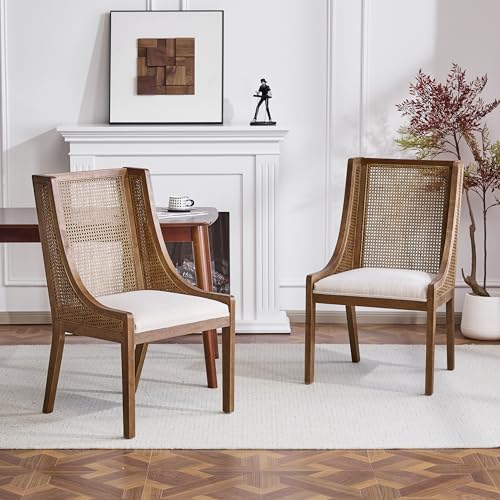
Christopher Knight Home Yone Dining Chairs Set of 2 — Best cane-webbing pair
The Yone pair makes its design argument through texture: fabric upholstery on a rubberwood frame, with cane webbing as the feature material, in beige and brown. Cane webbing — the woven, open cane panel familiar from a century of chair backs — brings pattern without print and airiness without fragility of appearance. In a dining room full of smooth surfaces, a cane back is the detail every guest’s eye finds.
Rubberwood is the frame’s honest footnote: a plantation hardwood widely used in furniture of this class, sturdy and fine-grained, named plainly in the listing. The pairing of cane and rubberwood places the Yone in the warm, natural-materials family of design — the family that suits linen tablecloths, ceramic tableware, and rooms that prefer their design quiet and tactile over loud and glossy.
As a pair, the Yone works the way the Huacar does but in an opposite register: two cane-backed chairs at the heads of a rectangular table, or flanking a simpler set, add the designed note without redesigning the room. Buyers building slowly will appreciate that the pair’s neutral palette forgives later additions.
- Set size: 2 chairs
- Feature material: cane webbing, as printed in the listing
- Frame: rubberwood frame
- Upholstery: fabric upholstery
- Colours named in listing: beige and brown
- Where to buy: the Christopher Knight Home Yone Dining Chairs Set of 2 listing on Amazon — check price on Amazon
Strengths
- Cane webbing delivers pattern and lightness in a single material.
- Natural, warm materials suit relaxed and organic dining rooms.
- A neutral pair integrates with simpler existing chairs gracefully.
Trade-offs
- Cane panels dislike being leaned on with point loads — teach the household.
- A pair alone will not furnish a table; budget the full count.
- The quiet register may underwhelm buyers chasing drama.
Best for: texture-led, natural-materials rooms and head-of-table accents. A weak match for: buyers who want one bold colour to carry the room.

Furniture of America Nazaen III Side Chairs Walnut Set of 2 — Best rounded-back walnut pair
The Nazaen III pair closes the guide with wood at its most deliberate: side chairs in rich walnut, 21.5 inches wide as the listing prints, with rounded backrests and a description the maker calls semi-handmade. A rounded backrest in solid-toned wood is mid-century design reduced to its essence — no upholstery to hide behind, no ornament to distract — so the curve itself has to be right, and a listing willing to print a width and a making-method is at least inviting that judgement.
Side chairs are the flexible citizens of the dining room, and this pair’s flexibility is a design feature in itself: they can serve the table, flank a sideboard, or take a corner as reading chairs without looking displaced. The 21.5-inch width is generous for a side chair, promising a seat that does not ration its sitter, while the armless profile still tucks cleanly when the table calls.
Walnut’s richness is the pair’s atmosphere. Against pale walls it reads as deliberate punctuation; against dark ones it nearly vanishes and lets shape speak. Either way, this is the pick for buyers whose design instinct runs to timber and restraint — the ones who believe a chair should be beautiful the way a well-made table is beautiful, by proportion and material rather than by upholstery.
- Set size: 2 chairs
- Width printed in listing: 21.5 inches
- Back: rounded backrest
- Finish named in listing: rich walnut
- Making described in listing as: semi-handmade, in the maker’s wording
- Where to buy: the Furniture of America Nazaen III Side Chairs Walnut Set of 2 listing on Amazon — check price on Amazon
Strengths
- A pure-proportion design that needs no upholstery to justify itself.
- A printed width helps buyers plan rim space honestly.
- Armless side chairs work at the table and everywhere else in the house.
Trade-offs
- An unupholstered seat is firm through a long dinner without a pad.
- Walnut tones vary; a pair bought later may not match the first exactly.
- Restraint reads as plainness to buyers who wanted visible luxury.
Best for: timber-led, mid-century rooms and lovers of proportion over padding. Not suited for: sitters who equate comfort with deep upholstery.
Six Silhouettes Side by Side
The comparison below strips each design to its form, its surface, and its count — the three facts that decide whether it can furnish your table.
| Chair | Design language | Sold as | Surface and frame |
|---|---|---|---|
| Huacar Sculptural Dining Chairs Set of 2 Boucle | Sculptural softness | Pair | Cream boucle over a metal frame |
| Merax Upholstered Armchair Dining Chairs Walnut Set of 4 | Dressed walnut formality | Set of 4 | Fabric cushions, walnut, gold arms |
| CIMOTA Barrel Dining Chairs Set of 4 Velvet | Velvet enclosure | Set of 4 | Velvet fabric, wood legs, open back |
| HNY Retro Barrel Dining Chairs Set of 6 Faux Leather | Retro practicality | Set of 6 | Faux leather, metal legs, open back |
| Christopher Knight Home Yone Dining Chairs Set of 2 | Woven texture | Pair | Cane webbing, rubberwood, fabric |
| Furniture of America Nazaen III Side Chairs Walnut Set of 2 | Rounded timber restraint | Pair | Rich walnut, rounded backrest |
How Do You Seat a Table With Armchairs Without Crowding It?
Count rim, not chairs. An armchair at a dining table claims roughly a third more edge than a side chair, because its arms set the spacing for its neighbours too. A table that seats six in side chairs seats four in armchairs with grace — and grace, at a hosted dinner, is worth more than the two extra places nobody enjoys. The Merax and barrel sets in this guide reward tables planned around them rather than tables they are squeezed onto.
Height is the second check. Arms must clear the tabletop or slide beneath it; an arm that stops against the top’s edge parks the sitter too far from their plate, and the chair spends the meal as a small act of resistance. Measure the arm height against your top and its apron before ordering armchairs in any quantity — the least glamorous measurement in this guide, and the one that decides whether glamour works.
Mixed seating is the designer’s own escape hatch: armchairs at the two heads, side chairs along the sides. It gives a rectangular table hierarchy and ceremony while keeping the long edges flexible, and it lets a buyer combine, say, the Merax arms with walnut side chairs in a shared timber language. Readers furnishing a counter as well as a table will find the same width discipline applied to taller seating in Best Leather Bar Chairs, where arm and back choices meet a very different piece of furniture.
What Mistakes Do Buyers of Design-Led Chairs Make?
The first is buying the photograph instead of the chair: a single sculptural seat in a styled loft tells you nothing about six of them around your table under your ceiling light. Multiply the chair mentally before buying it singly. The second is ignoring the back view — the angle your room actually lives with — and discovering that a chair gorgeous from the front is a billboard of staples and plain board from behind.
The third mistake is palette collision. Design-led chairs arrive with strong colour opinions — cream boucle, khaki velvet, retro brown — and a room already holding two strong opinions will not absorb a third without a fight. The fourth is neglecting the floor: slim metal legs concentrate weight, wood legs drag, and both meet your flooring daily. Felt, glides, and lifting habits belong in the same budget conversation as the chairs.
Finally, buyers forget that design-led also means direction-led. A mid-century set will pull every later purchase in the room toward mid-century. That gravity is the pleasure of the category when chosen deliberately, and a slow regret when it arrives unnoticed with a pair of chairs bought on a whim.
Can Strong Design Survive Family Life?
Mostly, yes — with honest matching between the chair and the household’s actual habits. The HNY’s faux leather was practically invented for this question, and the Nazaen’s unupholstered walnut shrugs off what would stain boucle for a week. The Huacar’s cream loops sit at the other pole: a beautiful chair for households whose dinners are adult, careful, or rare. None of these positions is more virtuous; the failure mode is only mismatch.
Care routines scale with the material. Velvet wants a brush and quick blotting; boucle wants a gentle vacuum with an upholstery tool and patience with crumbs; cane wants dust kept out of its weave and no one standing on it, ever, to reach a shelf. Walnut wants what all wood wants — coasters are for tables, but chairs ask only to be kept out of standing water and harsh sun. A household willing to give a chair its small specific care can keep design-led furniture looking designed for years.
There is also a household-scale argument for beauty itself. Rooms people find beautiful get treated better — meals linger, clutter migrates elsewhere, the table gets cleared because it deserves to be seen. A design-led set is partly a bet on that effect, and experienced hosts will tell you the bet usually pays. Readers planning the drinks side of those long evenings may enjoy the cellar arithmetic in Best 125-Bottle Wine Refrigerators, where capacity claims need the same careful reading as chair set sizes.
How Should You Stage a Room Around One Strong Silhouette?
Let the chairs be the loudest furniture and quiet everything within their sightline. A plain table, a simple rug or none, walls that hold their peace — the silhouette needs that calm around it the way a painting needs wall. Then repeat one element of the chair elsewhere, once: the walnut echoed in a sideboard, the boucle’s cream in a cushion, the cane’s weave in a pendant shade. One echo is design; five echoes are a theme restaurant.
Lighting decides whether sculptural upholstery performs. Boucle and velvet both live on shadow — raking light from a window or a low pendant reveals their texture, while flat overhead light flattens them into ordinary cloth. If your dining light is a single ceiling dome, consider that the chairs’ beauty will arrive at half strength, and either change the light or choose the walnut and cane designs, which hold their own under any illumination.
And give the set a season before judging it. Design-led chairs change a room’s balance, and the eye needs weeks to stop seeing the old arrangement’s ghost. Households that rearrange the rest of the room in the first weekend often chase their own tail; live with the chairs, let the room settle, then move the one thing that still argues.
What About the Rest of the House?
A design-led dining set rarely stays a dining-only decision. Its language leaks — happily — into the rooms around it, and the wise buyer plans the leak. The household that chooses walnut and cane for dinner will find itself choosing similar warmth elsewhere, from the kitchen’s stools to the laundry’s cabinetry; even a utilitarian purchase like the stacked laundry pairs surveyed in Best Stacked Washer Dryers gets judged, in a design-led home, by whether its lines can hold their own in an open-plan sightline. Coherence is not vanity. It is how a house comes to feel like one decision made slowly, rather than forty decisions made in a hurry.
Reading a Listing Like a Designer Would
Designers read furniture listings backwards: materials first, construction second, photograph last. Follow that order here. The listings in this guide name boucle, velvet, faux leather, cane, rubberwood, walnut, metal, and wood legs — a vocabulary you can verify, compare, and care for. What they mostly do not name is joinery, foam density, or frame timber beyond the headline, and a careful buyer treats those silences as information too: at this level of the market, you are buying form and surface, and the form had better be worth it.
Measurements deserve the same backward reading. One listing in this guide prints a width — the Nazaen’s 21.5 inches — and that single number lets a buyer plan a table’s seating with real precision. Where a listing withholds dimensions, the product page’s specification section usually holds them, and five minutes there prevents the classic design-chair disappointment: a silhouette you love arriving at a scale your room cannot use. Designer chairs are unusually scale-sensitive, because their proportions are their whole argument; a sculptural chair two inches too large for its table is not slightly wrong, it is wrong in the way a misprinted letter is wrong.
Photographs, read last, should be read forensically. Count the chairs in the scene and compare with the set size in the title. Look at what the chair is photographed beside — a low table flatters tall backs, a vast loft flatters everything — and find the one image, if it exists, taken from behind. That rear view is the one your room will live with, and it is the image sellers of genuinely designed chairs are proudest to show.
The Back View: Designing the Side Nobody Photographs
Stand in a dining room doorway and you are looking at backs: a row of them, at eye height, forming the room’s most repeated shape. This is why the backs in this guide were weighed so heavily. The barrel chairs present a continuous, upholstered curve — handsome from behind by construction. The cane Yone shows its woven panel, which is its best face in either direction. The Nazaen’s rounded walnut backrest is a shaped board of timber, designed to be seen. Even the Huacar’s boucle wraps its form so the rear reads as sculpture rather than upholstery’s backstage.
What you want to avoid, in any design-led purchase, is the chair whose rear exposes the manufacturing: visible staples, an unfinished panel, a zipper doing structural work. Listings rarely photograph that angle for chairs that suffer from it, which is itself a clue. When a rear image is missing, buyer photographs in reviews often supply it — the one research step this guide recommends without reservation.
There is a styling consequence too. A beautiful row of backs lets the dining table itself stay plain, even austere, and still produce a room that feels designed. Households often discover, a month after buying chairs like these, that the table they meant to replace no longer needs replacing. That is the economics of the category at its best: six considered chairs doing the work of a whole room’s renovation.
Era Mixing: Mid-Century Bones in Contemporary Rooms
Nearly every silhouette in this guide descends from mid-century design — the barrel, the rounded walnut back, the cane panel, the sculptural boucle form all carry that era’s DNA. Yet none of these chairs requires a mid-century room. The contemporary way to use them is as the room’s single historical accent: modern table, contemporary lighting, and chairs that bring the warmth and curve the rest of the room deliberately lacks. Era purity is for museums; era conversation is for houses.
The mixing rule that works is temperature, not chronology. Walnut, cane, boucle, and velvet are all warm materials; they coexist happily across decades because they share a temperature. Chrome, glass, and blackened steel run cool. A room can hold both temperatures when each has a clear territory — cool table, warm chairs, or the reverse — and fails when the temperatures alternate chair by chair like a chessboard.
Buyers should also know that mid-century forms are forgiving of ordinary rooms in one specific way: they were designed for postwar houses, which were small. These silhouettes assume modest ceiling heights, tables that seat four to six, and rooms that double for other uses. That is precisely the modern apartment and the modern open-plan corner, which is why this design language, seventy years on, still outsells every attempt to replace it.
What Happens When a Designed Chair Breaks?
Repairability is the unglamorous question design buyers forget to ask, and it divides this field honestly. Wooden chairs — the Nazaen above all — can be reglued, refinished, and re-seated by any competent furniture repairer, indefinitely; a walnut side chair is a fifty-year object with ordinary care. Upholstered forms live by their fabric: velvet and boucle can be professionally cleaned and eventually re-covered, at a cost that makes sense only because the form beneath is worth keeping.
Cane has its own craft tradition — webbing can be replaced by specialists, and a re-caned chair returns genuinely renewed rather than patched. Metal frames rarely fail at all, though a bent leg is a replacement conversation rather than a repair one. Faux leather is the honest exception in the field: when its surface eventually cracks or peels, re-covering is rarely economical, and the HNY set should be bought with that lifecycle understood — years of hard, wipeable service, not a half-century heirloom. Different chairs promise different lifespans, and a guide that pretended otherwise would be selling, not advising.
The practical habit that protects all of them is the same: keep the purchase record, photograph the listing’s details at buying time, and note the maker’s name somewhere more durable than a shipping box. Design-led chairs reward owners who treat them as long possessions, and long possessions deserve paperwork.
Ordering Pairs Without Losing the Match
Three of these six designs are sold as pairs, which creates a quiet risk the sets of four and six do not carry: variation between orders. Upholstery dye lots shift, walnut tones wander, and a pair bought in March may sit a half-shade away from its siblings bought in November. The defence is simple and worth following strictly — order the full count in one purchase whenever the table’s size is already known. Staged buying is a strategy for households still deciding; it should never be a habit formed by accident.
If staging is genuinely necessary, buy the later pairs against a swatch of the first: a cushion, a photograph taken in daylight, the listing’s colour name recorded exactly. And place the pairs so that any slight variation reads symmetrically — the two newer chairs opposite each other rather than adjacent — because the eye forgives a pattern what it never forgives in a gradient. Designers use this trick instinctively; there is no reason a household cannot borrow it.
Keep one more discipline with pair-bought designs: retain the option, mentally, of stopping. A table of four Yone or Nazaen chairs is a complete thought. Six is a bigger thought, not a better one, and the households happiest with design-led purchases are usually those who bought the count their room asked for rather than the count their enthusiasm suggested on the first evening.
The First Fortnight: Living With a Silhouette
New design-led chairs pass through three phases in a household. In the first days they are looked at more than sat in, and every member of the household has a verdict. In the second week they begin their real work — the breakfast sat in without noticing them is the first sign of success, because furniture that disappears into use while remaining beautiful when noticed has achieved the whole point of design. By the end of the fortnight, the room’s other furniture has either settled around them or revealed itself as the next decision.
Use that fortnight deliberately. Eat at the table daily rather than saving the chairs for occasions, because daily use is the test that matters and the return window is the only leverage a buyer ever has. Check the arm heights against real plates and elbows, the barrel wraps against real postures, the cane against real backs in real clothing. A chair that hosts a Tuesday well will host a celebration beautifully; the reverse is not always true.
And photograph the room at the fortnight’s end, from the doorway, in ordinary light. That photograph — not the listing’s, not the first evening’s — is the chair’s true portrait, and it is the one to compare against what you hoped for when you ordered. Most buyers of the six designs in this guide find the portrait better than the hope, because these forms were chosen, again and again, for what they do to real rooms.
What Should You Spend Attention on, If Not Money?
Design-led chairs redirect a buyer’s budget of attention rather than simply enlarging it. The hours that plain-chair buyers spend comparing prices across identical silhouettes, the readers of this guide spend on silhouette, scale, and the rear view — and that reallocation is worth making consciously. Decide the design idea first, in the abstract: enclosure, sculpture, texture, timber. Then let the picks compete within that idea, because a barrel and a cane chair are not rivals in any sense that a comparison table can settle; they are answers to different questions about what a room is for.
Attention also belongs on the room’s existing commitments. A designed chair does not enter an empty space; it enters a negotiation with a table bought in another year, a rug with its own opinions, a light fitting that cannot be moved. The buyers who end happiest with this category are those who conducted that negotiation honestly before ordering — who knew which existing piece the chairs had to befriend, and which piece they were quietly voting to replace. Walk into the purchase with that map drawn, and the six silhouettes above sort themselves with surprising speed.
Final Recommendation
Choose by the idea you want your dining room to be about. For softness made architectural, the Huacar boucle pair — bought in whatever multiple your table needs — is the guide’s purest design statement. For formality, the Merax walnut armchairs furnish a hosted room in one set of four. For conversation-shaped comfort, the CIMOTA velvet barrels; for six seats and wipeable retro nerve, the HNY faux-leather barrels, synthetic and proud of it. For texture, the Yone cane pair; for timber restraint, the Nazaen III walnut pair.
Whichever silhouette you choose, repeat it with conviction and give it a quiet room to work in — a designed chair, multiplied and respected, stops being furniture and becomes the way the room thinks about itself.
Frequently Asked Questions
Does “designer” in this guide mean famous designer brands?
No, and the guide says so at the top: the word is read as design-led form — sculptural, barrel, walnut, cane — not licensed names or verified famous designers. Judge each chair on its silhouette and materials, which are stated per listing.
Is the HNY barrel set genuine leather?
It is faux leather, per its own listing — a synthetic upholstery in a retro brown. That makes it wipeable and practical at a set size of six, but buyers who want hide should not choose it.
How many boxes do I need for six matching chairs?
It depends on the design: the HNY set arrives as six in one configuration, the CIMOTA and Merax as fours, and the Huacar, Yone, and Nazaen as pairs — three boxes of a pair design to seat six. Always confirm the set size on the listing before ordering.
Can I mix two of these designs at one table?
Yes, with a shared language: walnut armchairs with walnut side chairs, or a boucle pair heading a table of plain seats. Mixing works when one element — timber, colour, era — repeats; it fails when each chair argues a different century.
Are barrel chairs comfortable for long dinners?
The wrap-around back supports a turned, conversational posture and gives forearms a resting line, which many sitters love through long meals. Their width is the constraint: barrel chairs seat fewer people per table than side chairs do.
Should designer chairs match the table’s era exactly?
No — they should converse with it. A mid-century chair at a contemporary table is the standard modern arrangement, and it works when one element repeats between them: a timber tone, a curve, a colour temperature. Exact era matching is for period rooms; conversation is for living ones.
How do I keep velvet and boucle dining chairs presentable?
Blot spills immediately, never rub; brush velvet’s pile in one direction when dry; vacuum boucle gently with an upholstery attachment. Both fabrics reward prompt, calm responses and punish scrubbing.
Related Guides
Design-led dining choices continue elsewhere on this site. The companion guide to Best Chairs for the Head of a Dining Table takes the single most ceremonial seat at the table and gives it a survey of its own, for readers whose rectangular table still wants one chair to rule the end of it.



[…] planning a whole-room scheme around one hero chair may enjoy the sculptural confidence on show in Best Designer Dining Chairs, where form is argued as fiercely as comfort is […]