What's inside
- Key Takeaways
- Quick Picks
- How did we choose front-loaders for a guide about colour?
- How do the six finishes and machines compare?
- Why doesn’t colour change how a washer washes?
- How do dark finishes behave across a decade of laundry?
- What does metallic silver do that neither black nor white can?
- How should you match a coloured washer to its dryer?
- Which finish suits a laundry room with no natural light?
- How do you clean and protect a coloured finish properly?
- Does a coloured finish affect resale or replacement later?
- How do you coordinate a coloured washer with cabinetry and worktops?
- What should you check in the listing photographs before trusting a colour?
- How does a coloured machine change a laundry room’s daily mood?
- What mistakes do buyers of coloured washers keep making?
- Final Recommendation
- Frequently Asked Questions
- Related Guides
As an Amazon Associate I earn from qualifying purchases. This post may contain affiliate links at no extra cost to you.
cottageverdict.com is reader-supported. When you buy through links on our site, we may earn an affiliate commission.
Where to buy: every machine below is sold on Amazon under the heading name shown, so read the listing’s finish wording as carefully as its capacity line, since colour names vary between makers, and check price on Amazon once both agree with your room.
The best colorful front-load washers begin with a confession this guide will repeat until it sticks: the colour of a washing machine changes nothing about how it washes. A black steel drum spins no faster than a white one, metallic silver extracts no more water than black stainless, and no finish yet invented has improved a detergent’s chemistry. What colour changes is everything around the wash: how the laundry room feels, how honestly the machine shows its daily grime, how well it ages in a visible space, and whether opening the laundry door pleases you or faintly depresses you for a decade.
That is not a trivial list. Laundry machines are among the largest objects in a home, they increasingly live in sight, in open-plan utility spaces, kitchen runs, and renovated bathrooms, and their finishes have quietly become a design decision on par with worktops and taps. Makers have answered with a palette that goes well beyond the historic white: metallic silvers, black steels, black stainless finishes, and deep blacks, each with its own behaviour toward fingerprints, scratches, lint, and light. This guide treats those finishes as the serious subject they are, while keeping the underlying machines honest.
The six linked picks span the palette deliberately. A Kenmore in metallic silver with steam treatment and an efficiency certification in its title. An LG in black steel at a generous 5.2 cubic feet with steam and TurboWash. A Samsung in black stainless steel, also efficiency-certified in its title. A second LG, the WM4000HBA, listed in black with Wi-Fi. A compact TABU in black with fifteen cycles for smaller spaces. And, as the palette’s control sample, a GE Profile in classic white at 4.8 cubic feet, included so the coloured finishes can be judged against the finish they are all quietly replacing.
Read the reviews in that spirit: machine first, finish always in view. Where a title states a feature, steam, certification, connectivity, the review uses it. Where it does not, the review stays silent rather than borrowing glamour from a sibling model. And throughout, the finish gets its own honest accounting, because a colour you must polish daily is a chore wearing a design’s clothing, and a colour that hides a week of lint is a servant in disguise.
Key Takeaways
- Colour changes care, light, and mood in the laundry room; it does not change wash performance by one degree.
- Dark finishes hide some sins and advertise others: black steel shows lint and dust, metallic finishes show fingerprints.
- The GE Profile in white is this set’s control sample, the finish every coloured machine must justify replacing.
- Two picks carry an efficiency certification in their titles, the Kenmore in silver and the Samsung in black stainless.
- The largest machine here, at 5.2 cubic feet, wears black steel, proof the palette now spans serious family sizes.
- A compact black TABU shows the palette reaching small spaces, with fifteen cycles in a stackable frame.
Quick Picks
| Pick | Badge | Why it earns its place |
|---|---|---|
| Kenmore 4.5 Cu. Ft. Front Load Washer, Metallic Silver | Metallic silver with steam | A 4.5 cubic foot front-loader in metallic silver with steam treatment, Accela Wash, touch controls, and certification in its title. |
| LG 5.2 Cu. Ft. Front Load Washer in Black Steel | Black steel at family scale | The set’s largest machine, a 5.2 cubic foot stackable LG in black steel with steam and TurboWash technology. |
| Samsung 4.5 Cu. Ft. Front Load Washer, Black Stainless Steel | Black stainless, certified | A 4.5 cubic foot Samsung, model WF45T6000AV in its title, wearing black stainless steel with certification stated. |
| LG WM4000HBA 4.5 Cu. Ft. Front-Load Washer, Black | Connected black all-rounder | A 4.5 cubic foot LG listed in black, its fuller title naming black steel, with Wi-Fi connectivity and high-efficiency billing. |
| TABU 4.0 Cu. Ft. Front Load Washer, Black | Compact black, fifteen cycles | A 4.0 cubic foot black front-loader, compact and stackable, with fifteen cycles and an LED display for smaller spaces. |
| GE Profile 4.8 Cu. Ft. Smart Front Load Washer, White | The white control sample | A 4.8 cubic foot, 28-inch GE Profile in white, included as the palette’s benchmark and a serious machine in its own right. |
How did we choose front-loaders for a guide about colour?
The first rule was palette coverage with machine credibility. Each pick had to be a front-load washer worth considering on its own merits, capacity, features stated in its title, format, and then contribute a distinct finish to the set: metallic silver, black steel in two interpretations, black stainless steel, compact black, and white. A gorgeous finish on a machine nobody should buy would have failed the first test, and a superb machine duplicating another pick’s exact colour story would have failed the second.
The second rule was title discipline, applied as strictly here as anywhere in the batch. Capacities come from the titles: 4.5, 5.2, 4.5, 4.5, 4.0, and 4.8 cubic feet in pick order. Features come from the titles too: steam on the Kenmore and the big LG, efficiency certification on the Kenmore and the Samsung, Wi-Fi on the WM4000HBA, fifteen cycles on the TABU. Finish descriptions follow the titles’ own words, which is why the WM4000HBA is described carefully, listed as black while its fuller title text names black steel, a small lesson in why buyers should read finish wording completely.
Third, the reviews weigh finish behaviour as evidence, not decoration. How a finish handles fingerprints is a daily fact. How it handles a scratch is a yearly one. How it sits under a laundry room’s actual lighting, warm, cold, or daylight-starved, decides whether the colour you chose in a bright showroom is the colour you live with. Each review therefore gives the finish a paragraph of its own, separate from the machine’s, because conflating the two is how buyers end up with a wonderful washer they faintly resent looking at.
Finally, the set spans the room types coloured machines actually enter: the visible renovated laundry, the kitchen run, the apartment corner, and the traditional white utility room considering a change. If your room is hidden and purely functional, this guide will still serve you, by demonstrating calmly that white remains a perfectly rational finish, which is a conclusion the palette’s marketing would prefer you never reached.
One scope note completes the method: finishes were assessed as families, silver, black steel, black stainless, black, and white, because individual makers formulate each family slightly differently, and a buyer comparing across brands should expect cousins rather than twins even where the names on the listings match word for word.

Kenmore 4.5 Cu. Ft. Front Load Washer, Metallic Silver — Metallic silver with steam
Metallic silver is the diplomat of the palette, and this Kenmore wears it with a specification that needs no diplomatic help. The listing describes a 4.5 cubic foot front-load washer in metallic silver with a stain-removing steam treatment, Accela Wash for shorter laundry time, touch controls, and an ENERGY STAR certification stated outright in the title. That combination, a mid-size family capacity, steam for the loads that benefit from it, and a certified efficiency story, would earn a shortlist place in any front-load guide. The finish is the bonus, and it is a genuinely useful one.
Silver’s practical gift is forgiveness. Between white’s clinical brightness and black’s lint confession, a metallic silver surface splits the difference: it reflects enough light to keep a small laundry room feeling open, yet its brushed, mid-tone character hides the everyday evidence, splashes, dust, the faint detergent film, far better than either extreme. Fingerprints register less dramatically than on black stainless, and the finish flatters both warm and cool lighting, which matters in rooms whose only light is a ceiling bulb of uncertain vintage.
As a machine, the steam treatment suits the loads front-load buyers actually fuss over: work shirts, bedding that benefits from a thorough hot cycle, and the occasional stain that needs more than a standard wash’s persuasion. Accela Wash addresses the opposite end of the diary, the load that simply needs to be done sooner. Touch controls keep the silver fascia unbroken and wipeable, a small aesthetic decision with daily consequences, since a panel you can clean with one pass is a panel that stays silver rather than graduating to grey.
Choose this Kenmore if your laundry room is visible, your lighting is mixed, and you want the palette’s easiest finish to live with wrapped around a certified, steam-equipped machine. It is the set’s most balanced proposition, and its balance is precisely what most households, whatever their design ambitions, actually need.
- Capacity printed in the listing title: 4.5 cu. ft.
- Finish named in the title: metallic silver
- Features in the title: steam treatment, Accela Wash
- Certification stated in the title: ENERGY STAR certified
- Controls described in the title: touch controls
Strengths
- Silver finish forgives splashes, dust, and fingerprints
- Steam and certification both stated in the title
- Mid-size capacity suits most family laundry rooms
Trade-offs
- Silver can read as appliance-grey in cold light
- Touch panel offers no dial for traditionalists
- Steam benefits specific loads rather than every load
Best for: a visible laundry room wanting the palette’s lowest-maintenance coloured finish.
Not suited for: a buyer chasing the drama of a true black machine.

LG 5.2 Cu. Ft. Front Load Washer in Black Steel — Black steel at family scale
Black steel is the finish that turned laundry appliances into furniture, and this LG is its fullest expression in the set: a 5.2 cubic foot stackable smart front-load washer in black steel, with steam and TurboWash technology, per its listing title. Scale matters to the colour story here. A dark finish on a small machine is an accent; on the largest washer in the guide, standing in a laundry room or anchoring a kitchen run, it is a design commitment, and households should make it with the same seriousness they would give a dark worktop or a black range cooker.
The machine underneath the finish justifies the commitment. Five point two cubic feet is family territory, the class that swallows a king duvet as a dedicated load and shortens the weekly cycle count, while TurboWash addresses the time those big loads take and steam handles the loads that need persuasion. Stackable format adds the vertical option, pairing the washer with a matching dryer above it, and in black steel that column becomes a deliberate piece of room architecture rather than two appliances that happen to share a wall.
Now the finish’s honest ledger. Black steel shows pale lint, dust, and dried detergent splashes with documentary clarity, and in a sunlit room it will ask for a weekly wipe to keep its dignity. In exchange it hides the darker evidence, scuffs and shadows, better than white, resists the yellowing that ages white enamel in bright rooms, and gives a laundry space a gravity that lighter finishes cannot. Fingerprints sit in the middle of the scale: visible on the door surround, manageable with the same weekly cloth that handles the lint.
Buy the big LG if your room is designed, your loads are large, and your household will give a dark finish its modest weekly courtesy. It is the palette’s statement piece with a family machine’s substance underneath, and statement pieces earn their place exactly when the substance is real.
- Capacity printed in the listing title: 5.2 cu. ft.
- Finish named in the title: black steel
- Features in the title: steam, TurboWash technology
- Format described in the title: stackable, smart
- Positioning: largest machine in this set
Strengths
- Largest capacity wears the palette’s boldest finish
- Steam and TurboWash stated in the title
- Stacking builds a designed laundry column
Trade-offs
- Dark finish documents lint and splashes weekly
- Statement scale overwhelms small, dim rooms
- Family capacity demands loose, honest loading
Best for: a designed laundry room with family-scale loads and a weekly wipe habit.
Not suited for: a low-light utility room where a dark giant will brood.

Samsung 4.5 Cu. Ft. Front Load Washer, Black Stainless Steel — Black stainless, certified
Black stainless steel is the palette’s most architectural finish, a darkened metal that reads less like a colour applied to an appliance and more like a material the appliance is made from. Samsung’s entry states its case compactly in the listing: a WF45T6000AV front-load washer of 4.5 cubic feet in black stainless steel, carrying an ENERGY STAR mark in the title. For buyers furnishing a kitchen-adjacent laundry or an open-plan utility space with dark cabinetry and steel elsewhere, this is the finish designed to belong there, coordinating with black stainless ranges and refrigerators across the modern kitchen palette.
The machine’s proposition is the mainstream front-load one at the market’s centre size. Four and a half cubic feet covers couples and small families completely, bedding as dedicated loads, weekly clothing in a few cycles, and the certification in the title gives its running-cost story a stated anchor rather than an implication. Samsung’s laundry ecosystem, distribution, parts, and service familiarity, stands behind the purchase in the way this guide has noted for the brand elsewhere in the batch: unglamorous, and valuable precisely when a machine is expected to serve for years.
Black stainless has a specific care personality that buyers should hear plainly. Its darkened surface is a finish over steel, and like all such finishes it prefers soft cloths to abrasive pads; a scratch that reaches through the dark layer announces itself more visibly than a scratch on plain steel, because the bright line contrasts with the dark field. Households with belt buckles, tool belts, and laundry baskets swinging at hip height should weigh that fact. Treated with ordinary care, the finish ages gracefully; treated roughly, it keeps receipts.
Choose the Samsung if your room’s palette is dark and metallic, your household is mid-size, and you value a certification stated in writing. It is the connoisseur’s finish in this set, rewarding the careful and quietly taxing the careless, which is a fair description of most beautiful things a home can contain.
- Capacity printed in the listing title: 4.5 cu. ft.
- Finish named in the title: black stainless steel
- Model named in the title: WF45T6000AV
- Certification stated in the title: ENERGY STAR
- Configuration: standalone front-load washer
Strengths
- Black stainless coordinates with dark modern kitchens
- Certification stated outright in the listing title
- Centre-size capacity suits most households fully
Trade-offs
- Finish layer resents abrasive cleaning and hard knocks
- Dark surface shows pale dust between wipes
- Mid-size tub will not match the big LG for bedding
Best for: a dark, metallic kitchen palette with a careful household and mid-size loads.
Not suited for: a rough-and-tumble utility room where finishes take knocks.

LG WM4000HBA 4.5 Cu. Ft. Front-Load Washer, Black — Connected black all-rounder
This LG arrives with a small lesson in finish literacy attached. The listing presents the WM4000HBA as a 4.5 cubic foot smart front-load washer in black, while its fuller title text describes a high-efficiency machine with Wi-Fi connectivity in black steel. Black and black steel are neighbours, not synonyms: a flat black reads softer and more matte, a black steel keeps a metallic depth under the darkness. Before ordering, read the listing’s finish line completely and look at its photographs in ordinary light, because the difference between the two is exactly the kind of detail a colour-led purchase exists to get right.
As a machine, the proposition is the connected mainstream. Wi-Fi connectivity brings the practical smart features this batch keeps endorsing, cycle-end alerts that rescue forgotten loads, a remote glance at remaining time, and diagnostic help when a fault appears, while the high-efficiency billing in the title places it in the low-water front-load mainstream. At 4.5 cubic feet it matches the Kenmore and Samsung here litre for litre, which usefully isolates the real differences among the three: finish character, feature emphasis, and brand ecosystem, rather than size.
Against its black steel sibling above, this machine trades scale for subtlety. The darker, less metallic reading suits rooms where the washer should recede rather than preside, a laundry alcove off a hallway, a bathroom installation, a kitchen run where the cabinetry already carries the design argument. Fingerprint behaviour follows the finish’s matte lean: smudges soften rather than shine, though pale lint keeps its usual visibility against any dark ground, and the weekly wipe remains the household’s small tax on darkness.
Select the WM4000HBA if you want the dark palette in its quieter register, with connectivity doing useful work and a centre-size tub beneath it. Confirm the exact finish wording on the listing first, then enjoy the rare purchase in which the homework was about something as pleasant as what colour your laundry room gets to be.
- Capacity printed in the listing title: 4.5 cu. ft.
- Finish wording in the title: black, with black steel in fuller text
- Connectivity in the title: Wi-Fi enabled, smart
- Efficiency wording in the title: high-efficiency
- Model named in the title: WM4000HBA
Strengths
- Quieter dark register suits alcoves and bathrooms
- Wi-Fi alerts serve forgetful laundry households
- Centre size matches the set’s mainstream picks
Trade-offs
- Finish naming needs careful reading before ordering
- Dark ground still advertises pale lint
- Connectivity value depends on laundry-room Wi-Fi
Best for: a household wanting dark, connected, and understated in one machine.
Not suited for: a buyer who needs a finish name that brooks no interpretation.
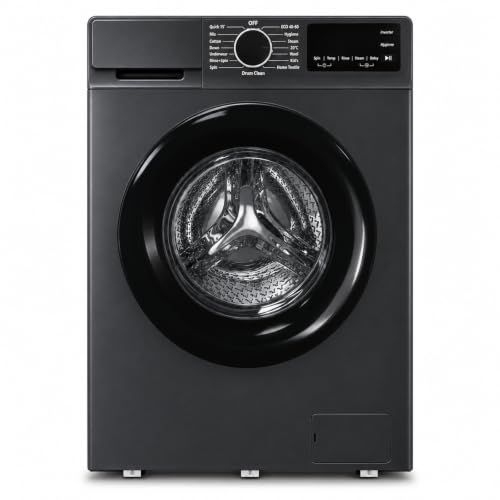
TABU 4.0 Cu. Ft. Front Load Washer, Black — Compact black, fifteen cycles
The palette’s reach into small spaces is this TABU’s contribution, and it is a welcome one, because compact laundry has historically been offered in any colour the buyer wanted provided it was white. The listing describes a 4.0 cubic foot front-load washer in black with fifteen washing cycles, a compact, space-saving, stackable design, energy-efficiency billing, and an LED display, aimed at apartments and laundry rooms. A black compact changes a small laundry corner’s whole register: where a white box reads as an appliance stored in the room, a black one reads as a furnishing chosen for it.
Four cubic feet in a compact frame deserves a clarifying word, since it exceeds the drums of the apartment combos elsewhere in this batch while keeping a space-saving stance. This is a washer-only machine, no drying function, so its capacity serves households that dry on airers, lines, or a separate compact dryer in the stack the design anticipates. Fifteen cycles is a generous vocabulary for the class, giving delicates, quick washes, and heavy programmes their own settings rather than forcing one programme to impersonate them all.
Black in a small room behaves differently than black at family scale. A compact dark machine reads as an accent, a deliberate dark note in a corner, rather than as a looming presence, and its lint visibility is proportionately easier to manage: one small surface, one quick wipe. The LED display’s brightness against the black fascia is a small daily pleasure owners mention in this class, legible at a glance across the room, where pale panels can wash out under strong light.
Buy the TABU if your laundry space is small, visible, and tired of white goods, and if your drying life is already solved by airer or line. It brings the palette to the corner of the home that design forgot, and it brings a real cycle vocabulary with it, which is more than a coat of paint could ever claim.
- Capacity printed in the listing title: 4.0 cu. ft.
- Finish named in the title: black
- Cycles in the title: 15 washing cycles
- Format in the title: compact, space-saving, stackable
- Display described in the title: LED display
Strengths
- Black finish dignifies small, visible laundry corners
- Fifteen cycles is generous for the compact class
- Stackable design anticipates a compact dryer above
Trade-offs
- Washer only, so drying needs its own solution
- Lesser-known brand means checking service locally
- Compact frame still caps bedding ambitions
Best for: a small, visible laundry space that wants design and cycles together.
Not suited for: a household needing a washer-dryer in a single box.

GE Profile 4.8 Cu. Ft. Smart Front Load Washer, White — The white control sample
Every palette needs its control sample, and this GE Profile is a distinguished one. The listing describes a 28-inch smart front-load washer of 4.8 cubic feet in white, model GFW550SSNWW, from GE’s Profile tier. White is included in this guide without irony, because it remains the finish against which every coloured claim must be measured: it brightens dim rooms, it coordinates with every existing appliance a household already owns, it hides pale lint and dust better than any dark finish, and it never dates the way a fashionable colour can. A guide that could not say those things plainly would be a brochure, not a guide.
The machine earns its place beyond the colour argument. Four point eight cubic feet sits between the set’s mainstream and its largest, a genuinely family-capable size, and the Profile tier is GE’s feature-forward line, with smart connectivity stated in the title. The 28-inch width is a fraction broader than the common 27-inch class, a detail worth measuring in a tight laundry room, because even the control sample must fit through the door before it can control anything.
White’s honest ledger runs the other way from black’s. It shows dark scuffs, rust-adjacent marks, and the greying film that hard water and time deposit, and in very bright rooms old white enamel can yellow at different rates across panels, a mismatch dark finishes never suffer. It also forgives the most common laundry evidence, pale lint, pale dust, dried pale detergent, completely, which is why busy utility rooms stayed white for fifty years without anyone being foolish.
Choose the GE Profile if your room is dim, your other appliances are white, or your design sense simply prefers light, and let no one call the choice unadventurous. It is a large, smart, serious washer wearing the finish that built the category, and in the right room it is not the absence of a colour decision. It is the colour decision, made correctly.
- Capacity printed in the listing title: 4.8 cu. ft.
- Width in the title: 28 inches
- Finish named in the title: white
- Tier and model in the title: GE Profile, GFW550SSNWW
- Connectivity described in the title: smart washer
Strengths
- White brightens dim rooms and hides pale laundry evidence
- Family-capable capacity above the set’s mainstream
- Profile tier with smart features stated in title
Trade-offs
- Shows dark scuffs and hard-water greying
- Slightly broader cabinet needs doorway measuring
- White will not satisfy a deliberate dark design scheme
Best for: a dim or white-applianced laundry room wanting a large, smart machine.
Not suited for: a designed dark scheme where white would break the palette.
How do the six finishes and machines compare?
| Pick | At a glance |
|---|---|
| Kenmore 4.5 Cu. Ft. Front Load Washer, Metallic Silver | 4.5 cu. ft., metallic silver, steam, certified. |
| LG 5.2 Cu. Ft. Front Load Washer in Black Steel | 5.2 cu. ft., black steel, steam, stackable. |
| Samsung 4.5 Cu. Ft. Front Load Washer, Black Stainless Steel | 4.5 cu. ft., black stainless steel, certified. |
| LG WM4000HBA 4.5 Cu. Ft. Front-Load Washer, Black | 4.5 cu. ft., black or black steel per title, Wi-Fi. |
| TABU 4.0 Cu. Ft. Front Load Washer, Black | 4.0 cu. ft., black, compact and stackable. |
| GE Profile 4.8 Cu. Ft. Smart Front Load Washer, White | 4.8 cu. ft., white, 28-inch, smart. |
Why doesn’t colour change how a washer washes?
Because the wash happens in a sealed stainless drum, driven by a motor, a pump, and a control board that have never seen the cabinet’s exterior and never will. Capacity, wash motion, spin extraction, and cycle design are properties of the machine’s engineering, identical across the finishes a given model is sold in. When two listings differ only in finish, their laundry results will differ not at all, and any salesperson implying otherwise is selling theatre. This guide’s insistence on the point is not pedantry; it is the fact that makes colour shopping safe, because it frees you to choose the finish purely on the grounds where finishes genuinely differ.
Those grounds are real, and there are four of them. First, light: a finish decides how much of the room’s light the machine returns, which changes the room’s felt size and mood. Second, evidence: every finish hides one kind of household trace and advertises another, lint against dark, scuffs against light, fingerprints against gloss. Third, ageing: finishes weather differently across a decade of sun, steam, and knocks. Fourth, coordination: the machine must live with cabinetry, worktops, and the dryer beside or above it. Choose on those four grounds with clear eyes and the colour decision becomes both honest and satisfying, which is all any design decision can be.
How do dark finishes behave across a decade of laundry?
Dark finishes, the black steels and black stainless of this set, age by accumulation of small events rather than by gradual fading. Their colour stays true for years, immune to the yellowing that sunlight and heat visit on white enamel, yet each scratch, chip, or polished wear spot writes a permanent bright line into the dark field. The finish’s dignity therefore depends on the household’s physical habits: baskets carried carefully, buckles kept away from the fascia, cleaning done with soft cloths. A careful household’s black machine looks designed at year ten. A careless household’s looks mapped.
Daily evidence runs the other way from ageing. Pale lint, dust, and dried detergent solution are the laundry room’s commonest traces, and dark finishes publish all three at full contrast, which is why black machines develop a reputation for looking dirty in homes where they are actually cleaned as often as white ones. The remedy is rhythm rather than effort: a weekly wipe with a damp microfibre cloth, thirty seconds, keeps a dark finish in its designed state. Households unwilling to grant those thirty seconds should choose silver or white with the same self-knowledge they would bring to choosing a black car.
Heat and steam, the laundry room’s climate, treat dark finishes kindly on the whole, since the finishes themselves are stable coatings over steel. The vulnerability is mechanical, not chemical. If your laundry room doubles as a workshop, a mudroom, or a passage for bicycles and tools, price that traffic into the finish decision now, because the room’s life, not the showroom’s lighting, is what the colour must survive.
What does metallic silver do that neither black nor white can?
Silver occupies the palette’s diplomatic middle, and its talents are the talents of compromise in the best sense. It returns light generously enough to keep a small or dim laundry room from feeling like a cave, which black cannot promise, while its mid-tone, faintly brushed character forgives the pale traces that white publishes and the fingerprints that gloss black collects. In mixed company, white appliances on one side, dark cabinetry on the other, silver is the finish that argues with neither, which is why it anchors so many transitional kitchens and utility spaces.
Its weaknesses are matters of taste and light temperature. Under cold, blue-leaning light, silver can read as industrial grey, the appliance as warehouse equipment rather than furnishing. Under warm light the same finish glows faintly champagne and looks expensive. Rooms differ, bulbs differ, and the honest advice is to judge a silver machine under lighting like your own, in a showroom’s warmer corner or with the bulb question asked aloud, rather than under the retailer’s flattering array.
Silver also carries a resale and coordination neutrality that planners underrate. A household expecting to replace a dryer later, or to sell the home within the machine’s life, will find silver the easiest finish to match forward and the least likely to date a room in a buyer’s photograph. None of that makes it the exciting choice. It makes it the choice whose regrets, across a decade of mornings, are statistically the fewest, and laundry is a decade-of-mornings purchase if ever one existed.
How should you match a coloured washer to its dryer?
The safest match is the maker’s own: a washer and dryer designed as a pair share finish formulation, panel geometry, and control language, and in coloured finishes that shared formulation matters more than in white, because black steel from one maker is not black steel from another. If a coloured washer is the design anchor of your room, budget for its matching dryer in the same purchase or accept, consciously, a two-tone laundry whose contrast you have chosen rather than discovered. Chosen contrast can look deliberate, especially black against white in a graphic scheme. Discovered contrast just looks unfinished.
Stacking sharpens the question, since a stacked pair reads as one object. The stackable picks in this set, the big LG and the TABU, anticipate their makers’ matching dryers, and a mismatched stack, different blacks, different panel depths, will bother a design-minded owner daily at eye level. Where stacking is planned, verify the matching dryer’s finish name against the washer’s with the same care this guide applied to the WM4000HBA’s black-versus-black-steel wording, because finish names are marketing dialects, not standards, and dialects differ across a single brand’s own tiers.
Where the dryer already exists and is staying, let it set the palette. A white dryer beside a black washer can be framed as a deliberate two-tone, helped by a shared worktop or a unifying wall colour. A silver dryer beside a black washer is harder to frame and easier to regret. The room is the composition; the machines are its largest shapes; and thinking like the room’s composer, rather than like two separate appliance shoppers, is the whole skill this section exists to teach.
Which finish suits a laundry room with no natural light?
Light-starved rooms punish darkness and reward reflection, so the ranking inverts the showroom’s. White leads, because it returns the most of whatever artificial light exists and keeps a windowless utility room from feeling like a cellar. Silver follows closely, returning slightly less light while hiding more evidence, and in a windowless room lit by a single warm bulb it often looks the richest of the three. Both finishes also show the room’s true enemies, damp marks and mildew shadows on surrounding walls, more honestly, which is a maintenance virtue disguised as an aesthetic one.
Dark finishes in a windowless room need help to succeed: strong, warm artificial light, pale walls to carry the contrast, and a household that enjoys a deliberate, cocooning utility space. Without that help, a black machine in a dim room reads as a large absence, and its lint visibility worsens because low light turns every pale trace into the brightest object present. If your heart is set on black and your room has no window, spend on the lighting first; it is the cheapest design upgrade in this entire guide and it transforms every finish, including the one you already own.
Renters in windowless flats should note the compact exception: a small black machine like the TABU reads as an accent rather than an absence, because its scale leaves the room’s pale walls dominant. Scale mediates every rule in this section, and the smaller the machine, the more darkness a dim room can afford. Let the room’s light, the machine’s size, and your wipe willingness vote together, and the finish will be right in the way that matters at seven in the morning.
How do you clean and protect a coloured finish properly?
The method is gentle and universal: a soft cloth, warm water, a drop of mild detergent for greasy marks, and a dry buff afterwards. What varies by finish is what to avoid. Black stainless and other coated dark finishes resent abrasive pads, scouring powders, and Magic-Eraser enthusiasm, all of which can polish a visible track through the dark layer. Plain metallic finishes tolerate slightly more vigour but reward the same gentleness. White enamel tolerates the most, yet harsh chemicals can dull its gloss into patchiness across a decade of enthusiastic cleaning.
Detergent splashes are the laundry room’s own finish hazard, and they deserve a habit rather than a remedy: wipe the fascia and the door surround when you wipe the dispenser, weekly, before alkaline drips dry into pale maps on dark finishes or faint etching on light ones. Keep a dedicated microfibre cloth in the laundry room itself, because a cloth that lives elsewhere will be fetched later, and later, in finish care, is where small marks become permanent ones.
Finally, protect the finish at its known weak points. The door surround takes knocks from baskets and buckles; the top surface collects whatever the household sets down, keys, tools, plant pots, each a scratch audition. A simple top mat or tray, and a house rule that the washer’s top is not a workbench, will preserve any finish in this set longer than any product sold for the purpose. Finishes age at the speed of their household’s habits, and habits, unlike coatings, can be upgraded for free.
Does a coloured finish affect resale or replacement later?
In two directions. Within your own ownership, a coloured machine commits you to its palette when the dryer, or eventually the washer itself, is replaced: the matching finish must still exist in the maker’s line, or the room inherits a mismatch. Mainstream colours from major makers, the blacks and silvers of this set, have strong continuity, while a fashionable one-season shade is a promise nobody made you. Buyers of coloured machines should therefore prefer the palette’s established citizens over its novelties, however charming the novelty looks in the launch photographs.
At the home’s sale, the effect is subtler. A coherent, designed laundry with matched coloured machines photographs as an upgraded room and can support the impression of a cared-for house. A single coloured machine amid tired white companions photographs as an accident. The lesson is not to avoid colour; it is to finish the composition or keep it simple, because rooms, like sentences, are judged by whether their parts agree with each other.
There is also a private resale market for the machines themselves, and here mainstream finishes and mainstream brands hold value best, since a buyer of a used washer is buying years of service and wants parts and familiarity more than daring. The GE Profile’s white practicality and the big brands’ established blacks will always find the next household more easily than an obscure shade from a vanished line, a small, cold fact worth one thought before a warm purchase.
How do you coordinate a coloured washer with cabinetry and worktops?
Treat the machine as the room’s largest colour block and build outward from it. With a black steel or black stainless washer, cabinetry can go either of two successful ways: deep and tonal, where dark units let the machines disappear into a moody composition, or pale and contrasting, where light cabinets throw the dark machines forward as the room’s deliberate anchors. The failure mode is the middle, mid-tone cabinets of similar value to the machines, which produce a room that looks undecided at every glance. Commit to tonal or to contrast and the composition resolves.
Worktops and metals ask for the same decisiveness. Black stainless coordinates naturally with darkened taps and handles, while bright chrome beside it can look like a disagreement unless repeated enough times to become a pattern. Silver machines forgive nearly every metal choice, which is another of their diplomatic talents, and white machines ask only that the room give them one deliberate companion, a coloured wall, a patterned floor, so the whiteness reads as calm rather than as unfinished. Design a laundry room the way you would a sentence: one subject, clear emphasis, and nothing competing at the same volume.
What should you check in the listing photographs before trusting a colour?
Photographs lie about colour in predictable ways, so read them like a sceptic. Showroom shots are lit to flatter, which deepens blacks and warms silvers; owner photographs, where a listing includes them, tell the truth about lint and fingerprints and are worth ten renders. Look for a photograph taken in daylight or ordinary room light, study the door surround where fingerprints gather, and compare the finish across several images in the set, since a colour that shifts dramatically between the listing’s own photographs is a colour that will shift across your room’s day as well.
Then verify the words against the pictures. The finish name in the title, the finish name in the specification section, and the colour your eyes report should form a single story. Where they diverge, as they can between a headline’s black and a fuller text’s black steel, trust the specification and the photographs, and message the seller if money is about to move on the distinction. Colour is the one attribute of this purchase that cannot be evaluated after delivery without cost, which makes it the attribute most worth evaluating twice before it.
How does a coloured machine change a laundry room’s daily mood?
It sounds soft until you live with it, and then it is simply true: the laundry room is a workplace visited daily, and its largest object sets its emotional weather. A room anchored by a machine whose finish pleases its owner gets entered more willingly, kept tidier, and left in better order, because people maintain spaces they enjoy looking at. The effect compounds quietly across years in the direction of the choice, which is why this guide treats colour as a legitimate purchasing axis rather than as a garnish on the real decision. The wash results are identical. The decade of mornings is not.
Choose, therefore, with the morning in mind. Stand in your laundry doorway at the hour you usually wash, note the light and your honest mood in that doorway, and pick the finish that improves that specific moment rather than the finish that won a bright afternoon in a showroom. A machine chosen for seven in the morning will still be pleasing you when its ten-thousandth load is spinning, long after the showroom’s opinion has been forgotten.
What mistakes do buyers of coloured washers keep making?
Believing, even half-believing, that the premium finish washes better leads the list. It does not, it cannot, and the moment a buyer pays for colour expecting performance, every subsequent judgement warps. Pay for colour as colour, with the machine chosen on capacity and features first, and the purchase stays honest from the showroom to the last cycle.
Choosing a dark finish for a household that will never wipe it is the second error, and it is a self-knowledge failure rather than a design one. Black steel in a no-wipe home looks neglected within a month, while the same home in silver or white looks serene. Match the finish to the household’s real habits, not to the household’s aspirations on the day of purchase.
Third, buyers split the pair without a plan, ordering the coloured washer now and assuming a matching dryer can be added whenever. Finishes are dialects that drift between seasons and tiers, and the dryer bought in two years may wear a visibly different black. If the pair matters, buy the pair, or choose the contrast deliberately and document the choice as design rather than accident.
Finally, shoppers judge finishes under showroom light and nowhere else. Ask for the machine under warm light, look at it from the doorway’s distance rather than the label’s distance, and imagine it wearing a week of lint. The finish that survives that imagination will survive the decade, and the one that only survives the showroom will not.
Final Recommendation
If the palette must produce one recommendation for the most households, it is the metallic silver Kenmore: certified, steam-equipped, and wearing the finish that forgives the most. The black steel LG is the statement for designed rooms and family loads, the black stainless Samsung the connoisseur’s coordinate for dark kitchens, the WM4000HBA the quiet connected all-rounder, the TABU the small room’s liberation from compulsory white, and the GE Profile the proof that white, chosen deliberately at 4.8 cubic feet, remains a first-class decision.
Choose the machine by your laundry and the finish by your room, your light, and your honest habits, in that order, and you will own a washer that pleases you twice every wash day: once when the load comes out clean, and once when you simply look at the beautiful, well-chosen object that cleaned it.
And if, after all of it, two finishes still tie in your heart, choose the one your household’s habits will keep beautiful with the least effort, because a finish loved effortlessly outlasts a finish loved heroically.
Frequently Asked Questions
Does black steel wash better than white?
No. Finish is exterior only; the drum, motor, and cycles that determine results are the same across a model’s colours. Choose black steel for its look and its care profile, and choose the model underneath it for capacity and features.
Which finish hides fingerprints best?
Metallic silver and other mid-tone brushed finishes disguise fingerprints most successfully, while gloss dark finishes publish them and white sits between. A weekly wipe with a soft cloth keeps any finish in this set presentable.
Can I stack a coloured washer with a white dryer?
Mechanically, stacking follows the maker’s specified kit and matching models; aesthetically, a mixed stack reads as two objects rather than one column. If the composition matters to you, match finish names exactly and verify them on both listings before ordering.
Do dark finishes fade or yellow over time?
Dark finishes hold their colour well and do not yellow the way white enamel can in bright, warm rooms. Their ageing risk is mechanical, scratches and chips showing as bright lines, which careful handling and soft-cloth cleaning largely prevent.
Is white still a sensible choice for a new laundry room?
Entirely. White brightens dim rooms, hides pale lint and dust, coordinates with existing appliances, and never dates. The GE Profile in this set pairs that finish with family capacity and smart features, which is why it stands here as a recommendation rather than a default.
Why do two listings describe black differently?
Finish names are marketing language, not standards, so one maker’s black may be another’s black steel, and a single listing’s short and long titles can differ, as the WM4000HBA shows. Read the full finish wording and study photographs in ordinary light before committing.
Related Guides
Continue the tour of the house’s hard-working rooms and the linen they produce: next, the durability-first machines in Best Commercial Washers for Home Use Best Dryers for Large Families Best Long-Lasting Electric Dryers Best Bath Rugs.


