What's inside
- Key Takeaways
- Quick Picks
- How Did We Choose These Portable Washers?
- What Actually Happens During a Twin-Tub Wash?
- How Much Laundry Does a Pound Rating Really Hold?
- Where Will the Water Come From, and Where Will It Go?
- How Do You Wash Well in a Machine This Simple?
- How Do You Keep a Portable Washer Clean and Fresh?
- How Much Time Does a Twin Tub Really Take Each Week?
- Which Portable Washer Suits Which Small Home?
- How Do Portable Washers Treat Water and Energy Use?
- What Should You Measure and Check Before Ordering?
- How Do the Six Portable Washers Compare Side by Side?
- What Mistakes Do First-Time Twin-Tub Owners Make?
- Final Recommendation
- Frequently Asked Questions
- Related Guides
As an Amazon Associate I earn from qualifying purchases. This post may contain affiliate links at no extra cost to you.
cottageverdict.com is reader-supported. When you buy through links on our site, we may earn an affiliate commission.
Where to buy: every machine below is sold on Amazon under its pool name, and the honest way to shop this category is to read the drainage line before the capacity line, because a twin tub with a pump and one with a gravity hose live very different lives beside your sink; check price on Amazon only once you know which of those two routines you are actually willing to perform.
The best portable washing machines and compact washers solve a plumbing problem before they solve a laundry problem. They exist for renters who cannot cut into a supply line, dorm residents sharing a floor with a hundred other people, RV travellers who refuse laundromat queues, and anyone whose cottage, studio or spare bathroom has a tap, a drain and about two feet of floor but no laundry room. Everything in this guide was chosen for households that wash where they live, not where an architect once planned.
One truth needs saying at the start, because marketing photographs hide it: all six picks here are twin tubs. A twin tub washes in one compartment and spin-dries in a second, smaller one, and moving the clothes between them is your job. So is filling the wash side, watching the water level, and draining the tub when the cycle ends, either through a pump or by lowering a hose into a sink or floor drain. There is no load-and-leave button anywhere in this line-up, and pretending otherwise would set you up for a disappointing first weekend.
There is a generational point here too. Twin tubs were the default washing machine in much of the world for decades, and they persist because the format is repairable, frugal and honest about what washing actually involves: water, agitation, time and a way of getting the water back out. Modern portable versions simply shrink that proven layout for small homes. Nothing in this guide is experimental technology, and for buyers wary of app-connected appliances that stop working when a server closes, that old-fashioned simplicity is itself a feature worth weighing.
That hands-on bargain buys real things in return. These machines are light enough to carry to a balcony, cheap to run because they use modest water volumes, gentle on small mixed loads that would rattle around a full-size drum, and independent of any installation beyond a nearby tap. The question this guide answers is not whether a twin tub beats a plumbed automatic — it does not, for sheer convenience — but which twin tub matches your space, your load size and your patience, and what each one asks of you in exchange.
Key Takeaways
- Every pick in this guide is a semi-automatic twin tub: you move clothes from the wash side to the spinner yourself, every single load.
- Drainage divides the field — a built-in pump empties uphill into a sink, while a gravity drain needs the hose end lower than the tub.
- Capacity figures combine both tubs, so the wash-side number is the one that decides how much laundry a cycle really holds.
- Spin tubs on these machines remove water surprisingly well, which shortens line-drying time even without any heated dryer.
- The smallest model suits one person’s weekly basics; the two largest handle family overflow and bulky cottage loads.
- No pick here heats water or connects permanently, so a nearby tap and a patient ten minutes are part of the deal.
Quick Picks
| Pick | Badge | Why it earns its place |
|---|---|---|
| Auertech 28 lbs Twin Tub Portable Washing Machine | Pump-drained family-size twin tub | The biggest wash side in this guide paired with a drain pump, so larger loads do not end with you lifting buckets of grey water. |
| Giantex 20 lbs Twin Tub Portable Washing Machine | The long-running simple classic | A straightforward blue-and-white twin tub with no pump and no pretensions — the format in its most basic, repairable form. |
| COSTWAY Twin Tub Portable Washing Machine, Blue and White | Evenly split wash and spin tubs | A 12-pound wash side with an unusually generous 8-pound spinner, so the transfer step moves more of the load in each trip. |
| INTERGREAT 25.4 lbs Twin Tub Portable Washer | High capacity with plain manners | Nearly the Auertech’s capacity in a blue semi-automatic body, for buyers who want volume without paying attention to extras. |
| SUPER DEAL 13 lbs Compact Mini Twin Tub Washer | The smallest true twin tub | Thirteen pounds of wash-and-spin in a body built to live in a cupboard, with a gravity drain that keeps the design dead simple. |
| Dawmilon 30 lbs Twin Tub Washer and Spinner Combo | Maximum capacity, pump included | The largest combined rating here — 20 pounds washing, 10 spinning — with a drain pump to empty it, aimed squarely at apartments, dorms and RVs doing real volume. |
How Did We Choose These Portable Washers?
We started from what actually constrains a portable buyer: floor footprint, the combined weight you might carry up stairs, and how the machine empties itself. Models whose listings hid their drainage method or blurred the split between wash and spin capacity were set aside, because those two facts decide whether a twin tub feels charming or maddening by the third load. What remained were six machines whose listings state their tub split, their drainage and their intended spaces plainly.
Capacity claims received particular scepticism. Combined ratings flatter every machine in this category, so we re-expressed each pick by its wash-side and spin-side figures wherever the listing states them, and treated listings that only quote a combined total with corresponding caution. Where a listing names its intended spaces — dorms, RVs, apartments — we tested the rest of its specification against those spaces: a machine claiming RV duty, for instance, should be light and drain simply, and the ones below do.
We also weighed the rhythm each machine imposes. A twin tub day is a sequence — fill, wash, transfer, spin, drain, rinse, spin again — and the listings differ in how much of that sequence they soften. A drain pump removes the heaviest bucket work. A generous spinner cuts the number of transfer trips. Timer controls, present across this field in simple dial form, at least let you walk away during the wash portion instead of hovering.
Finally, we matched each machine to a named household rather than ranking them on one ladder. A student washing gym kit twice a week and a family topping up a cottage laundry between town trips need different tubs, and the reviews below say so pick by pick. If your situation instead involves a plumbed laundry corner and a wish for proper automatic cycles, the traditional route is covered in Best Top-Load Washers With Agitators and Water-Level Choice, which looks at full-size machines built around a central agitator and manual water-level selection.
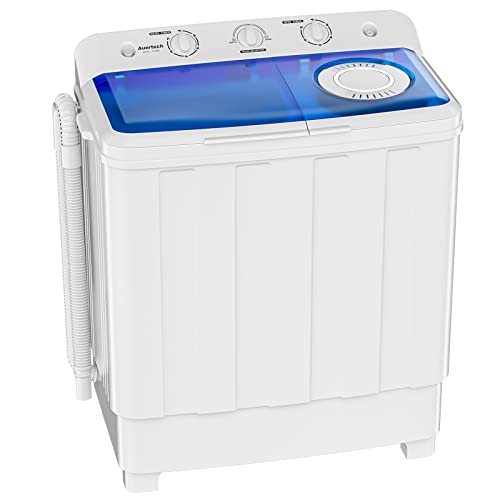
Auertech 28 lbs Twin Tub Portable Washing Machine — Pump-drained family-size twin tub
The Auertech’s listing splits its 28 pounds honestly: 18 pounds of washing capacity on one side and 10 pounds of spinner on the other, and that wash figure is the largest here. In practice the wash tub takes a realistic family top-up — several days of children’s clothes, a pile of tea towels and work shirts, or a set of guest bedding washed in two passes — without the constant small-batch cycling the little machines demand. It is still a twin tub, so those pounds arrive with the usual transfer ritual, but fewer rituals per week is a genuine quality-of-life gain.
The detail that earns this machine its place is the drain pump. Where gravity-drain models need their hose end lower than the tub, the pump pushes used water up into a sink or standpipe, which frees you to park the machine on a bathroom floor, a balcony or a utility corner without choreographing the drain route first. For renters washing in a kitchen, that single feature converts the whole exercise from a plumbing puzzle into a routine. The listing pitches the machine at dorms, apartments and RVs, and the pump is precisely why it copes with all three.
Living with it week to week, the pattern that emerges is batch confidence. Because the wash side is genuinely large, you stop pre-sorting laundry into apologetic mini-loads and instead wash the way a plumbed household does — one proper load of mixed clothing, then one of towels, then bedding on its own day. The spinner keeps up because its ten pounds match the rhythm of the wash side; two spin batches clear a full wash load, and each emerges dry enough for a rack in a warm room. Owners upgrading from a mini machine notice the change immediately: laundry becomes a twice-weekly event rather than a daily background chore, and the machine’s size, its one real cost, starts to look like a fair trade for that time back.
- Format: semi-automatic twin tub, wash and spin compartments side by side
- Capacity from the listing: 28 lbs total — 18 lbs washer, 10 lbs spinner
- Drainage: built-in drain pump
- Intended spaces named in the listing: dorms, apartments, RVs
- Operation: manual fill, manual transfer to the spinner, timed wash and spin
Strengths
- Largest wash tub in this line-up, so weekly laundry takes fewer batches
- Drain pump empties into a raised sink without bucket carrying
- Spinner capacity matches the wash side better than most rivals here
Trade-offs
- Biggest footprint of the six, so measure the corner it will live in
- Semi-automatic routine still asks for your presence at every transfer
- The pump adds a component that gravity models simply do not have
Best for: households washing family-sized top-up loads in a space where the drain sits higher than the machine.
Not suited for: anyone hoping to start a load, leave the building and return to finished laundry.
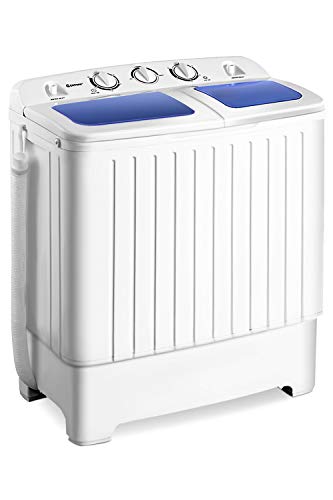
Giantex 20 lbs Twin Tub Portable Washing Machine — The long-running simple classic
The Giantex is the machine many people picture when they first search this category: a compact blue-and-white twin tub, 20 pounds of combined capacity, two timer dials and nothing else competing for your attention. Its listing is short because the product is short on complications. You fill the wash tub from a jug or a short hose, set the wash timer, move the load across to the spinner when it stops, then drain through the hose. Every step is visible, mechanical and understandable within one load.
That simplicity is the argument for it. There is no pump to clog and no electronics board to sulk in a damp bathroom; if you are comfortable with the manual routine, the Giantex asks the least learning of any pick here. The trade is equally plain: 20 pounds combined means the wash side handles modest batches — a few days of one person’s clothes, or a couple of towels and a sheet — and the drainage is your responsibility to arrange, with the tub positioned so water can run out downhill. In a dorm room with a shower drain nearby, that is easy; in a third-floor flat, plan the route before the first fill.
There is also a longevity argument for this kind of austerity. Twin tubs live hard lives in steamy bathrooms, and every powered extra is a component exposed to that damp. The Giantex’s appeal is that its whole mechanism can be understood by looking at it: a motor, a belt-driven agitator, a spinner, two timers. Students pass machines like this down through halls of residence for years, and its blue-and-white body has become something close to the category’s default silhouette. Buy it if your laundry is modest and your drain is low, and it will repay you with a routine so plain it becomes invisible — which, for a utility appliance, is praise rather than criticism.
- Format: semi-automatic twin tub in blue and white
- Capacity from the listing: 20 lbs combined wash and spin
- Drainage: hose drain arranged by the user (no pump named in the listing)
- Controls: timer dials for wash and spin
- Operation: manual fill and manual transfer between tubs
Strengths
- Fewest parts and systems of any pick, so the least to go wrong
- Light, compact body suits dorm rooms and small flats
- The routine is learned in a single load and never changes
Trade-offs
- Modest wash capacity means frequent small batches for couples
- No drain pump, so placement must respect gravity
- Basic presentation — this is a utility appliance, not furniture
Best for: students and solo renters who want the twin-tub format at its simplest and cheapest to understand.
Not suited for: households washing bulky bedding or anyone whose only drain is a high kitchen sink.
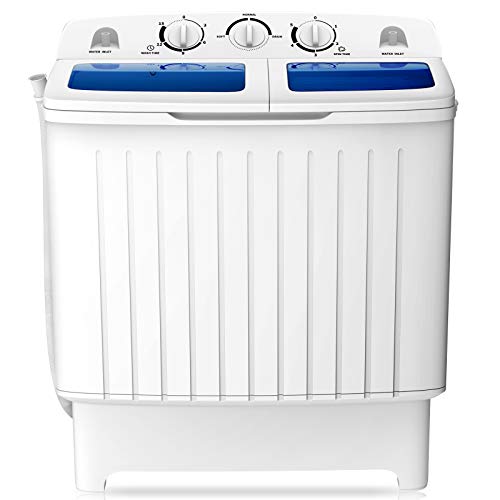
COSTWAY Twin Tub Portable Washing Machine, Blue and White — Evenly split wash and spin tubs
Most twin tubs pair a decent wash tub with a spinner so small it feels like an afterthought. The COSTWAY narrows that gap: its listing gives 12 pounds of washer and 8 pounds of spinner inside a 20-pound combined machine, and that balance changes the feel of laundry day. Instead of spinning a washed load in three pinched batches, you move it in roughly two, and the spinner’s output — clothes that come out damp rather than wet — is what makes air-drying on a rack realistic overnight.
The listing also names timer control, and on a machine like this the timers are the whole interface: one dial washes, one spins, and the discipline of the routine comes from you. COSTWAY pitches it at RVs, apartments and dorms, which matches its middleweight footprint — bigger than a countertop novelty, smaller than the family machines above. Plan on gravity drainage and a spot where the hose can fall to a drain or out to a balcony edge, and the machine settles into that niche without complaint.
The COSTWAY also illustrates a point buyers miss: spinner quality matters more than wash quality in this format, because every machine here agitates adequately, while spin performance decides whether your clothes dry overnight or drip for two days. An eight-pound spinner that runs a full, balanced load to a genuinely dry-feeling finish changes what a twin tub can replace. Paired with a heated airer in winter, this machine covers a small household’s laundry completely, with the laundromat reserved for duvets and rugs. That is a respectable ceiling for a 20-pound appliance that stores in a corner, and it is why this pick, rather than a larger gravity model, suits rack-drying households best.
- Format: semi-automatic twin tub, blue and white finish
- Capacity from the listing: 20 lbs total — 12 lbs washer, 8 lbs spinner
- Controls: timer control for wash and spin cycles
- Drainage: hose drain arranged by the user
- Intended spaces named in the listing: RVs, apartments, dorms
Strengths
- Spinner is large relative to the wash tub, cutting transfer trips
- Timer controls keep the routine predictable and repeatable
- Middleweight size suits RV storage bays and flat corners alike
Trade-offs
- Wash side is mid-sized, so family laundry still means several batches
- No pump, so drainage height limits where it can sit
- Two-tone styling will not blend into a fitted kitchen
Best for: RV owners and flat-dwellers who spin-dry most loads and hang them to finish.
Not suited for: anyone wanting the fewest possible batches for a large household.

INTERGREAT 25.4 lbs Twin Tub Portable Washer — High capacity with plain manners
The INTERGREAT sits near the top of this category by size: 25.4 pounds of combined capacity in a semi-automatic twin tub finished in blue. Its listing is refreshingly blunt — a washer with a spin cycle, aimed at dorms and apartments — and the machine follows that brief. The wash side swallows the kind of mixed load that accumulates in a shared flat: several shirts, underwear and socks for days, a couple of towels, and the odd hoodie, all in one fill rather than two.
Because it is a semi-automatic with no pump named in the listing, the INTERGREAT’s ownership experience is defined by placement. Give it a bathroom corner near the shower drain or a utility spot where the hose falls naturally, and its size becomes pure advantage; fight gravity every load and even a big tub turns into a chore. Shared households benefit most: one person’s small wash does not monopolise a tiny machine, and the spinner keeps pace well enough that the queue of roommates moves. It is a volume answer, honestly presented.
Consider the arithmetic of a shared house. Four adults produce perhaps thirty pounds of laundry a week, and a small machine turns that into ten attended sessions — a rota nobody keeps. The INTERGREAT compresses the same week into four or five sessions, which a rota can actually survive. Its plainness helps here too: housemates cannot break a routine that consists of two timers and a transfer, and there are no programmes to argue about or settings to reset. The compromises are space and drainage, both settled once at installation rather than renegotiated weekly. For a house-share with a bathroom corner and a floor drain, few appliances return their cost as predictably as this one.
- Format: semi-automatic twin tub with spin cycle, blue finish
- Capacity from the listing: 25.4 lbs combined
- Drainage: hose drain arranged by the user (no pump named in the listing)
- Intended spaces named in the listing: dorms, apartments
- Operation: manual fill, timed wash, manual transfer, timed spin
Strengths
- Second-largest capacity here, good for shared flats
- Straightforward controls with nothing digital to fail
- Spinner sized for real loads rather than token batches
Trade-offs
- Large body needs a permanent corner, not a cupboard shelf
- Gravity drainage dictates where that corner can be
- Finish and styling are purely utilitarian
Best for: shared apartments and dorm suites pooling laundry into fewer, larger batches.
Not suited for: small studios where every square foot already has a job.
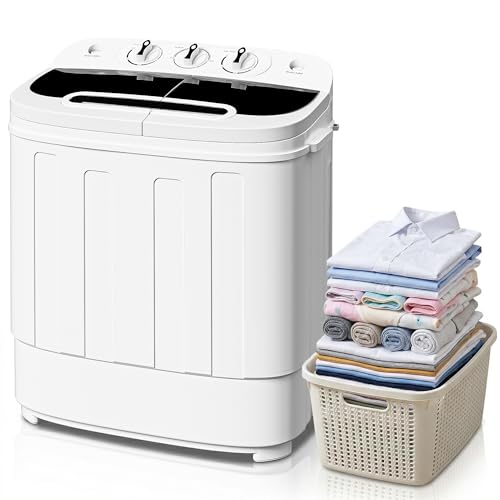
SUPER DEAL 13 lbs Compact Mini Twin Tub Washer — The smallest true twin tub
The SUPER DEAL is the pick for people whose alternative is a bucket in the bath. At 13 pounds combined capacity it is the smallest machine in this guide, and its listing leans into that: camping, apartments, dorms, college rooms and RVs are its named habitats, all places where a washer must earn a tiny footprint every day. The wash side handles the honest basics — underwear, socks, gym kit, a couple of T-shirts, baby clothes in a pinch — and the spinner leaves them dry enough for a heated towel rail to finish.
Its drainage tells you the design philosophy: a built-in gravity drain, nothing powered, nothing to prime. Stand the machine in a bath, a shower tray or beside a floor drain, drop the hose, and water leaves. That simplicity also caps the ambition — jeans go in one or two at a time, a duvet cover is a project rather than a load, and anyone washing for two adults will run it often. Bought with those expectations set, it is a liberating little appliance; bought as a family washer, it will frustrate within a week.
Its natural habitat deserves a moment, because it explains the design. In a campervan or a bedsit, the alternative to this machine is a sink, a bucket or a bag carried to a shared laundry — each with its own queue, cost or indignity. A washer that lives in a cupboard, comes out twice a week onto the shower tray, and returns its owner a load of clean smalls in twenty minutes changes daily life out of proportion to its size. Parents of newborns discover it too: a machine this small makes the constant cycle of muslins, vests and bibs a background task instead of a laundry emergency, and its gentle small-load washing suits those fabrics well.
- Format: compact mini twin tub, wash and spin combo
- Capacity from the listing: 13 lbs combined
- Drainage: built-in gravity drain
- Intended spaces named in the listing: camping, apartments, dorms, college, RVs, small spaces
- Operation: manual fill and transfer, timed cycles
Strengths
- Smallest and easiest to store of the six picks
- Gravity drain has no pump to maintain or replace
- Ideal size for daily smalls and gym-kit turnaround
Trade-offs
- Thirteen pounds combined means tiny batches by family standards
- Bulky items must be washed one piece at a time
- Must sit where water can drain downhill from the tub
Best for: campers, students and solo dwellers washing small loads very frequently.
Not suited for: couples or families, or anyone whose laundry includes heavy denim and bedding weekly.

Dawmilon 30 lbs Twin Tub Washer and Spinner Combo — Maximum capacity, pump included
On paper the Dawmilon out-sizes everything in this guide: a 30-pound combined rating split into a 20-pound washer and a 10-pound spinner, the biggest wash side and joint-biggest spinner on offer. Translated into laundry, that wash tub takes a full family change of bedding in one fill or the accumulated clothing of a dorm room’s busiest week, and the spinner’s size means the transfer step stays proportional instead of becoming a bottleneck of tiny batches.
Crucially, the listing pairs that volume with a drain pump, so emptying 20 pounds of wash water does not depend on your floor plan’s kindness. The machine is pitched at apartments, dorms, RVs and camping, and the pump is what makes the apartment claim credible — a big twin tub that can only drain downhill would be exiled to bathrooms, whereas this one can work beside a kitchen sink. It remains semi-automatic to its core: you fill it, you move the clothes, you decide when a rinse is done. Volume, not automation, is what the extra size buys.
That volume has a physical side worth respecting. Twenty pounds of dry laundry becomes considerably heavier wet, and you will lift it, batch by batch, from wash tub to spinner at chest height. For most adults that is unremarkable exercise; for anyone with a bad back or limited grip, it is the real specification of this machine, more decisive than any number on the listing. Plan the machine’s position so the transfer is a short, level move, keep a basket beside it for staging, and the Dawmilon’s size stays an asset. Bought for a household that shares the lifting, it is the closest this format comes to a family washer.
- Format: semi-automatic twin tub washer and spinner combo
- Capacity from the listing: 30 lbs total — 20 lbs washer, 10 lbs spinner
- Drainage: drain pump included
- Intended spaces named in the listing: apartments, dorms, RVs, camping
- Operation: manual fill, timed wash, manual transfer, timed spin
Strengths
- Largest wash and spin capacities in this guide
- Pump drainage suits kitchen and utility placements
- Fewer, bigger batches suit family overflow laundry
Trade-offs
- The heaviest, bulkiest body here — pick its home carefully
- Semi-automatic routine scales up too: transfers move more wet clothing
- Oversized for one person washing only smalls
Best for: families in flats without laundry hookups who need genuine batch volume.
Not suited for: anyone short on floor space or lifting strength for wet loads.
What Actually Happens During a Twin-Tub Wash?
New owners are often surprised by the choreography, so here it is plainly. You fill the wash tub — from a jug, a bucket or a short inlet hose run from a tap — add detergent once the water is in, and set the wash timer. When it stops, you lift the wet load across into the spinner, in batches if the spinner is smaller, and run the spin timer while the wash water drains away. For a rinse, you either refill the wash tub with clean water for a short second agitation or rinse under the tap, then spin once more. A full session for one load takes roughly half an hour of clock time and perhaps eight minutes of your actual hands.
None of that is a flaw; it is the format’s founding bargain, and owners who accept it tend to love these machines for years. The problems start when a buyer expects a plumbed automatic’s indifference. If your evenings cannot spare those eight attended minutes, no twin tub will satisfy you, and the honest move is toward a compact automatic instead. If, on the other hand, your current routine involves a laundromat bag and a bus ride, eight attended minutes beside your own sink will feel like a promotion.
How Much Laundry Does a Pound Rating Really Hold?
Capacity figures in this category are combined and optimistic, so translate them into garments. As a working rule, the wash-side rating in pounds roughly equals that many pounds of dry clothing: a large bath towel weighs about a pound and a half, a pair of jeans around a pound and a half, T-shirts about a quarter pound each. A 12-pound wash tub therefore takes four towels, or six to eight shirts with smalls, or two pairs of jeans with a top or two — respectable, but not a family week. The 18- and 20-pound wash tubs roughly double the jeans figure and swallow bedding sets that smaller machines refuse.
Spin capacity deserves the same translation, because it governs your transfer labour. A ten-pound spinner clears a family wash load in two rounds; a five- or six-pound spinner needs three, and each round is a pause in your session. When comparing two machines with similar wash tubs, choose the larger spinner — it is the specification you will feel every single week, in minutes rather than in theory. Listings that hide the split entirely are telling you something about which half they are proud of.
Overloading is the classic beginner’s error, and twin tubs punish it visibly: clothes in an overfilled wash tub barely move, emerging with detergent residue and the same dirt redistributed, while an overfilled spinner vibrates and walks across the floor. Load to about two-thirds of the tub’s height, keep heavy and light items in separate batches where you can, and the wash quality from these simple machines surprises people. The spinner deserves the same respect — balanced, evenly packed loads spin quietly; one lumpy towel in a corner does not.
Where Will the Water Come From, and Where Will It Go?
Every twin-tub session is a small plumbing exercise, and planning it once, properly, pays off for years. Filling is the easy half: most owners use a shower head on a hose, a tap with a short inlet pipe, or plain buckets for the smallest machines. Draining is the half that decides placement. Pump models — the Auertech and the Dawmilon here — push water up into a sink, so they can live on any floor near one. Gravity models must sit higher than their drain point, which is why so many live in baths, shower trays or on a low stand beside a floor drain.
Renters should also think about the floor itself. A spinning twin tub with an unbalanced load can wander, and a small leak at a hose joint goes unnoticed on tile but not on laminate. A shallow tray or a waterproof mat under the machine, plus a habit of staying in earshot during the spin, covers nearly every mishap this category produces. Households upgrading their whole laundry corner sometimes pair a portable washer with a vented compact dryer; if low running cost matters more than drying speed, Best Energy-Efficient Electric Clothes Dryers compares the most frugal full-size options, though all of them assume a plumbed, permanent laundry space this guide’s readers usually do not have.
How Do You Wash Well in a Machine This Simple?
Technique matters more, not less, when the machine is basic. Dissolve detergent fully in the fill water before clothes go in, because powder dropped onto dry fabric in a small tub can leave white marks. Wash in a sensible order — lightly soiled items first in the same water, then heavier soil — since a twin tub lets you reuse one fill for two batches, a frugality automatic machines deny you. Whites and light colours in the first fill, work clothes and towels in the second, is the classic sequence and it halves water use on big days.
Rinsing deserves its own paragraph because it is where twin-tub results are won or lost. Detergent left in fabric makes clothes stiff and can irritate skin, so give every load a genuine rinse — a short clean-water agitation, not a token splash — and spin after it. Delicates go in last and get the shortest wash time; the gentle end of these machines’ agitation is genuinely gentle when the tub is not crowded. Treat the spinner as a wringer, not storage: clothes left sitting in it crease into shapes no iron fully forgives. Small rooms reward this kind of honest, item-by-item thinking, a theme pursued from the bathing side in Best 36-Inch-Wide Whirlpool Tubs, where every inch of a narrow bathroom has to justify itself.
How Do You Keep a Portable Washer Clean and Fresh?
Twin tubs reward a simple aftercare habit: when the last spin finishes, leave both lids open until the tubs are dry to the touch. A sealed, damp plastic tub grows musty smells quickly, and those smells transfer to the next load. Wipe the wash tub’s rim and the spinner’s inner lid with the cloth you used for the floor, run a plain hot-water fill with a splash of white vinegar once a month if your water is hard, and the machine stays neutral-smelling with almost no effort.
Lint deserves a mention because small tubs concentrate it. Most of these machines carry a simple lint filter in the wash tub; empty it every load, not every week, because a clogged filter redeposits fluff onto dark clothes. Drain hoses should be lifted and emptied fully after use rather than left holding a cup of grey water, and pump models benefit from an occasional clear-water flush. None of this needs products beyond what a kitchen already holds — the format’s maintenance is as manual and transparent as its washing.
How Much Time Does a Twin Tub Really Take Each Week?
Honest arithmetic helps more than enthusiasm here. A single load, start to finish, occupies about thirty minutes of clock time: five to fill and load, fifteen washing while you do something else nearby, a few minutes transferring and spinning, and a rinse-and-spin repeat. Your hands are busy for perhaps a third of that. A solo renter running the small SUPER DEAL four times a week spends roughly forty attended minutes; a family running the Dawmilon three times spends a similar total, because bigger batches replace frequent ones.
Compare that honestly with the alternatives rather than with a fantasy. A laundromat trip consumes travel, waiting and folding time in one long block, plus the cost per load. A plumbed automatic consumes almost no attention but demands a laundry space many homes simply do not have. The twin tub sits between them: modest attention, no installation, no trips. Households that thrive with these machines build the routine into an existing rhythm — washing while cooking, spinning while the kettle boils — rather than treating laundry as a separate expedition, and that habit, more than any specification, decides whether ownership feels easy.
Which Portable Washer Suits Which Small Home?
Dorm rooms and house-shares should start from the SUPER DEAL and Giantex end of the range: small bodies, simple drains, loads sized to one person’s week. The moment two people’s laundry merges, step up to the COSTWAY for its spinner or the INTERGREAT for shared volume, because batch count, not wash quality, is what wears out goodwill in a shared bathroom. Couples in studios sit naturally with the COSTWAY too, provided the drainage falls the right way.
Families and cottage owners should look at the pump pair first. The Auertech covers the flat-with-a-sink reality most family renters face, while the Dawmilon suits a house or large apartment doing overflow washing for children, guests and sport kits. RV travellers split by storage: the SUPER DEAL disappears into a locker, the COSTWAY rides in a garage bay, and both drain without infrastructure. Matching the machine to the building, rather than to an abstract ranking, is the whole method of this guide — the best portable washer is the one whose routine your home makes effortless.
How Do Portable Washers Treat Water and Energy Use?
Frugality is built into the format. A twin tub washes in a fraction of the water a full-size automatic draws, and because you can reuse one fill for a second, lighter-soiled batch, a big laundry day can run on surprisingly little. There is no water heating inside any machine here — the temperature is whatever your tap or kettle provides — so energy use is essentially the motors alone, which is to say very modest. For households on metered water or tight budgets, that economy compounds week after week.
The honest counterweight is your own time, already covered above, plus the discipline of small batches: six small loads use more fills than two large ones in a plumbed machine. Choosing the largest tub your space accepts is therefore also the greenest choice in this category, since it minimises the number of fills per pound of laundry. The two pump models spend a little extra energy on drainage, a trivial sum against the water they save you hauling and reheating for a second fill.
What Should You Measure and Check Before Ordering?
Measure the space with the machine’s working needs in mind, not just its footprint. You need room to stand in front of it, lift a lid fully, and move wet laundry sideways from one tub to the other without dripping across the room. Check the route from storage to washing spot too: a machine that must be carried through a narrow doorway twice a week will eventually be left out, so decide whether it lives permanently in place or genuinely fits its cupboard.
Then audit your water points. How will you fill — tap, shower hose or bucket — and how far is that source from the machine’s home? Where exactly will the drain hose or pump outlet discharge, and is that point lower than the tub for gravity models? Finally, check the electrical side: these are ordinary plug-in appliances, but a bathroom-adjacent socket should be in good condition and sensibly positioned away from splash zones. Answer those four questions on paper and the correct model from this guide usually selects itself.
How Do the Six Portable Washers Compare Side by Side?
| Pick | Specification from the listing | Where it fits best |
|---|---|---|
| Auertech 28 lbs Twin Tub Portable Washing Machine | 28 lbs total (18 wash / 10 spin), drain pump | Family top-ups and cottage laundry where the sink is the drain |
| Giantex 20 lbs Twin Tub Portable Washing Machine | 20 lbs combined, hose drainage | Dorms and solo renters with a low drain nearby |
| COSTWAY Twin Tub Portable Washing Machine, Blue and White | 20 lbs total (12 wash / 8 spin), timer control | Rack-drying households that value a capable spinner |
| INTERGREAT 25.4 lbs Twin Tub Portable Washer | 25.4 lbs combined, semi-automatic | Shared flats washing pooled loads near a floor drain |
| SUPER DEAL 13 lbs Compact Mini Twin Tub Washer | 13 lbs combined, built-in gravity drain | Cupboard storage and daily smalls in tiny spaces |
| Dawmilon 30 lbs Twin Tub Washer and Spinner Combo | 30 lbs total (20 wash / 10 spin), drain pump | Maximum twin-tub volume for flats and family overflow |
What Mistakes Do First-Time Twin-Tub Owners Make?
The most common mistake is shopping by the combined capacity number. A machine advertised at 20 pounds does not wash 20 pounds of clothes; it washes its wash-side share and spins the rest, and buyers who miss that split feel cheated by a perfectly honest product. Read the split, picture your actual loads against it, and the disappointment never happens.
Placement comes second. A gravity-drain machine bought for a kitchen with no low drain becomes a bucket-hauling ritual, while the same machine in a bathroom would have been effortless. Decide where the water leaves before you decide which badge you like, and if the answer is a raised sink, restrict yourself to the pump models from the start.
Noise expectations also need setting before purchase. A twin tub’s wash is a low sloshing hum, but the spin, especially slightly unbalanced, is a vigorous event that neighbours below will hear through a thin floor. Wash at sociable hours, stand the machine on a mat, and balance loads carefully, and the format stays neighbourly; run a lopsided spin at midnight in a wooden-floored flat and no specification sheet will save the relationship.
Third, owners under-rinse. Because every rinse costs effort in this format, the temptation is to skip it, and the result — stiff, detergent-heavy clothes — gets blamed on the machine. Build the rinse into your routine as a non-negotiable step and twin-tub laundry comes out genuinely clean. A related error is leaving wet clothes sitting in the spinner between batches; move them to a rack promptly and they dry faster with fewer creases.
A quieter mistake is detergent dosing by habit. These tubs use far less water than a full-size machine, so a full-size scoop of detergent overwhelms the rinse and leaves fabric harsh. Start with about a third of what you would use in a plumbed washer, adjust by how the rinse water looks, and remember that in a twin tub you can simply rinse again — the feedback loop is immediate, which makes this format oddly good at teaching economical dosing.
Finally, do not ignore the spin balance. One heavy item alone in the spinner will thump, wander and eventually strain the machine. Pair heavy pieces opposite each other, spread the load evenly around the drum, and stop and rearrange at the first loud protest rather than letting a cycle finish in distress.
Final Recommendation
Choose by drainage first and capacity second. If your only practical drain is a raised sink, the Auertech and Dawmilon, with their pumps, are the two honest answers, sized for top-up loads and family volume respectively. If you have a floor drain or a bath to stand the machine in, the Giantex, COSTWAY and INTERGREAT cover the simple-to-shared spectrum with gravity drainage, and the SUPER DEAL remains the cupboard-sized answer for one person’s smalls. Every one of them will ask for your hands at the transfer step; the right one asks a number of times per week you can live with.
One last piece of framing before the verdict: none of these machines will heat water, iron out a landlord’s rules, or make a studio feel like a house with a utility room. What they do is return control of a basic chore to people the housing market left without laundry, at a running cost measured in pennies and a time cost measured in minutes. Judge them as that kind of tool — closer to a good mop than to a fitted kitchen — and their value becomes very clear.
Our single strongest recommendation for most readers is the Auertech: its wash tub is big enough to matter, its spinner keeps pace, and its pump removes the one chore — hauling grey water — that makes owners abandon this format. A portable washer earns its keep not by imitating a plumbed machine but by making laundry possible in a home that plumbing forgot, and on that measure the Auertech is the pick we would put beside our own sink.
Frequently Asked Questions
Do portable twin tubs actually get clothes clean?
Yes, provided the load is sized honestly and rinsed properly. The agitation in a twin tub is vigorous, the water is as hot as your tap supplies, and because you control the wash time you can extend it for genuinely dirty loads. Where results disappoint, the cause is almost always overloading or a skipped rinse rather than weak washing action. Ground-in dirt on work clothes benefits from a ten-minute pre-soak in the filled tub before the timer starts — a step this format makes trivially easy, since the water simply waits with the clothes in it until you walk back and turn the dial.
Can I leave a twin tub running while I go out?
We would not. These machines fill and drain under your supervision, hoses are temporary, and an unbalanced spin can move the machine. The attended minutes are short — a wash timer runs while you do other things nearby — but nearby is the operative word. If unattended operation is essential, a plumbed automatic is the right category instead.
How dry do clothes come out of the spinner?
Surprisingly dry. A good spin cycle removes most of the water a wash leaves behind, so clothes emerge damp rather than dripping and typically dry on an indoor rack within hours, faster near warmth or moving air. Heavy cotton towels and jeans take longest; synthetics and light cottons can be nearly ready to fold the same evening. A second short spin, after shaking the load out and repacking it evenly, squeezes out a surprising extra cupful of water and is worth the two minutes on heavy items.
Will a portable washer damage delicate clothes?
It can if you treat delicates like workwear. Use the shortest wash time, a loosely filled tub and a mesh bag for fragile items, and spin delicates briefly or not at all. The format’s advantage is control: nothing happens inside the machine that you did not choose, which careful owners turn into very gentle handling.
What do I need besides the machine itself?
A way to fill it — a jug, bucket or short hose — a drain route, and a rack or line for finishing the dry. A waterproof mat under the machine protects floors, and a small basket makes the wash-to-spinner transfer tidier. None of it is specialised; most households already own everything required.
Can a portable washer run from a bathroom tap?
In most homes, yes — filling is the flexible half of the routine. Owners fill from a shower hose, a mixer tap with a short inlet pipe, or buckets carried a few steps, and all three work. What matters is the drain side: confirm your discharge point and its height before choosing between a pump model and a gravity model, because that single fact governs where the machine can live.
Are twin tubs suitable for washing bedding?
The larger models handle a duvet cover or a set of sheets comfortably in one fill; the smaller ones need bedding split piece by piece, and a thick duvet itself is beyond every machine here. Judge by the wash-side capacity, keep the tub no more than two-thirds full, and bedding day stays realistic on the Auertech, INTERGREAT and Dawmilon.
Related Guides
Laundry this hands-on pairs naturally with textiles that forgive frequent washing, and our guide to Best Bath Towel Sheets looks at oversized towels that survive exactly this kind of weekly twin-tub routine.


