What's inside
- Key Takeaways
- Quick Picks
- How Did We Choose These Digital Alarm Clocks with Temperature Sensor?
- How Do the Six Temperature Clocks Compare at a Glance?
- What Does a Bedside Temperature Reading Actually Tell You?
- Why Does Humidity Change How a Room Feels?
- Where Should You Place a Temperature Clock for a Fair Reading?
- How Do Atomic and Auto-Set Clocks Keep Themselves Right?
- What Mistakes Do Temperature Clock Buyers Make?
- How Should a Temperature Clock Shape Your Morning Routine?
- How Do Temperature Clocks Help a Household Argue With Its Thermostat?
- What Should Nurseries and Older Sleepers Take From These Readings?
- How Does a Weather Station Change a Kitchen?
- Why Do Gardeners and Rural Households Trust Pressure Trends?
- How Long Do Sensor Clocks Serve Before They Drift From Truth?
- What Is the Difference Between a Sensor Clock and a Smart Display?
- How Should You Read a Temperature Trend Rather Than a Temperature?
- What About Bedrooms That Are Too Warm to Sleep In?
- How Do These Clocks Serve Renters Who Cannot Change the Heating?
- How Should a Household Split These Clocks Across Its Rooms?
- What Does the Date Display Quietly Do for a Household?
- Why Does the Outdoor Sensor Need a Shaded, Sheltered Post?
- How Do Sensor Clocks Behave Across the Four Seasons?
- What Should You Check in the First Week With a Sensor Clock?
- How Does Knowing the Room Change the Way You Sleep in It?
- Why Keep a Sensor Clock When the Forecast Is Free?
- Final Recommendation
- Frequently Asked Questions
- Related Guides
As an Amazon Associate I earn from qualifying purchases. This post may contain affiliate links at no extra cost to you.
cottageverdict.com is reader-supported. When you buy through links on our site, we may earn an affiliate commission.
Where to buy: every clock below is sold through Amazon, and its name links to its listing in the Quick Picks table, in its detailed section and in the comparison table, so you can check price on Amazon and confirm exactly what its display measures before ordering. The best digital alarm clocks with temperature sensor answer the second question of every morning — not “what time is it?” but “what is it like in here, and out there?” Each of these clocks reads the temperature of the room it sits in and shows that reading on its face, beside the time. A note on honesty before we begin: a bedside clock’s sensor measures its immediate surroundings, on your nightstand, and that reading is a household convenience — a guide to a layer, a window, a thermostat adjustment — not a laboratory or medical measurement, and this guide will treat it with exactly that respect throughout.
The six picks spread wider than most clock categories. The Netzu is a compact plug-in 3-in-1 with temperature, date and time. The JALL adds humidity to temperature inside a wood grain case with three alarms. The DreamSky auto-sets its time, handles daylight saving automatically and adds a USB port. The WallarGe is a 12.5-inch atomic wall-or-desk clock reading temperature and humidity for a whole room. The Newentor is a wireless weather station with an outdoor sensor, colour display, barometric pressure and a forecast. And the AcuRite What-to-Wear station is an alarm clock built to help children dress for the day’s conditions. Choosing among them is choosing how much of the weather you want at the bedside, and whose morning it serves.
Key Takeaways
- Every pick measures the temperature of the room it sits in; the Newentor alone adds a wireless outdoor sensor, which is a different and larger promise.
- Humidity joins temperature on the JALL and the WallarGe — the two readings together describe a room’s comfort far better than temperature alone.
- Treat every reading as a bedside guide to comfort, not a precision instrument; placement beside a lamp or a window will move any sensor’s number.
- Atomic and auto-set clocks — the WallarGe, DreamSky and Newentor — remove time-setting and daylight saving from your life entirely.
- Scale divides the guide: nightstand compacts at one end, a 12.5-inch room clock and two weather stations at the other.
Quick Picks
| Pick | Badge | Why it earns its place |
|---|---|---|
| Netzu 3-in-1 Digital Alarm Clock with Temperature | Best Compact Plug-In | A small plug-in clock showing temperature, date and time with four brightness levels and three volumes. |
| JALL Wood Grain Alarm Clock Temp & Humidity | Best Temp + Humidity | Temperature and humidity in a wood grain case with three alarms, a large display and a dimmer. |
| DreamSky Auto Set Alarm Clock with Date & Temp | Best Auto-Setting | Auto-set time with automatic DST, temperature display, dimmable brightness, snooze and a USB port. |
| WallarGe 12.5-inch Atomic Clock Temp and Humidity | Best Large Room Clock | A 12.5-inch self-setting atomic clock with indoor temperature and humidity, for wall or desk. |
| Newentor Weather Station Wireless Thermometer | Best Weather Station | A wireless indoor-outdoor thermometer with atomic clock, barometric pressure and forecast on a colour display. |
| AcuRite What-to-Wear Weather Station Alarm Clock | Best for Kids’ Mornings | An alarm clock weather station designed to help children choose clothes for the day’s conditions. |
How Did We Choose These Digital Alarm Clocks with Temperature Sensor?
The first filter was the sensor itself, and what each listing honestly claims for it. Every pick reads room temperature; we note, pick by pick, where humidity joins it, where an outdoor sensor extends it, and where the listing simply does not extend it. A clock that reads the nightstand’s air is a fine thing and we praise it as such; we do not let the praise drift into claims about accuracy grades that no listing here makes. Readers deserve to know which instrument they are buying: a comfort guide, a room monitor, or a small weather station.
The second filter was clock craft, because a thermometer that wakes you badly has failed the title’s first noun. Auto-setting and atomic models earned their places for removing the two recurring chores of clock ownership — the initial set and the twice-yearly daylight saving correction. Alarm counts, snooze, dimmers and backup or battery arrangements were weighed as they would be in any clock guide.
The third filter was placement spread. A temperature clock’s reading is its location, so the guide deliberately spans the nightstand, the desk, the wall and the child’s bedroom, with display sizes to match each post. A reader should finish this guide knowing not only which clock, but where in the house its sensor will tell the most useful truth.

Netzu 3-in-1 Digital Alarm Clock with Temperature — Best Compact Plug-In
The Netzu is the category at its most distilled: a small, compact plug-in alarm clock, described in its listing as 3-in-1, showing temperature, date and time, with four brightness levels and three volumes, for bedroom or office. Three-in-one is the honest summary — the clock tells you when it is, what day it is, and how the room feels, in one glance from the pillow, without a phone’s unlock or a weather app’s advertisement standing between you and the morning.
Four brightness levels and three volumes are the two dials of bedside courtesy, and the Netzu offers both in a small case. The brightness ladder lets the display fall to a night level that informs without glowing; the volume choice lets the alarm be set for the sleeper it serves rather than the factory’s guess. In a compact plug-in clock these are the decisions that decide whether it is kept, and Netzu has put its budget exactly there instead of into size or spectacle.
Its temperature reading should be understood as the nightstand’s own climate, which is precisely the climate you sleep in — arguably the most relevant few cubic feet of air in the house. If the number says the room cooled overnight, it says so about the air around your bed, not a hallway thermostat’s average. Readers wanting humidity as well should move to the JALL; readers wanting the outdoors should move to the Newentor. Readers wanting the essential trio, small and bright and clear, have found the purest version here.
- Display: temperature, date and time
- Brightness: 4 levels
- Alarm: 3 volume levels
- Power: plug-in
- Form: small and compact
Strengths
- The essential three readings in the smallest footprint here.
- Four brightness and three volume levels cover real bedrooms.
- Plug-in power means no battery routine to maintain.
Trade-offs
- No humidity reading; the JALL and WallarGe carry that flag.
- Plug-in only, so an outage story depends on arrangements the listing does not detail.
- Compact display suits the nightstand, not reading across a large room.
Best for: small bedrooms, offices and anyone wanting time, date and room temperature at one glance.
Not suited for: humidity watchers or whole-room display needs.

JALL Wood Grain Alarm Clock Temp & Humidity — Best Temp + Humidity
The JALL adds the second half of the comfort equation. Its listing describes a wood grain digital alarm clock for the bedroom with three alarms, temperature and humidity — a thermometer and hygrometer in the listing’s own words — multiple alarms with snooze, a large display and a dimmer, for nightstand, desk and living room, in black. Temperature tells you the room’s heat; humidity tells you its feel, and the two together explain mornings that the thermometer alone cannot: the night that read mild and slept clammy, the winter room that read warm and woke everyone with dry throats.
Three alarms is a household feature disguised as a number. It runs a couple’s two schedules plus a third — a medication time, a school run, a weekend exception — without reprogramming, and in a family bedroom that third alarm is the difference between a clock that serves the household and one that serves a person. The wood grain finish carries the other half of the appeal: a sensor-rich clock that still looks like furniture, its display glowing through a finish that belongs on a nightstand rather than in a laboratory.
Read its humidity the way you read its temperature: as the room’s own story, told from the nightstand. A hygrometer beside a steamy en-suite door will report the shower’s weather; placed on an open nightstand it reports the bedroom’s. The JALL gives you both numbers with a large, dimmable face to read them by — the most complete picture of a sleeping room’s climate in this guide, short of the WallarGe’s wall-sized version of the same idea.
- Sensors: temperature and humidity
- Alarms: 3, with snooze
- Display: large, with dimmer
- Finish: wood grain, black
- Placement per listing: nightstand, desk, living room
Strengths
- Temperature plus humidity describes real sleeping comfort.
- Three alarms serve a whole household’s schedules.
- Wood grain case hides a sensor clock in furniture’s clothing.
Trade-offs
- Room readings only; no outdoor sensor for the day’s actual weather.
- Auto-setting is not stated in the listing, so daylight saving remains a manual ritual.
- Large display asks more nightstand width than the Netzu.
Best for: households watching bedroom humidity, couples with layered schedules, and furniture-first bedrooms.
Not suited for: readers wanting outdoor weather at the bedside.

DreamSky Auto Set Alarm Clock with Date & Temp — Best Auto-Setting
The DreamSky removes the chores. Its listing describes an auto set digital clock with date and temperature for bedrooms: an electric desk clock with dimmable brightness, auto DST, a USB port, temperature display and snooze. Auto set means the clock arrives knowing the time; auto DST means it steps forward and back with the calendar’s two annual traps without being asked. Anyone who has driven to work under a bedroom clock that was an hour wrong on the Monday after the change will price those features correctly: they are not conveniences, they are the elimination of a recurring household failure.
Around that self-sufficiency, the specification stays practical. The dimmer serves the night, the snooze serves the morning, the USB port gives the phone a place to charge that is not the clock’s job to apologise for, and the temperature display gives the room’s reading alongside the date — the two facts a dressing person needs, time and warmth, on one face. It is a clock designed by someone who listed everything annoying about owning a clock and deleted the list item by item.
Its sensor scope is the room, like the Netzu’s, and its display is nightstand-scaled. What it adds over the Netzu is autonomy; what it gives up to the JALL is humidity. Readers whose enemy is administration — the setting, the correcting, the remembering — should start here and quite possibly stop here.
- Time: auto set, with automatic DST
- Display: date and temperature, dimmable brightness
- Charging: USB port
- Alarm: with snooze
- Power: electric
Strengths
- Auto set and auto DST delete clock ownership’s two recurring chores.
- Temperature and date cover the dressing decisions at a glance.
- USB port keeps the phone fed from the same surface.
Trade-offs
- No humidity reading is named in the listing.
- Outdoor temperature is not given in the listing; its sensor reads the room.
- Multiple alarms are not stated in the listing, so layered households should verify.
Best for: anyone who hates resetting clocks, and bedrooms that want date, temperature and charging together.
Not suited for: humidity tracking or outdoor weather.
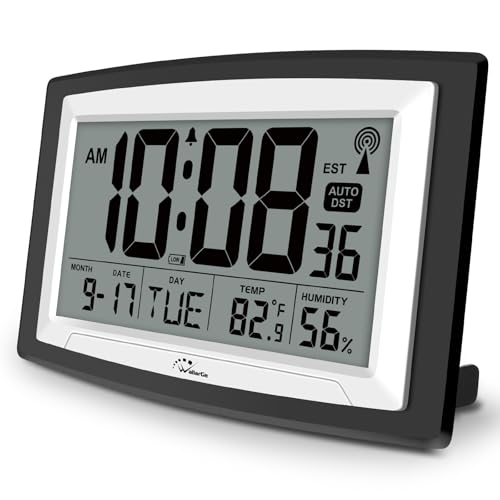
WallarGe 12.5-inch Atomic Clock Temp and Humidity — Best Large Room Clock
Scale changes the job. The WallarGe’s listing describes a 12.5-inch atomic clock with indoor temperature and humidity, auto DST, battery operation, a large display for seniors, self-setting, suited to classroom, garage, office and library as much as to wall or desk at home. At twelve and a half inches this is not a nightstand whisper but a room’s public instrument: the time and the climate, readable from every corner, set by the atomic signal so that its authority is never in question.
Atomic self-setting deserves its plain explanation: the clock receives a broadcast time signal and corrects itself, handling daylight saving on its own, so the largest clock in the house is also the one that never needs a ladder, a manual or an apology. Battery operation frees its placement entirely — a wall without a socket nearby, a garage beam, a classroom above the door. For seniors, the listing’s own emphasis, the combination of huge digits and zero administration is the whole product: time and room conditions, always right, readable without glasses or a step-stool.
Its temperature and humidity are the room’s, read at the clock’s post — on a wall, that is a fairer sample of the room’s air than a nightstand’s corner, away from body heat and bedside lamps. Understand its role honestly: this is a room monitor and timepiece more than a personal alarm clock, and bedrooms wanting a dawn wake-up should pair it with one of the nightstand picks rather than asking it to be both. As the house’s climate-and-time authority, nothing else here competes.
- Size: 12.5-inch display
- Time: atomic, self-setting, auto DST
- Sensors: indoor temperature and humidity
- Power: battery operated
- Placement: wall or desk
Strengths
- Huge self-setting display serves whole rooms and weaker eyes.
- Temperature and humidity read at wall height sample the room fairly.
- Battery power frees it from socket geography entirely.
Trade-offs
- A room clock first; its alarm role is secondary to its display role.
- Indoor readings only; the outdoor story belongs to the weather stations.
- Its size overwhelms a small nightstand by design.
Best for: seniors, large rooms, classrooms, garages and anyone wanting a self-setting wall authority.
Not suited for: intimate bedside alarm duties.

Newentor Weather Station Wireless Thermometer — Best Weather Station
The Newentor crosses the border from clock-with-sensor into weather station, and its listing says so: a wireless indoor outdoor thermometer in black with one sensor, a colour display digital weather thermometer with atomic clock, barometric pressure, a forecast station and an adjustable backlight. The outdoor sensor is the revolution. Every other pick here reports the room; the Newentor reports the world beyond the window as well, which is the temperature that actually decides coats, commutes and whether the pipes need thinking about.
Barometric pressure and a forecast display add the forward-looking half: not just what the air is doing but what it intends. A falling pressure trend is the garden’s and the hiker’s oldest instrument, and having it on a colour display beside the atomic-accurate time turns a bedside or kitchen surface into a small observatory. The atomic clock keeps the station’s time beyond argument, and the adjustable backlight keeps its colour display polite at night.
Its demands are the honest costs of the larger promise: an outdoor sensor to place — shaded, sheltered, within wireless reach — and a display with more to read than a sleeper may want at 3 a.m. Readers should site it as a station, in a kitchen, hallway or study, and let a simpler clock guard the pillow. Judged as a station, it is the most capable instrument in this guide, and the only one that can tell you, before the curtains open, what the day outside has actually done.
- Sensors: indoor plus wireless outdoor, 1 sensor included
- Data: barometric pressure and forecast
- Display: colour, adjustable backlight
- Time: atomic clock
- Colour: black
Strengths
- Outdoor sensor reports the weather that decides the day.
- Pressure and forecast add prediction to measurement.
- Atomic time and colour display make it a complete home station.
Trade-offs
- Outdoor sensor needs thoughtful placement and its own batteries.
- Information density suits a kitchen or study better than a pillow.
- Its alarm role is the station’s sideline, not its headline.
Best for: weather watchers, gardeners, commuters and rural households.
Not suited for: minimal bedside setups.

AcuRite What-to-Wear Weather Station Alarm Clock — Best for Kids’ Mornings
The AcuRite asks a different question of the weather: not “what is it?” but “what should a child wear?” Its listing describes the (00777) What-to-Wear Weather Station with Alarm Clock as a station that helps children get dressed for school with hyperlocal conditions — an alarm clock and weather display fused into a morning routine for the smallest members of the household. The genius is translational. A temperature number is an abstraction a seven-year-old must convert; a station organised around dressing converts it for them, turning the morning’s first argument — the coat negotiation — into a fact the child can read themselves.
That independence is the real product. A child who checks their own station and chooses their own layers is practising the exact self-sufficiency school mornings run on, and the alarm clock half of the device keeps the whole routine in one object on the child’s own dresser. Parents should read “hyperlocal” in the listing’s spirit: the station reports conditions at your house, which is where the dressing decision happens, rather than a city-wide average from an airport across town.
It is, deliberately, the specialist of the six. Adults wanting their own data-rich station should take the Newentor; adults wanting a bedroom comfort reading should take the JALL or Netzu. Households with a school-age child and a daily wardrobe debate have a pick that was designed around their exact 7 a.m. problem, and designed with evident affection for it.
- Type: weather station with alarm clock
- Purpose per listing: helps children dress for conditions
- Conditions: hyperlocal, per listing
- Model: 00777
- Audience: kids’ school mornings
Strengths
- Translates weather into a dressing decision a child can own.
- Alarm and station in one object anchor the whole morning routine.
- Hyperlocal conditions beat a distant airport’s average for school runs.
Trade-offs
- Child-first design; adult data seekers should choose the Newentor.
- Detailed sensor specifications are not stated in the listing beyond its stated purpose.
- Its charm is specific to households with young children.
Best for: families with school-age children and daily coat negotiations.
Not suited for: adult weather hobbyists.
How Do the Six Temperature Clocks Compare at a Glance?
| Pick | Reads | Time setting | Distinguishing feature |
|---|---|---|---|
| Netzu 3-in-1 Digital Alarm Clock with Temperature | Room temperature | Manual | Compact 3-in-1 display |
| JALL Wood Grain Alarm Clock Temp & Humidity | Temperature + humidity | Manual | Three alarms, wood grain |
| DreamSky Auto Set Alarm Clock with Date & Temp | Room temperature | Auto set, auto DST | USB port |
| WallarGe 12.5-inch Atomic Clock Temp and Humidity | Temperature + humidity | Atomic self-setting | 12.5-inch room display |
| Newentor Weather Station Wireless Thermometer | Indoor + outdoor, pressure | Atomic | Forecast colour station |
| AcuRite What-to-Wear Weather Station Alarm Clock | Local conditions | Station clock | Kids’ dressing guidance |
What Does a Bedside Temperature Reading Actually Tell You?
It tells you the climate of the few feet of air you sleep in, which is more useful and less grand than it sounds. It explains the night you woke cold despite a correctly set thermostat — the bedroom runs cooler than the hallway where the thermostat lives, and now you have the number to prove it and the extra blanket’s justification. It settles the household’s oldest debate, whether the room is warm or the sleeper is, with evidence both parties agreed to accept. And across seasons it teaches the house’s own patterns: which room hoards the afternoon sun, which corner the winter finds first.
What it does not do is certify anything. A clock’s sensor sits beside lamps, chargers and sleepers, all of which warm its air; its reading is a household instrument, honest within its post. Move the clock and the number moves a little — that is not a flaw but a reminder that temperature is a place, not an abstraction. Readers who internalise that will use these clocks well and quote them modestly, which is all any of their listings ask.
Why Does Humidity Change How a Room Feels?
Because skin reads moisture as readily as heat. Air that is warm and dry pulls moisture from throats and skin overnight, and sleepers wake feeling parched in a room the thermometer calls comfortable. Air that is warm and damp refuses sweat its evaporation and sleeps clammy at the same number. The JALL and WallarGe earn their humidity readings by explaining those nights. A household watching both numbers can act intelligently — a humidifier in the dry winter bedroom, ventilation in the damp summer one — instead of arguing with a thermostat that was never the whole story. Comfort is a two-number problem, and half this guide exists because the second number matters.
Where Should You Place a Temperature Clock for a Fair Reading?
Away from the small weather systems of the nightstand itself. A lamp’s warmth, a charging phone’s heat and the sleeper’s own exhaled air all bias a sensor placed among them; a clock at the nightstand’s outer edge, or on a dresser, samples the room more honestly. Keep it out of direct morning sun, which will announce a heatwave that exists only on the windowsill, and away from the en-suite door if steam readings are not your aim. The WallarGe’s wall post is naturally fair; the stations’ outdoor sensor wants the opposite care — shade, shelter from rain, and air that moves. Placement is the calibration the owner controls, and five thoughtful minutes of it are worth more than any specification.
How Do Atomic and Auto-Set Clocks Keep Themselves Right?
Atomic clocks listen. A national time signal broadcasts the official time continuously, and a self-setting clock like the WallarGe or the Newentor’s clock receives it, corrects its own drift and steps through daylight saving without being touched. Auto-set clocks like the DreamSky arrive pre-set and handle DST from their internal calendar. Either way, the household’s oldest clock chores — the ladder, the buttons, the biannual hour of doubt — are abolished. The one condition is reception: atomic signals favour placement away from heavy electronics and, in difficult buildings, near a window for the nightly synchronisation. Set the clock where the signal reaches, and time becomes the one household utility that simply never needs you again.
What Mistakes Do Temperature Clock Buyers Make?
The first is expecting a bedside reading to be a certified measurement, then feeling betrayed by a degree’s difference from another device across the room — two honest sensors in two places reporting two true local numbers. The second is buying an indoor-only clock for an outdoor question; the coat decision needs the Newentor’s outdoor sensor or the AcuRite’s local conditions, not the nightstand’s warmth. The third is placing the clock in the lamp’s heat plume and concluding the bedroom is a sauna. The fourth is ignoring humidity, the number that explains the nights temperature cannot. And the fifth is forgetting that a weather station’s outdoor sensor has batteries of its own, which will choose the coldest week of the year to expire unless the household replaces them in autumn like clockwork — pun intended and, by then, earned.
How Should a Temperature Clock Shape Your Morning Routine?
Let it replace the phone’s first unlock. The sequence these clocks invite is older and calmer: alarm, glance — time, room temperature, perhaps humidity or the outdoor number — and the day’s first decisions made from facts rather than feeds. Layers chosen, window opened or kept shut, the run taken or postponed by the outdoor sensor’s evidence. Households that adopt the routine describe the same small surprise: the morning feels owned rather than interrupted. The clock cannot make the day good, but it can hand you the day’s terms early, plainly and without an opinion attached — which, from a bedside object, is a considerable gift.
How Do Temperature Clocks Help a Household Argue With Its Thermostat?
Most homes heat and cool by a thermostat in a hallway — a room nobody sleeps in, with a climate nobody experiences. A temperature clock in the bedroom produces the evidence that starts a useful conversation: the sleeping rooms run colder than the hall in winter, hotter in the summer’s second heatwave night, and the thermostat’s number is an average that describes no one’s actual night. Households use the bedroom reading to justify the small, effective adjustments — a door left open for airflow, a vent redirected, the thermostat’s night setback softened by a degree — that no amount of arguing from sensation ever settled. The clock is not a heating engineer; it is a witness, and a household with a witness argues less and sleeps better.
Across a season, the readings become a diary. The week the bedroom would not cool teaches the household its own house: which windows to open at dusk, which room to move a heat-sensitive sleeper into during a hot spell, when the spare blanket graduates from the cupboard. None of this requires precision. It requires a consistent number in a consistent place, watched with mild attention — exactly what these clocks provide and all they promise to provide.
What Should Nurseries and Older Sleepers Take From These Readings?
Comfort guidance, plainly framed. A nursery clock with temperature — the Netzu or JALL pattern, placed sensibly in the room — gives parents a consistent local reading to dress the room and the baby by, as one input among their own judgement and their health visitor’s guidance, never as a medical instrument. For older sleepers, whose rooms are often kept by habit rather than by feel, the large WallarGe reading makes the room’s climate a visible, discussable fact: a carer or a spouse can see at a glance whether the room ran cold, and act on evidence. In both rooms the principle is identical — the clock informs the humans; the humans decide. This guide recommends these instruments for awareness, and awareness, in a sleeping room, is most of what comfort ever needed.
How Does a Weather Station Change a Kitchen?
The kitchen is the weather station’s natural capital. It is where the day is planned — lunches, lifts, the garden’s watering, the dog’s long or short walk — and a colour display with the outdoor temperature, the pressure trend and the forecast turns the kettle’s boiling minute into the day’s briefing. The Newentor in a kitchen serves people who never enter the bedroom it might have guarded; the AcuRite by the back door serves the school run at the exact threshold where coats are chosen. Households deciding between a bedside sensor clock and a station should ask where the weather questions are actually asked in their house. The answer is rarely the pillow. It is the doorway, coffee in hand, keys in the other — and the station belongs within sight of it.
Why Do Gardeners and Rural Households Trust Pressure Trends?
Because a barometer reads the sky’s intentions before the sky declares them. A steadily falling pressure has warned of coming weather since long before forecasts existed, and for people whose work and animals live outdoors, that warning — cover the tender plants, bring the tools in, expect the track to be mud by morning — is worth more than a temperature at any precision. The Newentor’s pressure display puts that old instrument on a modern colour face beside the atomic time. Paired with the outdoor sensor’s actual temperature, it gives a rural household the two numbers its grandparents kept in separate brass instruments, now agreeing with each other on one screen and asking nothing but a glance at breakfast.
How Long Do Sensor Clocks Serve Before They Drift From Truth?
Household sensors are stable instruments for household purposes; a clock that read its nightstand fairly when new will read the same nightstand fairly for years, because the comparison that matters is the clock against its own history in the same place. What owners should watch is not drift but environment: the new lamp that warms the clock’s corner, the charger that moved beside it, the curtain that now traps its air. When a reading starts telling a new story, check the clock’s neighbourhood before doubting the clock. And for the outdoor sensor, the rhythm is batteries and shelter — a sensor whose cells fade will fall silent rather than lie, which is the honest failure, provided the household notices the silence and feeds it before the coldest week makes the point.
What Is the Difference Between a Sensor Clock and a Smart Display?
A smart display knows the weather from the internet: a forecast for a postcode, assembled elsewhere. A sensor clock knows the weather from its own skin: the air in this room, at this moment, measured here. The two disagree often enough to be instructive — the app announcing a mild night while the bedroom sensor explains why everyone slept badly. Each has its place; the sensor clock’s place is the truth of the room, available with no network, no account and no advertisement, at the exact distance of a glance from a pillow. Households that have been misled by a cheerful forecast into a cold nursery or a scorched greenhouse tend to develop a permanent loyalty to the instrument that was actually there.
How Should You Read a Temperature Trend Rather Than a Temperature?
One reading is a fact; three readings are a story. The household that glances at its clock morning and evening learns its rooms the way a sailor learns a coast: the bedroom that holds the day’s heat until midnight in August, the spare room that surrenders to the cold by 4 a.m. in January. Decisions improve when they are made from the story — the blanket moved before the cold week rather than during it, the fan bought for the room that actually hoards heat. No app or diary is required; the clock’s steady presence does the recording in the owner’s memory, which is where household knowledge has always lived. This is the quiet, compounding return on a sensor clock, and it is why owners describe them, years in, as furniture they would replace within the week if one failed.
What About Bedrooms That Are Too Warm to Sleep In?
They are the sensor clock’s most grateful constituency, because the reading turns a miserable impression into a solvable problem. A bedroom number that stays high into the night directs the household to causes with addresses: the radiator that never closes, the west wall’s stored sun, the bedding that suits a colder house. The clock cannot cool the room, but it can end the era of guessing which remedy worked — open the window an hour earlier and watch the number answer; change the duvet and watch it answer again. Sleep is too important to troubleshoot blind, and a five-second glance that replaces blind troubleshooting with experiments is among the best bargains in this guide.
How Do These Clocks Serve Renters Who Cannot Change the Heating?
Renters live with other people’s thermostats, radiators and insulation, and a sensor clock is one of the few instruments entirely within their power. It documents the room they actually rent — evidence for a conversation with a landlord, and, more usefully day to day, a guide to the renter’s own arsenal: where the fan earns its place, which room to sleep in during a heatwave, when the extra layer is the room’s fault rather than the sleeper’s. Because every pick here is portable — plug-in, battery or a sensor placed on a shelf — the instrument leaves with the tenant, taking its knowledge of how they sleep to the next home. Few purchases serve a renting life as proportionally as a clock that tells the truth about the air.
How Should a Household Split These Clocks Across Its Rooms?
The natural fleet emerges from the guide’s own logic. A sensor clock at the main bedside — JALL for the full comfort picture, Netzu for the compact version — watches the sleeping climate. The WallarGe takes the wall of the room where time must be public: a hall, a kitchen, an older relative’s living room. A station takes the threshold where the day is decided, by the back door or in the kitchen’s planning corner. And the child’s room gets the AcuRite, because its weather question is genuinely different from every adult’s. Households rarely buy the fleet at once; they buy the bedside clock, discover the habit of knowing, and colonise the other rooms one honest question at a time. That progression — from curiosity to infrastructure — is the surest sign the first purchase was the right one.
What Does the Date Display Quietly Do for a Household?
It ends a small daily uncertainty that retirement, shift work and holidays all manufacture: what day is it, exactly? The Netzu and DreamSky show the date beside the time, and owners report the feature’s value out of all proportion to its cost — the bin day remembered, the appointment day confirmed, the medication schedule anchored, all without a phone’s unlocking ceremony. In a child’s room the date teaches the calendar’s shape; in an older person’s room it is a dignity, a fact available without asking. When a listing bothers to include the date, it is designing for real mornings rather than showroom glances, and this guide has weighted it accordingly.
Why Does the Outdoor Sensor Need a Shaded, Sheltered Post?
Because it is measuring air, and the sun will happily let it measure sunshine instead. A sensor in direct sun reports the temperature of a small black box baking in light — a number that can soar far beyond the air’s truth and send a household out dressed for a heatwave that exists only on a fence post. Shade keeps the sensor in the air’s own story; shelter keeps rain from its workings and extends its battery’s life; height and airflow keep it out of the ground’s frost pockets and the wall’s stored warmth. The Newentor’s promise of outdoor truth is only as good as its post, and the ten minutes spent choosing that post — the north side, under an eave, within easy battery-changing reach — is the difference between a weather station and a random number generator with a colour screen.
How Do Sensor Clocks Behave Across the Four Seasons?
Each season asks them a different question. Spring asks whether the heating can finally rest and whether the greenhouse or the seedlings need protection on the one clear, cold night. Summer asks whether the bedroom will be sleepable and whether the outdoor sensor’s dawn reading justifies the early run. Autumn asks when the house’s warmth begins its nightly retreat and whether the pipes’ season is approaching. Winter asks everything at once — room comfort, outdoor severity, the pressure’s warnings — and it is in winter that owners feel the purchase most completely. A sensor clock bought in any season earns its place by the second; bought in autumn, it arrives like a professional hired exactly at the busy time, and the household wonders how it ever faced January uninstrumented.
What Should You Check in the First Week With a Sensor Clock?
Compare it against itself, in its post, across the day’s rhythm: the dawn reading, the afternoon reading, the midnight reading, until the room’s pattern is familiar and any oddity stands out as information rather than noise. Check the alarm as you would any clock’s — test-fired, at its real volume, on a harmless morning. For a station, walk out and confirm the outdoor sensor’s reading against the feel of the air and its shaded post; a sensor reporting noon’s heat at dawn has a placement problem, not a future. And note the DST or atomic behaviour if a changeover falls in the window: the self-setting clocks should pass through it unnoticed, which is the entire point of them. A week of this mild attention converts a new gadget into a known instrument, and known instruments are the ones households actually use.
How Does Knowing the Room Change the Way You Sleep in It?
Subtly, and then completely. The first week, the reading is a novelty to report at breakfast. By the first season, it has reorganised small behaviours that were previously superstition: the window opened on evidence, the blanket chosen by number, the thermostat defended or indicted by a witness. Sleep itself improves in the way it improves whenever a discomfort gets a name and a remedy — not dramatically, but in the aggregate of a hundred nights each slightly better understood than the one before. That is the honest scale of this category’s promise. These clocks will not transform a household; they will inform it, nightly, in two digits and a decimal’s worth of truth, and informed households sleep the way they do everything else — a little more deliberately, and a little better.
Why Keep a Sensor Clock When the Forecast Is Free?
Because the forecast describes a place that is not your bedroom. It is modelled for a district, measured at an airport, and delivered with an advertisement; the sensor clock measures the air you slept in and the air outside your own door, and delivers nothing else, ever. The two sources correct each other usefully — the forecast says what is coming, the sensor says what arrived — and a household with both is better informed than a household with either. But if one must be chosen for the bedside, choose the witness over the prediction. Mornings are made of the weather that actually happened, and the small clock on the nightstand is the only instrument in the house that was present for all of it.
Final Recommendation
Choose by the question your mornings actually ask. “How does our bedroom sleep?” belongs to the JALL Wood Grain Alarm Clock Temp & Humidity, or in its simplest form to the Netzu 3-in-1 Digital Alarm Clock with Temperature. “Never make me set a clock again” belongs to the DreamSky Auto Set Alarm Clock with Date & Temp, and “give the whole house one authority” belongs to the WallarGe on a wall.
“What is the day outside doing?” has only two answers here: the Newentor’s full station for the adult weather watcher, and the AcuRite for the child dressing for school. None of these instruments pretends to a laboratory’s authority, and that modesty is their charm — each simply keeps, beside your bed or on your wall, a faithful small account of time and air, the two things every morning is made of — and it asks, in return, nothing but a glance and, once a year or so, a fresh set of batteries.
Frequently Asked Questions
How accurate is a bedside clock’s temperature reading?
Treat it as a household guide to the air around the clock, not a laboratory measurement. Placement matters — near a lamp or in a sunbeam the reading reflects that spot. Used to judge comfort, layers and thermostat habits, it is genuinely useful; used as a certified figure, it is the wrong instrument.
Which picks also measure humidity?
The JALL and the WallarGe, per their listings. Humidity explains how a room feels at a given temperature — dry winter air and damp summer air sleep very differently at the same number — so comfort watchers should start with those two.
Do any of these measure outdoor temperature?
The Newentor does, through its wireless outdoor sensor, and adds barometric pressure and a forecast. The AcuRite station is built around local conditions for dressing decisions. The nightstand clocks read the room they sit in.
What does atomic or auto set actually save me?
The setting, the correcting and the daylight saving ritual, forever. Atomic clocks correct themselves from a broadcast time signal; the DreamSky auto-sets and handles DST automatically. In practice: you hang it or plug it in, and time is never your chore again.
Where should I put the clock for the fairest room reading?
At the edge of the nightstand or on a dresser, away from lamp heat, chargers and direct sun. A wall clock like the WallarGe samples room air naturally. The reading is always the reading of its post, so choose the post deliberately.
What if two clocks in the same room disagree?
Believe both, about their own posts. Temperature is a property of a place, and a nightstand corner and a wall across the room are different places with genuinely different air. A small disagreement is the instruments working, not failing. A large and growing disagreement is a clue — a moved lamp, a blocked vent, a sensor in a sunbeam — and the room, not the clocks, is usually where the story is.
Will the humidity reading help with a dry winter bedroom?
It will help you see the problem plainly. Winter heating dries indoor air, and the JALL or WallarGe humidity reading turns the dry-throat mornings into a number you can act on — running a humidifier, airing the room, adjusting the heat — and then watch improve. The clock diagnoses nothing and treats nothing; it simply makes the invisible visible, which is where every household remedy honestly begins.
Does a temperature clock use much power?
Very little. The sensor is a sip, not a drink; plug-in models draw a trickle, and battery models like the WallarGe run their displays and sensors for long stretches on a set of cells. The outdoor sensor of a station is the one battery to schedule — replace it in autumn, before the cold weeks when its reading matters most and its silence would be missed.
Can I trust the reading if the clock sits beside my bed?
Trust it as the reading of that place: the air beside your bed, warmed slightly by you and the lamp, which is also the air you actually sleep in. For a whole-room picture, place the clock at the nightstand’s edge or choose a wall clock like the WallarGe. Either way the number is honest about its post — the skill is choosing the post whose truth you want.
Do these clocks show the temperature in Fahrenheit and Celsius?
Most clocks of this kind offer a unit choice in their settings, but the listings summarised here do not each state it, so check the individual product details for the model you choose rather than assuming. It is a ten-second check that prevents a season of mental arithmetic at the bedside.
Which pick suits a child’s bedroom best?
The AcuRite What-to-Wear station, designed to turn local conditions into a dressing decision a child can make themselves. For a plain time-and-temperature clock in an older child’s room, the compact Netzu is the simple answer.
Related Guides
The night-light side of the bedside story continues in Best Bedside Alarm Clocks with Night Light; the bathroom’s humidity battleground is covered in Best Tub Bath Mats; and the warmest route out of bed is in Best Men’s Boiled Wool Slippers.


