What's inside
- Where to Buy Washers and Dryers for Large Families, Judged by the Week They Have to Survive
- Key Takeaways
- Quick Picks
- How Did We Build a Family Shortlist From a One-Brand Pool?
- Family Pairs at a Glance
- What Does Fourteen Loads a Week Actually Demand From a Pair?
- How Should a Family Split Laundry Duty Across a Week?
- Which Family Buying Mistakes Show Up Again and Again?
- How Do You Verify a Family Pair Before the Truck Arrives?
- How Long Should a Family Expect a Hard-Working Pair to Last?
- Final Recommendation
- Why Does Cycle Time Matter More Than Families Expect?
- How Should Families Think About Noise and Placement?
- How Do Bedding Weeks Change the Calculation?
- What Should a Family Do in the First Month With a New Pair?
- What About Water, Detergent, and Energy at Family Scale?
- When Is a Second Machine the Real Answer?
- Frequently Asked Questions
- Related Guides
As an Amazon Associate I earn from qualifying purchases. This post may contain affiliate links at no extra cost to you.
cottageverdict.com is reader-supported. When you buy through links on our site, we may earn an affiliate commission.
Where to Buy Washers and Dryers for Large Families, Judged by the Week They Have to Survive
The best washers and dryers for large families are not chosen by drum size alone; they are chosen by rhythm. A household of six does not produce laundry in a smooth stream — it produces avalanches: the school-week accumulation, the sports-kit emergency, the bedding change that three bedrooms demand on the same Saturday. The right pair is the one whose washer capacity, dryer capacity, and cycle behaviour let that avalanche clear in a day without anyone standing guard over the machines. This guide judges six options by that standard, counting loads per week rather than admiring specifications.
One fact about this guide must be stated before any pick is praised. Every linked listing in our verified pool for this keyword is a Samsung. That is a property of the pool, not a claim that one brand owns family laundry, and pretending otherwise would be dishonest. So the four linked picks below are Samsung pairs and a Samsung laundry hub, each examined on its own merits, and the two remaining picks cover the LG and GE pair classes in prose — no links, no borrowed model numbers — so the brand picture stays honest and complete.
Who this guide is for deserves one clarifying sentence. “Large family” here means a household whose laundry behaves like a small institution’s: five or more people, or fewer people with institutional loads — cloth nappies, team sports, a home business’s linens, or multi-generational living. A couple with a big house and four loads a week does not need this guide’s arithmetic, and a trio with a newborn and a rugby habit very much does.
Fuel also divides the linked set. Three of the Samsung pairs dry electrically. The Bespoke AI Laundry Hub, a single tall unit, dries with gas, and that fact is flagged wherever the hub appears, because a family that falls for the hub’s footprint still needs a gas line where it will stand.
Key Takeaways
- Judge family pairs by loads cleared per week: washer drums here run 4.4 to 4.6 cu. ft., dryers 7.2 to 7.6 cu. ft.
- All four linked listings are Samsung — a pool fact this guide states openly — with LG and GE pair classes covered in prose for balance.
- The Bespoke hub’s dryer is gas; the three Samsung pairs are electric, so your laundry room’s connections narrow the field fast.
- Bundles variously include pedestals, hoses, vents, cords, and a one-year CPS protection term — read the title as a contents list.
- Steam appears on the hub’s washer and on the platinum pair; sensor and AI-dial features matter only if the household uses them.
- A dryer at least half again the washer’s size keeps the weekly rhythm unbroken, and every linked pick satisfies that ratio.
Quick Picks
| Pick | Badge | Why it earns its place |
|---|---|---|
| Samsung Bespoke AI Laundry Hub | Single-unit family hub, gas | A 4.6 cu. ft. steam washer under a 7.6 cu. ft. gas dryer in one footprint, for homes short on floor space. |
| Samsung Front Load Smart Laundry Pair White | Ready-to-install pair | Vent, power cord, and water hoses ride in the bundle with a one-year CPS warranty. |
| Samsung Platinum Front Load Smart Laundry Pair | Pedestals and AI dial | An AI Smart Dial, steam, and pedestals included, over a 4.5 washer and 7.5 electric dryer. |
| Samsung Top Load Washer and Electric Laundry Pair | Top-load family kit | A 4.4 top-loader and 7.2 electric dryer with vent, cable, hoses, and CPS protection in one kit. |
| LG Mega-Capacity Top-Load Pair Class | Prose-only alternative | LG’s connected top-load pairs, discussed at class level for households loyal to that ecosystem. |
| GE Profile Front-Load Pair Class | Prose-only alternative | GE’s front-load family pairs, covered at class level as the other major ecosystem to compare. |
How Did We Build a Family Shortlist From a One-Brand Pool?
We began with the arithmetic of a large household. Six people generate roughly twelve to sixteen washer loads a week once bedding and towels join clothing, and a pair earns a family shortlist only if its washer sits in the mid-fours or better and its dryer clears each wash load in a single tumble. All four linked listings satisfy that test; the capacities printed in their titles are the evidence, and no pick here relies on a smaller drum dressed up by marketing language.
Then we confronted the brand question directly rather than laundering it. The verified pool for this keyword returned Samsung listings only, so the linked half of this guide is a Samsung comparison — hub against pair, pedestals against kit, gas against electric — and it is a genuinely useful comparison, because those four listings differ in exactly the ways a family must decide. The prose half restores the wider market: LG’s connected top-load pair class and GE’s front-load pair class are the ecosystems a family cross-shops, and we discuss what to look for in each without inventing listings we did not verify. Families whose laundry room doubles as a business asset will find a sterner duty conversation in Best Washers and Dryers for a Salon and Spa, where the same capacity logic meets commercial expectations.
We also stress-tested each candidate against the family’s worst ordinary week rather than its average one: bedding turnover plus sports kits plus a stomach bug moving through the house. Averages flatter small machines; worst weeks are when a pair proves whether it belongs in a large family’s home, and they are the weeks this guide optimised for throughout.
Bundle contents formed the third filter. Family laundry cannot wait a week for a missing vent section, so listings that name hoses, cords, vents, pedestals, or protection terms in their titles earned credit for installation readiness, and we repeat those contents in each review so the comparison stays concrete.
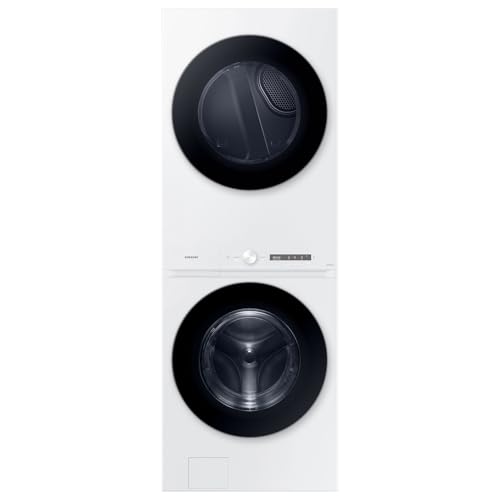
Samsung Bespoke AI Laundry Hub — Single-unit family hub, gas
The Bespoke AI Laundry Hub folds a family’s two machines into one tall appliance: a 4.6 cu. ft. washer with steam wash below, a 7.6 cu. ft. dryer above, in white, under the model reference WH46DBH100GWA3. For a large family in a small house, that single footprint is the entire argument — the laundry corner that could never hold a side-by-side pair can hold this, and the week’s twelve loads still have somewhere to go.
The dryer is gas. Read that sentence twice if your laundry room is all-electric, because no feature downstream of it matters without a gas line and a vent path. For homes already plumbed for gas, the 7.6 cu. ft. dryer is the largest drying drum among the linked picks here, and it swallows the output of the 4.6 washer with room for the bedding that family loads so often include. Steam wash on the washer side addresses the family’s grime profile — grass, food, and the unidentifiable contributions of small children — as the title claims it, with the listing page as the place to confirm the cycle’s exact name.
The hub format carries a family’s specific risk, and honesty requires naming it: one unit means one point of failure. When a side-by-side pair loses its dryer, the washer still works and a laundromat bridges the gap for drying only; when a hub goes down, everything stops. Large families, who feel a laundry outage within forty-eight hours, should weigh that concentration against the footprint saving with clear eyes. The counterweight is simplicity — one delivery, one control centre, one appliance to level — and in a genuinely tight room, that trade is often correct.
Daily life with a stacked hub also changes the choreography of the chore. Loads travel upward, controls sit at a shared height between the drums, and the person loading the washer is not crouching at floor level. For households where grandparents or older children share laundry duty, that ergonomics point is not a luxury; it decides who can actually help.
- Format: single-unit laundry hub, washer below and dryer above
- Washer: 4.6 cu. ft., steam wash named in the title
- Dryer: 7.6 cu. ft., GAS — requires a gas line and venting
- Finish: white; model reference WH46DBH100GWA3
- Installation note: one footprint, one delivery, one point of failure
- Where to buy: the Samsung Bespoke AI Laundry Hub listing on Amazon — check price on Amazon
Strengths
- The largest dryer among the linked picks, in half the floor space of a pair.
- Steam wash is named for the family’s stain-heavy everyday loads.
- Shared-height controls suit households where several generations do laundry.
Trade-offs
- Gas drying excludes all-electric homes outright.
- A single unit means a single failure stops the whole laundry.
- The washer, at 4.6 cu. ft., is generous but not the largest a family can buy.
A family’s week in the hub’s company runs like this: uniforms wash below while yesterday’s towels dry above, and because the two drums work simultaneously in one cabinet, the laundry corner processes the day in parallel rather than in sequence. That parallelism is the hub’s hidden capacity — not a bigger number, but two numbers working at once in the space of one machine. Households that batch by category will feel the benefit most, since the dryer is never waiting on a washer that is itself waiting for floor space.
Best for: large families in small homes with a gas line at the laundry position. Not suited for: all-electric households or anyone who wants washer and dryer independently replaceable.

Samsung Front Load Smart Laundry Pair White — Ready-to-install pair
This white front-load pair is the logistics champion of the linked set. The machines are a 4.5 cu. ft. washer and a 7.5 cu. ft. electric dryer, and the title then does something family buyers should appreciate: it lists the dryer vent, the power cord, and the water hoses as included, and attaches a one-year CPS warranty. A family replacing a dead washer on a school-week deadline does not need a scavenger hunt; it needs a truck, a crew, and machines that wash that evening. This bundle is built for that week.
The capacities sit in the family’s sweet spot. A 4.5 front-load drum handles a bedroom’s full bedding change or a day and a half of clothing for six, and the 7.5 dryer keeps the ratio generous, so nothing queues damp on the laundry-room floor. Front-load tumbling is also the gentler action for the clothes a family cannot afford to chew through — school uniforms on their fortieth wash, the good towels, the inherited quilts.
The word smart in the title is doing unspecified work, and this guide declines to decorate it. What is verified is the configuration, the capacities, the electric fuel, and the bundle contents; connected features, if any, are the listing page’s to describe. A family that buys this pair for its readiness and its drums is buying what the title actually promises, which is the correct basis for the decision.
White, unfashionable as it sounds, is the family’s pragmatic finish: it matches whatever the dryer in the next house will be, shows detergent spills before they set, and never dates the room. In a house where the laundry pair is infrastructure rather than décor, that plainness is a feature.
- Washer: 4.5 cu. ft., front-load, white
- Dryer: 7.5 cu. ft., electric
- Bundle contents named in title: dryer vent, power cord, water hoses
- Protection named in title: 1-year CPS warranty
- Format: side-by-side pair, stackable configuration to confirm on the listing page
- Where to buy: the Samsung Front Load Smart Laundry Pair White listing on Amazon — check price on Amazon
Strengths
- Installation hardware is bundled, so the pair can wash the day it arrives.
- Dryer headroom is the second-largest here, keeping the weekly rhythm smooth.
- Front-load action is kind to uniforms and bedding washed dozens of times a year.
Trade-offs
- No pedestals are named, so loading height stays at floor level unless bought separately.
- The smart designation is unspecified in the title and must be checked on the listing.
- Steam is not claimed for either machine in the verified title.
There is a quieter virtue to this pair’s plainness. With no pedestal to align and no learning dial to teach, every adult and teenager in the house can run it correctly on the first day, and a machine everyone can run is a machine whose capacity the family actually uses. In the arithmetic of the fourteen-load week, usability is throughput: the best pair is the one that never sits idle because its controls intimidated the person standing in front of it.
Best for: families replacing a pair under time pressure who want one complete delivery. A poor fit for: buyers who need pedestals or a named steam cycle included from the start.

Samsung Platinum Front Load Smart Laundry Pair — Pedestals and AI dial
The platinum pair is the white pair’s more considered sibling. The drums match — a 4.5 cu. ft. front-load washer and a 7.5 cu. ft. electric dryer — and the bundle again names its vent, power cord, and hoses with a one-year CPS warranty, but this listing adds pedestals under both machines and an AI Smart Dial on the control side, with steam and energy efficiency also claimed in the title. It is the linked pick for a family buying a ten-year appliance rather than an emergency replacement.
Pedestals change family laundry ergonomics more than any electronic feature. A front-load door raised by a pedestal meets a standing adult at basket height, which matters when the household’s laundry is loaded by parents with a toddler on one hip. The drawers beneath absorb the detergent, the stain sticks, and the mesh bags that otherwise colonise the top of the dryer. The AI Smart Dial, as the title names it, is Samsung’s learning control concept; what a family should verify on the listing page is whether that learning extends to the cycles they actually run, since a dial that remembers the bedding cycle is useful and one that merely glows is furniture.
Steam’s presence in this title, absent from the white pair’s, gives the platinum pair the edge for households whose loads include refresh-worthy clothing — the blazer, the good dress, the curtains at spring cleaning. Energy efficiency is likewise claimed in the title, and in a house running fourteen loads a week, efficiency claims compound into real money over a decade, which is the correct horizon for judging them.
Platinum as a finish sits between white’s plainness and black’s drama, and in a family laundry room it performs the same trick as gray: scuffs and lint dust read as texture rather than damage. Combined with the pedestals’ height, though, measure your overhead: the raised pair is the tallest side-by-side arrangement in this guide.
- Washer: 4.5 cu. ft., front-load, platinum finish
- Dryer: 7.5 cu. ft., electric
- Controls named in title: AI Smart Dial; steam also claimed
- Bundle contents named in title: pedestals, vent, power cord, hoses
- Protection named in title: 1-year CPS warranty
- Where to buy: the Samsung Platinum Front Load Smart Laundry Pair listing on Amazon — check price on Amazon
Strengths
- Pedestals included, lifting both machines to comfortable loading height with storage beneath.
- Steam and an AI Smart Dial are named, giving the pair the richest control story here.
- The same complete hookup bundle as the white pair, with nothing left to chase.
Trade-offs
- Pedestal height can collide with wall cabinets in older laundry rooms.
- Learning controls reward households that run repeatable cycles and baffle those that improvise.
- Drums match the white pair’s, so the premium buys ergonomics and features, not capacity.
Consider also what the platinum pair asks of the room around it. Pedestals need a level, solid floor to keep a spinning front-loader composed, and the pair’s total height should be checked against any shelf that holds the family’s detergent stock. Those are five-minute checks with a tape and a level, and they belong before the order, because a pedestal pair that rocks or crowds its cabinets will be blamed for faults that belong to the installation.
Best for: families buying for the long term who load laundry standing and value steam. Not the right match for: rooms with low cabinets or buyers who prefer the simplest possible controls.

Samsung Top Load Washer and Electric Laundry Pair — Top-load family kit
Some families simply do laundry standing up, and this kit is theirs. A 4.4 cu. ft. high-efficiency top-load washer pairs with a 7.2 cu. ft. electric dryer, and the kit’s title itemises a vent, a power cable, water hoses, and CPS protection. The drums are the smallest of the linked set, and the honest framing is that they are smaller by a margin most families will never detect: a tenth or two of a cubic foot is a hand towel’s worth of difference across a week of loads.
Top-load geometry suits the way family laundry actually happens. Loads are dropped in from above between other tasks, a forgotten sock can join mid-cycle in many designs, and nobody kneels on a cold floor to fish out a hair tie. For households where children graduate to doing their own laundry early, the top-loader is also the format a ten-year-old can operate safely and completely, which distributes the family’s labour in a way no app feature can.
The kit’s completeness deserves the same praise as the front-load bundles’: vent, cable, and hoses named in the title mean the delivery can end with a test wash rather than a parts list. CPS protection is named as well, and families should register it promptly and note its term in the same place they keep the order record.
What the kit does not claim is as important as what it does. No steam, no pedestal, no named smart platform appears in its title; the word smart attaches to the washer without elaboration. Buy it as a well-sized, well-bundled mechanical pair and it will not disappoint; buy it expecting the platinum pair’s control story and it will.
- Washer: 4.4 cu. ft., top-load, high-efficiency, white
- Dryer: 7.2 cu. ft., electric
- Bundle contents named in title: vent, power cable, water hoses
- Protection named in title: CPS protection (term to confirm on the listing page)
- Format: two-machine kit
- Where to buy: the Samsung Top Load Washer and Electric Laundry Pair listing on Amazon — check price on Amazon
Strengths
- Top-load loading suits busy, standing, multi-generational laundry routines.
- A complete kit with hookup parts and protection named in one listing.
- Dryer headroom stays healthy despite the set’s smallest washer.
Trade-offs
- The smallest drums of the linked set, by a small but real margin.
- No steam or pedestal is included or claimed in the title.
- Deep top-load tubs ask a reach that shorter users should test mentally before buying.
The kit also forgives the family’s most common loading sin: the mid-cycle addition. A design that lets a stray sock join late — where the specific model allows it, which the listing page will describe — matches the reality of laundry gathered from bedroom floors in stages. Front-loaders forgive that sin less gracefully. Neither virtue appears in a capacity figure, yet both decide how a machine feels at 7 a.m. on a school day, which is when family laundry equipment earns its keep.
Best for: families who load standing, teach children the chore early, and want a complete kit. Poorly suited to: households determined to maximise drum size or steam features.
LG Mega-Capacity Top-Load Pair Class — Prose-only alternative
Because the linked pool for this keyword is entirely Samsung, the LG alternative is discussed here at class level, without a link: LG’s mega-capacity top-load pairs are the other ecosystem a large family will meet in every showroom, typically built around very large top-load washers, connected controls under the maker’s smart platform, and dryers offering steam and sensor drying. A family comparing classes should ask three questions of any LG pair it finds: does the washer’s printed capacity beat the 4.5 class decisively enough to matter, is the dryer at least half again as large, and are the hookup parts bundled or billed separately?
The class’s appeal for families is the combination of the biggest top-load drums in the mainstream market with a mature app ecosystem for cycle downloads and alerts. Its caution is the mirror of the Samsung bundles above: showroom pairs are often priced as bare machines, so the hoses, cords, venting, and any protection plan must be added to the comparison before the class looks cheaper or dearer than a bundled listing. Judge the class by installed, working totals — never by the tag on the washer alone.
- Class discussed: LG mega-capacity top-load washer and dryer pairs
- What to verify when you find one: printed washer capacity, dryer ratio, connected features by name
- Comparison discipline: price the installed pair, including hoses, cord, vent, and protection
- Where to buy: through LG’s own storefront or an appliance dealer, where the pair’s full specification sheet can be read before ordering
Strengths
- The class offers some of the largest top-load washer drums a family can buy.
- A mature connected ecosystem suits households that run laundry by phone alert.
- Dealer networks give the class strong in-person service coverage.
Trade-offs
- No verified listing for this class sits in this guide’s pool, so nothing here is linked.
- Bare-machine pricing can hide the hookup costs the Samsung bundles include.
- Class-level discussion cannot confirm any single model’s cycle list.
Families already living inside LG’s appliance ecosystem should weight familiarity honestly. A control layout the household knows, an app already on everyone’s phone, and a service relationship already established are worth real loads per week, because they remove friction from every cycle. That is the strongest argument for the class — stronger than any single feature — and it applies symmetrically to the Samsung and GE ecosystems for households living in those instead.
Best for: families loyal to LG’s ecosystem who will verify a specific pair’s sheet before buying. A weak match for: buyers who want a verified, bundled, one-order purchase today.
GE Profile Front-Load Pair Class — Prose-only alternative
The second prose pick covers the GE front-load pair class, the third ecosystem in the family conversation. GE’s family front-loaders compete on wash-system features — venting systems that address front-load freshness, dispenser automation, and connected controls — paired with dryers in the same mid-seven capacity class as the linked Samsung sets. Discussed at class level, the questions to carry into any specific GE listing are whether its freshness system suits a household that washes daily (the exact household that needs it least, since doors rarely stay shut for long) and whether its dispensers genuinely reduce the per-load effort for the family’s detergent habits.
For a large family, the GE class’s strongest card is often its dealer and service footprint, which matters when a machine carrying fourteen loads a week needs a part in year four. Its honest limitation in this guide is the same as the LG class’s: no verified listing, no link, and no model-level claims. Treat both prose picks as maps for cross-shopping, and hold any specific model to the same title-and-listing verification the linked picks received.
- Class discussed: GE Profile front-load washer and dryer pairs
- What to verify when you find one: freshness/venting system details, dispenser type, dryer capacity ratio
- Comparison discipline: weigh service coverage alongside features for a high-cycle household
- Where to buy: through GE’s own channels or an appliance dealer, reading the model’s full specification before committing
Strengths
- Freshness-focused wash systems address the classic front-load complaint directly.
- A broad dealer network supports a machine that will cycle heavily for years.
- Capacities in the class match the family class of the linked picks.
Trade-offs
- Covered without a link because no listing for the class was verified in the pool.
- Freshness systems help most where machines sit idle, which family machines rarely do.
- Feature names vary by model, so class impressions must be re-verified per listing.
A final class-level note concerns resale and replacement planning. Mainstream ecosystems hold their value in a practical sense: parts stay available, manuals stay findable, and the next buyer of your house recognises the machines. A family purchasing a decade of heavy use should count that boring durability of support as a feature, because the fourteenth load of the week in year seven matters as much as the first load in week one.
Best for: families who prize service access and front-load freshness engineering. Not suited for: anyone who wants to order from this page without a further verification step.
Family Pairs at a Glance
| Option | Washer | Dryer and fuel | Family note |
|---|---|---|---|
| Samsung Bespoke AI Laundry Hub | 4.6 cu. ft., steam wash, single unit | 7.6 cu. ft. GAS | One footprint for small homes; one point of failure |
| Samsung Front Load Smart Laundry Pair White | 4.5 cu. ft. front-load | 7.5 cu. ft. electric | Vent, cord, hoses, and warranty bundled |
| Samsung Platinum Front Load Smart Laundry Pair | 4.5 cu. ft. front-load, AI dial, steam | 7.5 cu. ft. electric | Pedestals included; tallest side-by-side setup |
| Samsung Top Load Washer and Electric Laundry Pair | 4.4 cu. ft. top-load | 7.2 cu. ft. electric | Complete kit; child-friendly loading height |
| LG Mega-Capacity Top-Load Pair Class | Class-level, verify per model | Class-level, verify per model | Prose-only; largest top-load class reputation |
| GE Profile Front-Load Pair Class | Class-level, verify per model | Class-level, verify per model | Prose-only; freshness systems and dealer network |
What Does Fourteen Loads a Week Actually Demand From a Pair?
Run the arithmetic honestly. Fourteen loads a week is two a day, every day, with bedding weeks pushing higher. At that cadence, cycle time matters as much as capacity: a pair whose washer runs long and whose dryer runs longer turns laundry into a background occupation, while a well-matched pair clears the day’s two loads inside a morning. The linked sets here cluster tightly in capacity because they were chosen against this arithmetic — the differences that remain are format, fuel, and bundle, which is where a family should spend its decision.
Sorting is the family’s other throughput tool. A household that washes by person rather than by fabric spends cycles on part-full drums; a household that washes by category — all towels, all school clothes, all bedding — fills drums properly and dries evenly. Big machines reward the second system and expose the first. If your family will not sort, buy for the loads you actually run, not the loads the brochure imagines.
Staggering matters too. Two loads a day need not mean two loads at once: a morning wash moved promptly to the dryer, and an evening wash started after dinner, keeps one pair working like two. Sensor drying, where a listing names it, protects that rhythm by ending cycles at dryness rather than at a timer’s pessimism — a point explored from the dryer’s side in Best Sensor Dryers, which isolates the sensing question from the pair question entirely.
How Should a Family Split Laundry Duty Across a Week?
Assign loads to people, not to days. When one parent owns laundry, the pair’s capacity is wasted on their schedule; when each older child owns their basket and one parent owns towels and bedding, the machines run in short, frequent, manageable sessions. Top-load formats lower the age at which that delegation works, which is a genuine if unglamorous argument for the kit in this guide.
Keep a staging system beside the machines: a basket per category, a shelf for the detergent the household actually uses, and a rule that the washer is emptied within the hour. The rule sounds fussy until a forgotten load in a front-loader teaches the whole family why freshness systems exist. Families that run the system find the pair’s size stops mattering, because the rhythm carries the week; families that do not will find even the largest drum becomes a very big place to forget wet clothes.
Which Family Buying Mistakes Show Up Again and Again?
The first is buying for the household you had. Children grow, laundry volume peaks in the school years, and a pair bought for toddlers will be judged by teenagers; buy for the peak you can see coming. The second is ignoring fuel until delivery — the hub in this guide dries with gas, and discovering that at the curb is a family-sized problem. The third is treating the bundle as packaging rather than contents: hoses, vents, and pedestals named in a title are value, and skipping the comparison understates one pair and overstates another.
Fourth comes brand blindness in both directions — refusing a strong pair because the pool skewed to one maker, or refusing to cross-shop the LG and GE classes because a guide linked only Samsung. The prose picks exist to prevent the second error; your own openness prevents the first. Finally, families forget the room: pedestals under cabinets, tower heights under soffits, and doors swinging into sinks have ended more good purchases than any specification.
How Do You Verify a Family Pair Before the Truck Arrives?
Read the listing page as a contract. Capacities, fuel, and every bundle item named in the title should reappear there in fuller language; anything that shrinks in the retelling deserves a message to the seller before dispatch. Confirm the electrical or gas requirement against your laundry room’s actual connections, and the delivery terms against your staircase. Then check the unglamorous third document — the warranty and any CPS plan paperwork — so registration happens in the first week, not the first breakdown. Buyers who want to sanity-check the sanitising claims made for family top-loaders will find the honest version of that conversation in Best Top-Load Washers With Sanitizing, which states plainly what its pool could and could not verify.
How Long Should a Family Expect a Hard-Working Pair to Last?
Honest expectations protect the purchase. A pair cycling twice a day accumulates in five years the cycle count a couple’s machines gather in fifteen, and components wear by cycles, not by birthdays. Families should therefore weight build, service access, and parts availability more heavily than households washing four loads a week — and should read the protection plans bundled with several picks here as genuinely relevant rather than as packaging. Register them, keep the order records, and note the plan’s term beside the household’s other appliance dates.
Maintenance stretches whatever lifespan the build allows. Lint screens cleared every load, vent runs cleaned on a schedule, washer gaskets wiped and doors left ajar, hoses inspected yearly — at family volumes these are not fussy extras but the difference between a pair that serves a childhood and one that serves a lease. The machines in this guide were chosen to carry a family’s week; the family’s half of the bargain is this modest, regular care.
Final Recommendation
Most large families should take the platinum pair: pedestals that save backs across a decade of daily loading, steam for the refresh loads, a complete bundle, and drums sized exactly for the fourteen-load week. Families in small homes with gas service should seriously consider the hub and accept its single-unit risk as the price of its footprint. The white pair is the emergency replacement done right, the top-load kit is the delegation-friendly workhorse, and the LG and GE classes stand as the cross-shop every family should perform before money moves. Choose by your week’s rhythm, and the machines will disappear into it — which is the highest praise family laundry equipment can earn.
Why Does Cycle Time Matter More Than Families Expect?
A pair’s brochure number is capacity, but a family’s lived number is the clock. Consider the school-night sequence: dinner ends, baths run, and the laundry that must be clean by morning is one load of uniforms and one of pyjamas and towels. If the washer takes ninety minutes and the dryer another ninety, the second load finishes near midnight and somebody’s sleep absorbs the difference. Pairs that wash and dry briskly — and dryers that stop at true dryness instead of a fixed pessimistic timer — return that hour to the household every single night, which across a school year is a larger gift than half a cubic foot of drum.
This is why the features named in these titles deserve reading as time features. Sensor drying is a clock feature. Steam refresh is a clock feature, because it returns a garment to service in minutes instead of a full wash-and-dry round. Even the bundle contents are clock features: a pair installed completely on delivery day starts saving time immediately, while a bare pair waiting on a vent section saves nothing at all. When a family compares the linked sets, it should ask of every line in every title a single question — does this give us back time, and how often?
The hub adds a spatial version of the same argument. Two drums in one cabinet can run a wash and a dry truly simultaneously in a room where a pair would have to be stacked to fit, and simultaneity is time. The counterweight remains its single point of failure, and families should hold both truths at once rather than letting either one decide alone.
How Should Families Think About Noise and Placement?
Fourteen loads a week means the machines are audible members of the household. A pair installed beside bedrooms will be heard at the spin cycle’s peak; a pair in a basement will be forgotten, which carries its own cost in damp loads left sitting. Placement is therefore a rhythm decision: put the machines where the household actually passes, on a floor that does not amplify vibration, with enough light to see stains before they are washed in rather than after.
Level floors matter more at family volumes than at any other. An unbalanced machine walked across a utility room is a nuisance for a couple; for a family mid-bedding-week it is a schedule failure. The installation hour — levelling, testing a full spin with a real load, confirming the vent run — is the highest-value hour in the pair’s entire life, and families should insist on spending it properly whether the installer is a delivery crew or themselves.
How Do Bedding Weeks Change the Calculation?
Every few weeks, a large family hits the bedding turnover: duvet covers, mattress protectors, blankets, and the pillow laundry that nobody schedules until a spill schedules it. Those loads are bulky rather than heavy, and they test the dryer’s volume more than the washer’s. The linked pairs’ dryers, at 7.2 to 7.6 cu. ft., absorb a full bedding load without the mid-cycle rearrangement that smaller drums demand, and the hub’s gas dryer leads the set on exactly this test. Plan bedding as its own laundry session, wash one bed’s worth at a time, and the family’s ordinary rhythm survives the turnover intact.
Towels deserve the same respect. A week’s towels for six people is a dense, water-heavy load that benefits from the hottest wash the fabrics allow and a dryer given room to work. Cramming towels into a mixed load to save a cycle costs more in drying time than it saves in washing, at any capacity in this guide.
What Should a Family Do in the First Month With a New Pair?
Run the experiment the purchase assumed. Track the loads for two ordinary weeks — count them, note which ones split or waited, and learn whether the family’s true number is eleven or seventeen. That count governs everything downstream: detergent purchasing, the bedding schedule, and the moment in a few years when the household’s growth argues for a second machine or a larger pair. Register warranties and any CPS plan in the first week, photograph the installed pair with its connections visible, and keep the listing’s contents list with the order record.
Use that first month to learn the machines’ voices, too. A healthy pair has a rhythm of sounds — fill, tumble, spin, drain — and the family that knows the normal pattern hears the abnormal one early: the thump of a load that has balled to one side, the longer drain that hints at a filter asking for attention. Catching those small changes is how a hard-working pair stays hard-working, and it costs nothing but familiarity.
Then set the defaults and teach them. Choose the two or three cycles the family will actually live on, show every laundry-age member where they are, and put the lint-screen rule on the wall if you must. A family pair succeeds socially before it succeeds mechanically: the machines are shared infrastructure, and shared infrastructure runs on shared habits.
What About Water, Detergent, and Energy at Family Scale?
At fourteen loads a week, small inefficiencies stop being small. A washer that meters water to the sensed load — the working definition of the high-efficiency designs in this guide — saves its advantage hundreds of times a year, and a dryer that stops at dryness rather than at a timer does the same for energy. Families should therefore read efficiency claims in titles as volume claims: modest per load, decisive per year. The platinum pair’s title claims energy efficiency outright; the other listings leave the question to their specification pages, where the family’s comparison should be made on the same per-load basis.
Detergent is the cost families most often mishandle at scale. Big drums invite big doses, and excess detergent in a high-efficiency machine cushions the wash, dulls fabrics, and leaves residue that the next load inherits. Measure the dose for the load in the drum, not for the drum’s maximum, and teach the measurement to everyone who washes. The savings are real, and so is the improvement in how the clothes feel — a benefit no feature list can sell you, because it is a habit rather than a purchase.
Finally, plan consumables like the infrastructure they are. A family that runs out of detergent on bedding day has a logistics failure, not a laundry failure, and the fix is a shelf with a week’s reserve beside machines that were bought to never be the bottleneck. The pair’s job is capacity and rhythm; the household’s job is to never starve them.
When Is a Second Machine the Real Answer?
Some households outgrow any single pair, and recognising that moment is part of honest advice. The signals are consistent: laundry runs daily and still backlogs, bedding weeks displace ordinary washing for days, or two adults’ work schedules collide on the same laundry evening every week. At that point the choice is not a bigger pair — the drums in this guide already sit at the practical ceiling — but a second washer or a second dryer in whatever space can be found, even a compact unit handling the overflow category, such as sports kits or delicates, that clogs the main pair’s rhythm.
Until those signals appear, resist the duplication. A second machine costs connections, space, and maintenance, and most families who feel overwhelmed discover, once they count, that their true load number fits the pairs here with room to spare. Count first, buy second — in that order the family’s money follows its evidence.
Frequently Asked Questions
Why are all the linked picks in this guide from Samsung?
Because the verified pool for this keyword returned Samsung listings only, and this guide links only what it verified. Rather than hide that, we state it in the introduction and cover the LG and GE pair classes in prose, so the comparison stays honest and the wider market is still represented.
Is the Bespoke hub’s dryer electric or gas?
Gas. The title states a 7.6 cu. ft. gas dryer, which makes the hub the largest dryer here and also the only linked pick that needs a gas line and venting. The three Samsung pairs all dry electrically.
How many loads a week can these pairs realistically handle?
Comfortably in the low-to-mid teens, which covers most households of five to seven including bedding and towels. The constraint is rarely the drum; it is the household’s rhythm of starting, moving, and folding loads, which the body of this guide addresses directly.
Are pedestals worth it for a family pair?
For front-load pairs loaded several times a day, generally yes: the raised door height reduces bending across thousands of loads, and the drawers store the supplies that otherwise crowd the machines. Measure overhead clearance first, as the platinum pair’s pedestals make it the tallest setup here.
What should I check before ordering a bundle pair?
That every item named in the title — hoses, vent, cord, pedestals, protection — reappears in the listing’s contents, that the fuel matches your home, and that delivery terms fit your space. Bundle contents are set by the seller, so the listing page is the governing document.
Does a single-unit hub make sense for a big family?
When floor space is the binding constraint and gas service exists, yes: the hub carries family-sized drums in one footprint. The trade is resilience — one failure stops everything — so households with room for a pair usually keep the pair’s independence.
What size washer should a family of six start from?
Start at the 4.5 class represented by both front-load pairs here, and treat anything smaller as a compromise that bedding weeks will expose. Families of six with heavy sports or workwear loads should look hardest at the largest drums and the hub’s dryer, and should count their true weekly loads before deciding the 4.4 kit is close enough.
Can one pair really serve a family of seven?
Yes, provided the household runs a rhythm rather than a weekly avalanche. The pairs here clear two loads a day without strain; what defeats a single pair is not volume but bunching — seven days of laundry presented on one afternoon. Spread the week, and one good pair is enough for most families of seven.
Should a family prefer a hub or a pair when both fit?
Prefer the pair for resilience and the hub for space. Two machines fail independently and can be replaced independently; the hub trades that independence for a single footprint and parallel processing in tight rooms. Where space genuinely binds, the hub’s trade is the right one.
How do I keep a front-load family washer from smelling?
Leave the door ajar between washes, wipe the gasket fold weekly, and run the tub-clean cycle on the maker’s schedule. Family machines wash so often that mildew rarely gets the still, damp days it needs — the risk concentrates in holiday weeks when the pair sits idle and closed.
Is gas or electric drying better for a large family?
Neither is universally better; the home decides. Gas suits houses already plumbed for it and offers the largest drum in this guide through the hub. Electric pairs install almost anywhere with the right outlet. Choose by your connections first and by drum second.
Related Guides
When the washer is settled and only the drying side needs attention, Best Dryers for Large Families takes the family-throughput question to dryers alone, which is the right read for households replacing one half of a working pair.



[…] and get the warranty terms in writing. Buyers comparing formats should also read our guide to Best Washers and Dryers for Large Families, where throughput per week — not format loyalty — decides the […]