What's inside
- Key Takeaways
- Quick Picks
- How Did We Judge Top Quilts Made for Hammocks?
- The Six, Compared Fairly
- Why Does the Underquilt Matter as Much as the Top Quilt?
- How Do You Set Up a Top Quilt in a Hammock?
- Which Hammock Mistakes Chill Sleepers Most?
- How Do You Choose a Top Quilt Size for the Diagonal?
- What Happens to a Hammock System in Wind and Rain?
- How Do You Care for a Hammock Quilt System?
- How Do You Layer Clothing Inside a Hammock Quilt?
- What Should a First Hammock System Cost You in Weight?
- How Do You Read a Hammock Quilt Listing Like a Skeptic?
- Final Recommendation
- Frequently Asked Questions
- Related Guides
As an Amazon Associate I earn from qualifying purchases. This post may contain affiliate links at no extra cost to you.
cottageverdict.com is reader-supported. When you buy through links on our site, we may earn an affiliate commission.
Where to buy: Every pick below is sold on Amazon. Each linked name opens its own listing — check price on Amazon, confirm what the listing includes — especially on the two combination sets — and check sizes against your hammock before ordering.
The best hammock top quilts solve the top half of a two-half problem. A hammock sleeper is insulated from below by an underquilt that hangs uncompressed beneath the fabric, and from above by a top quilt that drapes along the hammock’s diagonal. This guide covers the top half: six listings whose titles describe top quilts for hammocks, judged on stated temperature ranges, stated weights and dimensions, footbox design, and brand. Two of the six are combination sets — the Oak Creek bundle and the onewind combo each include an underquilt as well as a top quilt — and they are framed as combos every time they are named below, because a reader comparing prices deserves to know when a listing is selling two pieces of insulation rather than one.
Why a top quilt rather than a sleeping bag in a hammock? Because getting into a bag inside a hammock is a wrestling match conducted on a moving surface, and because the bag’s underside insulation is crushed useless beneath you anyway. A top quilt enters from above, settles along the diagonal, and lets you regulate temperature with a foot or a shoulder the way a bed does. The picks below assume you already understand that bargain — and that you own, or are buying, the underquilt that makes the system honest.
A word about the phrase “for sale” in the search that brought many readers here: everything in this guide is a current, purchasable listing, checked as a set, with no discontinued legends and no cottage-industry waiting lists. That constraint shapes the shelf — it favours makers who actually stock hammock quilts at scale — and it is why the reviews lean so hard on stated figures: in a live marketplace, the title is the one document every buyer can verify for themselves before money moves.
Key Takeaways
- A hammock top quilt is half a system: without an underquilt beneath the hammock, no top quilt in this guide will keep you warm, because your underside insulation is compressed to nothing by your own weight.
- Two picks — the Oak Creek Hidden Ridge bundle and the onewind combo — include an underquilt in the listing, and both are priced and judged as two-piece sets wherever they appear in this guide.
- Stated temperature figures appear only where titles print them: the onewind footbox quilt states a 45-to-60-degree range, and the Top Deck states 40 degrees, while the other picks publish no figure at all.
- A footbox matters more in a hammock than on the ground, because the hammock’s gathered foot end gives loose fabric nowhere to live — an anchored footbox keeps the quilt’s low end located all night, through every turn and every small hours adjustment a sleeper makes without ever quite waking up.
- Diagonal lie decides coverage: size a top quilt for your body laid at an angle, not for your height standing up, or the shoulders and hips at the wide points of the diagonal will find the edges in the coldest hour of the night, every night, until the quilt is replaced by one that fits the way you actually sleep.
Quick Picks
| Pick | Badge | Why it earns its place |
|---|---|---|
| Travel Bird Hammock Top Quilt | Purest Single Top Quilt | An ultralight topquilt designed for hammocks and nothing else — the single-piece specialist. |
| onewind Hammock Top Quilt With Footbox | Best Stated-Range Footbox Quilt | A footboxed, wearable quilt with a stated 45-to-60-degree range at 78 by 54 inches. |
| ENO Vesta TopQuilt | Hammock-Brand Specialist Pick | A water-repellent insulated top quilt from the hammock specialist ENO, in its Storm colourway. |
| Top Deck Ultralight Topquilt (40 Degree) | Best Stated Warmth for the Weight | A stated 40-degree rating at a stated 35oz — the clearest warmth paperwork here. |
| Oak Creek Hidden Ridge Topquilt and Underquilt Bundle | Best Complete Two-Piece Bundle | Top quilt and underquilt together, full length, with carabiners and a compression sack, at 3.4 lbs for the set. |
| onewind Underquilt and Topquilt Combo | Best Winter-Leaning Combo | A top-and-under combo pitched at winter camping — both halves of the system in one listing. |
How Did We Judge Top Quilts Made for Hammocks?
First, by whether the listing understands hammocks at all. A hammock top quilt must drape rather than bridge, anchor at the foot rather than pool, and size for a diagonal body — and the titles here were read for exactly those signals: footboxes, stated dimensions, hammock-first design briefs. Generic camping quilts can work in a hammock, and our ground-focused guides cover plenty, but this shelf is for pieces that name the hammock in their own description of themselves.
Second, by honesty about what is in the box. Combination listings are excellent value when recognised and a comparison trap when missed, so the two combos are labelled at every mention. Readers building the other half of the system separately will find the dedicated shelf in our guide to Best Lightweight Hammock Underquilts, where the underside pieces get the same stated-facts treatment.
Third, by the paperwork: stated ranges, stated weights, stated sizes were credited wherever a title prints them, and their absence was noted without invention wherever it does not. A hammock is an unforgiving place to discover that a quilt is shorter than you assumed, so the dimension in a title is worth more than the adjective beside it.
We also asked a beginner’s question of every pick — could a first-time hanger succeed with this on their first cold night, given a fair test hang at home? — because this category recruits constantly. The combos score highest on that test by construction, the stated-figure singles next, and the unrated singles ask the most of their owners. None of the six failed it outright, but the ranking shaped the badges, and readers new to hammocks should let it shape their shortlist too.

Travel Bird Hammock Top Quilt — Purest Single Top Quilt
The Travel Bird is the specialist of the six: an ultralight top quilt for hammocks, full stop — its title names no other venue and bundles nothing else into the box. That purity has a real appeal for the hammock camper who already owns an underquilt and wants the top half designed for the sling rather than adapted to it. A hammock-first top quilt is cut and shaped for the diagonal, drapes into the hammock’s curve instead of spanning across it, and stays where a sleeping body puts it through the small hours.
The title promises warm insulation without stating a figure, so we grade it the way unrated pieces must be graded: as a mild-to-cool-weather top layer whose true range its owner should establish on a garden hang before trusting it on a trip. Ultralight framing suggests it packs small and carries kindly, suiting backpackers who hang rather than pitch. Buy it as the dedicated top half of a system you are assembling deliberately, pair it with an underquilt you trust, and its specialism becomes the point — nothing in the box is paying for versatility you will never use.
It is also the cleanest recommendation here for a second hammock in the household — the guest rig, the child’s setup — where a simple, single-purpose top quilt beats a configurable one that needs explaining to its borrower.
There is a weight-philosophy point here too. A dedicated top quilt spends every gram on the top half’s job, where a convertible or ground-shared design spends some of its budget on features a hammock never uses — groundsheet-proof fabrics, pad straps, widths meant for flat sleeping. The Travel Bird’s narrow brief is therefore not a limitation but an efficiency, and hangers who have already made their peace with owning hammock-specific gear will recognise the logic immediately.
- Form: top quilt designed for hammocks, per the title
- Framing: ultralight, per the listing title
- Included: top quilt only — no underquilt in this listing
- Stated warmth: no temperature figure in the title
- Where to buy: the Travel Bird Hammock Top Quilt listing on Amazon — check price on Amazon
Strengths
- Hammock-first design drapes the diagonal properly.
- Single-piece listing keeps the comparison honest.
- Ultralight brief suits backpackers who hang.
Trade-offs
- No stated temperature figure to plan around.
- Requires an underquilt bought separately.
- Specialist shape is wasted on ground sleeping.
Best for: hammock campers completing a system with a dedicated top half. Not suited for: anyone whose underquilt does not exist yet — buy the system, not the half.

onewind Hammock Top Quilt With Footbox — Best Stated-Range Footbox Quilt
onewind’s top quilt prints the most useful paperwork in this guide after the Top Deck: a stated range of 45 to 60 degrees, stated dimensions of 78 by 54 inches, a footbox, and a wearable design, in an OD Green colourway. Take those facts in order. The range frames it honestly as a mild-weather quilt — this is spring-to-autumn equipment and says so. The dimensions are generous: seventy-eight inches covers a tall diagonal, and fifty-four inches of width wraps the shoulders where the diagonal is widest. The footbox anchors the low end in the hammock’s gathered foot, and the wearable cut means the quilt works around camp in the evening before it works in the hammock at night.
onewind is a hammock-system maker — its underquilts appear elsewhere in this batch’s guides — and that systems thinking shows in a top quilt designed to drape, anchor, and pair. The wearable feature deserves its sentence: a quilt you can wear to the fire and then carry straight into the hammock collapses the evening’s warm layer and the night’s into one carried object, which is the sort of small arithmetic that keeps packs light without keeping campers cold.
Grade its range conservatively, as with every maker’s figure: at the warm end it is a summer quilt, at the cold end a quilt for layered sleepers on still nights, and in the middle it is exactly what most hammock campers actually need for most of the year.
The stated range also makes this the easiest pick to lend with confidence. A borrower told “this quilt is for mild nights, roughly the range on its label” has been given honest instructions; a borrower handed an unrated quilt has been given a riddle. Households and clubs that share gear should weight that clarity heavily — a stated range is a safety feature for the second sleeper, not just a specification for the first.
- Stated range: 45 to 60 degrees, per the listing title
- Size: 78 by 54 inches, per the listing title
- Foot end: footbox included, per the listing title
- Design: wearable, per the listing title; OD Green colourway
- Where to buy: the onewind Hammock Top Quilt With Footbox listing on Amazon — check price on Amazon
Strengths
- Stated range and dimensions make planning easy.
- Footbox anchors the quilt in the hammock’s foot end.
- Wearable cut serves the camp evening as well.
Trade-offs
- Mild-weather range excludes cold trips by design.
- Wearable features add hardware some minimalists skip.
- Still needs an underquilt beneath the hammock.
Best for: three-season hammock campers wanting stated numbers and a footbox. A poor fit for: winter hangers, whose season starts where this range ends.

ENO Vesta TopQuilt — Hammock-Brand Specialist Pick
ENO — Eagles Nest Outfitters — is the name that introduced a generation to hammock camping, and the Vesta TopQuilt is its entry here: a water-repellent, insulated hammock blanket in a Storm colourway, per its title. The water-repellent finish is the feature to weight most heavily in a hammock context, because hammock sleepers live closer to the weather than tent sleepers do — a tarp’s edge, a night’s dew, the splash of a hard rain all reach the top quilt first, and a shell that sheds that moisture keeps the insulation under it working through the wettest hour of the night.
The title calls it a blanket as readily as a quilt, and that honesty about form is worth noting: expect a draping, blanket-like top layer shaped by a hammock specialist rather than a technical footboxed quilt. For ENO hammock owners, the pairing logic is its own argument — gear designed inside one system tends to fit that system’s geometry, ridgelines, and habits. No temperature figure is stated, so grade it as a mild-weather piece and test it on a garden hang, the way this guide advises for every unrated pick.
Brand buyers are sometimes mocked for paying for a name; here the name buys a design office that thinks about hammocks all day, and in a category where geometry is destiny, that is a rational thing to purchase.
The Storm colourway deserves its practical sentence: dark, weather-toned colours forgive the evidence of outdoor life — the dew spots, the leaf stains, the faint smoke of a hundred firesides — in a way pale shells never do, and a top quilt lives outdoors more visibly than any other piece of sleep gear. It is a small consideration that compounds across seasons, like every other honest detail in this category.
- Maker: ENO (Eagles Nest Outfitters), per the listing title
- Shell behaviour: water-repellent, per the listing title
- Form: insulated hammock blanket / top quilt
- Colourway named in title: Storm
- Where to buy: the ENO Vesta TopQuilt listing on Amazon — check price on Amazon
Strengths
- Designed by a dedicated hammock specialist brand.
- Water-repellent shell suits exposed hammock sleep.
- Natural pairing for ENO hammock owners.
Trade-offs
- The title prints no temperature figure at all.
- Blanket-like form lacks a technical footbox brief.
- Brand coherence matters less to mixed-system owners.
Best for: ENO hammock owners and brand-loyal hangers in mild weather. Not the right match for: campers who plan strictly by stated temperature figures.

Top Deck Ultralight Topquilt (40 Degree) — Best Stated Warmth for the Weight
The Top Deck topquilt states the two numbers a hammock backpacker most wants to read together: 40 degrees and 35oz, both in its title. A stated 40-degree rating reaches genuinely cool nights — the shoulder-season trips where hammock camping is at its best and its coldest — and it does so at a weight that keeps the whole sleep system honest. Among single top quilts here, this is the paperwork leader: warmth claimed, weight claimed, hammock use named outright alongside outback camping, hiking, and backpacking.
Treat the 40-degree figure with the usual respect and the usual margin. In a hammock, your comfort at a stated rating depends on the underquilt below you performing to a matching standard; a 40-degree top over a summer underquilt is a 40-degree claim with a hole in it. Paired properly, though, this is the pick for the hanger whose season extends into frosty mornings and who counts ounces because the trail is long. The ultralight framing also implies a pack size that leaves room for the food those longer, colder trips demand.
It earns a final distinction: of the single-piece picks, it is the one we would hand to a camper upgrading from a mild-weather quilt, because its stated figures make the upgrade measurable rather than a matter of hope.
One caution travels with its stated weight: 35oz is light enough that the shell and construction should be handled with the respect ultralight gear always asks. It will not enjoy being sat on at the fire, dragged across bark, or lent to the careless — and in exchange for that courtesy it will carry a shoulder-season rating at a summer weight, which is the trade its whole design exists to offer.
- Stated rating: 40 degree, per the listing title
- Stated weight: 35oz, per the listing title
- Form: ultralight top quilt for hammocks and ground
- Included: top quilt only — no underquilt in this listing
- Where to buy: the Top Deck Ultralight Topquilt (40 Degree) listing on Amazon — check price on Amazon
Strengths
- Warmest stated rating among the single quilts.
- Stated weight keeps system planning honest.
- Shoulder-season range extends the hanging year.
Trade-offs
- Demands a matching underquilt to deliver its rating.
- Maker’s figure still needs a home test at the edge.
- Overkill for high-summer hammock lounging.
Best for: shoulder-season hammock backpackers planning by numbers. Poorly suited to: summer-only hangers, who would carry warmth they never use.
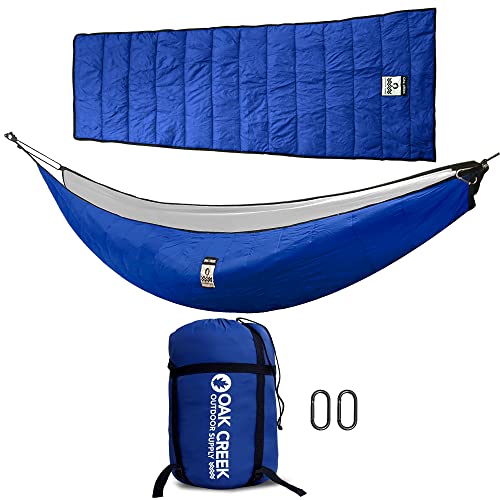
Oak Creek Hidden Ridge Topquilt and Underquilt Bundle — Best Complete Two-Piece Bundle
Say it first and say it clearly: this listing is a bundle — the Oak Creek Hidden Ridge set includes both a top quilt and an underquilt, full length, in one purchase. That changes every comparison in this guide, because the bundle is not competing with single top quilts; it is competing with the cost and effort of assembling a matched system from two shelves. For a new hammock camper starting from nothing, that is the most useful offer here: both halves, designed together, arriving together, with the compatibility question answered by the maker instead of by trial and error at midnight.
The stated particulars support the system brief: full-length coverage for both pieces, a 3-to-4-season framing, a 240T rip-stop nylon shell, carabiners and a compression sack included, and a stated weight of 3.4 lbs for the set. Read that weight as a system’s weight — divided between two pieces of insulation, it is a reasonable carry for the seasons claimed — and read the included hardware as a sign the maker expects you to hang it the day it arrives. Rip-stop nylon is the pragmatic shell choice for a set aimed at real use rather than ultralight records.
Judge the bundle as a starting system and it is the easiest recommendation in the guide for a beginner; judge it as a top quilt alone and you will misunderstand both its price and its weight. It is two products, honestly labelled, and this review insists on the label because the value only makes sense with it attached.
Full length deserves emphasis for tall beginners especially, because a first system that is too short teaches a hatred of hammocks that was really a hatred of arithmetic. A full-length underquilt protects the calves and feet that short underquilts abandon, and a full-length top quilt completes the envelope — the beginner’s first cold night in this bundle is graded by the system as designed, not by a sizing compromise nobody warned them about.
- Included: top quilt AND underquilt — a two-piece bundle
- Coverage: full length, per the listing title
- Season framing: 3 to 4 seasons, per the listing title
- Shell and kit: 240T rip-stop nylon; carabiners and compression sack included; set weighs 3.4 lbs
- Where to buy: the Oak Creek Hidden Ridge Topquilt and Underquilt Bundle listing on Amazon — check price on Amazon
Strengths
- Complete matched system in a single purchase.
- Hardware included — ready to hang on arrival.
- Full-length pieces suit tall hangers properly.
Trade-offs
- Set weight exceeds any single quilt here, fairly.
- Owners of one half already pay for duplication.
- Rip-stop shell is durable rather than ultralight.
Best for: new hammock campers buying a whole sleep system at once. A weak match for: experienced hangers upgrading only their top quilt.

onewind Underquilt and Topquilt Combo — Best Winter-Leaning Combo
The second combo in the guide, and the same disclosure applies at the top: this onewind listing includes an underquilt and a top quilt together — a combo, in the maker’s own word — pitched at winter camping alongside hiking and backpacking. That winter framing distinguishes it from the Oak Creek bundle’s 3-to-4-season brief: this is the set aimed at the cold end of the hammock year, for hangers who refuse to retreat to the ground when the temperature falls and who want both halves of their insulation designed as one cold-weather answer.
onewind’s presence twice in this guide — the footboxed single quilt above and this combo — reflects a maker that builds hammock sleep systems as systems, and a matched combo removes the classic winter-hammock failure, which is not a bad top quilt or a bad underquilt but a mismatch between them: gaps at the ends, ranges that do not overlap, a warm top leaking heat into a cold underside. No temperature figure is stated in the title, so the winter claim should be tested the way this guide always advises — a garden hang on a cold night, close to a warm house, before any trip depends on it.
For the committed winter hanger, the combo’s appeal is coherence; for everyone else, it is a reminder that in cold weather the system is the product, and single-piece shopping is how gaps get bought one at a time.
Winter hangers should also note what a combo cannot do: it cannot repeal physics at the tarp line. The coldest hammock nights are won by site selection and wind discipline as much as by insulation, and the combo’s job is to make the insulation side of that equation a solved problem so the camper’s attention can go to the weather side, where it belongs in January.
- Included: underquilt AND top quilt — a two-piece combo
- Framing: winter camping, per the listing title
- Maker: onewind hammock sleep systems
- Stated warmth: no temperature figure in the title
- Where to buy: the onewind Underquilt and Topquilt Combo listing on Amazon — check price on Amazon
Strengths
- Both halves designed together for cold weather.
- Removes top-and-under mismatch gaps by design.
- Winter brief serves the hardest hammock season.
Trade-offs
- Unstated rating demands a cold home test first.
- Combo duplicates pieces some hangers already own.
- Winter systems are bulkier by nature, combo or not.
Best for: committed cold-weather hangers buying a matched system. Not suited for: summer campers, who need one light piece and no system at all.
The Six, Compared Fairly
| Listing | What is in the box | Stated figures | Best hang |
|---|---|---|---|
| Travel Bird Hammock Top Quilt | Top quilt only | None stated | Mild-weather system building |
| onewind Hammock Top Quilt With Footbox | Top quilt only | 45–60 degrees; 78 by 54 inches | Three-season diagonal comfort |
| ENO Vesta TopQuilt | Top quilt only | None stated | ENO owners, damp nights |
| Top Deck Ultralight Topquilt (40 Degree) | Top quilt only | 40 degrees; 35oz | Shoulder-season backpacking |
| Oak Creek Hidden Ridge Topquilt and Underquilt Bundle | Top quilt + underquilt bundle | 3–4 seasons; 3.4 lbs the set | First complete system |
| onewind Underquilt and Topquilt Combo | Top quilt + underquilt combo | None stated | Winter-leaning matched system |
Why Does the Underquilt Matter as Much as the Top Quilt?
Because the cold in a hammock attacks from below, continuously, all night. Air moves freely under a hammock, and your body compresses any insulation it lies on to a fraction of its loft — the same physics that makes a sleeping pad essential on the ground, with the added cruelty that a hammock offers no ground to borrow warmth from. An underquilt solves it by hanging beneath the fabric, loft intact, in the still air your body actually touches. Every top quilt in this guide assumes that solution exists; the two combos include it in the box, and the four singles assume you own it already.
This is also why hammock insulation is bought as a system even by people who shop piece by piece: the halves must overlap in range and meet at the ends without gaps. A household that heats room by room learns the same systems lesson — our guide to Best Air Conditioners for Small Homes is full of small homes cooled badly by one heroic machine and well by matched, modest ones — and a hammock, like a house, is warm when the whole envelope is considered rather than its most visible layer.
The ends deserve their own sentence, because that is where systems quietly fail. An underquilt that seals at the shoulders but gaps at the feet turns the hammock’s gathered end into a cold scoop; a top quilt whose footbox does not reach that same end leaves the gap unguarded from above. When you test-hang a new pairing, check the ends with your hands before you check your comfort with your back — the hands find in ten seconds what the back would report at 4 a.m.
How Do You Set Up a Top Quilt in a Hammock?
Enter from above and settle by stages. Hang the underquilt first and check its seal at both ends, then get in, find the diagonal, and only then arrange the top quilt — footbox or foot end located in the hammock’s low gathered end, body of the quilt draped along your diagonal, edges tucked lightly against the hammock’s walls where they will stay by geometry rather than by straps. Doing it in that order matters: a top quilt arranged before you find the diagonal will be rearranged by it, usually at the coldest hour.
Vent before you overheat. Hammock systems trap warmth efficiently, and a sweating sleeper is a sleeper manufacturing tomorrow’s chill, because damp insulation underperforms all night. A foot slipped out, a shoulder freed, the quilt folded down to the waist for the first hour — small vents early beat a full cold reset at 3 a.m. And keep tomorrow’s clothing inside the system with you, where it stays warm and dry instead of waiting, cold and stiff, in a pack outside the tarp.
Practise the entry at home, in daylight, at least once. The sequence — underquilt sealed, body in, diagonal found, quilt arranged — takes thirty seconds when rehearsed and five cold minutes when improvised in the dark with the wind up. Hammock camping’s learning curve is famously front-loaded: the first three nights teach nearly everything, and the campers who do that teaching in the garden arrive at their first real trip already fluent.
Which Hammock Mistakes Chill Sleepers Most?
Skipping the underquilt is the first, the worst, and the most common — no top quilt in this guide or any other can compensate for a bare underside. The second is sizing by standing height rather than diagonal length, which leaves shoulders or feet finding the quilt’s edge all night. Third is comparing a combo’s price against a single quilt’s price without noticing the second piece of insulation in the box — the error this guide’s labelling exists to prevent.
Fourth, hanging the whole system too tight or too loose: a hammock strung drum-tight flattens the diagonal and presses the underquilt’s loft, while a sloppy hang pools the top quilt at the low point and leaves the shoulders bare. And fifth, neglecting the tarp’s role in warmth — wind strips heat from a hammock system faster than from any tent, a truth our guide to Best Outdoor Range Hoods teaches in a different dialect, since moving air is the enemy of every warm envelope ever built, over a grill or over a sleeper.
A sixth mistake is subtler and sadder: giving up on hammocks after one cold night in a half-built system. The camper who sleeps cold with only a top quilt has not tested hammock sleeping; they have tested half of it, and the verdict says nothing about the whole. Every guide in this series repeats the same advice because the pattern is so common — complete the system, test it at home, and only then judge. Most of the people who follow that sequence are still hanging, warmly, years later.
How Do You Choose a Top Quilt Size for the Diagonal?
Measure yourself lying down, at an angle, because that is the body the quilt must cover. The diagonal lie makes a sleeper effectively longer and wider than their standing measurements suggest — the shoulders ride high on one side, the hips swing wide, the feet settle into the far gathered end — and a quilt sized to a standing height will spend the night a few inches short at exactly those wide points. Length should let the quilt reach your chin with your feet settled in the foot end; width should let both edges rest against the hammock’s walls with your knees bent, because a side-lying hammock sleeper is the widest shape a human makes.
When a title states dimensions, use them literally, the way this guide used the onewind single’s 78 by 54 inches: lay a tape on your own hammock, mark the diagonal you actually sleep on, and compare. When a title states nothing, treat the listing itself as the place to ask, and be suspicious of any quilt whose maker cannot tell you how long it is — in a hammock, an unknown length is not a neutral fact but a draft scheduled for 3 a.m.
Partners and children change the arithmetic again. Two hammocks side by side want two systems, not one wide quilt stretched across a gap that moves; a child in their own hammock wants a quilt sized down enough to tuck, because a small body in an adult quilt swims in cold air pockets the fill cannot warm. Size the system to the sleeper, every time, and the hammock rewards you with the deepest sleep in camping.
What Happens to a Hammock System in Wind and Rain?
Wind is the hammock’s tax collector. It flows under the underquilt, worries at the top quilt’s edges, and strips the still-air layer that all insulation depends on — which is why experienced hangers pitch the tarp low and close in bad weather, turning it from a rain roof into a wind wall, and choose sites with natural shelter even at the cost of the view. A water-repellent top quilt like the ENO Vesta earns its finish on exactly those nights, when spray and driven dew reach the sleeper despite the tarp’s best work.
Rain adds the second problem: everything hangs, so everything can drip. Keep the insulation off the tarp’s inner surface, where condensation collects, and check the underquilt’s ends after a stormy hour — water finds the low seams first. In the morning, air both halves at the first dry opportunity, because a system packed damp for a day’s hiking loses loft and gains smell in equal measure, and neither is recovered by wishing at the next camp.
The honest conclusion is that hammock systems ask for more weather craft than tents do, and repay it with comfort tents cannot match. Campers who enjoy that craft — the site chosen like a chess move, the tarp rigged like a sail — are the ones this entire category exists for.
How Do You Care for a Hammock Quilt System?
Two halves, two habits, one rule for both: never store insulation compressed and damp. Air the top quilt and underquilt after every trip before they go away, shake the loft back into each by hand, and store them loose in breathable sacks or hung in a wardrobe. Suspension cords and straps deserve a glance at the same moment — the underquilt hangs by them all night, and a frayed cord discovered at home costs a repair, while the same cord discovered at a trailhead costs the trip’s sleep.
Wash rarely and gently, following the same down discipline this batch’s other guides describe: front-loading machine, suitable wash, long low drying for down pieces, and complete dryness before storage. Synthetic pieces forgive more and dry faster, one reason combos and bundles aimed at beginners so often choose them. Check buckles, carabiners, and compression sacks while you are at it — the Oak Creek bundle’s included hardware is part of the system, and a failed carabiner at dusk is a small object with an outsized vote on how the night goes.
Keep a simple log if you hang often: which nights, how cold, what you wore, where the system felt thin. Six lines a trip builds the only specification sheet that is truly yours, and it will choose your next quilt more wisely than any title can.
How Do You Layer Clothing Inside a Hammock Quilt?
The same ground rules as ground quilts, with one hammock twist: everything you wear stays inside a narrower envelope, so bulky layers crowd the quilt’s drape sooner. Favour warm, slim layers — the insulating jacket you hiked in, leggings or insulated trousers, sleep socks, and a hat — and let the quilt do the voluminous work it was designed for. A puffy jacket worn inside a top quilt is the classic shoulder-season upgrade, effectively adding a second quilt across the torso where your organs most want the warmth, while leaving the legs to the quilt alone.
Keep a dry set sacred. The clothes you sleep in should never be the clothes you hiked in, however tired the day was, because a day’s sweat in a hammock system has nowhere to evaporate to and will tax the insulation all night. Campers who protect one dry layer sleep warmer in a mid-range quilt than campers in premium quilts wearing the day’s damp — a sentence worth reading twice before upgrading anything in this guide.
And mind the small cold addresses a hammock creates: the shoulder that presses the fabric’s edge, the hip at the diagonal’s wide point, the feet in the gathered end. A sit-pad tucked at whichever address complains on your test hang is targeted insulation at almost no weight, and it is the mark of a hanger who has stopped buying warmth in bulk and started placing it precisely.
What Should a First Hammock System Cost You in Weight?
Less than fear suggests, more than marketing promises — and the honest answer is assembled from stated figures like the ones in this guide. A top quilt at a stated 35oz, an underquilt of similar intent, the hammock and its suspension and tarp: the system lands where a tent-plus-pad-plus-bag system lands, within the usual arguments either way, and anyone who tells you one side wins by pounds is selling something. What hammock systems win on is not the scale but the morning — sleep quality is a performance metric too, and the hanger who slept deeply outwalks the ground sleeper who merely survived, whatever the spreadsheet said at the trailhead.
The combos complicate the arithmetic helpfully: a stated set weight like the Oak Creek bundle’s 3.4 lbs for both halves lets a beginner budget the whole envelope at once, instead of discovering the second half’s weight after falling in love with the first. However you assemble it, weigh the system, write the number down, and let your own knees grade it on your own trails — the only review panel whose verdict you cannot return.
How Do You Read a Hammock Quilt Listing Like a Skeptic?
Start with the box contents, because this category hides its biggest trap there: establish whether the price buys a top quilt, an underquilt, or both, before you compare it against anything. The two combos in this guide announce themselves honestly, but the wider market is full of listings photographed as systems and sold as halves, and the disappointed reviews underneath them write themselves. Second, hunt for the stated figures — a range, a weight, a dimension — and treat their absence as information: a maker who prints numbers can be held to them, and a maker who prints only adjectives is asking to be graded on a curve of their own drawing.
Third, read the form words precisely. Footbox, wearable, full length, water-repellent — each is a claim about geometry or behaviour that you can test on the first hang, and a listing that uses them loosely will use its warmth claims loosely too. Fourth, check the variant in the basket: colours and sizes under one listing can differ in dimensions, and the hammock waiting at home has a fixed geometry that the wrong variant will not fit, however warm it is.
None of this requires expertise — it requires the same slow reading this guide applied to its six picks. Ten minutes of it at the kitchen table is worth a cold night of it at the campsite, which is the exchange rate this entire category trades at.
Final Recommendation
Build by halves and be honest about which half you need. If you own an underquilt and want the clearest paperwork, take the Top Deck with its stated 40 degrees at 35oz; for three-season comfort with a footbox and a stated range, take the onewind single. ENO owners will feel at home with the Vesta, and minimalists with the Travel Bird. If you own neither half, stop shopping for pieces: the Oak Creek bundle assembles a full-length matched system in one box, and the onewind combo does the same with a winter lean. A hammock at dawn, warm from both sides, is one of camping’s great pleasures — and it belongs to the campers who bought the system, not just the quilt, and tested the whole of it under their own trees before the trip that counted.
One last sequencing note for anyone starting from zero: underquilt first, top quilt second, refinements last. That order protects you from the category’s signature disappointment — a beautiful top quilt over a bare underside — and it means your very first full night in the system is a fair test of hammock sleeping itself, which most people, given one warm diagonal night, decide they should have tried years ago.
Keep the receipts, metaphorically and literally: note which piece you bought for which season, and let the system grow by replacement rather than by accumulation. Two well-matched halves, understood deeply, will out-sleep a wardrobe of almost-right quilts gathered over years of optimistic sales — in hammocks as in everything else this site covers, coherence is the luxury that actually keeps you warm, on the coldest nights, in the deepest woods, at the end of the longest trails of the year, wherever two good trees are standing and waiting in the quiet dark beyond the firelight at the edge of camp, in any season you choose to hang there, from the first spring night to the last hard frost of the hanging year that lies ahead of you now, season after season, for as long as you keep hanging between those trees, in the woods you love best, under the open sky above the trees you chose for yourself.
Frequently Asked Questions
Can I use a regular sleeping bag in a hammock instead?
You can, and many campers start there, but you will wrestle it into place on a moving surface and its underside insulation will compress beneath you to very little warmth. Most bag-in-hammock sleepers add a pad inside the hammock, which works after a fashion; the top-quilt-plus-underquilt system exists because it works without the wrestling or the pad.
What if I get cold in a hammock despite owning both halves?
Work the checklist in order: underside seal first, because a gapping underquilt is the usual culprit; then the ends, where top and under insulation must meet; then your clothing, which should be a dry set reserved for sleep; then the site itself, since a hammock hung in a wind channel or a frost hollow taxes any system. Change one variable per night and keep notes — cold in a hammock is almost always a diagnosis, not a verdict on the gear, and the diagnosis is usually free to fix.
How warm an underquilt do I need with these top quilts?
Match the ranges. A top quilt stated at 40 degrees wants an underquilt comfortable at a similar temperature, or the underside becomes the system’s ceiling no matter what the top claims. With the two combos in this guide, the maker has done the matching for you, which is much of their value.
Do I need a tarp with a hammock quilt system?
Yes — the tarp is the system’s roof and windbreak, and without it the best-matched quilts are still exposed to rain and to the wind that strips their warmth. Size it to cover the hammock’s full length with margin at both ends, learn to pitch it low in bad weather, and treat it as insulation equipment rather than as an accessory: in a hammock, shelter and warmth are the same purchase made twice.
What does a footbox do in a hammock?
It gives your feet a fixed, enclosed address at the hammock’s low end, so the quilt cannot slide off your feet as you shift along the diagonal. In a hammock’s gathered foot, that anchoring matters more than on flat ground, and footboxed designs like the onewind single hold their position with noticeably less attention from the sleeper. Sleepers whose feet run cold should weight the footbox heavily in their choice, because feet are where a hammock night is most often lost.
Are the bundle and combo good value?
Judge them against the cost of two separate pieces, not against a single top quilt — that is the comparison their contents justify. For a beginner with no insulation at all, a matched set usually wins on coherence alone; for an owner replacing one worn half, a single piece is the honest purchase. Remember, too, that a set’s hardware — the carabiners and sacks in the Oak Creek bundle — has its own small value, because a system that arrives ready to hang gets tested sooner, and tested gear is the theme of this entire guide.
How do I test a hammock system at home?
Hang it between garden trees or posts on a night a few degrees colder than your trip’s expected low, sleep the whole night, and note where cold arrives first — underside, feet, or shoulders each indict a different half of the system. Fix the indicted half, retest once, and travel with a system you have evidence about.
Can one top quilt serve both hammock and ground camping?
Often, yes — a top quilt is a top quilt, and several picks here name ground camping alongside hammocks in their titles. The compromises run in both directions: hammock-first quilts may lack the width a ground sleeper wants for tucking, and ground quilts may bridge rather than drape in a hammock. Occasional cross-use is painless; a season of it argues for the dedicated shape, which is why this guide’s shelf is hammock-first.
Related Guides
Hammock sleepers comparing top insulation across the wider market will find the ground-and-hammock crossover covered in Best Backpacking Sleeping Quilts, where several designs serve both worlds and the same system thinking applies throughout. Readers still assembling their first rig should start there and with the underquilt shelf, then return to this guide’s six with a complete picture of what a warm night between two trees actually requires.


