What's inside
- Key Takeaways
- Quick Picks
- How We Chose These Picks
- How Do the Six Compare at a Glance?
- How Small Is Too Small for a Toaster Oven?
- Where Should a Compact Oven Live?
- How Do You Cook Well in a Small Cavity?
- How Should You Clean a Compact Oven?
- What Should Dorm and RV Buyers Check Before Anything Else?
- How Does Toast Quality Vary Across Compacts?
- Can a Compact Oven Air Fry Properly?
- Which Accessories Actually Earn Their Space?
- Is a Compact Oven a Good Second Oven for Holidays?
- How Do Compact Ovens Handle Baking, Honestly?
- Where Does a Compact Oven Go When It Is Not Cooking?
- Which Mistakes Do Compact Buyers Keep Making?
- Final Recommendation
- Frequently Asked Questions
- Related Guides
As an Amazon Associate I earn from qualifying purchases. This post may contain affiliate links at no extra cost to you.
cottageverdict.com is reader-supported. When you buy through links on our site, we may earn an affiliate commission.
Where to buy: all six ovens below are sold through Amazon, and the linked names in the Quick Picks table and the detailed reviews point to each model’s own listing, where you can check price on Amazon and confirm exterior dimensions against your counter before ordering. The best compact toaster ovens solve a specific arithmetic problem — full breakfast and weeknight usefulness, in a footprint that a small kitchen can surrender without resentment — and this guide judges them on how honestly they solve it.
Compact is a promise that manufacturers keep loosely. Some of these ovens are small because their cavities are small; others are small only on the counter, having traded height for width or depth in ways that suit one kitchen and sabotage another. The six below cover the real spectrum: a compact air fryer from Cuisinart for households refusing to give up frying, a genuinely tiny two-slice Elite Gourmet for dorms and caravans, a budget BLACK+DECKER that still swallows a 9-inch pizza, Breville’s Mini Smart Oven carrying full-size engineering in a reduced body, Panasonic’s infrared FlashXpress that needs no preheating at all, and a four-slice Hamilton Beach whose roll-top door saves the space a dropped door would steal.
Read the dimensions in each pick section as the headline, because in this category the tape measure outranks the wattage. A compact oven that fits is a daily appliance; a compact oven that almost fits is an argument stored on your counter. We will keep returning to three measurements — the counter footprint, the door’s working swing, and the interior’s honest capacity in slices, pizzas, and your own casserole dish — because those are the numbers that decide whether compact is a delight or a disappointment.
Key Takeaways
- Measure the counter with the door open and a tray pulled halfway out; that working footprint, not the box dimensions, is the oven’s true size.
- Compact cavities preheat quickly and suit one or two people beautifully, but they batch-cook badly for families — capacity honesty matters more than features.
- The Panasonic FlashXpress removes preheating from the routine entirely with double infrared heating, a genuine difference rather than a badge.
- Breville’s Mini Smart Oven proves compact need not mean crude: eight functions and serious element control in the smallest serious body here.
- A roll-top door, as on the Hamilton Beach, returns the space a drop-down door consumes and makes a tight counter feel larger.
- Two-slice ovens like the Elite Gourmet are dorm and caravan specialists; buying one for a family kitchen is a false economy that batches forever.
Quick Picks
| Pick | Badge | Why it earns its place |
|---|---|---|
| Cuisinart Compact Air Fryer Toaster Oven | Best Compact Air Fryer | Six functions including air frying in a reduced stainless body, with rack, pan, and fry basket included. |
| Elite Gourmet ETO236 Compact Toaster Oven | Best for Dorms and RVs | A true two-slice miniature with a 15-minute timer, built for the smallest counters in this guide. |
| BLACK+DECKER TO1313SBD Compact Toaster Oven | Best Budget Compact | Convection cooking, a 9-inch pizza capacity, stay-on function, and a removable crumb tray at an entry price tier. |
| Breville Mini Smart Oven BOV450XL | Best Premium Mini | Eight cooking functions and Breville’s element intelligence in a space-saving brushed stainless body. |
| Panasonic FlashXpress Toaster Oven | Best No-Preheat Oven | Double infrared heating at 1300 watts, six auto cook options, and precise temperature control with no waiting. |
| Hamilton Beach Easy Reach 4-Slice Toaster Oven | Best Roll-Top Door | Four-slice capacity behind a door that rolls up out of the way, with a 200 to 450°F range and auto shutoff. |
How We Chose These Picks
We defined compact by the counter, not by the cavity alone. Each model here had to present a credible space story — a reduced footprint, a space-saving door, a storage trick, or a capacity deliberately sized for one or two — and each had to publish the dimensions or capacities that let a buyer verify the story, which is why the pick sections lean on listing-stated facts: slice counts, pizza diameters, timer lengths, temperature ranges, and the accessories in the box. Models that were merely cheap and small, with no design thought behind the smallness, did not make the six.
We also insisted the set span the compact category’s real sub-species rather than repeating one. There is a compact air fryer, because many small kitchens want frying without a second appliance; a premium mini with genuine cooking intelligence; an infrared outlier that changes the preheat equation; a roll-top access design; a convection budget box; and an honest two-slice miniature for the dorm-and-caravan world. A reader should be able to find their own kitchen in one of those six shapes, and to rule out the other five for reasons this guide states plainly.
Finally, we weighted the ownership details that small kitchens feel most: crumb trays that actually remove, doors that do not annex the worktop, exteriors that wipe clean, and timers that shut the oven off when a distracted student or a tired parent forgets. In a large kitchen an awkward oven is an inconvenience; in a small one it is a daily negotiation, and negotiations are what compact buyers are paying to avoid.

Cuisinart Compact Air Fryer Toaster Oven — Best Compact Air Fryer
Cuisinart’s compact entry refuses the usual compromise — that a small oven must surrender the air fryer — and packs six functions into a stainless body sized for real small kitchens. Adjustable temperature control, an oven rack, a baking pan, and an air fry basket all arrive in the box, which matters more in this class than elsewhere: a compact buyer has no drawer space for accessories bought later, and a fry basket that exists from day one is the difference between air frying as a habit and air frying as an intention. The proportions follow Cuisinart’s mainstream ovens, shrunk with the geometry kept sensible rather than merely squeezed.
Cooking behaviour tracks the brand’s larger models in miniature. The smaller cavity heats quickly — less air, less steel, less waiting — and recovers briskly after the door opens, which suits the way compact ovens are actually used: toast at eight, a personal pizza at one, a tray of wings for two at seven. Air frying in this footprint is a single-layer discipline, as it is everywhere, but the layer it offers is honestly sized for two portions, and the convection-assisted browning across a small tray is easier to keep even than across a cavernous one, because the fan’s throw covers a compact floor without struggling to reach the corners.
The limits are the honest limits of the class. A household of four will batch its way through dinner and resent the arithmetic; a tall casserole will not fit, because compact height is the first dimension every maker sacrifices; and the function count, while complete for weeknight life, omits the low-temperature specialties of dehydrating and proofing. Within its intended life — one or two people, full weeknight repertoire, frying included — this is the most complete small oven in the guide, and the one we would buy first for a small flat with serious cooking intentions.
- Functions: 6-in-1 including air fry, with adjustable temperature
- Included: oven rack, baking pan, and air fry basket
- Finish: stainless steel
- Capacity class: personal pizzas and two-portion trays
Strengths
- Air frying survives the shrink, with the basket included from day one.
- Fast preheat and recovery, the natural gifts of a small cavity.
- Accessory set covers the weeknight repertoire without extra purchases.
Trade-offs
- Family quantities mean batching, with the second batch always later than wanted.
- Compact height excludes tall dishes and proud roasts.
- No dehydrate or proof specialties on the function menu.
Best for: singles and couples in small flats who cook properly and fry weekly. Not suited for: families of four or bakers of tall, deep dishes.

Elite Gourmet ETO236 Compact Toaster Oven — Best for Dorms and RVs
The Elite Gourmet ETO236 is the only oven here that is small in the absolute sense: a two-slice toaster oven with bake, broil, and toast functions, adjustable temperature, and a 15-minute timer, designed — as its listing says plainly — for small kitchens, dorms, and RVs. There is a refreshing honesty in a product that knows its parish. Two slices, a single small tray, a timer that assumes snacks and reheats rather than roasts: this is the oven for the room where the kitchen is a counter corner and the alternative is a microwave’s grey sadness over every meal.
Within that parish it performs real services. Toast and bagels emerge actually toasted, with dry heat and browned surfaces a microwave cannot imitate. Frozen snacks — a handful of nuggets, a personal portion of fries, a slice of leftover pizza — crisp in the small cavity with an efficiency that borders on the charming, because there is so little air to heat that the oven is ready almost as soon as it is switched on. The 15-minute timer suits this repertoire exactly and doubles as a safety limit in a dorm room, where an oven that cannot run away for an hour is a feature a residence hall can love.
Nobody should buy it for more than its parish. Fifteen minutes excludes slow roasting entirely, two slices define breakfast for one, and adjustable temperature without a wide, precise range makes it a reheating and snacking instrument rather than a baker’s tool. But judged inside its purpose — the smallest honest oven for the smallest honest spaces — it has no rival in this guide, and its price tier means a student can own real toast without a loan. Compact, at this end of the scale, stops meaning compromised and starts meaning fitted.
- Capacity: 2 slices, the smallest in this guide
- Functions: bake, broil, toast, adjustable temperature
- Timer: 15 minutes, snack-scaled and dorm-safe
- Intended homes: small kitchens, dorms, RVs, per the listing
Strengths
- Genuinely miniature footprint for counters measured in inches.
- Near-instant readiness thanks to a tiny cavity volume.
- Short timer suits snacks and doubles as a safety boundary.
Trade-offs
- Two slices and fifteen minutes define hard outer limits.
- No air fry or convection ambitions at this size.
- A snacking and reheating instrument, not a roasting oven.
Best for: students, RV travellers, and one-person snack-and-toast routines. Not suited for: anyone cooking meals for more than one hungry person.
BLACK+DECKER TO1313SBD Compact Toaster Oven — Best Budget Compact
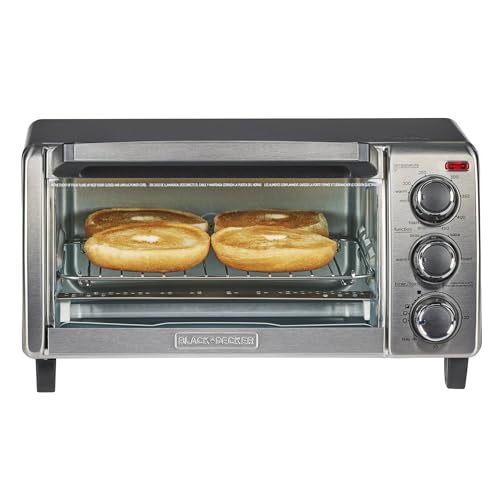
BLACK+DECKER’s compact entry makes the budget case with unusual completeness: convection cooking rather than bare elements, a cavity that fits a 9-inch pizza, a timer with a stay-on function for longer jobs, and a removable crumb tray, in a silver body 15.47 inches across per the listing. The 9-inch pizza figure is the one to underline, because it separates this oven from the toy class — a real, if personal, pizza is a meal, and an oven that holds one while also toasting, baking, and broiling with convection assistance covers the majority of what a single person or a couple actually cooks in a week.
Convection at this price tier is the quiet headline. A fan evens the browning, shortens the effective cooking time on tray foods, and rescues the budget category from its traditional vice of raw centres under scorched tops. The stay-on function deserves its balanced reading: it frees the oven from snack-timer limits for a small roast or a tray of vegetables that wants forty minutes, and it simultaneously asks the owner to be the shutoff discipline that a timer would otherwise provide. Used with a phone alarm as a household habit, it is flexibility; used carelessly, it is how ovens get left on, and the guide’s position is that adults may choose the flexibility with their eyes open.
Expect budget manners elsewhere. Temperature accuracy will be approximate rather than calibrated, the fit and finish plain, and the controls the simple dials of its class. None of that prevents it from toasting evenly, crisping a pizza properly, and reheating leftovers with dignity for years, which is the entire contract at this tier. For a first flat, a spare oven for a holiday kitchen crunch, or a budget that must also buy the kettle and the knives, this BLACK+DECKER is the compact we recommend without a single asterisk on the cooking itself.
- Size: 15.47 inches wide, silver finish
- Capacity proof: fits a 9-inch pizza
- Cooking: convection-assisted bake, broil, toast
- Details: timer with stay-on function; removable crumb tray
Strengths
- Convection evenness at an entry price tier.
- Nine-inch pizza capacity lifts it out of the toy class.
- Stay-on function permits longer cooks than snack timers allow.
Trade-offs
- Temperature settings are approximate, dial-class accuracy.
- Stay-on mode makes the owner the safety timer.
- Plain fit and finish, as the tier dictates.
Best for: first flats and budget buyers wanting real convection cooking. Not suited for: precision bakers or anyone wanting air frying built in.
Breville Mini Smart Oven BOV450XL — Best Premium Mini
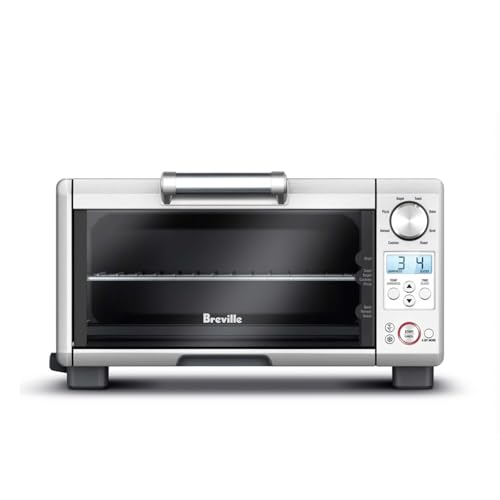
The Mini Smart Oven is Breville’s argument that compact is a dimension, not a discount. Eight cooking functions — the listing promises even baking, toasting, and broiling among them — live in a brushed stainless body explicitly designed as the space-saving member of a serious oven family, and the engineering philosophy is inherited rather than improvised: element control that treats temperature as a promise, presets tuned by people who appear to cook, and an interface that respects the user’s intelligence. For the small kitchen owned by a serious cook, this is the pick that ends the search.
Its cooking manners are the point. Where budget compacts approximate, the Mini aims: toast shade that repeats from morning to morning, baking temperatures that hold their setting with the discipline its larger siblings are known for, and browning that stays even across its tray because the element intelligence distributes heat deliberately rather than hopefully. The cavity is sized for the one-or-two life — a small roast chicken is ambitious but conceivable in this class, a tray of vegetables or a personal pizza is routine — and every cubic inch behaves as though it were engineered, because it was.
The costs are the premium tier’s usual two: money and the absence of air frying, which this model’s generation predates as a headline function. A buyer whose weeknight life centres on fries and wings should take the Cuisinart compact instead and spend the difference on ingredients. A buyer whose life centres on baking, roasting, and toast done properly, in a kitchen where every centimetre of counter is contested, will find the Mini the rare appliance that shrinks without apologising — the compact oven for people who notice cooking quality and refuse to trade it for space.
- Functions: 8, including bake, toast, and broil
- Design: space-saving body in brushed stainless steel
- Engineering: Breville element-control philosophy in miniature
- Capacity class: one-to-two households, small roasts and trays
Strengths
- Cooking precision no other compact here attempts to match.
- Repeatable toast and baking results, morning after morning.
- Premium build that suits a permanent counter place.
Trade-offs
- No dedicated air fry function in this design.
- Premium price tier among compacts.
- Capacity remains compact, however clever the engineering.
Best for: serious cooks in small kitchens who bake and roast more than they fry. Not suited for: air-fry-first households or the tightest budgets.
Panasonic FlashXpress Toaster Oven — Best No-Preheat Oven
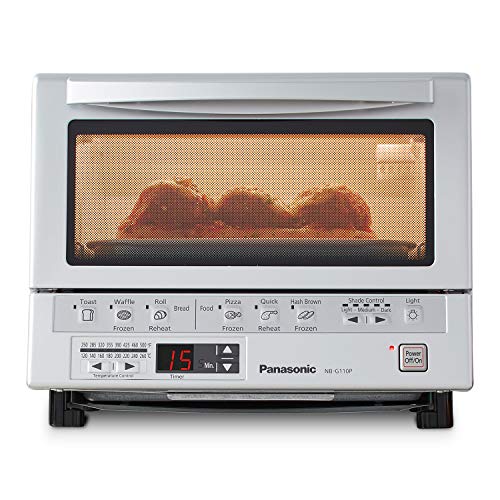
The FlashXpress plays a different sport from every other oven here. Its double infrared heating — near and far infrared elements working together at 1300 watts — reaches cooking intensity almost instantly, which abolishes the preheat as a stage of cooking. Toast goes in cold and the oven simply begins; frozen snacks start cooking while a conventional compact is still warming its walls. Six auto cook options and precise temperature control, per the listing, wrap that speed in enough programmability for the reheating-and-snacking repertoire that dominates compact-oven life, and the four-slice capacity keeps it in family-breakfast territory rather than dorm territory.
Infrared changes technique in ways worth learning. Because the heat is radiant and immediate, foods brown from the surface inward with a speed that rewards attention the first few times — the difference between golden and scorched can be a minute at the end, and the glass door earns its keep as a viewing window rather than a formality. Delicate items that a conventional oven’s long preheat-and-bake cycle dries out often emerge better here, having spent less total time under heat. Owners describe a short apprenticeship — a week of watching closely — after which the speed becomes the reason the oven is used daily while a larger rival gathers dust.
Its boundaries are capacity and convention. The cavity is a four-slice compact’s cavity, not a roasting chamber, and infrared’s surface intensity is a virtue for toast, pizza, and reheating rather than for deep dishes that need gentle, surrounding heat over time. Buy it as the fastest route from hungry to eating in this guide, and it will justify itself at breakfast within the week; buy it as a miniature general-purpose oven for Sunday roasts, and you have misread a sprinter as a marathoner — a distinction this guide exists to keep clear.
- Heating: double infrared, near and far elements
- Power: 1300 watts
- Capacity: 4 slices
- Controls: six auto cook options, precise temperature control
Strengths
- No preheating stage; cooking starts the moment food goes in.
- Surface browning speed that flatters toast, pizza, and reheats.
- Compact body with family-breakfast slice capacity.
Trade-offs
- Radiant intensity demands attention near the end of a cook.
- Deep, slow dishes prefer a conventional cavity’s gentle surround.
- Capacity is four-slice class, not batch class.
Best for: impatient breakfasts, snackers, and reheaters who value minutes. Not suited for: slow roasts or deep casserole cooking.

Hamilton Beach Easy Reach 4-Slice Toaster Oven — Best Roll-Top Door
This Hamilton Beach is the four-slice, non-air-fry member of the Easy Reach family, and its roll-top door is a space feature as much as an access feature — a distinction compact buyers should savour. A drop-down door on a tight counter becomes a hot shelf jutting into the room’s scarcest square footage, blocking drawers and walkways; the roll-top slides up and over the cavity, so the oven’s working footprint barely exceeds its resting one. Add the access benefits — food rolls toward you, the hot glass leaves the forearm zone, the cavity opens for cleaning like a drawer rather than a cave — and the design solves two compact problems with one hinge.
The specification is honest mainstream: bake, broil, and toast functions, a temperature range the listing states as 200 to 450°F, auto shutoff for peace of mind, and four-slice capacity that covers a couple’s breakfast or a small family’s toast round in one pass. The 200°F floor is worth noting — it is a warming and gentle-baking floor rather than a low-temperature specialist’s, so this is not the oven for dehydrating or delicate holding at very low heat. Within the ordinary repertoire it is complete, and the silver finish and proportions sit unobtrusively in kitchens where a larger appliance would shout.
Cleaning is where the roll-top’s second dividend pays. Crumbs and drips in a drop-door oven hide at the hinge line and the cavity’s dark rear; here the open, lifted cavity invites a cloth, and owners of Easy Reach ovens consistently report actually wiping them — the highest compliment small-appliance design can earn. The door track wants its own occasional crumb sweep, a small tax. For renters, small families, and any kitchen where the counter’s edge is a cliff the shopping must not fall off, this is the compact whose shape respects the room it lives in.
- Door: roll-top Easy Reach design
- Capacity: 4 slices
- Temperature: 200 to 450°F, per the listing
- Safety: auto shutoff included
Strengths
- Door consumes no extra counter space when open.
- Access and cleaning are the easiest in this guide.
- Four-slice capacity with a full mainstream temperature range.
Trade-offs
- No air fry function in this version of the family.
- Temperature floor of 200°F excludes low-heat specialties.
- Door track collects crumbs and needs a periodic sweep.
Best for: tight counters, renters, and anyone who cleans as they go. Not suited for: air-fry devotees or low-temperature specialists.
How Do the Six Compare at a Glance?
| Pick | Capacity signal | Heating style | Space idea | Natural home |
|---|---|---|---|---|
| Cuisinart Compact Air Fryer Toaster Oven | Two-portion trays | Convection plus air fry | Shrunk mainstream body | Small flat, serious cooking |
| Elite Gourmet ETO236 Compact Toaster Oven | 2 slices | Conventional elements | Absolute miniature | Dorm, RV, studio corner |
| BLACK+DECKER TO1313SBD Compact Toaster Oven | 9-inch pizza | Convection | 15.47-inch width | First flat on a budget |
| Breville Mini Smart Oven BOV450XL | Small trays, one-to-two | Controlled elements, 8 functions | Premium engineering, reduced body | Cook’s small kitchen |
| Panasonic FlashXpress Toaster Oven | 4 slices | Double infrared, 1300W | No preheat, no waiting | Fast breakfasts and snacks |
| Hamilton Beach Easy Reach 4-Slice Toaster Oven | 4 slices | Conventional, 200–450°F | Roll-top door saves swing space | Tight counters, renters |
How Small Is Too Small for a Toaster Oven?
The answer lives in your largest regular food. If a personal pizza is a weekly event, the oven must honestly hold one — the BLACK+DECKER’s 9-inch rating is a real threshold, and anything smaller demotes pizza night to the full-size oven or the delivery app. If breakfast for two is the mission, four slices is the comfort line and two slices is a queue. Work from the food backwards to the cavity, because slice counts and pizza diameters are the only capacity languages manufacturers speak with any consistency, and both are printed in our pick sections for exactly this calculation.
Height is the silent dimension. Compact ovens sacrifice vertical room first, so measure the interior against your tallest regular dish with its lid and a centimetre of air above it. A casserole that fits width-wise but kisses the top element will brown like a crème brûlée whether it wants to or not. Households whose cooking is flat — toast, trays, pizzas, fillets — can go remarkably small with no regret, as the Ninja-like shallowness of several picks here proves; households whose cooking stands tall should buy the least compact oven their counter tolerates and call the extra inches insurance.
Where Should a Compact Oven Live?
On the counter it will actually be used from, with its working space respected. That means clearance above for exhaust heat, a few inches behind for vents, and — the measurement everyone skips — room in front for the door and a pulled-out tray, unless you choose the Hamilton Beach’s roll-top and reclaim that frontage. Under-cabinet placement deserves a thermometer’s scepticism: cabinets trap heat, and an oven that scorches the cupboard above it is in the wrong home no matter how neatly it slides into the gap. Many compact owners settle on a heat-resistant board that lets the oven pull forward for big jobs and tuck back after, a compromise that suits rental kitchens particularly well.
Power access shapes placement too. These ovens draw serious current for their size, and a compact on an extension lead or a shared, loaded circuit is a nuisance trip waiting for toast. Place it near its own socket where you can, keep its cord off the hot rear panel, and remember that in RVs and older flats the circuit may be the real capacity limit — the Elite Gourmet’s modest appetite is a considered feature in exactly those homes, not a compromise to apologise for.
How Do You Cook Well in a Small Cavity?
By respecting proximity. Food sits close to the elements in a compact oven, so the top of anything tall browns faster than the same dish in a big oven; tenting with foil for the first half of a bake, choosing the lower rack position, and rotating the tray once are the three habits that convert proximity from a hazard into an advantage. Small cavities also reward preheating discipline in reverse: they reach temperature so quickly that the common big-oven habit of loading food during preheat produces scorched tops on raw centres here, most of all in the infrared Panasonic, which has no preheat to hide in at all.
Batching technique matters when guests exceed capacity. Hold finished items in the cooling but still-warm oven with the door ajar while the next tray cooks, sequence foods from longest to shortest so everything lands together, and accept the format’s truth — a compact oven cooking for six is a production line, and production lines run on order, not hope. Owners who plan the sequence eat well from small ovens for years; owners who improvise discover the queue at the table, which is the one-star review this category collects most unfairly.
How Should You Clean a Compact Oven?
Often, briefly, and while warm. Small cavities concentrate grease on nearby walls faster than big ones, so the weekly wipe that a full-size oven forgives skipping becomes the compact’s standing appointment. Removable crumb trays — present on the BLACK+DECKER and across this class — should be emptied before they look full, because in a small cavity the tray sits close under the elements and old crumbs announce themselves in the next toast. A paste of bicarbonate on a cloth handles the walls without the harsh sprays whose residues bake into smells.
The door glass is a cooking instrument in this format, since watching colour is how compact cooking is timed; keep it clear enough to judge browning without opening the door and dumping the heat a small cavity can least afford to lose. The Hamilton Beach’s open roll-top makes all of this easiest, the Panasonic’s interior rewards a gentle hand around its elements, and every model here benefits from the same closing ritual: door ajar while cooling, so steam leaves instead of condensing into next week’s odour.
What Should Dorm and RV Buyers Check Before Anything Else?
The rules of the building and the limits of the circuit, in that order. Many dormitories restrict heating appliances by wattage or by element type, and an oven that breaches the residence rules is a confiscation with a power cord; the Elite Gourmet’s snack-scale design exists in a world shaped by those rules, and checking the handbook takes less time than the appeal. RVs add the electrical dimension: a compact oven shares a modest supply with everything else in the vehicle, and the model that trips the breaker whenever the water heater cycles will be unplugged by the second campsite, however well it toasts.
Ventilation is the third check, and the one travellers forget. A dorm room or RV has little air volume, so an oven’s exhaust heat and cooking smells fill the living space personally; foods that a house kitchen disperses become roommates. Compact ovens in these settings earn their keep on toast, reheats, and short cooks, and their owners learn to save the garlicky tray bakes for outdoor kitchens and picnic shelters. None of this diminishes the category — a hot, crisp meal in a small rolling home is one of travel’s genuine luxuries — but it does mean the smallest, quickest oven usually beats the most capable one once the walls are close enough to touch.
How Does Toast Quality Vary Across Compacts?
More than the price spread suggests, because toast exposes element geometry without mercy. Ovens with elements close above and below the rack — most of this six — toast fast and can scorch a distracted slice; the Panasonic’s infrared pair toasts fastest of all and with a distinctive, even surface colour that conventional elements approach only on their best mornings. The Breville Mini’s claim rests on repeatability: the same setting producing the same shade on the fourth morning as on the first, a virtue that sounds dull until a household has argued about burnt toast for the fortieth time.
Bagels and thick breads separate the field further. A compact cavity’s height decides whether a halved bagel sits at a sane distance from the top element, and bagel functions that heat one side harder than the other — crisping the cut face while warming the crust — exist on the more thoughtful models for good reason. Frozen waffles and pastries, the other breakfast staples, forgive almost everything except a timer that cannot be trusted, which returns us to the category’s recurring lesson: in small ovens, control honesty beats raw power, and the dial you can trust is worth more than the wattage you cannot feel.
Can a Compact Oven Air Fry Properly?
Yes, within the physics of its tray — and the Cuisinart compact in this guide is the proof of concept, basket included. Air frying is forced hot air plus exposure, and a compact cavity actually assists the exposure half of the equation: the fan’s output crosses a small floor completely, so a single layer of wings or fries crisps with fewer dead zones than a large cavity manages at the same fan strength. The constraint is purely arithmetic — one layer of a small tray is a portion for two, not a party — and households that accept the arithmetic get genuinely crisp results without a second appliance colonising the counter.
Technique scales down with the oven. Shake or turn the basket’s contents once, because compact trays load more densely by temptation; leave the visible gaps that let air behave like air rather than steam; and expect the second batch to run a minute faster in a heat-soaked cavity. What a compact air fryer cannot do is apologise its way into family volume — for that, the larger ovens in our companion guide exist, and the honest small-kitchen answer is sometimes a compact for two on weekdays and a batch plan for guests, rather than a big oven sulking underused for six days to shine on the seventh.
Which Accessories Actually Earn Their Space?
In a small kitchen every accessory must pay rent, so the list is short and opinionated. A quarter sheet pan that fits the cavity precisely is the first purchase for any model that ships without one, because it converts the oven from a toast box into a roasting instrument for vegetables, fillets, and cookies. A small rack that lifts food off the pan doubles the crisping logic for reheats. Silicone-tipped tongs sized to the cavity prevent the knuckle-burning archaeology that full-size tools cause in small ovens, and a heat-resistant mat under the unit protects rental counters and lets the oven slide forward for big jobs.
Beyond those, restraint wins. Pizza stones cut for compact cavities exist and delight pizza households — the BLACK+DECKER’s 9-inch party trick improves with one — but they store awkwardly and serve a single dish. Extra fry baskets, rotisserie kits, and dehydrating racks belong to the larger format’s ecosystem. The compact philosophy that this entire guide argues for applies to the drawer beneath it too: few tools, each used weekly, in an oven whose smallness is a discipline rather than a deprivation.
Is a Compact Oven a Good Second Oven for Holidays?
It is the classic second oven, and many households meet the category exactly there — bought in November for the feast’s overflow, then quietly promoted to daily service by January. The holiday logic is sound: a compact oven roasts the vegetables while the bird occupies the main cavity, warms the rolls at a different temperature from everything else, and reheats the evening’s second wave without firing the big oven again. The Breville Mini and the Cuisinart compact, with their real cooking control, play this supporting role best; the Elite Gourmet, honestly, does not, and buying it for Thanksgiving is the one mismatch this guide will actively talk you out of.
The placement plan matters as much as the model. A second oven needs its own counter territory for the day — a sideboard or a cleared stretch with socket access — and a household that rehearses that layout before the feast cooks calmly through it. After the holiday, the promotion test is simple: if the compact is still on the counter in February, used weekly, it was never a seasonal purchase at all. It was the kitchen admitting what size its ordinary life actually is, which is the most useful thing an appliance can tell you.
How Do Compact Ovens Handle Baking, Honestly?
Small bakes, well; large bakes, with choreography. A compact cavity’s proximity to the elements gives muffins and small cookie trays a beautiful rise-and-colour, provided the tray is rotated once and the temperature is set a touch conservatively the first time a recipe meets the oven — every compact runs its own dialect, and a single calibration bake of a familiar recipe teaches the translation. Butter-heavy batters forgive the format; delicate sponges and custards, which want gentle, surrounding, unhurried heat, find the small cavity’s intensity harder to love, and the Breville Mini’s control discipline is the closest any compact here comes to persuading them.
Bread is the honest boundary. A compact oven will happily crisp rolls, bake flatbreads, and finish par-baked loaves, and the Panasonic’s infrared surface makes a persuasive case for the flatbread role specifically. A full risen loaf needs headroom the category does not have, and no badge on any of these six should be read as promising one. That is not a failure of compact design but its definition: the oven that does breakfast, snacks, trays, and reheats superbly, in a footprint a small kitchen can spare, has kept its promise in full — and the loaf, twice a month, can have the big oven’s undivided attention.
Where Does a Compact Oven Go When It Is Not Cooking?
The question decides more purchases than any feature, because a compact oven that must be fetched from a cupboard will be fetched less and less, until it is furniture. The honest options rank themselves: a permanent counter place is best and is what the category is designed for; a heat-safe board that slides the oven forward for use and back for tidiness is the renter’s favourite compromise; a low shelf at waist height works for the lighter models; and a high cupboard works for nobody, because hot ovens and overhead lifting are a combination safety advice exists to prevent. The Hamilton Beach’s modest depth and the Elite Gourmet’s genuine smallness widen the permanent-place options, which is a real, if unglamorous, part of their appeal.
Cord and heat management complete the storage picture. Coil the cord loosely rather than wrapping it around a warm body, let the oven cool fully before it is pushed back against a wall or under a cabinet, and keep the top surface clear in storage as in use — the compact oven stored under a pile of tea towels is one forgotten preheat away from a story nobody wants to tell. Households that give the oven a true home use it daily; that, in the end, is the whole compact proposition, an appliance small enough to live where the cooking happens.
Which Mistakes Do Compact Buyers Keep Making?
- Measuring the counter for the closed oven and discovering the open door’s swing only after delivery, usually against a drawer that no longer opens.
- Buying the two-slice dorm oven for a family kitchen because it was cheapest, then batching breakfast for four every morning in quiet fury.
- Loading food during preheat out of big-oven habit, scorching tops in a cavity that reaches temperature in moments.
- Ignoring the height dimension entirely, so the beloved lidded casserole meets the top element on its first outing.
- Letting crumbs accumulate in a small cavity where they sit close to the elements, then blaming the oven for a smoky smell.
- Placing the oven tight under cabinets, trapping exhaust heat and slowly toasting the cupboard the kitchen came with.
Final Recommendation
Match the oven’s shape to the kitchen’s scarcest resource. Where the scarcity is frying capability in a small body, the Cuisinart Compact Air Fryer Toaster Oven is the complete answer; where it is cooking quality above all, the Breville Mini Smart Oven BOV450XL stands alone in this class; where it is minutes, the Panasonic FlashXpress Toaster Oven has no preheat to wait for and no rival in this guide for breakfast speed.
The remaining three solve their briefs just as cleanly: the Hamilton Beach returns counter space its door would have eaten, the BLACK+DECKER brings convection and a real pizza to the tightest budgets, and the Elite Gourmet fits the rooms the others cannot enter. Measure your counter with the door open, measure your tallest dish, count your breakfast slices — then buy the smallest oven that passes all three measurements, and it will feel less like an appliance and more like the corner of the kitchen that finally makes sense.
Frequently Asked Questions
Can a compact toaster oven really replace a microwave for reheating?
For anything with a crust, a coating, or a texture worth keeping, it replaces it triumphantly — pizza, fries, roasted vegetables, and pastry all reheat better in dry heat. For soups, drinks, and steaming vegetables, the microwave keeps its job, because reheating liquids in an oven is slow theatre. Most small kitchens that own a good compact oven find the microwave demoted to beverages and butter, which is a fair division of labour and frees the oven to do the reheating that actually benefits from an oven.
Is a 9-inch pizza capacity enough?
For one hungry person or two moderate ones sharing with a salad, yes — a 9-inch pizza is a genuine meal, which is why the BLACK+DECKER’s rating matters. For a household whose pizza night means a shared large pie, no compact in this guide is the right tool, and pretending otherwise leads to two sequential pizzas and one eater waiting. Capacity honesty is the theme of this whole category: buy for the meal you actually cook weekly, not the feast you cook twice a year.
Why does the Panasonic not need preheating?
Because infrared elements deliver their heat as radiation the instant they glow, rather than by first warming the cavity’s air and walls the way conventional elements do. The food’s surface begins receiving full cooking energy immediately, so the preheat stage — which exists in other ovens to bring the environment up to temperature — has nothing to do. The technique adjustment is attention: food cooks and browns at full intensity from minute one, so the first few uses deserve watching through the glass rather than timing from habit.
Are compact ovens cheaper to run than full-size ovens?
For small loads, clearly yes: less air to heat, less steel to warm, shorter preheats, and cooking times that start sooner. The saving shrinks as loads grow and vanishes when a compact oven must run two batches to do a big oven’s single job. The economical household therefore owns the compact for its natural repertoire — breakfasts, snacks, one-and-two-person dinners, reheating — and keeps the full-size oven for the batch work, which is the same matching rule that governs cooking quality in this category.
What is the difference between the two Hamilton Beach Easy Reach models in these guides?
They are cousins, not twins. The model in this compact guide is the four-slice oven with bake, broil, and toast and a 200 to 450°F range; the larger Easy Reach in our air fryer toaster oven guide adds air frying and six-slice capacity in a bigger body. Both share the roll-top door that defines the family. Choose by the two honest questions — do you air fry, and how many slices is breakfast — and the family tree resolves itself without regret in either direction.
How long do compact toaster ovens last?
Years of daily service is the fair expectation across this six, with crumb discipline and door care deciding which end of the range a given unit reaches. The components that tire first are door mechanisms and timer knobs, both treated kindly by owners who do not force them, and heating elements that resent foil contact and grease baths. A compact oven is a simple machine wearing few disguises; treat it as a small oven rather than a disposable gadget and it will generally outlast the kitchen layout it was bought for.
Do compact ovens use standard-size accessories?
Rarely, and assuming so is the classic first-week disappointment. Trays, baskets, and racks are cavity-specific in this class, which is why the Cuisinart compact’s included rack, pan, and basket carry real weight in our assessment, and why measuring the interior before ordering a quarter sheet pan is a ritual worth performing with the oven’s own tape measure rather than the catalogue’s optimism. When in doubt, buy accessories by interior dimensions in inches, never by the word compact, which describes a philosophy and not a size.
Should I choose a compact oven or a two-slice pop-up toaster plus a big oven?
Choose the compact oven if reheating and tray cooking matter to your week, because a pop-up toaster, however excellent, only ever toasts — it cannot crisp last night’s pizza, roast a tray of vegetables for two, or warm a casserole through. Choose the pop-up if breakfast toast is genuinely the whole mission and counter space is at its most desperate, since a pop-up’s footprint is smaller still and its toast can be superb. Most small households that try the compact route discover the oven absorbs the toaster’s job adequately while adding three more, and the pop-up is the appliance that ends up in the cupboard — the reverse of the usual kitchen story, and a pleasant one.
What temperature should I use when a recipe assumes a full-size oven?
Start with the recipe’s temperature and a shorter leash. Compact cavities run effectively hotter at the food’s surface because of proximity, so the practical method is to set the stated temperature, check five minutes earlier than the stated time, and note the correction for that recipe in that oven — most households find a small, consistent adjustment, often a slight reduction or a few minutes less, and once noted it never needs re-deriving. Convection models, including the BLACK+DECKER and the Cuisinart here, traditionally take a modest temperature reduction for fan-assisted recipes; your first calibration bake will tell you your own oven’s exact dialect.
Related Guides
Compact cooking pairs naturally with the rest of a small kitchen’s kit. Readers speccing the whole counter often continue with Best 4-Slice Toasters for the breakfast end of the bench, cool a sun-baked small kitchen with Best 6,000 BTU Window Air Conditioners, and solve the washing-up in the same footprint spirit through Best 18-Inch Dishwashers.


