What's inside
- Key Takeaways
- Quick Picks
- How Did We Narrow This Down to Water per Load?
- Side by Side: Where Each Pick Spends Its Water
- What Actually Happens Inside a Septic Tank When the Dishwasher Drains?
- Which Detergent Habits Protect the Tank?
- How Should a Septic Household Actually Run Whatever It Buys?
- A Septic Household’s Week, Run Well
- How Wide Is the Real Gap Between a Tank Machine and a Plumbed One?
- What Should You Measure Before Anything Is Delivered?
- Missteps That Quietly Overload a Tank
- What About the Water Nobody Counts — Rinsing, Leaks, and Second Runs?
- Reading a Cycle Table the Way a Septic Owner Should
- Which Format Suits Which Kind of Septic Property?
- When the Tank, Not the Machine, Is the Real Limit
- Older Tanks, Newer Machines: Does Age Change the Advice?
- Final Recommendation
- Frequently Asked Questions
- Related Guides
As an Amazon Associate I earn from qualifying purchases. This post may contain affiliate links at no extra cost to you.
cottageverdict.com is reader-supported. When you buy through links on our site, we may earn an affiliate commission.
Three of the six picks below link to live Amazon listings, and each linked pick takes you to that exact listing so you can check price on Amazon before deciding. The other three slots describe a class of full-size built-in machines that septic households usually end up buying through appliance retailers, so they are covered in plain prose with no link attached.
A septic tank does not care how clean your plates get. It cares about two things: how much water arrives in a day, and what dissolved chemistry rides along with that water. That is why the honest way to shop for the best dishwashers for septic systems is to ignore the phrase septic safe entirely. No certification by that name exists, no listing in the verified pool for this guide claims one, and any badge a seller invents with those words is decoration rather than evidence. The real axis is gallons per cycle. Every load a dishwasher runs becomes greywater that your tank and drain field must absorb, and a household running two loads a day sends the tank a very different workload depending on whether each cycle is a small countertop draw or a long, hot, full-size soak.
That framing explains the shape of this guide. The three linked picks are countertop machines with small built-in tanks — two of them hold five litres, filled by jug — because a tank you fill by hand is a tank whose volume you can count exactly. Nothing about them is mysterious: you pour in a measured amount, the machine washes a modest load, and the drain hose sends that same modest amount to your sink and onward to the septic system. The three prose slots cover the built-in eco-cycle class, the half-load class, and the soil-sensing class, which are the features that actually trim water per load in a full-size machine. Detergent discipline runs through everything below, because the wrong dose of the wrong product does more quiet harm to a septic system than any single wash cycle ever will.
Key Takeaways
- No verified listing in this guide carries a septic-safe certification, because no such certification exists to carry; judge machines by water per load instead.
- The three linked picks are tank-fed countertops: two state a 5L tank in their listings, and a hand-filled tank makes your per-load water use a number you chose, not a number you guess.
- Full-size built-ins earn their place here through eco cycles, half-load options, and soil sensors that shorten cycles on lightly soiled loads — features described at class level in the prose slots.
- Detergent dosing matters as much as machine choice: measured pods or powder, no antibacterial overkill, and no grease deliberately flushed toward the tank.
- Running fewer, fuller loads beats running frequent small ones for total daily greywater, whichever machine you own.
Quick Picks
| Pick | Badge | Why it made the list |
|---|---|---|
| EUHOMY Countertop Dishwasher With 5L Tank | Counted water, eight programs | Its listing states a 5L tank, eight programs, and a 167°F wash, so the water budget per load is printed on the box rather than buried in a manual. |
| ChuMaste Countertop Dishwasher With Tank | Tank or tap, your choice | A tank machine that can also connect to the tap, with five wash programs — handy when a septic cottage hosts a crowd for one weekend a year. |
| Countertop Dishwasher With 5L Built-In Tank | The plain 5L option | Another five-litre tank design with five programs and an optional tap connection, for buyers who want the counted-water idea without extra modes. |
| Built-In Dishwashers With a True Eco Cycle | Class pick, prose | The full-size route: an eco program that genuinely lengthens time to save water, described at class level because no single listing defines it. |
| Built-Ins With a Half-Load Option | Class pick, prose | Washing one rack only, with water matched to the smaller load, is the built-in feature septic households actually use weekly. |
| Built-Ins With Soil-Sensing Auto Cycles | Class pick, prose | Sensors that end the cycle when the water runs clear trim gallons on the lightly soiled loads most households really run. |
How Did We Narrow This Down to Water per Load?
Most dishwasher guides rank by cleaning theatre: jet counts, spray-arm geometry, trademarked wash names. For a septic household that ranking is upside down, so this guide ranked by a duller and more useful question — how much water leaves the machine per load, and how much control do you keep over that number? Tank countertops won the linked slots because their listings state the tank size outright. A five-litre tank is a hard ceiling on fill water for a cycle in a way that a plumbed machine’s estimated consumption figure is not, and the EUHOMY listing adds program count and wash temperature on top of its stated tank.
Built-in machines could not compete on stated numbers, because full-size listings rarely print a per-cycle gallon figure in their titles, and this guide does not invent figures a title does not state. So the built-in half of the list is organised by mechanism instead: eco cycles that trade time for water, half-load settings that avoid filling a full tub’s worth of spray for six plates, and soil sensors that stop early. If you are also weighing a standard plumbed machine for a second property on municipal water, our companion guide to Best Dishwashers for Rentals covers the durability-first thinking that suits tenant kitchens, which is a different problem from protecting a tank and drain field.

EUHOMY Countertop Dishwasher With 5L Tank — Counted water, eight programs
The EUHOMY earns the top linked slot because its listing is unusually forthcoming: a 5L tank, eight programs, dual spray arms covering 360 degrees, a stated 40dB operating level, and a wash temperature of 167°F. For a septic household the headline is the tank. Five litres filled by jug is the entire fill for a load, and you will feel every litre of it in your arm before the machine ever runs, which quietly disciplines the whole household into running full loads instead of hopeful half-empty ones.
Eight programs on a countertop is more range than most owners use, but the spread matters here for a subtler reason. Shorter, lighter programs exist alongside the hot intensive one, so a load of glasses and lunch plates does not have to take the same hot, long route as a casserole dish. The listing also says no hookup is needed, which suits the exact buildings septic systems serve: older cottages, farmhouses with idiosyncratic plumbing, and kitchens where nobody wants to cut into forty-year-old pipework to feed a machine that might move next year.
- Format: countertop, tank-fed, no hookup needed per the listing
- Tank: 5L, stated in the listing title
- Programs: 8, stated in the listing title
- Wash temperature: 167°F, stated in the listing title
- Spray: 360° dual spray arms
- Noise figure in the listing: 40dB
- Load scale in the listing: 30+ items
- Where to buy: the EUHOMY Countertop Dishwasher listing on Amazon — check price on Amazon
Strengths
- The stated tank size turns water-per-load from an estimate into a counted quantity, which is the whole point of this guide.
- A 167°F wash temperature, as stated, gives the hot cycle real sanitising weight for baby bottles and preserving jars.
- Eight programs let lightly soiled loads take a lighter route instead of defaulting to the longest cycle.
Trade-offs
- Countertop capacity is a cottage-sized answer; a family of six will run it twice where a built-in runs once, eroding the water saving.
- Filling by jug is a daily chore some households abandon within a month, and an unused machine saves no water at all.
- The drain hose still needs a sink within reach, so placement is not as free as the no-hookup promise suggests.
Best for: septic cottages, farmhouses, and small households that want their per-load water use printed on the tank rather than promised in a brochure.
Not suited for: large families whose daily dish volume would force back-to-back cycles all evening.
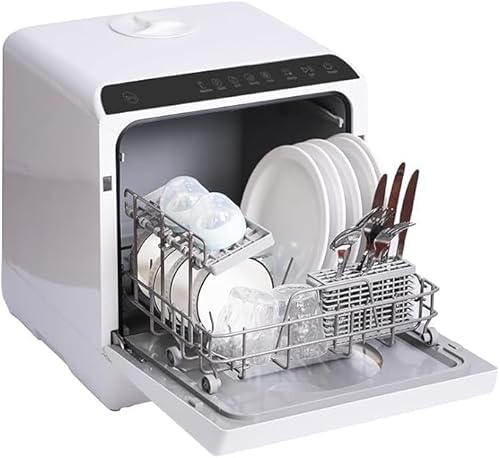
ChuMaste Countertop Dishwasher With Tank — Tank or tap, your choice
The ChuMaste takes a slightly different bet: it is a tank machine first, with five wash programs, but its listing says it can also be connected to the tap. On septic that dual nature cuts both ways, and it is worth being honest about which way it cuts for you. Run from the tank, it behaves like the EUHOMY — counted water, modest loads, nothing plumbed. Run from the tap during a visiting-grandchildren weekend, it stops asking you to ferry jugs and starts behaving like a small plumbed machine, and its water use becomes whatever the selected program draws.
Five programs is a calmer spread than eight, and for most septic households it is enough: a daily program, a quick one, a heavy one, and a couple of specialists cover real life. The listing names apartments, dorms, and RVs as its habitats, which tells you the design priority is compact flexibility rather than maximum load size. In a septic kitchen that translates to a machine that can live on the counter beside the sink, drain into it, and be carried to a utility room when counter space matters more than convenience.
One practical note from this class of machine generally: the drain stream is small enough to watch, and watching it teaches you things. If the outflow runs cloudy white long after the cycle should have settled, detergent is overdosed. If it smells stale, the hose has a sag collecting residue. Septic ownership is full of these small observable signals, and a machine that discharges visibly into a sink — rather than invisibly into a wall — turns its owner into a better observer of the whole system. That sounds like a consolation prize for jug-carrying. In practice, households report it as the reason they caught a failing inlet valve months before it would have mattered.
- Format: portable countertop with water tank
- Programs: 5 wash programs, stated in the listing title
- Water supply: tank fill, or connection to the tap per the listing
- Named habitats in the listing: apartments, dorms, RVs
- Where to buy: the ChuMaste listing on Amazon — check price on Amazon before you commit
Strengths
- The tap option rescues busy weekends without giving up counted-tank running the rest of the year.
- Five programs keep the control panel honest and quick to learn for guests and older relatives.
- Portable format suits septic properties where permanent plumbing changes need a contractor and a permit conversation.
Trade-offs
- The listing states no tank capacity figure, so its counted-water ceiling is less precisely known than the 5L machines.
- Tap mode removes the very discipline that makes tank machines attractive on septic; the saving becomes a habit, not a hardware limit.
- Countertop footprint still has to be earned in a small kitchen, and this class of machine is tall enough to fight low wall cabinets.
Best for: septic households that host in bursts and want one machine that is frugal on ordinary Tuesdays and tireless on holiday weekends.
A poor fit for: strict water accountants who want a stated litre figure for the tank before they spend anything.
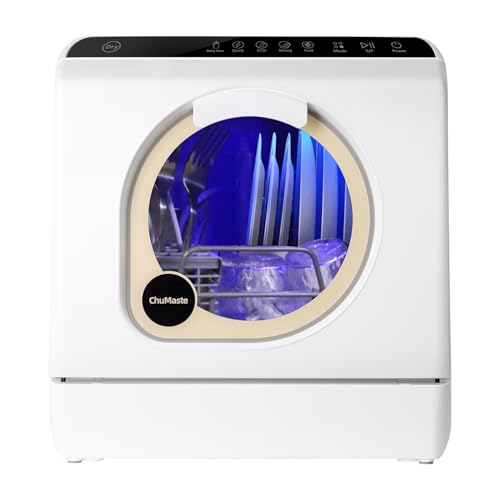
Countertop Dishwasher With 5L Built-In Tank — The plain 5L option
The third linked pick is the straightforward one: a portable countertop machine with a 5L built-in water tank, five wash programs, and the same option to connect to the tap when jug-filling loses its charm. It does not out-spec the EUHOMY — no temperature figure, no noise figure, no program-count bragging — and that plainness is precisely its role in this guide. Some septic households do not want a dashboard. They want a box that takes five litres, washes the day’s dishes for two people, and drains into the sink.
Because the listing is terse, judge this machine on the two facts it does state and on the class behaviour shared by every tank countertop. The facts: five litres of tank, five programs. The class behaviour: loads are small, cycles are comparatively short, and the machine lives or dies by how honestly the household loads it. Crammed badly, any countertop leaves a mug unworn by spray; loaded with a little air between items, five litres goes further than visitors expect.
- Format: portable countertop
- Tank: 5L built-in, stated in the listing title
- Programs: 5 wash programs, stated in the listing title
- Water supply: tank fill, with tap connection also mentioned in the listing
- Named habitats in the listing: apartments, dorms, RVs
- Where to buy: find the 5L Built-In Tank countertop listing on Amazon — check price on Amazon there
Strengths
- The stated 5L tank keeps the counted-water promise that anchors this entire guide.
- A short, plain listing usually means a short, plain control panel — quick to teach, hard to mis-set.
- Tap connection as a fallback means the machine survives a change of house or a change of heart about jug-filling.
Trade-offs
- No wash temperature or noise figure is stated, so sanitising heat and quietness are unknowns rather than features.
- Five programs on a no-name listing may cluster closer together in practice than the labels imply.
- Like every countertop here, it serves small loads; big households should read the prose built-in slots below instead.
Best for: couples and solo households on septic who want the simplest possible counted-water machine.
Weakest fit: buyers who comparison-shop by published temperature and decibel figures, since this listing publishes neither.
Built-In Dishwashers With a True Eco Cycle — The full-size route, in prose
Plenty of septic households need a real built-in: a family of five cannot countertop its way through December. For them the eco cycle is the feature that matters, and it needs explaining because the word eco is printed on machines that use it very differently. A genuine eco program saves water and energy by stretching time — longer soaks, lower spray pressure doing slower work, cooler water given more minutes to soften soil. A fake one is a normal cycle wearing a green leaf icon. The difference shows in the manual’s cycle table, where an honest eco program lists a longer duration alongside lower consumption, so read that table at the retailer’s site or in the shop rather than trusting the badge on the door.
Used properly, an eco cycle becomes the household default for the loads that dominate real life: breakfast plates, mugs, cutlery, and last night’s serving bowls, none of which need violence. Save the intensive program for the roasting pan. That habit — eco by default, heavy only when earned — is where a built-in’s water story is actually written, and no machine can write it for you. This slot is prose because the eco class spans dozens of models across every major brand, and the right one for your kitchen depends on your cutout, your door style, and your local installers.
- Format: full-size built-in, plumbed
- Defining feature: an eco program whose manual lists longer duration with lower water use
- Buying route: appliance retail, where cycle tables and manuals can be read before purchase
- Household habit that unlocks the saving: eco as the default, intensive reserved for baked-on loads
Strengths
- Full family capacity means one load a day instead of two or three countertop cycles.
- An honest eco program trims every ordinary load, and ordinary loads are ninety percent of a household’s year.
- Built-ins keep counters clear and add a fitted look that matters when a rural property is sold.
Trade-offs
- Even an eco built-in cycle generally moves more water than a 5L tank machine’s entire fill.
- Eco cycles are slow; households that run the machine after dinner and unload before bed may find the timing awkward.
- The leaf icon proves nothing, so this route demands manual-reading homework the countertop route does not.
Best for: larger septic households that need built-in capacity and will actually read the cycle table before buying.
Not the right match for: anyone hoping the badge alone guarantees low water use — it does not, and the manual is the only referee.
Built-Ins With a Half-Load Option — Wash one rack, spend half the effort
The half-load option is the least glamorous feature in this guide and possibly the most used. It tells the machine to wash only the upper or only the lower rack, matching spray and water to a partial load instead of running the full programme for a third of a tub. Septic households feel its absence keenly: without it, the choice every small-load evening is between running a full cycle for six plates — water the tank did not need — or letting dishes sit and sour until the tub fills, which in a warm farmhouse kitchen is its own small misery.
Half-load implementations vary. Some genuinely reduce water and time; others mostly reduce detergent theatre while drawing nearly the same fill. The manual’s cycle table separates the two, again, and a half-load row with its own consumption figure is the one worth paying for. Pair the feature with a household rule — half-load is for genuinely half loads, not a licence to run the machine four times a day — and it becomes a real greywater saving rather than a rationalisation. Readers planning a bigger kitchen refit alongside the septic work may also be pricing cold storage for a growing household, and the capacity-first thinking in Best Commercial Upright Freezers is a useful contrast in how appliance classes scale.
- Format: full-size built-in, plumbed
- Defining feature: half-load or single-rack wash with its own line in the cycle table
- Best partner habit: a household rule that half-load means half, not an excuse for constant running
- Buying route: appliance retail; compare cycle tables between finalists
Strengths
- Solves the six-plates problem that pushes septic households into wasteful full cycles.
- Keeps the kitchen cleared nightly, which matters for hygiene in homes where dishes otherwise wait.
- Widely available across brands, so it rarely forces a compromise on size or style.
Trade-offs
- Weak implementations save little water; the feature name alone is not evidence.
- It can quietly train a household into more frequent washing, cancelling its own benefit.
- Large items that only fit the lower rack limit which rack a given half load can use.
Best for: small-to-medium septic households whose loads are uneven — tiny on weeknights, enormous on Sundays.
Poorly suited to: households that already run one full load a day like clockwork, who would gain almost nothing.
Built-Ins With Soil-Sensing Auto Cycles — Let the water report back
A soil sensor does something quietly elegant: it reads how dirty the wash water is as the cycle runs and shortens or extends the programme accordingly. On a lightly soiled load — the toast plates and coffee mugs that dominate most kitchens — the machine discovers early that the water is running clear and wraps up sooner, spending less water and less heat than a fixed programme would. On a genuinely filthy load it takes the time it needs. For a septic system, that adaptivity is worth more than a single low consumption figure measured on a test load nobody actually runs.
The catch is that sensors judge turbidity, not virtue. A load of greasy but clear-rinsing items can fool a sensor into finishing early, and a load of starchy pasta water can make a clean-ish load look filthy. Owners learn their machine’s personality within a fortnight: which loads to trust to auto, and which to pin to a named programme. That learning curve is the honest price of the feature, and it is still a good trade for septic households, because most loads really are light and the savings repeat daily. As with the eco slot, this is a class description rather than a single model: sensor systems appear across mid-range and premium built-ins from most major makers.
- Format: full-size built-in, plumbed
- Defining feature: turbidity or soil sensing that adapts cycle length and water use
- Reality check: sensors read cloudiness, so greasy-clear loads can finish early
- Buying route: appliance retail; look for an auto or sensor programme in the cycle list
Strengths
- Savings land exactly where most households live: on the lightly soiled majority of loads.
- No new habit required — the machine adapts even when the person loading it is half asleep.
- Pairs naturally with eco defaults, one handling light loads, the other handling ordinary ones.
Trade-offs
- Sensor judgement is imperfect on greasy or starchy edge cases, so results vary load to load.
- The feature sits in mid-range machines and up, which may stretch a replacement budget.
- One more sensor is one more component that can fail in year nine of the machine’s life.
Best for: septic households that run varied loads and want the machine itself to notice when a load is easy.
A weak match for: cooks whose daily loads are uniformly heavy roasting pans, where sensing has nothing to save.
Side by Side: Where Each Pick Spends Its Water
| Pick | Water story | Load scale | Install reality |
|---|---|---|---|
| EUHOMY Countertop Dishwasher With 5L Tank | 5L tank stated; you count every fill | 30+ items per the listing | Countertop, drains to sink, no hookup |
| ChuMaste Countertop Dishwasher With Tank | Tank running, or tap when hosting | Compact countertop loads | Countertop, tank or tap supply |
| Countertop Dishwasher With 5L Built-In Tank | 5L tank stated; five programs | Small household loads | Countertop, tank or tap supply |
| Built-Ins With a True Eco Cycle | Eco programme trades time for water | Full family loads | Plumbed built-in, professional install common |
| Built-Ins With a Half-Load Option | Single-rack washing for partial loads | Half loads, on demand | Plumbed built-in |
| Built-Ins With Soil-Sensing Auto Cycles | Cycle adapts to how dirty the water is | Full loads, mostly light ones | Plumbed built-in |
What Actually Happens Inside a Septic Tank When the Dishwasher Drains?
A septic tank is a settling and digestion vessel, not a bottomless pit. Solids sink, fats float, bacteria work through the middle layer, and clarified water exits to the drain field where soil finishes the treatment. A dishwasher disturbs that calm in three specific ways. First, volume: a surge of greywater pushes the tank’s contents toward the outlet faster, giving solids less settling time. Second, heat: very hot discharge is a brief shock, though a single cycle’s worth dilutes quickly in a full tank. Third, chemistry: antibacterial agents and heavy chlorine loads can thin the bacterial population the tank depends on, which is why the detergent conversation below matters more than any hardware choice in this guide.
None of this makes dishwashers enemies of septic systems. It makes them citizens with obligations. Spread loads across the day rather than stacking dishwasher, laundry, and three showers into one morning. Keep the tank pumped on its recommended schedule, because a tank full of sludge has no settling room left no matter how gently you wash. And treat the drain field as the finite asset it is: it absorbs what the household sends, at the rate soil allows, and every litre not sent is a litre of capacity preserved for the days when guests arrive and the whole house runs at once.
Which Detergent Habits Protect the Tank?
Dose like you mean it, which usually means dosing less than the box encourages. Modern detergents are concentrated; a measured pod or a level scoop of powder handles a normal load, and doubling up adds chemistry to the tank without adding cleanliness to the plates. Phosphate-free products are the default in most regions now and suit septic systems well. The bigger discipline is what never enters the machine at all: cooking grease should be wiped or poured into a jar for the bin, not melted down the drain under hot water, because it re-solidifies in cooler pipes and coats the tank’s outlet. Antibacterial everything is another habit to retire — the tank is a bacterial workplace, and sterilising its workforce is sabotage dressed as hygiene.
Rinse aid deserves a word, because hard-water households lean on it and septic households worry about it. In ordinary doses it is a minor addition compared with the detergent itself, and spotted glasses are a small price argument compared with re-washing loads that came out filmed. Re-washing is the real enemy: a load run twice doubles its water and its chemistry. Anything that gets the load right the first time — correct loading, right programme, honest dosing — is septic-friendly almost by definition. If you are refitting the whole kitchen’s electrical side at the same time, the sizing questions in Best 27-Inch Electric Wall Ovens show how another appliance class handles a fixed cavity, which is the same measure-twice discipline a built-in dishwasher install rewards.
How Should a Septic Household Actually Run Whatever It Buys?
Scrape, do not pre-rinse. Pre-rinsing under a running tap can spend more water than the machine’s whole cycle, and modern detergents need some soil to work against anyway. Load fully but loosely, with space for spray to pass. Choose the lightest programme the load honestly qualifies for, and let that be a point of household pride rather than a compromise. Run the machine at a different hour from the washing machine, so the tank receives the day’s greywater in sips rather than gulps. Once a month, clean the filter, check the spray arms spin freely, and confirm the drain hose has no sag where grease can pool.
For tank countertops, add one ritual: keep a notebook or a phone tally of fills for the first month. It sounds fussy and it changes behaviour permanently, because households that have seen their own number — so many litres a week, so many a month — start defending it without being asked. That tally also gives you the evidence to size any future built-in: you will know your real load count rather than a sales estimate.
A Septic Household’s Week, Run Well
Picture the week of a four-person farmhouse that has its rhythm sorted. Monday’s dinner load runs after the meal, alone, while the washing machine sits quiet. Tuesday is a tank-countertop day at the cottage annex where two people are staying, five litres at lunch and five at dinner, and nobody thinks about it twice. Wednesday the laundry runs in the morning and the dishwasher waits until evening, not because a rule is posted on the fridge but because the household absorbed the idea that the tank likes its arrivals spaced. Thursday’s load is light — soup bowls and mugs — and takes the short programme without apology. Friday brings guests, two full built-in loads, and the eco cycle handles the first while the roasting pan from dinner earns the intensive one. Saturday is preserving day, jars at a genuinely hot wash, and Sunday the machine rests while leftovers cover lunch.
Nothing in that week required sacrifice. It required sequence. The total water is unremarkable; the timing is everything, because a septic system experiences a household not as a weekly total but as a series of arrivals. The same litres delivered in a calm procession are a non-event. The same litres delivered in a Saturday-morning pile-up — dishwasher, two laundry loads, three showers, a bath — are the surge that pushes unsettled solids toward the field. When installers say a system failed from hydraulic overload, this pile-up, repeated for years, is usually what they mean.
Guests deserve their own sentence in this rhythm, because visiting family doubles a house’s water life while knowing none of its customs. The kind move is a small, cheerful briefing: the machine runs after dinner, the eco button is the green one, please don’t pre-rinse in the sink for ten minutes. People comply happily when the reason is one clause long — the house runs on a septic tank, so we spread the water out. Vagueness invites improvisation; a clear rhythm invites recruits.
How Wide Is the Real Gap Between a Tank Machine and a Plumbed One?
It helps to think in fills rather than in gallons quoted from test cycles. A tank countertop announces its fill on the side of the jug: five litres, carried across the kitchen, poured in, gone down the drain an hour later. You can multiply that by loads per week in your head and arrive at a household number that belongs to you. A plumbed built-in hides its fill inside a programme. The manual’s cycle table lists consumption per programme, measured on a standard load in a laboratory, and your real loads — heavier, lighter, packed by different hands — will wander around that figure in both directions.
The practical consequence is not that one format is virtuous and the other wasteful. It is that the tank machine gives a small household certainty, while the built-in gives a large household efficiency per dish that a countertop cannot match once loads multiply. Two countertop cycles to clear a family dinner can meet or exceed one eco built-in cycle for the same dishes. That crossover point — roughly, the household size where daily loads stop fitting a countertop — is the real decision in this guide, and it sits somewhere around three to four people depending on how much cooking the kitchen does.
There is also a grey-water timing difference worth knowing. A countertop drains its modest volume in a short, visible stream into the sink. A built-in drains in pulses across a longer cycle. Neither pattern troubles a healthy tank, but during a pumping backlog or a saturated drain field after heavy rain, the countertop’s small, countable discharge is easier to schedule around — run it in the dry afternoon, not during the storm. Septic ownership rewards that kind of scheduling instinct, and tank machines train it automatically.
What Should You Measure Before Anything Is Delivered?
For a countertop, measure three things: the height between your counter and the underside of the wall cabinets, because this class of machine is taller than it looks in photographs; the distance from the intended spot to the sink, because the drain hose sets a hard leash; and the counter depth, because a machine that overhangs the edge will eventually be knocked by a passing hip. For the tank machines above, also confirm a comfortable jug route — you will carry water to this machine every running day, and a route that crosses the whole kitchen gets old by February.
For a built-in, the measurements turn professional: cavity width and height, door swing against adjacent cabinet handles, the state of the shut-off valve, and whether the existing drain loop rises high enough to prevent backflow. On a septic property there is one extra check that city buyers skip — walk the drain field and confirm nothing about the installation tempts anyone to route a new drain line anywhere near it, and confirm the tank’s pumping record is current, because installing a new machine on top of an overdue tank confuses every later diagnosis. Rural properties also tend to stack projects: the same season that brings a dishwasher often brings a freezer for a garden harvest or a side of beef, and the electrical and drainage planning for both should happen in one conversation with one contractor, not two surprises a month apart.
Missteps That Quietly Overload a Tank
The classic error is buying on a septic-safe badge and then running the machine carelessly for a decade, as if the badge were a permit. Second is the garbage-disposal habit: grinding all food waste into the water stream loads the tank with solids it was never sized for, and many septic installers advise against disposals entirely. Third is detergent escalation — when a load comes out dull, the household adds more product instead of checking the filter, the spray arms, or the water temperature, and the tank pays for the misdiagnosis. Fourth is stacking: dishwasher, laundry, and back-to-back showers in a single Saturday-morning surge. Fifth is forgetting that a countertop’s drain hose into the sink still ends in the same septic tank; portable does not mean exempt.
What About the Water Nobody Counts — Rinsing, Leaks, and Second Runs?
Three invisible flows dwarf the differences between machines in this guide. The first is the pre-rinse tap, already mentioned and worth repeating with emphasis: a minute of running tap while scrubbing plates can rival a countertop’s entire tank, and it arrives at the septic system carrying the same soil the machine was built to handle. Scrape into the bin, load, close the door. The second invisible flow is the slow leak — a weeping inlet valve or a perished door seal that sends a trickle to the tank all night. On city water a trickle is a line on a bill; on septic it is a permanent low-grade surge, and it is the reason a mysteriously soggy drain field should trigger a leak hunt before a tank panic.
The third flow is the second run: the load that comes out filmed or gritty and goes straight back in. Every re-run doubles that load’s water and chemistry, so the septic-friendliest feature a dishwasher can have is the unglamorous ability to get ordinary loads right the first time — honest spray coverage, a filter that is easy to remove and therefore actually gets cleaned, and programmes whose names match what they do. When you compare finalists, weigh that reliability as a water feature, because it is one.
Hard water ties into this quietly. Mineral film is the most common cause of the dull load that gets re-run, and households on wells — which is to say, a large share of septic households — fight it constantly. Rinse aid, a periodic citric-acid descale, and detergent matched to hard water prevent more re-runs than any cycle choice. The well-and-septic kitchen is a small ecosystem; treating its water chemistry as one subject rather than three appliances’ separate problems is what experienced rural owners do instinctively.
Reading a Cycle Table the Way a Septic Owner Should
Every built-in’s manual carries a table most buyers never open: programme names down the side, duration, water, and energy across the top. For a septic household this table is the product. Read it in a specific order. First, find the programme you will actually use daily — for most households the auto or the eco — and take its water figure as the machine’s true appetite, ignoring the quick-wash figure that marketing prefers. Second, compare that figure across your finalists; machines that look identical in a showroom can differ meaningfully on the programme that matters. Third, check whether the half-load and eco rows carry their own figures or inherit the main row silently, which tells you whether those features meter water or merely rename the cycle.
Duration deserves a septic reading too. A long eco cycle spreads its drainage across more minutes, which a marginal drain field experiences more gently than a short cycle’s concentrated dump. Nobody markets drainage pacing, because city buyers do not care, but on a wet spring field it is a real if modest virtue. Conversely, a very fast cycle on a built-in is not automatically a water sin — some quick programmes genuinely sip — and the table, again, is the only honest witness. Sellers’ floor staff rarely know these numbers; the PDF manual on the manufacturer’s site always does, and ten minutes with it outperforms an hour in a showroom.
One more column hides in some manuals: the water figure for the sensor programme given as a range rather than a point. That range is the most truthful number in the whole document. It admits the machine’s appetite depends on your loads, which is the thesis of this entire guide — and it lets a septic household estimate honestly, using the top of the range for planning and enjoying the bottom of it on easy weeks.
Which Format Suits Which Kind of Septic Property?
The seasonal cottage is the tank countertop’s natural home. It stands empty half the year, hosts two to six people in bursts, and cannot justify a plumbing project for a machine that might run forty loads annually. A tank machine arrives in a box, works the same evening, drains into the sink, and can be drained and stored before the pipes are winterised. The EUHOMY’s eight programmes are arguably wasted there, but its stated tank and hot wash earn their keep during preserving weekends and fishing trips, when loads are small, filthy, and irregular.
The year-round farmhouse is the built-in’s territory, with the eco and sensor classes doing the quiet work described in the prose slots. Its loads are daily, its household is stable, and its septic arithmetic is a rhythm problem rather than a capacity problem. The in-between property — the weekend house that hosts ten at holidays, the homestead with a granny flat — is where the ChuMaste’s tank-or-tap duality stops looking like a compromise and starts looking like foresight: counted water for the ordinary weekends, tap-fed stamina for the two weekends a year when the house is full and the jug route would break anyone’s patience.
The rental cabin on septic deserves a warning of its own. Guests run machines the way they run everything — hopefully. A tank countertop in a rental is a jug-filling puzzle that strangers will solve by overfilling, underfilling, or running the machine empty-ish five times a day. If you let property on septic, the built-in with a simple auto programme is the safer citizen, and the detergent should be pods you supply, dosed by design rather than by a guest’s enthusiasm.
When the Tank, Not the Machine, Is the Real Limit
Sometimes the honest answer to a dishwasher question is a pumping truck. If the tank is undersized for the house as it now lives — a two-bedroom cottage that became a four-bedroom family home, a property that added a rental annex — no dishwasher choice fixes the arithmetic, and money spent chasing ever-smaller cycles is money not spent on the tank work that actually protects the drain field. Warning signs live outside the kitchen: slow drains everywhere at once, lush grass over the field in a dry summer, gurgling when the washing machine empties. A dishwasher guide cannot diagnose those, but it can refuse to sell you a five-litre solution to a five-thousand-litre problem.
The reverse also happens. Households blame the tank for what is really a tired dishwasher: a machine with a clogged filter and limping spray pressure gets run twice per load, doubling its greywater while the owners shop for septic remedies. Clean the filter, descale if your water demands it, confirm the machine actually reaches temperature, and only then judge its water manners. Half the septic dishwasher problems reported to installers are maintenance problems wearing a septic costume.
Older Tanks, Newer Machines: Does Age Change the Advice?
Mostly it sharpens it. An older, smaller tank has less settling room and usually feeds an older drain field whose soil has been accepting water for decades, so the margin for hydraulic pile-ups is thinner than the original design assumed — back when the house may have had fewer bathrooms and no dishwasher at all. For those properties the tank countertops stop being a compromise and become the proportionate answer, and the built-in classes should be shopped with the eco row of the cycle table treated as a hard requirement rather than a preference. Get the tank inspected before the machine arrives, too: a new dishwasher installed the same month a tired tank finally fails will be blamed for the failure by everyone at the kitchen table, fairly or not.
Newer systems invert the worry. A modern, generously sized tank with a well-sited field handles an ordinary family’s dishwasher without drama, and owners of such systems sometimes over-correct — buying the tiniest countertop for a six-person house and running it into the ground. Match the machine to the household first and the tank second; the tank’s real enemies remain grease, antibacterial excess, and the Saturday pile-up, none of which a product choice alone can fix.
Final Recommendation
If your household is small and your counter can spare the room, start with the EUHOMY: its stated 5L tank and eight programs make it the most transparent water bargain in this guide, and its 167°F stated wash covers the loads that genuinely need heat. Choose the ChuMaste if hosting weekends regularly overwhelm jug-filling, and the plain 5L tank machine if you want the fewest possible decisions between you and a finished load. If your household is family-sized, skip the countertops entirely and shop the built-in classes in prose — eco cycle first, half-load second, soil sensing third — reading cycle tables like contracts. Whatever you buy, remember that on septic land the gentlest dishwasher is the one whose water you can count, and the household that counts it rarely has to think about the tank at all.
Frequently Asked Questions
Is there such a thing as a certified septic-safe dishwasher?
No certification by that name exists, and none of the verified listings for this guide claims one. What exists are machines that use less water per load and detergents that are easier on bacterial systems. Treat any septic-safe badge as marketing and shop by water per load instead.
Does a countertop dishwasher really use less water than a built-in?
Per load, yes, almost by construction: the tank machines here state a 5L fill, while a built-in fills a full tub’s spray system. Per dish the gap narrows, because countertops run more often. A small household wins outright; a large one may not, which is why this guide splits its picks by household size.
What detergent should a septic household use?
A standard phosphate-free detergent at a measured dose — one pod or one level scoop for a normal load. Avoid antibacterial-heavy products as a daily default, and keep grease out of the machine entirely by wiping pans into the bin first.
Can a dishwasher and a garbage disposal share a septic system?
They can, but many septic professionals advise against the disposal because ground food adds solids the tank must store between pumpings. If a disposal stays, use it sparingly, run cold water with it, and expect a shorter interval between tank pumpings.
How often should loads run on a septic system?
As rarely as full loads allow. One full load beats two half loads for both water and chemistry, and spacing the dishwasher away from laundry and shower peaks keeps the tank’s settling process calm. The machine matters less than the rhythm.
Does hot wash water harm the bacteria in the tank?
A single cycle’s hot discharge dilutes into hundreds of litres of tank contents and does not sterilise anything. The genuine chemical risks are sustained antibacterial dosing and large bleach loads, not the temperature of one dishwasher cycle — even one whose listing states a 167°F wash.
Should a septic household avoid a dishwasher altogether?
No. A modern dishwasher run in full loads generally treats a septic system more gently than the alternative it replaces — a sink of hand-washing under a running tap, repeated three times a day. The machine concentrates water use into countable, schedulable events; the tap disperses it into unnoticed all-day flow.
Related Guides
Septic kitchens usually sit in homes that are being improved one appliance at a time, and the range is often next on the list once the dishwasher is settled. Our live guide to Best 30-Inch Electric Ranges covers the standard-width class most rural kitchens are built around, with the same insistence on stated figures over badges.


