What's inside
- Key Takeaways
- Quick Picks
- How We Chose These Picks
- Why Does the Chest Format Matter More, Not Less, at Mini Size?
- What Does a Mini Chest Actually Hold, in Food Rather Than Cubic Feet?
- How Does a Mini Chest Change a Household’s Shopping, Month by Month?
- What Should the First Month With a Mini Chest Teach You?
- Six Small Chests, One Table
- How Do You Place and Run a Mini Chest So It Earns Its Corner?
- What Do Mini Chest Buyers Most Often Get Wrong?
- Final Recommendation
- Frequently Asked Questions
- Related Guides
As an Amazon Associate I earn from qualifying purchases. This post may contain affiliate links at no extra cost to you.
**cottageverdict.com is reader-supported. When you buy through links on our site, we may earn an affiliate commission.**
Where to buy: all six mini chests below are sold through their Amazon listings, linked from the Quick Picks table and from each review heading, so dimensions and current configuration can be confirmed before one claims its corner of your kitchen, garage or apartment.
A mini chest freezer is the smallest honest answer to a universal problem: the kitchen freezer is full, and it is always full at the worst moment — the bulk buy in the car, the batch cook cooling on the counter, the ice cream that deserves its own temperature. The best mini chest freezers solve that problem in the chest format’s own terms: a top-opening lid that keeps cold pooled inside, a single deep well that takes awkward shapes, and a footprint closer to a laundry basket than to an appliance. This guide reviews six verified models between 1.8 and 4.0 cubic feet, every one of them a genuine chest — a point worth making plainly, because the category’s search results are padded with small uprights wearing the chest name, and an upright, however mini, is a different machine with a door that spills its cold at every opening.
One such upright, a 1.1 cubic foot model that surfaces constantly in this category’s searches, is deliberately absent here: it is a fine small freezer and no chest at all, and a guide titled for chests owes its readers the format it promises. The same literalism governs every figure below. Capacities are used only where titles print them — which, happily, is everywhere in this guide — and secondary claims such as temperature range, basket counts and food-weight capacity appear only for the models whose titles state them. A mini chest is a simple machine, and simple machines deserve simple, checkable descriptions.
Within the shared format, the six divide by the jobs small freezers actually do. Two sit at the family-overflow size around three and a half cubic feet, one of them convertible to refrigerator duty. One is the class’s true miniature at 1.8. One carries a stated food-weight capacity for buyers who think in pounds rather than cubic feet. And the largest, at 4.0, prints an ultra-low temperature figure that speaks to buyers storing at the coldest end. Between them they cover the whole honest territory of the mini chest: the satellite, the specialist and the small storehouse.
Key Takeaways
- Every pick is a true top-opening chest between 1.8 and 4.0 cu ft; the category’s small uprights are excluded by design, not by oversight.
- The Midea 3.5 is convertible between freezer and refrigerator duty — the only dual-role cabinet in this guide.
- The DEMULLER 4.0 is the only title that prints a temperature floor: down to -12 degrees Fahrenheit, with a cabinet temperature display.
- The BLACK+DECKER 2.0 states its capacity in food weight — up to 70 lbs — a useful translation of cubic feet into shopping.
- Two-basket organisation appears on both Kismile models and the DEMULLER; the other picks carry a single removable basket.
- The unbranded 3.5 claims seven temperature settings with ultra-quiet, energy-saving running — the manners-first specification here.
Quick Picks
| Pick | Badge | Why it is here |
|---|---|---|
| Midea 3.5 Cu Ft Chest Freezer (Convertible) | The two-role mini | A convertible 3.5 cu ft chest with LED light and removable basket that can serve as fridge or freezer. |
| Kismile 3.2 Cu Ft Chest Freezer | The double-basket black | 3.2 cu ft in black with two removable baskets and a freestanding top-open design for home kitchens. |
| Kismile 1.8 Cu Ft Mini Chest Freezer | The true miniature | The smallest chest here at 1.8 cu ft, still carrying two baskets and full temperature adjustment. |
| BLACK+DECKER BCFK206 2.0 Cu Ft Chest Freezer | The seventy-pounder | A 2.0 cu ft white chest whose title states capacity as up to 70 lbs of frozen food, with mechanical control. |
| DEMULLER 4.0 Cu Ft Chest Freezer | The deep cold | The largest mini here, printing temperatures down to -12 degrees and a live cabinet temperature display. |
| 3.5 Cu Ft Mini Chest Freezer (Black) | The quiet seven-step | An unbranded 3.5 in black claiming seven temperature settings, ultra-quiet and energy-saving running. |
How We Chose These Picks
Format came first, and it eliminated more candidates than any other filter. A mini chest freezer must open from the top into a single well; models with a front door, however small and however the search page labelled them, were set aside as uprights belonging to a different guide. What survived that filter was then read title by title for the facts a small-chest buyer can act on: capacity in cubic feet, basket count, temperature adjustment, and any distinctive claim — a convertible role, a temperature floor, a food-weight capacity — that separates one small box from another.
The final six were chosen for spread across the class’s real jobs rather than for brand coverage. There are two Kismile models because the maker’s line genuinely spans the class’s two most useful sizes, the miniature and the mid; there are two 3.5 cubic foot models because that size is the class’s centre of gravity and the two specimens argue it in different dialects, one by brand and convertibility, one by quiet manners and fine temperature steps. Readers whose small-freezer thinking runs toward display and retail rather than the kitchen will find the opposite end of the glass in our guide to Best Glass Door Freezers, where the cabinets grow commercial and the food is meant to be seen. This guide keeps its lids opaque and its portions domestic.
A last word on method, because mini freezers attract inflated descriptions. Every figure in the reviews below is a title figure. Where a model offers something the others do not — the DEMULLER’s printed temperature floor is the clearest case — the review explains what the claim means for storage rather than merely repeating it, and where a title is silent, the review stays silent too and points to the product page.
Why Does the Chest Format Matter More, Not Less, at Mini Size?
Because a small freezer is opened more often, by more people, for smaller reasons — and every opening of a front door spends a small cabinet’s entire cold reserve at ankle height. A chest’s lid, lifted upward, lets the dense cold air stay where it lies, so the twentieth opening of the day costs the cabinet almost nothing. In a large chest that thrift is a virtue; in a mini chest, whose whole cold store could fit in a shopping bag, it is the difference between a machine that holds its temperature through a family’s daily traffic and one that is always recovering from the last visit. The format is not nostalgia. At this scale it is physics with the lid on top.
The well shape argues the same way. Mini freezers are bought for overflow, and overflow arrives in awkward geometry — the whole chicken, the long baguette-shaped parcel, the tub that fits nowhere in the kitchen freezer’s shelved compartments. A single unobstructed well takes shapes as they come, where a small upright’s shelves ration every item by height. The chest’s known cost — retrieval from the bottom — is also minimised at mini scale: in 1.8 to 4.0 cubic feet, the bottom is never far away, and the basket layer most of these models provide keeps the working stock at the top where hands actually go.
Sound belongs in the format’s defence too, briefly. A small chest’s compressor is a small machine doing steady work against a stable cold mass, and the format has no door to slam, no fan-driven frost-free cycle to announce itself — the cabinet’s acoustic footprint is a hum at the edge of attention. That is why minis succeed in rooms where a second full appliance would irritate: the format is quiet by construction, and the models in this guide that claim quietness explicitly are building on an already gentle base.
There is finally the question of where minis live. They live in kitchens’ spare corners, in garages beside the tools, in apartments where the freezer is also furniture, in offices and dorm-adjacent rooms. A chest’s low, lidded silhouette sits quietly in those places in a way a tall small upright does not, and its top surface — never to be used as a shelf while running, whatever the temptation — at least reads as a calm horizontal in a crowded room. Format, physics and furniture all point the same way, which is why this category exists as a category.
What Does a Mini Chest Actually Hold, in Food Rather Than Cubic Feet?
Translate, because cubic feet are a manufacturer’s dialect and households think in meals. The BLACK+DECKER title in this guide performs the translation itself, stating its 2.0 cubic foot cabinet as holding up to 70 lbs of frozen food — and that ratio is a usable mental ruler for the whole class. A 1.8 mini is a household’s buffer: a few weeks of proteins for a couple, or a dedicated store for one category — the ice cream, the baby food trays, the batch-cooked lunches — with room to breathe. The 3.2 and 3.5 models are the family overflow proper: the bulk buy absorbed whole, the garden’s first glut, a month of batch cooking laid flat. The 4.0 at the top of the class begins to provision: a small household’s whole frozen life could live in it if the kitchen freezer failed, which is a thought experiment worth running before choosing a size.
Packing geometry matters as much as volume. Flat-frozen bags and shallow trays stack into a dense, findable mass; round tubs and odd parcels waste the corners they cannot fill. Mini chest owners learn within a month to freeze flat — soups and sauces in bags laid like files, proteins portioned and pressed — and the habit multiplies the cabinet’s effective capacity more than any specification could. The baskets several picks provide are the second half of the system: the week’s working stock rides on top, the archive lies flat below, and the lid opens onto order rather than archaeology.
There is a dedicated-job pattern that recurs so often in small-freezer ownership that it deserves naming before the reviews: the single-category cabinet. One household’s mini is entirely ice cream and frozen desserts, held at their ideal point. Another’s is raw food for a pet, portioned weekly. A third’s is the baking cabinet — butter, doughs, nuts, chocolate — kept at a baker’s discipline. Dedicated cabinets work because a single category has a single ideal temperature and a single rhythm of access, and the mini sizes in this guide map onto those jobs almost one to one. Buyers who recognise their overflow as one category wearing many costumes should size for the category, not for the whole frozen life.
One more translation is worth making, into time. A mini chest is not measured in the meals it holds today but in the trips it saves across a season — the bulk shop done monthly instead of weekly, the garden processed in one weekend instead of five evenings, the special offer bought in quantity when it appears rather than admired and abandoned. Households that think of the purchase that way size it by their calendar, and the calendar rarely lies.
How Does a Mini Chest Change a Household’s Shopping, Month by Month?
The first change is the size of the shop itself. A household with three spare cubic feet of freezer buys proteins when they are cheap rather than when they are needed, takes the larger pack whose per-portion cost rewards freezer space, and stops performing the weekly triage of a kitchen freezer at breaking point. The second change is subtler: cooking loosens. Batch recipes double without negotiation, the garden’s glut becomes an asset instead of a deadline, and leftovers are frozen in portions as a matter of course rather than gambled against the fridge’s patience. A mini chest is a small appliance with an outsized effect on how a kitchen thinks, because it removes the constraint that was silently editing every plan.
The third change arrives at the first emergency, large or small. The dinner party whose dessert needs freezing, the power of a broken kitchen freezer with a repair days away, the relative arriving with a car’s worth of garden produce — the mini chest absorbs shocks that would otherwise become waste or panic. Households consistently report that the cabinet they bought for the weekly shop justified itself, in the end, on three or four dramatic days a year. That is not a failure of the original reasoning; it is the nature of reserve capacity in every domain, and it is why the correct size is usually the one that feels slightly generous in an ordinary week.
None of this requires the largest model. It requires the right one — the cabinet whose capacity matches the household’s overflow rhythm and whose character matches the room it will live in. The reviews below are organised around exactly those two matches, because a mini chest is too small to hide a mismatch and too useful to tolerate one.

Midea 3.5 Cu Ft Chest Freezer (Convertible) — The two-role mini
Midea’s 3.5 cubic foot chest brings the convertible idea down to mini scale: a fridge-freezer convertible with an LED light, a removable basket and adjustable temperature, positioned for kitchen, apartment and office. The dual role is the headline, and at this size it is arguably more useful than at any other. A small household’s overflow changes character across the year — frozen in the batch-cooking months, fresh during a holiday week when the fridge is besieged by ingredients and leftovers — and a cabinet that can be re-roled by its dial answers both seasons without a second purchase. As a freezer it is the class’s centre size; as a refrigerator it is a drinks-and-overflow cabinet of genuinely useful volume.
The LED light earns its recurring praise in this guide’s Midea reviews for a simple reason: a chest interior is a well, wells are dark, and a lit well is searched in seconds. In a mini chest the well is shallow, so the light’s value is speed rather than rescue — the difference between a lid opened and closed in one motion and a lid held open while a hand fishes. The removable basket seeds the two-layer organisation every chest owner builds, and adjustable temperature is the mechanism that makes the convertible claim operational rather than decorative.
The convertible role has a peacetime rhythm worth picturing, because it decides whether the feature is a gimmick or a genuine second appliance. Most of the year the cabinet freezes: the overflow, the batch trays, the ice. Then come the fresh-food surges — the December week when the fridge holds a bird, a ham and three days of ingredients; the summer party with its salads and drinks; the preserving weekend when produce waits its turn for the pot. On those weeks the dial turns, the cabinet becomes a refrigerator of real capacity, and the household discovers it owns a surge fridge it never had to store. A feature used four weeks a year can still be the reason to buy, when those four weeks are the year’s most crowded.
Buyers choosing between this and its larger 7.0 sibling in the backup guide should notice what does not change: the format, the light, the basket, the flexibility — only the scale. That consistency makes the Midea pair a natural ladder, and this 3.5 is the rung most apartments and small families actually need: a real freezer’s worth of overflow that can also, on the household’s busiest fresh-food weeks, become the second fridge.
- Capacity as listed: 3.5 cu ft
- Format as listed: chest, fridge-freezer convertible
- Interior as listed: LED light, removable basket
- Control as listed: adjustable temperature
- Where to buy: the Midea 3.5 convertible listing on Amazon — check price on Amazon
Strengths
- Two roles in one small footprint — freezer most of the year, fridge when life demands.
- The class’s centre size: family overflow without provisioning scale.
- A lit, basketed interior that makes a small well feel organised from day one.
Trade-offs
- One basket is a beginning; the deep layer’s order is the owner’s to build.
- No temperature range or floor is printed in the title; the DEMULLER prints one.
- Convertibility tempts role-changing; a freezer mid-conversion holds neither job.
First look for: apartment and small-family households whose overflow changes with the seasons. First look elsewhere if: your overflow is frozen, always, and a single-role machine would be simpler.

Kismile 3.2 Cu Ft Chest Freezer — The double-basket black
Kismile’s 3.2 cubic foot chest states a tidy, complete specification: a small deep freezer in black with two removable baskets, adjustable temperature and a freestanding top-open door, fitted by its title for the kitchen. The two baskets are the detail that lifts it — at 3.2 cubic feet, a second basket doubles the organised layer, letting a household run a working basket and a category basket side by side above the deep store, which is the difference between a chest that gets tidier with use and one that slowly becomes a dig. Buyers comparing the class’s mid-sizes should weigh basket count more heavily than its modest place in the specification suggests; it is the feature touched at every single opening.
The black finish is the other considered choice. Mini chests live visibly — in kitchens, in utility corners, in rooms where a white appliance box announces itself — and a black cabinet reads as furniture in a way white rarely does, particularly beside dark appliances or in a garage-workshop setting. Kismile’s positioning of the model as a home kitchen fit, rather than a purely utilitarian box, matches that finish: this is a mini chest designed to be seen in the room it serves.
There is a kitchen-ergonomics point in the 3.2’s favour that larger minis cannot claim: it is the biggest size whose contents remain genuinely surveyable at a glance. Open a 3.2 and the whole store presents itself — two baskets above, a shallow archive below, nothing hidden behind anything else. Cross into the 4.0 class and the well deepens past survey into search; drop to the miniature and the survey is trivial but the store is small. Households that value knowing their freezer at a glance — the anti-archive temperament — will find this size the sweet spot of the entire guide, and its two baskets the mechanism that keeps the glance honest.
Adjustable temperature and the freestanding format complete an unpretentious, well-judged specification. Nothing in the title reaches for drama — no ultra-low figures, no conversion tricks — and that restraint is itself the pitch: the mid-size chest, organised properly with two baskets, in a finish that suits the room. Households whose overflow is steady, frozen and kitchen-based will find this the most naturally fitting pick in the guide.
- Capacity as listed: 3.2 cu ft
- Format as listed: freestanding chest, top-open door
- Organisation as listed: 2 removable baskets
- Control as listed: adjustable temperature
- Finish as listed: black
- Ordering route: the Kismile 3.2 black listing on Amazon is where to check price on Amazon
Strengths
- Two baskets double the organised layer at the class’s useful mid-size.
- Black finish lets a working appliance sit visibly in a kitchen without shouting.
- A complete, uninflated specification — every claim is a usable fact.
Trade-offs
- No interior light is claimed in the title, unlike the Midea.
- Single-role freezing only; households wanting fridge conversion should look up the page.
- At 3.2 it sits a step below the 3.5 pair for bulk-buy absorption.
Kitchen households, note: steady overflow, properly basketed, in a finish that belongs. Garage provisioners: the class’s top end is further down the page.

Kismile 1.8 Cu Ft Mini Chest Freezer — The true miniature
The 1.8 cubic foot Kismile is the guide’s genuine miniature — the smallest true chest here — and its title shows a maker refusing to let small mean stripped: a compact deep freezer in black with two removable baskets, adjustable temperature and a freestanding top-open door, fitted for the kitchen. Two baskets in a 1.8 cabinet is a statement of intent. At this size the whole interior is within arm’s reach, and the baskets turn that reach into a system — one for the week’s working stock, one for the dedicated category — so the miniature behaves like a scaled-down chest rather than a cold bucket.
Who is a 1.8 chest for? The household with exactly one overflow problem: the couple whose kitchen freezer is defeated by a monthly bulk buy of proteins; the baker whose doughs and butters need a dedicated cold address; the small apartment where a 3.5 would be furniture and a 1.8 is a corner. It is also the natural first freezer — the low-commitment way to learn whether a household’s life actually uses a second cabinet, bought at a size that can later retire to a single dedicated job if a bigger chest joins the household.
Smallness has one more virtue that spec sheets never print: honesty of use. A 1.8 cabinet fills quickly, empties visibly and forgives nothing, so its owner always knows what is inside — the miniature cannot become an archive because there is nowhere for archaeology to hide. Households that have lost food to a big freezer’s depths sometimes downsize deliberately for exactly this discipline, trading capacity for knowledge. It is a legitimate trade, and this little chest, with its two baskets imposing order on a well you can see the bottom of, is its purest expression in the guide.
The black finish and freestanding format match its bigger sibling, and the family resemblance is a quiet virtue: a household can start with the miniature and graduate to the 3.2 without relearning a control or a habit. As the smallest honest chest in the guide, it defines the class’s floor — below this size, the market’s offerings turn into uprights and novelties, and the chest idea itself dissolves.
- Capacity as listed: 1.8 cu ft — the smallest chest here
- Format as listed: freestanding chest, top-open door
- Organisation as listed: 2 removable baskets
- Control as listed: adjustable temperature
- Finish as listed: black
- Where to buy: the Kismile 1.8 mini listing on Amazon — check price on Amazon
Strengths
- A real chest — lid, well and baskets — at the class’s smallest honest size.
- Two baskets give a miniature a grown-up organisation system.
- The low-commitment first step into owning a second freezer.
Trade-offs
- Its capacity is a buffer, not a store; bulk buyers will outgrow it knowingly.
- No interior light is claimed in the title.
- Black finish only, per the title, for kitchens committed to white.
Made for: one-problem households and small apartments with a corner to spare. Not made for: any household whose overflow arrives by the season.
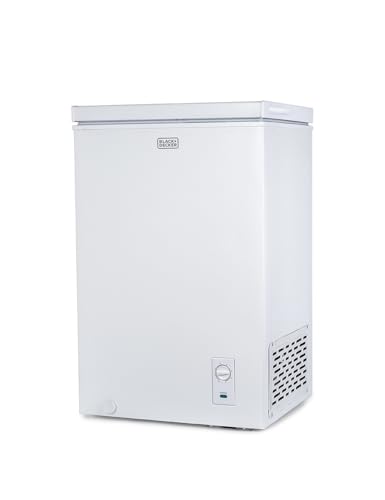
BLACK+DECKER BCFK206 2.0 Cu Ft Chest Freezer — The seventy-pounder
BLACK+DECKER’s compact chest, the BCFK206, performs the most helpful act of translation in this guide: its title states the 2.0 cubic foot cabinet as a deep freezer holding up to 70 lbs of frozen food, with a removable storage basket and mechanical temperature control, in white. Seventy pounds is a number a shopper can feel — it is a bulk-buy trip, a month of proteins for a small household, a quantity that can be pictured in bags and boxes — and a maker willing to print it beside the cubic figure is speaking the buyer’s language. The model code and the familiar badge complete a specification aimed at households who want the small chest decision to be simple.
Mechanical temperature control, which this guide defended in the backup context, suits the mini format for the same reasons: a dial that is set, held and returned to after any power interruption without menus or memory, in a machine whose whole job is to be set once and trusted. In a garage or utility corner — the BCFK206’s natural habitat — that legibility is worth more than a display. The single removable basket covers the working layer; below it, at 2.0 cubic feet, the well is shallow enough that retrieval never becomes the archaeology larger chests threaten.
The 70 lb figure deserves one more use before this review moves on: as a shopping rehearsal. Stand in the supermarket with the number in mind and it becomes a discipline — two bulk packs of chicken, a month of mince in portions, the frozen vegetables to see them through, and the cabinet is honestly full. Buyers who rehearse their real shop against a stated capacity make fewer sizing mistakes than buyers who shop by cubic intuition, and this model is the only one in the guide whose title lets them rehearse in the units the supermarket uses. That is a small kindness with a long shadow.
White finish, mainstream badge, honest weight figure, simple control: this is the mini chest as a settled appliance rather than a project, and for households replacing a dead compact or buying the category’s standard article, it is the lowest-drama purchase in the guide. Its claims are fewer than some rivals’ — no light is claimed, no second basket — and what it offers instead is the confidence of a specification that has been sold, in this general shape, for a very long time.
- Capacity as listed: 2.0 cu ft, holding up to 70 lbs of frozen food
- Format as listed: compact chest freezer
- Organisation as listed: removable storage basket
- Control as listed: mechanical temperature control
- Model as listed: BCFK206, white
- Purchase path: the BLACK+DECKER BCFK206 listing on Amazon is where to check price on Amazon
Strengths
- The stated 70 lb food capacity translates the size into shopping terms.
- Mechanical control suits set-and-trust duty in garages and utility corners.
- A mainstream badge and a settled, unpretentious specification.
Trade-offs
- One basket, where both Kismile models carry two.
- No interior light is claimed in the title.
- White only, per the title, in a guide where black finishes abound.
The low-drama choice: for households that want the standard small chest from a standard badge. The feature-hunter’s choice: it is not — the DEMULLER and the unbranded 3.5 argue harder below.

DEMULLER 4.0 Cu Ft Chest Freezer — The deep cold
DEMULLER’s 4.0 cubic foot chest is the specialist at the top of the mini class: an ultra-low temperature deep freezer whose title prints a floor of down to -12 degrees Fahrenheit, with two removable baskets, an accurate display of cabinet temperature, and a freestanding build. The temperature floor is the claim to unpack, because it is the only one of its kind in this guide. Ordinary freezer duty lives around the familiar zero-degree mark; a cabinet that states it can drive well below that is speaking to storage that rewards deeper cold — long-keeping meats, ice cream at a firm scoop, the catch or the harvest meant to wait out a season — and to buyers who think about temperature as a variable rather than a given.
The cabinet temperature display is the claim’s necessary partner. A deep-cold promise without a readout is a dial setting and a hope; a display that shows the cabinet’s actual temperature turns the promise into something the owner can verify on every visit, and it doubles as the household’s outage instrument — the number that says, at a glance, whether the cold held. Two removable baskets organise the top of a 4.0 well that is the deepest in this guide, and at this size that organisation stops being a courtesy and becomes the retrieval system itself.
Deep cold has a second audience beyond the long-keepers: the quality-keepers. Ice cream stored at the coldest settings keeps its texture rather than cycling toward iciness; fatty fish and rich meats resist the slow oxidation that shallower cold permits over months; the home ice-maker’s cubes freeze harder and melt slower in the glass. None of these benefits requires believing the cabinet is a laboratory instrument — only that temperature is a variable with consequences, and that a title willing to print its floor, beside a display willing to prove it, serves the buyer who manages that variable deliberately.
Judge this pick as the class’s cold-storage instrument: the largest mini here, the coldest stated reach, the only displayed temperature. Households storing ordinary overflow at ordinary temperatures will not use its depths and may prefer the Midea’s flexibility or the Kismile’s finish. Households who know exactly why they want the coldest small chest on the page have found the only title in the guide that answers them in numbers.
- Capacity as listed: 4.0 cu ft — the largest mini here
- Temperature as listed: down to -12 degrees Fahrenheit
- Readout as listed: display of cabinet temperature
- Organisation as listed: two removable baskets
- Format as listed: freestanding chest
- Where to buy: the DEMULLER 4.0 listing on Amazon — check price on Amazon
Strengths
- The only stated ultra-low temperature floor in the guide.
- A cabinet temperature display makes the cold verifiable at a glance.
- The class’s largest capacity with two-basket organisation.
Trade-offs
- Its depths are wasted on ordinary overflow stored at ordinary temperatures.
- No interior light is claimed alongside its display.
- At 4.0 it is the mini class’s ceiling — check the footprint as a small appliance, not a tiny one.
Cold specialists, here: long-keeping storage that rewards the deepest freeze. Ordinary overflow: the mid-size picks above will serve at less commitment.

3.5 Cu Ft Mini Chest Freezer (Black) — The quiet seven-step
The guide’s second 3.5 is an unbranded listing whose title, read on its own terms, is the most manner-conscious specification here: a small chest freezer of 3.5 cubic feet, a mini deep freezer in black with a removable basket, seven-temperature adjustment, and ultra-quiet, energy-saving running for home and apartment. Seven temperature settings is the finest control spread in this guide — the granularity that lets a cabinet be tuned to a single job, from ice cream’s preferred point to the deepest setting for long storage — and pairing it with quietness and efficiency claims makes the listing’s argument clearly: this is the 3.5 designed to live among people, in the apartment or the kitchen corner, where a freezer’s hum and appetite are part of its character.
The comparison with the Midea at the same size is the instructive one. The Midea offers a badge, a light and a second role as a refrigerator; this model offers finer temperature steps and the quiet-efficiency brief, with a single basket against the Midea’s one as well. Neither dominates; they divide the 3.5 buyer by priority — flexibility versus manners — and a household should choose by asking which it will notice weekly: the week the cabinet must become a fridge, or the every-night quiet of the room it stands in. Apartment households, whose freezer necessarily lives within earshot, will know their answer immediately.
Seven settings also change how the cabinet ages with its household. A young family’s 3.5 set deep for batch-cooked baby food becomes, in later years, the same cabinet set gentler for bread and ice cream, then deeper again for a teenager’s meal-prep era. Fine-grained control is the feature that lets one small machine follow a household’s changing frozen life without being replaced at each stage, and in a category where the cabinets themselves are inexpensive, that longevity of fit is the real economy on offer.
The unbranded caveat applies as it did in this batch’s other guides: no maker’s name stands behind the listing, so the product page’s seller information and the buyer’s own verification carry more weight. What can be said from the title is that its stated facts are the right facts for its brief — size, steps, quiet, thrift, basket, finish — and a specification that well-aimed deserves its place in the class’s centre beside the branded convertible.
- Capacity as listed: 3.5 cu ft
- Format as listed: small chest freezer, mini deep freezer
- Control as listed: 7-temp adjustable — the finest spread here
- Character as listed: ultra quiet, energy saving
- Organisation as listed: removable basket
- Finish as listed: black
- Ordering route: this unbranded 3.5 listing on Amazon is where to check price on Amazon
Strengths
- Seven temperature settings tune the cabinet to one job precisely.
- Ultra-quiet, energy-saving positioning suits apartment and in-room life.
- The class’s centre size in a furniture-friendly black finish.
Trade-offs
- No brand stands behind the listing; verification weight falls on the buyer.
- One basket, where the Kismile pair carry two.
- No light or convertible role is claimed against the Midea at the same size.
Apartment-shaped: a centre-size chest with drawing-room manners. Badge-first buyers: the Midea above carries the name you are looking for.
What Should the First Month With a Mini Chest Teach You?
Let the cabinet prove its temperature before it holds anything precious: a day running empty, a thermometer resting inside, a seal checked with a sheet of paper around the lid’s whole perimeter. Small freezers are simple machines, and the first month’s lessons are correspondingly practical. Learn how the well wants to be packed — flat bags filed, tubs in the corners they waste least, the basket reserved for what the week will actually touch. Learn the control’s dialect: what its settings mean in degrees, verified against the thermometer rather than assumed, because a dial’s numbers are a maker’s shorthand and the food cares only about the temperature itself.
By the second week, run the retrieval test that predicts the cabinet’s whole life: can you find, in under a minute, the item you froze first? If yes, the organisation system is working and merely needs keeping. If no, fix it now, while the contents are few and the fix is a rearrangement rather than an excavation. Mini chests forgive almost everything except being treated as bottomless; their wells are shallow enough that one honest system, installed early, serves for years without revision.
The month should also settle the cabinet’s social contract in the household: whose food lives there, what the temperature is set for, and whether the lid stays clear. Small appliances in shared rooms accumulate other people’s habits the way they accumulate frost — gradually, then entirely — and a five-minute agreement in week one is cheaper than a renegotiation in month six.
Six Small Chests, One Table
| Model | Capacity | Baskets | Signature claim |
|---|---|---|---|
| Midea 3.5 Convertible | 3.5 cu ft | 1 | Fridge-freezer convertible, LED light |
| Kismile 3.2 | 3.2 cu ft | 2 | Black finish, freestanding top-open design |
| Kismile 1.8 Mini | 1.8 cu ft | 2 | The true miniature, fully basketed |
| BLACK+DECKER BCFK206 | 2.0 cu ft | 1 | Up to 70 lbs of food, mechanical control |
| DEMULLER 4.0 | 4.0 cu ft | 2 | Down to -12 degrees, temperature display |
| Unbranded 3.5 (Black) | 3.5 cu ft | 1 | 7 temperature settings, ultra quiet |
The table shows the class’s real spread: barely a factor of two in capacity, and a world of difference in character. Organisation, cold depth, convertibility and manners divide these six more honestly than size does, which is why the reviews weigh the signature claims as heavily as the cubic figures.
How Do You Place and Run a Mini Chest So It Earns Its Corner?
Placement is a negotiation between the machine’s needs and the room’s life. The cabinet wants level footing, air at its vents, and a lid arc that clears whatever hangs above it — a shelf, a counter lip, a low ceiling in a utility nook — because a lid that cannot open fully turns every retrieval into a one-handed juggling act. It wants to be near the kitchen’s workflow rather than at the end of a corridor, because overflow freezers earn their keep in arm’s-reach moments. And it wants its top kept clear: the flat lid of a chest in a small room attracts objects the way a clear counter attracts post, and a lid used as a shelf is a lid that gets opened against resistance, sealed imperfectly, and cursed weekly.
Running one well is a small set of habits. Freeze flat, label with dates, keep the basket layer as the week’s working stock and the well as the archive, and rotate by the first-in-first-out law that every freezer guide in this series repeats because every freezer audit confirms it. Defrost on the maker’s rhythm rather than the ice’s: a mini chest’s defrost is a cooler, an hour and a towel, a genuinely small job that procrastination inflates. Households planning the whole utility corner at once — the freezer beside the second oven, the storage beside the laundry — will find the same permanence-minded thinking in our colleagues’ guide to Best Economical Double Wall Ovens, where value is likewise measured across a decade of daily use rather than a day of delivery.
Energy manners at this scale reward one specific placement decision: keep the cabinet out of the sun’s daily path and away from the oven’s flank. A mini chest in a hot microclimate works measurably harder than the same cabinet in the room’s cool corner, and since these machines are light enough to move before they are loaded, the experiment costs an afternoon rather than a delivery fee. Test the corner with a thermometer on a warm day if the room is borderline; the cabinet will repay the diligence every day it runs.
The last habit is the audit: once a season, empty the baskets, read the labels, and promote anything ageing toward the kitchen. A mini chest’s whole virtue is that its contents are few enough to know completely — the moment its owner stops knowing them, it has become a very small, very cold cupboard of mysteries, and the fix costs one honest half-hour.
What Do Mini Chest Buyers Most Often Get Wrong?
The first error is format confusion at the search page: ordering a small upright in the belief it is a chest, then discovering the door, the shelves and the cold spill are not what the plan assumed. This guide’s opening discipline — a chest opens from the top into a well — is the test to apply to any listing. The second error is sizing by the best week of the year: buying the 4.0 for the harvest fortnight and running it half-empty for fifty weeks, when the 3.2 with a borrowed cooler at harvest would have served the year better. The third is the mirror image — the 1.8 bought for a provisioning life, full from its first day, teaching its owner that arithmetic cannot be charmed.
Quieter errors follow ownership. The lid becomes a shelf; the baskets are removed “temporarily” and never return, taking the organisation with them; the cabinet is pushed against a wall until its vents breathe dust. And the category error beneath several of these guides deserves its final airing here: expecting a mini chest to behave like a second full freezer, with zones and drawers and an inventory system — when its actual genius is the opposite, a single cold well, honestly filled. The households that thrive with these machines are the ones that wanted exactly that, much as the readers of our guide to Best Dish Drawer Dishwashers thrive when they wanted a drawer rather than a smaller door.
Final Recommendation
Start at the class’s centre unless your needs argue otherwise. The Midea 3.5 is the most versatile mini chest here — convertible, lit, basketed — and the default recommendation for households whose overflow changes character across the year. The unbranded 3.5 answers the apartment brief with its seven settings and quiet manners; the Kismile 3.2 is the kitchen’s organised mid-size in black; its 1.8 sibling is the honest miniature for one-problem households; the BLACK+DECKER is the settled, low-drama standard; and the DEMULLER 4.0 is the cold specialist whose stated depths reward the buyer who needs them. Choose by the job, keep the lid clear and the baskets working, and the smallest freezer in the house will quietly become the one nobody would give back — the little well of cold that made the kitchen feel twice its size.
Frequently Asked Questions
Why are there no small uprights in a guide to mini freezers?
Because the title promises chest freezers, and an upright is a different format — front door, shelves, cold that pours out at every opening. A widely sold 1.1 cu ft upright appears in this category’s searches constantly and was excluded on exactly that ground. Readers who decide an upright suits them better should shop it as an upright, with its own virtues, rather than as a chest that happens to stand up.
Is 1.8 cu ft big enough to be worth owning?
For one defined job, yes — and that is the miniature’s honest brief. A 1.8 chest holds a couple’s monthly protein buy, a baker’s dedicated stores, or a small apartment’s entire overflow, in a corner footprint with two-basket organisation. It is not a storehouse and does not claim to be; households whose overflow is seasonal or family-scale should start at the 3.2 and 3.5 models instead.
What does the DEMULLER’s -12 degree figure actually mean for storage?
Its title states the cabinet can reach down to -12 degrees Fahrenheit, well below ordinary freezer duty. Deeper cold suits long-keeping storage — meat held for a season, ice cream kept firm, a catch or harvest waiting months — and the model’s cabinet temperature display lets the owner verify the cold rather than trust a dial. Ordinary overflow gains little from the depth, which is why this guide frames the model as the specialist’s pick.
How many baskets should a mini chest have?
Two is the comfortable number where offered, as on both Kismile models and the DEMULLER: one basket for the week’s working stock, one for a dedicated category, with the well below as archive. A single basket, as on the Midea, BLACK+DECKER and unbranded 3.5, still seeds the system — the owner simply adds bins below sooner. What matters is that some organised layer rides on top; a basketless well becomes a dig within a month.
How loud and costly is a mini chest to run, honestly?
Titles in this guide mostly stay silent on consumption, and this guide invents no figures — the one character claim made is the unbranded 3.5’s energy-saving positioning, which is a maker’s description rather than a measurement. The honest general answer is geometric: a small, well-sealed chest with a cold mass inside it is among the cheapest cold appliances a household can run, and the product page’s energy information for your chosen model is the figure to budget by. Noise follows the same logic — in-room buyers should weight the quiet claims and place the cabinet on a level floor, since a rocking cabinet amplifies its own hum.
Can a mini chest live in a bedroom or office?
Quietly, if the model is chosen for it — the unbranded 3.5’s title claims ultra-quiet running precisely for in-room life, and the class generally is gentler than full-size cabinets. The practical checks are the hum at night, the heat at the vents, and the lid’s clearance in a furnished room. A chest that passes those checks makes a surprisingly civilised roommate, particularly as a dedicated store for one person’s food.
Related Guides
Readers organising small-scale frozen storage may also enjoy our guide to Best Freezers With Drawers, where the retrieval problem these chests solve with baskets is answered with cabinetry instead. Between the basket and the drawer, every household’s frozen organisation finds its natural mechanism.


