What's inside
- Key Takeaways
- Quick Picks
- How Did We Judge Cleaners That Work Underwater on a Battery?
- Which Battery Pool Vacuums Earn a Place by the Water?
- How Do You Actually Clean a Pool With a Battery Handheld?
- What Should You Check Before Buying for Your Pool Type?
- Handheld or Robot: How Do You Choose Your End of the Family?
- How Do You Keep a Pool Battery Alive for Many Summers?
- What Are the Most Common Mistakes With Battery Pool Cleaners?
- What Role Does a Cover Play in How Much Vacuum You Need?
- Final Recommendation
- Frequently Asked Questions
- Related Guides
As an Amazon Associate I earn from qualifying purchases. This post may contain affiliate links at no extra cost to you.
cottageverdict.com is reader-supported. When you buy through links on our site, we may earn an affiliate commission.
Where to buy: the linked cleaners below are sold on Amazon, where it pays to check price on Amazon on the day you shop and to confirm which pole, filter bags and charger a given listing includes, because pool-cleaner bundles vary more than almost any other category we cover.
A pool changes its mind about being clean roughly every hour. Leaves arrive on a breeze nobody felt, sunscreen films the surface, grit migrates to the floor’s low corners, and the water that sparkled at breakfast is faintly reproachful by lunch. The best battery-operated pool vacuums exist for that rhythm: not the deep, scheduled, whole-pool campaign of a plumbed suction cleaner or a pressure-side machine, but the five-minute intervention — the quick pass before guests arrive, the rescue of a spa after a windy night, the spot-clean where a week’s worth of debris has gathered under the ladder. Battery power is what makes those interventions effortless, because a cleaner with no hose and no cord is a cleaner that actually gets carried to the water.
That freedom has a shape, and this guide is organised around it. At one end sit the handheld rechargeable vacuums from Water Tech’s Pool Blaster line — machines you mount on a standard pool pole and steer yourself, with the debris collected in an internal chamber rather than sent to the pool’s filter. At the other end sits a small robotic cleaner from Aiper, included honestly as the robotic end of the battery family: you charge it, lower it in, and it wanders the floor of an above-ground pool on its own. Between those poles of effort — your arm, or its little motor — lies the whole decision, and the right answer depends on your pool’s size, your debris, and how much of the cleaning you personally wish to do.
Two further entries are handled in prose, because they complete the battery story without being battery machines you can buy from this list: pole-mounted manual vacuums that use the pool’s own filtration, and the simple spa wands and squeeze-cleaners that keep hot tubs honest between services. They matter because the honest comparison for any battery cleaner is not another battery cleaner — it is the manual tool it replaces, with its hoses, its priming ritual and its claim on the filter’s lifespan. Judged against that ritual, a rechargeable handheld is not a gadget. It is the abolition of a chore.
Expectations, set plainly before the picks: no battery handheld will deep-clean a large inground pool in one charge, and no small robot will scrub a waterline. These are maintenance machines for pools that are already basically clean, and within that brief they are superb. Owners who understand the brief adore them. Owners who expected a robot butler for the price of a pool toy write the disappointed reviews you have probably already read. This guide is written so that you end up in the first group.
Key Takeaways
- Battery pool vacuums are maintenance tools for already-clean pools — spot-cleaning, spas and quick passes — not substitutes for a full filtration-driven clean.
- The Pool Blaster Max is the versatile centre of the category: pole-mounted, rechargeable, with its own debris chamber and filter bag.
- The Max CG scales the same idea up for larger pools, with a wider head and a build aimed at bigger debris loads.
- The Catfish Gen 2 is the spa and hot-tub specialist, small enough for steps, benches and tight above-ground corners.
- The Aiper Seagull SE removes your arm from the job entirely, wandering above-ground pool floors on a charge — the robotic end of the battery family.
- Manual pole vacuums and spa wands, covered in prose, remain the honest baseline every battery cleaner must beat on convenience.
- A pool cover is the silent partner of every pick here: pools that are covered between swims need smaller machines, shorter sessions and far fewer storm rescues across a season.
- Charge promptly, store dry and out of the sun, and rinse filter bags after every muddy session — battery pool cleaners die of storage habits far more often than of work.
Quick Picks
| Pick | Badge | Why it made the list |
|---|---|---|
| POOL BLASTER Max Cordless Pool Vacuum | The all-round handheld | The category’s benchmark: pole-mounted, rechargeable, self-contained debris capture for pools and spas alike. |
| POOL BLASTER Max CG Cordless Pool Vacuum | For larger pools | A wider head and commercial-grade intent make it the handheld for big water and heavy leaf fall. |
| POOL BLASTER Catfish Gen 2 Spa Vacuum | Spa and hot-tub specialist | A compact rechargeable wand for hot tubs, steps and spot-cleaning, with a runtime in the three-quarter-hour class. |
| AIPER Seagull SE Robotic Pool Vacuum | Hands-free floor patrol | A small cordless robot for above-ground pools that parks itself when its battery fades. |
| Pole-Mounted Manual Vacuums | Prose-only baseline | The hose-and-filter classic every battery cleaner replaces, discussed honestly for its remaining strengths. |
| Spa Wands and Squeeze Cleaners | Prose-only simplicity | Unpowered little tools that keep spas tidy between real cleans, at almost no cost or storage. |
How Did We Judge Cleaners That Work Underwater on a Battery?
Our first criterion was debris capture, because it separates the two philosophies in this category. A handheld battery vacuum with its own chamber and filter bag keeps everything it collects out of the pool’s circulation system — leaves, grit and the fine silt that otherwise loads the main filter and shortens its life. We favoured machines whose chambers are generous and whose filter options include a fine grade for sand and silt, because the debris that annoys pool owners most is rarely the leaf you can see; it is the grey film in the corners that clouds the water when disturbed.
Second came the battery’s honest shape: not the largest runtime a listing can claim, but whether the runtime matches the job the machine is shaped for. A spa wand needs enough charge for a thorough ten minutes, several times over. A handheld for a mid-size pool needs a full cleaning session with margin. A robot needs to finish an above-ground floor and park itself somewhere retrievable when it fades. Each pick below was judged against its own job’s arithmetic, and described in those terms rather than by competing decimals.
Third, we weighed the ownership details that pool gear lives or dies by: whether the unit seals properly after a season of opening, whether filter bags and chambers rinse clean without disintegrating, whether it mounts on the standard pole you already own, and whether the charger and battery arrangement will still make sense in three summers. Pool equipment lives a hard life — sun, chlorine, being dropped on decking — and a cleaner that cannot survive its own environment is expensive at any tier. Finally, we kept the honesty rule in view throughout: every pick is framed for the work it can truly do, and the prose entries exist to mark the territory where manual tools still win.
We also listened for the sound of a category maturing. Pool Blaster’s designs have been refined across many seasons rather than reinvented annually, and Aiper’s little robot represents a newer branch still proving its summers. Maturity is not a performance figure, but it predicts the ownership details that decide satisfaction in year two: seals that are stocked, filter bags that remain orderable, chargers that have not been orphaned by a connector change. In a category where the equipment lives outdoors and the season is short, that predictability is worth real money, and it shaped the order of this list as surely as suction did.
Which Battery Pool Vacuums Earn a Place by the Water?
Four linked machines divide the work by pool size and by how much of it you intend to do personally, and two prose entries cover the manual ground they evolved from. Start with your water — spa, above-ground, inground — and the shortlist narrows itself.
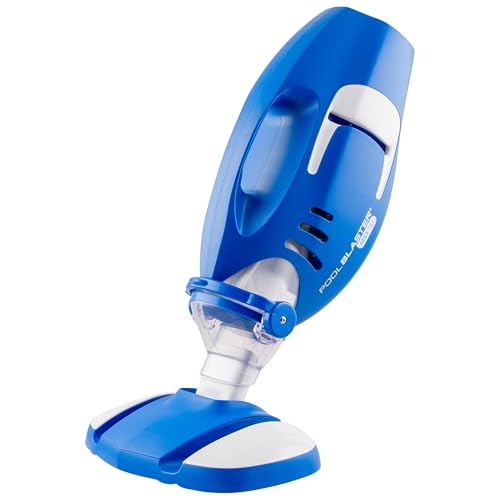
POOL BLASTER Max Cordless Pool Vacuum — The all-round handheld
The Pool Blaster Max is the machine that defined this category and, after many seasons on the market, still anchors it. The design is a self-contained cleaning head on a rechargeable battery body: clip it to your standard telescopic pole, switch it on, lower it in, and walk it slowly across the floor. Everything it meets — leaves, acorns, sand, the grit that collects in the seams — is drawn into its internal debris chamber and held in a reusable filter bag, entirely bypassing your pool’s filter. That independence is the Max’s deepest virtue. Every pass it makes is a pass your main filter never has to process, and over a summer of quick cleans the saving in filter load and backwashing is substantial.
In the hand, the experience is closer to vacuuming a carpet than to the old hose ritual. There is no priming, no hose to fill and sink, no skimmer plate to seat, no cord to manage around the deck furniture. You work the spots that need work — under the ladder, along the wall-floor joint where debris settles, the shallow-end corners — and you stop when the pool looks right rather than when a programme ends. The head is wide enough to make floor passes efficient in a mid-size pool, yet the unit is compact enough, pole removed, to serve as a handheld in a spa or on pool steps, which is why so many owners of larger cleaners keep a Max as their second machine.
There is a social dimension to this machine that spec sheets miss: it is the cleaner guests can be handed. When friends are arriving in an hour and the floor has a leaf drift in the deep end, the Max is the tool you give a willing teenager or a spouse without a training session — pole, switch, slow walk, done. Plumbed cleaners cannot be delegated to the uninitiated; their priming ritual is household arcana. A battery head is legible at a glance, and pools get cleaned by more hands, more often, because of it. Frequency, as this guide keeps insisting, is where clean water actually comes from.
The ownership rhythm is simple: rinse the filter bag after use, charge the unit so it is ready for the next intervention, and store it out of direct sun. Fine-debris filter bags are available for sand-heavy pools, and swapping grades takes a minute. Its limits are the category’s limits, honestly worn — a large inground pool is a long walk at pole’s length, and a pool neglected into green swamp needs chemistry and filtration, not a battery wand. Within its brief, though, the Max remains the purchase against which every rival in this guide is measured. Check price on Amazon when you shop; it sits mid-tier in a category where the mid-tier is the sweet spot.
- Format: rechargeable handheld head, pole-mounted
- Capture: internal chamber with reusable filter bag
- Use: inground and above-ground pools, spas, steps
- Power: rechargeable battery, fully cordless in water
- Tier: mid — the category’s benchmark position
Strengths
- Keeps debris out of the pool’s main filter
- No hoses, priming or cords to manage
- Doubles as a spa and step cleaner
Trade-offs
- Large pools make for long pole sessions
- Filter bag needs rinsing after muddy cleans
- Not a rescue tool for neglected green water
Best for: mid-size pools needing frequent, quick, filter-friendly maintenance cleans.
Not suited for: very large pools, or water that has already turned and needs full treatment.

POOL BLASTER Max CG Cordless Pool Vacuum — For larger pools
The Max CG is the Max’s bigger sibling, built — as its listing puts it — with commercial-grade intent for large swimming pools, and the difference shows first in the head: at the 12.75-inch class it sweeps a meaningfully wider path per pass, which is the specification that decides whether cleaning a big floor feels like a stroll or a sentence. In a large pool, passes are the currency. A wider head buys them back by the dozen, and the CG’s stronger appetite for bulky debris — the leaf clusters and twig drifts that gather after a storm — suits the scale of water it was made for.
Everything the original Max taught its owners applies here at scale: self-contained capture that spares the main filter, pole-mounted steering with no hoses anywhere in the story, and a rechargeable body that lives by the pool ready for the pre-party pass. Where the CG earns its separate place in this guide is the household — or the small hotel, the rental villa, the community pool — whose water is simply too extensive for the standard head to patrol comfortably. Owners of the smaller machine who upgrade their pool, or who inherit a bigger one with a house purchase, are this model’s natural audience, and the transition costs them nothing in habits: the rhythm of rinse, charge and store is identical.
Shared and commercial water is where the CG’s argument becomes undeniable. A rental villa’s pool must be turned around between guests on a schedule indifferent to your energy; a community pool collects the debris of dozens of swimmers and the trees around a whole neighbourhood. In those settings the wider head is not a luxury but a labour calculation, and the machine’s build — intended, as its name declares, for a grade above domestic duty — matches the arithmetic. Domestic owners of genuinely large pools are simply borrowing the professionals’ tool, which has been a sound buying strategy in every category this site covers.
The trade-offs scale with the machine. A wider, heavier head asks more of the arms across a long session, and the CG is overkill — cheerful, effective overkill, but overkill — for a small above-ground pool or a spa, where its width cannot even turn comfortably. Its tier is the upper end of this guide’s handhelds, reflecting the build. Buy it when the water is genuinely large and the leaf fall genuinely heavy; in that setting it stops looking like an upgrade and starts looking like the correct tool, which is the highest praise a buying guide keeps in reserve.
- Format: rechargeable handheld head, pole-mounted
- Head: wide, in the 12.75-inch class
- Capture: internal chamber and filter bag system
- Use: large inground and above-ground pools
- Tier: upper-mid among handheld battery cleaners
Strengths
- Wide head cuts passes on large floors sharply
- Built for heavy, bulky debris loads
- Same hose-free, filter-sparing method as the Max
Trade-offs
- Heavy going across very long sessions
- Too wide for spas and small pools
- Highest handheld tier in this line-up
Best for: large pools, leafy gardens, rental and shared pools with heavy weekly debris.
Not suited for: spas, hot tubs and small above-ground pools, where the Catfish below fits better.

POOL BLASTER Catfish Gen 2 Spa Vacuum — Spa and hot-tub specialist
Hot tubs collect a particular kind of evidence: grit tracked in on feet, sand that migrates from a nearby path, the small debris that settles on the bench seats and in the footwell where no circulation jet ever quite reaches. The Catfish Gen 2 exists for exactly that evidence. It is a compact, cordless, rechargeable spa vacuum — small enough to work a hot tub’s benches and corners, light enough to use by hand for spot-cleaning, and compatible with standard poles when it is asked to reach into a small above-ground pool. Its runtime sits in the three-quarter-hour class, which for spa work is not a limitation but an abundance: a thorough hot-tub clean takes minutes, so one charge covers many sessions.
The Gen 2’s appeal is the abolition of the spa-cleaning rigmarole. The alternatives are draining and wiping, syphon wands with their pumping ritual, or dragging the big pool cleaner into a space it does not fit. The Catfish simply goes in, gathers the grit into its chamber, and comes out to be rinsed — a two-minute intervention that keeps a spa inviting between its scheduled water care. Owners of above-ground pools with steps and ledges find the same virtue at small scale: the spots the big cleaner misses are precisely the spots this little machine was drawn for.
Spa owners develop a ritual around a tool like this, and the ritual is the review. Sunday evening, the cover comes off, the water gets its test strip, and the Catfish makes one slow circuit of the benches and footwell while the owner stands in the steam with a drink in hand. Four minutes. The grit that would otherwise be felt underfoot at the next soak — the grit that makes guests quietly judge a hot tub — never accumulates, because the tool is always charged, always by the tub, and always easier to use than to skip. Appliances that achieve that status in a household are rarer than appliances that win comparisons, and worth more.
Its boundaries are drawn by its size and it does not apologise for them. The chamber is small, the head is narrow, and a full-size pool floor would be an afternoon’s work at its pace. It is a specialist, priced and built as one, in the lower tier of this guide — and like most good specialists it will be used more often than the generalists it accompanies, because the job it does is the job that actually arises, weekly, in real spa ownership. If your water is small and warm, this is your pick; if your water is large, buy it as the companion to a Max rather than instead of one.
- Format: compact rechargeable spa vacuum
- Runtime: three-quarter-hour class per charge
- Pole: fits standard 1.25-inch poles for reach
- Use: hot tubs, spas, steps, small above-ground pools
- Tier: lower — a specialist at a specialist’s price
Strengths
- Sized for benches, footwells and tight corners
- One charge covers many spa sessions
- Works by hand or on a pole
Trade-offs
- Small chamber fills quickly in dirty water
- Narrow head makes big floors slow work
- Specialist tool — not a whole-pool cleaner
Best for: hot tubs and spas, plus the steps and ledges of larger pools.
Not suited for: whole-pool cleaning of anything beyond the smallest above-ground pools.
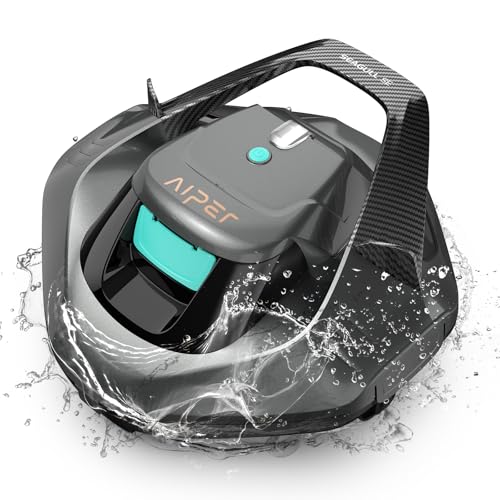
AIPER Seagull SE Robotic Pool Vacuum — Hands-free floor patrol
Every family of tools eventually produces the member that does the job while you do something else, and in the battery pool family that member is the little robot. The Aiper Seagull SE is a cordless robotic cleaner for above-ground pools — the listing frames it for pools up to the mid-hundreds of square feet — with a runtime in the hundred-minute class and a self-parking habit: when its battery fades, it coasts to the pool’s edge so you can fish it out with a hook rather than wading in after it. You charge it on the deck, lower it into the water, and it wanders the floor on its own patrol, gathering the grit and leaves that drift down between swims.
We include it with an honest frame, because a robot invites inflated hopes. The Seagull SE cleans flat above-ground floors; it does not climb walls, scrub waterlines or reason about corners the way a premium inground robot attempts to. Its navigation is the cheerful randomness of its class rather than a mapped plan, which means a session covers the floor the way weather covers a field — thoroughly in aggregate, unevenly in any given minute. For an above-ground pool whose owner wants to swim more and clean less, that trade is exactly right: the floor stays presentable across the week with almost no human minutes spent, and the pre-swim ritual becomes lifting out a robot rather than assembling a vacuum.
Watch one work for the first time and the appeal explains itself in a way no paragraph can: the little machine descends, bumps gently along the floor, turns with the randomness of a beetle and keeps going, while the owner reads on the deck with the conscience of someone whose pool is being cleaned. That scene, repeated across a summer, is worth more than its minutes — it is the difference between a pool that is a pleasure and a pool that is a responsibility with water in it. Above-ground pools are bought for joy and abandoned to chores more often than their owners admit; a small robot is, among other things, an insurance policy on the joy.
Ownership asks two small disciplines: retrieve and rinse it after sessions, and charge it promptly so the battery lives its longest life. In return it deletes the most repeated chore in above-ground pool ownership. Its tier is the top of this guide, which is the honest price of replacing your arm with a motor and a battery large enough to matter — and for the household that was about to stop maintaining its pool altogether, it is not an extravagance but a rescue. Check price on Amazon, and check your pool’s floor shape against its brief before buying; flat floors are its country.
- Format: cordless robotic cleaner, fully automatic
- Runtime: hundred-minute class per charge
- Pools: above-ground, up to mid-hundreds of sq ft
- Retrieval: self-parks at the wall when battery fades
- Tier: upper — the hands-free end of the family
Strengths
- Cleans with nobody holding a pole
- Self-parking makes retrieval a dry task
- Keeps floors presentable between deep cleans
Trade-offs
- Flat floors only — no walls or waterline
- Random patrol can miss a corner in a session
- Battery care decides its lifespan
Best for: above-ground pool owners who want maintenance to happen without them.
Not suited for: inground pools, sloped or dished floors, or anyone expecting wall-climbing.
Pole-Mounted Manual Vacuums — Prose-only baseline
Before batteries, there was the hose. The manual pool vacuum — a head on a pole, a hose running to the skimmer, the pool’s own pump providing suction — remains the baseline against which every cleaner in this guide is judged, and it deserves its paragraph of respect. Its suction is the strongest available in a home pool, drawn from a motor far larger than any battery carries; it sends debris to the main filter, which is both its weakness and, for heavy loads, its strength; and it costs, as a format, very little to buy and nothing to charge. A pool owner facing a storm’s worth of leaves or the opening clean of the season reaches for the hose first, and is right to.
There is also a diagnostic virtue in the manual ritual that battery convenience quietly removes, and experienced owners compensate for it deliberately. Connecting at the skimmer forces a weekly look at the pump basket, the skimmer weir and the filter’s pressure gauge — the pool’s vital signs, checked by hand. Owners who switch entirely to battery cleaning sometimes discover a failing pump or a blinded filter weeks late, because nothing in the new routine walks them past the gauges. Keep a monthly appointment with the plant room even after the hose retires, and the battery’s convenience costs you none of the old ritual’s wisdom.
Its costs are paid in ritual and in filter life. The hose must be primed, filled with water to purge its air, connected at the skimmer, and managed around the deck as you work; the debris it collects loads the filter, shortening the intervals between backwashes or cartridge cleans; and the whole arrangement tethers you to the pool’s plumbing, which is why the five-minute spot-clean — the job that arises most often — is the job it does worst. Battery handhelds did not replace this tool’s power. They replaced its friction, and understanding that distinction tells you exactly which tool to buy for which afternoon.
- Power: the pool’s own pump, via skimmer suction
- Capture: debris sent to the main filter
- Cost shape: cheap to buy, nothing to charge
- Best work: heavy loads and season-opening cleans
- Weakness: setup ritual kills quick spot-cleaning
Strengths
- Strongest suction available at home
- Handles storm-level debris loads
- No battery to age or charge
Trade-offs
- Priming and hose handling every session
- Loads the main filter with everything collected
- Hopeless for the two-minute touch-up
Best for: heavy clean-ups, pool opening, and owners who clean rarely but thoroughly.
Not suited for: frequent quick passes, where its setup costs more time than the cleaning.
Spa Wands and Squeeze Cleaners — Prose-only simplicity
At the simplest end of pool care sit the unpowered helpers: spa wands that suck up grit by a pumping or squeezing action, little venturi cleaners that use a garden hose’s pressure, and the humble net-and-brush pairing. Discussed generically, their virtues are real — they cost almost nothing, store in a drawer, never need charging, and for a hot tub with a light dusting of sand they can finish the job before a battery cleaner has been fetched. Spa ownership in particular rewards having one within reach, because spa debris is small, frequent and rarely worth a production.
There is a generational charm to these tools worth acknowledging: grandparents kept spas with nothing else for decades, and the wand in the drawer connects a new owner to that unhurried tradition of pool care. Not every job in a home needs a battery and a circuit board, and a guide that cannot say so has stopped advising and started selling. The wand’s place in this list is to mark the floor of necessity — everything above it in this guide is purchased convenience, and convenience, honestly labelled, is a perfectly respectable thing to buy.
Their ceiling is equally real. Human-powered suction is weak and intermittent, fine for grit on a bench and useless for leaves on a pool floor; venturi types add water to the pool as they work and dilute its chemistry in small but genuine measure; and none of them filters finely, so the silt that clouds water passes through their world untouched. They are the right tool for the smallest jobs and the wrong tool the moment the job has a floor’s worth of area. The Catfish in this guide exists precisely at the point where the wand’s charm runs out — and most spa owners, honestly advised, end up owning both, using each where its simplicity or its power belongs.
- Power: hand pumping, squeezing or hose pressure
- Capture: small internal traps or nets
- Cost shape: the cheapest tools in pool care
- Best work: light grit in spas and hot tubs
- Weakness: no fine filtration, no floor coverage
Strengths
- Almost free to buy and own
- Instant — no charging, no setup
- Perfect scale for a spa’s smallest jobs
Trade-offs
- Weak, intermittent suction
- Venturi types add water to the pool
- Useless beyond the smallest areas
Best for: spa owners wanting an instant grab-tool for light grit between real cleans.
Not suited for: pool floors, leaf loads, or fine silt that needs actual filtration.
How Do You Actually Clean a Pool With a Battery Handheld?
Technique matters more with a handheld than with any plumbed cleaner, because you are the navigation system. Charge the unit fully, fit the filter bag grade that matches your debris — the standard bag for leaves, the fine grade for sand and silt — and clip it to the pole before you reach the water. Work slowly. The single most common error is speed: a battery head pushed fast pushes a bow wave ahead of itself that scatters the very debris it came for, so the correct pace is a deliberate stroll, slower on the approach to leaf clusters, letting the suction gather rather than chase. Overlap your passes along the wall-floor joint and the corners, where circulation deposits its cargo, and spend your last minutes on the shallow-end steps and the ladder’s shadow, the two places every pool hides its grit.
Steps, swim-outs and beach entries deserve their own technique, because their geometry defeats a pole worked from the deck. For these, shorten the pole or unclip the head and work by hand from inside the water when the pool is in use anyway — the Max and the Catfish both tolerate the role happily — and brush debris from the vertical faces down to the floor first, then vacuum the floor beneath, rather than chasing the same grit twice. Tanning ledges in particular collect a tea-coloured film that a slow, flat pass lifts in one visit if the filter bag is clean when you start. Technique, in this category, is mostly the discipline of cleaning downhill.
When the chamber is full or the pass is done, lift the unit out over the water’s edge — most debris stays in the bag if you raise it steadily rather than swinging it over the deck — then rinse the bag from the outside in, let it dry, and put the cleaner straight on charge. That last habit is the one that decides battery lifespan across seasons: a rechargeable stored empty ages fast, while one stored charged and out of the sun is ready for the next intervention and the next summer. Finish with a glance at the water itself. A battery pass removes debris; it does not balance chemistry, and the owners who keep beautiful water are the ones who treat the vacuum and the test kit as two halves of one ritual rather than alternatives.
What Should You Check Before Buying for Your Pool Type?
Above-ground pools ask for lightness and floor gentleness: vinyl liners reward smooth heads and punish anything that digs, and the Seagull SE’s whole brief is written for this water. Inground pools ask first about scale — the Max for mid-size water, the CG when the floor plan gets grand — and about surface, since plaster, tile and vinyl each treat a cleaning head differently. Spas and hot tubs ask only about size and access, which is why the Catfish’s compact body matters more than any specification it carries. Across all three, confirm the pole fitting matches the pole you own, confirm which filter bags the listing includes, and think about where the charger will live: a cleaner whose charger migrates around the house is a cleaner that will be flat on the one afternoon the guests are coming.
Season timing is the third check, and the one nobody mentions. Buy before the season, not during its first heatwave, when stock thins and the nation’s pools all wake at once; a cleaner chosen calmly in spring, charged and tested before the first swim, starts its service as a known quantity. The owner who buys in a July panic buys whatever is left, learns it during the busiest weekends of the year, and forms a verdict on the whole category from the worst possible introduction. Pools reward foresight in everything, and their vacuums are no exception.
Debris type is the second check, and the most skipped. Leafy gardens overhanging the water argue for chamber capacity and a wider head. Sandy surroundings — a nearby path, a beach-entry design, a windy plot — argue for fine filter bags and patience. Homes whose pools mostly collect airborne dust and sunscreen film need the least machine of all, and those owners should buy the smallest pick that fits their water and spend the difference on a good cover, which prevents more debris than any vacuum removes. Matching the machine to the debris, rather than to the pool’s prestige, is the whole art of this category in one sentence.
Handheld or Robot: How Do You Choose Your End of the Family?
The decision is really about where your minutes go. A handheld converts cleaning into a walk: ten unhurried minutes with a pole, during which you see the pool’s condition at close range — the corner where algae threatens, the return jet that has weakened, the toy wedged behind the ladder. Owners who value that inspection, or whose pools have steps, ledges and shapes that defeat simple robots, should stay at the handheld end and buy the head that matches their water’s size. The walk is not wasted time; it is the pool’s weekly health check, performed with a vacuum as the excuse.
The robot converts cleaning into an absence: the minutes are simply never spent, and the inspection must be done deliberately instead, on a separate walk with a coffee rather than a pole. For above-ground pools with flat floors — the robot’s true country — that trade is heavily in the owner’s favour, because the floor is the whole job and the robot does the whole floor. The households that regret a robot are the ones whose pools were never in its country: slopes it cannot climb, corners it cannot reason with, a waterline the owner silently expected it to scrub. Read the Seagull’s brief as a border treaty and the machine will never disappoint you; expect it to govern territory it never claimed and disappointment is scheduled.
Some households, sensibly, refuse to choose. A Max for the weekly directed clean and the spa, a robot for the between-days patrol — the pairing costs less than most single premium cleaners and covers the category’s whole map. If your pool is large, busy and much used, that pairing is this guide’s quiet professional recommendation, offered in the knowledge that two right tools outlast one heroic one in every shed we have ever audited.
How Do You Keep a Pool Battery Alive for Many Summers?
A pool cleaner’s battery lives in the harshest neighbourhood of any household battery: heat, chlorine vapour, long idle winters and owners who think about it only when it is flat. The care routine that defeats that neighbourhood has four habits. Charge after use, not before the next use — a battery stored charged holds its health; a battery stored empty spends the winter quietly damaging itself. Store the unit indoors, out of sun and frost, with its seals clean; a gritty seal left closed all winter can take a set that leaks by spring. Rinse the whole unit in fresh water after its last autumn session, because dried chlorine is patient and corrosive. And run the machine briefly mid-winter if your climate allows the shed to stay above freezing — a battery exercised occasionally ages more gracefully than one abandoned from October to May.
Filters and bags deserve the same seasonal thinking. End the summer with them rinsed, dried and inspected; replace a bag whose fabric has gone thin rather than discovering its failure mid-clean next June, when it distributes a season’s silt back across the floor you just vacuumed. Check the pole fitting and the head’s wheels or brushes while the unit is dry and in your hands — the inspection costs four minutes in autumn and saves the first swim of the year being postponed by a parcel. Pool gear rewards owners who close the season deliberately, and a battery cleaner, cared for this way, will greet several summers as an old friend rather than a gamble.
What Are the Most Common Mistakes With Battery Pool Cleaners?
The champion mistake is expecting rescue from a maintenance tool: lowering a battery handheld into a pool that has gone green and neglected, then blaming the machine for the swamp. Algae and chemistry are the filter’s and the test kit’s territory; a battery cleaner maintains clean water, it does not redeem dirty water. Second comes vacuuming too fast, scattering debris with the bow wave and concluding the suction is weak. Third is neglecting the filter bag — a bag left full and wet in the sun becomes a smell, a stain and eventually a tear, and its replacement costs more than the rinsing ever would have.
Fourth, owners store the cleaner wherever it lands: in full sun that ages the seals, or flat in a cold shed that sulks the battery. Fifth, they buy the robot for a pool it cannot serve — a dished floor, a wall they expected it to climb — when the listing’s brief was plain. And sixth, they forget that a battery cleaner spares the main filter only when it is actually used; a Max sitting charged in the garage while the hose does every clean is a donation, not a tool. Every one of these mistakes is a mismatch between the machine’s brief and the owner’s expectations, which is why this guide has repeated the briefs so insistently: in this category, expectations are the product.
What Role Does a Cover Play in How Much Vacuum You Need?
The cheapest pool vacuum is the debris that never lands, and the honest guide says so even at the cost of selling fewer vacuums. A pool covered whenever it is not in use sheds most of its leaf load, much of its grit and a meaningful share of its sunscreen film, and the battery cleaner of a covered pool lives an easier, longer life of light patrols rather than storm rescues. Solar covers add a second dividend, warming the water while they shield it. Owners weighing a larger cleaner against a smaller one plus a decent cover should know that the cover frequently wins the comparison outright — prevention compounds daily, while suction only visits.
Covers have their own discipline, of course: a cover left in a heap grows its own ecology, and a cover dragged across a dirty deck delivers the dirt it was hired to exclude. But as a partner to every machine in this guide, the cover is the multiplier — it stretches a handheld’s charge across more days, keeps the robot’s little chamber from filling in a single session, and turns the spa wand’s job back into the triviality it should be. Buy the cleaner that fits your water, by all means. Just let the cover do the first shift.
Final Recommendation
One closing observation from years of watching pool owners: nobody regrets the battery cleaner they bought for the job it was briefed for, and almost everybody regrets, at least a little, the one bought for a job described only in their hopes. Match the machine to the water and the chore, and this category becomes simple. The Pool Blaster Max is the default answer for most pools — mid-size inground and above-ground water, regular quick cleans, an owner happy to steer — and it earns that position by sparing your filter every single pass. Step up to the Max CG when the pool is large or the trees are generous. Give the Catfish Gen 2 to the spa, where it will quietly become the most-used cleaner you own. And if your pool is an above-ground with a flat floor and your honest wish is to stop cleaning it personally, the Aiper Seagull SE is your robot — modest in its promises, faithful in keeping them. Keep a manual head for the season’s heavy opening clean and a wand by the spa, charge everything promptly, rinse everything always, and the water will hold its sparkle, all season, with less of your life than it used to take.
Frequently Asked Questions
Can a battery pool vacuum replace my pool’s filter system?
No, and nothing in this category claims to. The filter system circulates and polishes the whole body of water continuously; a battery vacuum removes settled debris during the minutes you run it. The two are partners — the vacuum keeps debris out of the filter, the filter keeps the water itself clear — and pools maintained with both need less chemistry and fewer rescues than pools kept with either alone.
How long do the batteries in these cleaners last across seasons?
With kind treatment — charged promptly after use, stored out of sun and frost, never left empty for a winter — a rechargeable pool cleaner should serve for several seasons. The battery is the component with a lifespan, which is why this guide weighs charging habits so heavily: the difference between a two-summer machine and a five-summer machine is usually the owner’s storage shelf, not the factory.
Will a handheld battery vacuum pick up sand and fine silt?
Yes, with the fine filter bag fitted and a slow pass. Sand is actually the handheld’s home turf, because it settles in corners and seams where circulation cleaners pass over it. Work deliberately, let the head linger, and empty the fine bag before it blinds — a clogged fine bag is the one way to make a good machine feel weak.
Is the robot safe for a vinyl-lined above-ground pool?
The Seagull SE is designed for above-ground pools and their liners, travelling on wheels rather than dragging an abrasive head. The cautions are the usual ones for any cleaner on vinyl: check the floor for sharp debris before a session, and retrieve the unit rather than leaving it parked in one spot for days. Within those habits, it is among the gentlest cleaners a liner can host.
Do I still need my telescopic pole with a battery handheld?
Yes — the Pool Blaster models are heads that mount on a standard pole, which most listings do not include. The good news is that the pole you already own for your manual head or leaf net almost certainly fits, since the category shares a standard fitting. Confirm the fitting in the listing, and budget for a pole only if your shed is genuinely without one.
How often should I run a battery pool vacuum?
Little and often beats rare and heroic. A handheld pass once or twice a week, or after any storm or party, keeps debris from compounding into the grey corner-film that takes real work to shift. Robot owners can run their machine every few days for the same reason. The schedule that fails is the monthly marathon, because settled debris stains, feeds algae and turns a maintenance tool’s job into a rescue it was never built for.
Can I leave a cordless pool cleaner in the water between uses?
It is better not to. Prolonged immersion ages seals, invites scale and chemical attack on the housing, and — in the robot’s case — parks a battery in the worst storage environment available. These machines are built for visits, not residence: clean, retrieve, rinse, charge and store them dry, and they will reward the routine with seasons of service. The pool’s plumbed equipment is what lives underwater; the battery family just calls.
Related Guides
Pool care connects to more of the home than the deck suggests, and the guides below follow the swimmers, the cars and the floors that share their season. For the car that ferries the pool chemicals, Best Battery Car Vacuums applies the same cordless logic to a smaller interior, while Best Black+Decker Vacuums for Cat Litter covers the other granular invader of household life. Garden-adjacent shoppers may also compare Best Canister Vacuums for Hardwood Floors and Pet Hair for the floors the swimmers track across, and the already-published Best Above-Ground Pool Vacuums remains the wider survey of this water, worth reading before any final decision is made.



[…] rightly, to this one in the first place. The same hunter’s eye applied outdoors lives in Best Battery-Operated Pool Vacuums, where the water changes every rule. Brand-focused shoppers can go deeper with Best Bissell Car […]