What's inside
- Key Takeaways
- Quick Picks
- Why shop for a first machine inside one brand?
- What about the SINGER Simple and Tradition lines?
- The four linked Singers, compared honestly
- What should a beginner sew first on a new Singer?
- How do you keep a first machine sewing like new?
- Beginner errors that make a good Singer look bad
- How long should a beginner expect the learning curve to be?
- What fabrics should a beginner start with, and which should wait?
- How does a beginner choose between dials and an app?
- What does a beginner need besides the machine itself?
- Why do so many sewing lives start with this particular brand?
- How should a gift buyer choose among these four?
- What happens when a beginner outgrows a first Singer?
- How do you set up a first sewing corner that invites use?
- What should the first month of practice include?
- Can a beginner machine handle a household’s real repair load?
- What separates beginners who keep sewing from those who stop?
- Final Recommendation
- Frequently Asked Questions
- Related Guides
As an Amazon Associate I earn from qualifying purchases. This post may contain affiliate links at no extra cost to you.
cottageverdict.com is reader-supported. When you buy through links on our site, we may earn an affiliate commission.
Choosing a first sewing machine inside a single brand is a quietly sensible strategy, and SINGER is the brand most beginners start with — the name their grandmother’s machine carried, the name on the shelf at every craft store. This guide to the best Singer sewing machines for beginners stays strictly inside that one brand, and it is built honestly: four current models whose listings speak directly to new sewers are reviewed in depth with links, while SINGER’s long-running Simple and Tradition lines — the machines many beginners meet first in shops — are discussed in prose so you understand where they fit, without our inventing listings for them here. Every machine below is a SINGER; if you want the cross-brand beginner picture, that is a different guide for a different day.
How should a beginner actually buy one of these? Resist the urge to purchase by stitch count alone, and instead match the machine to the sewing you will do in the first six months: mending and hems, simple garments, crafts, or a determined march toward quilting. Write that six-month list down — literally, on paper — before you open a single listing, because a written brief is the only known defense against a beautiful feature you will never use. Then notice how quickly the four picks below stop looking like rivals and start looking like answers to four different written lists, which is exactly what they are. Then order the exact model and configuration named in the listing — one of these picks is a color variant, one is a seasonal bundle with an extension table, and one is a new app-connected launch — because with beginner machines the bundle details are often the difference between a first month of sewing and a first month of shopping for the foot that was not in the box.
Key Takeaways
- This is a one-brand guide: all four linked picks are SINGER machines whose listings address beginners directly.
- The M3500 is the gentle start — lightweight, portable, with an accessory kit and easy stitch selection.
- The 4423 and 4452 Heavy Duty models add a metal frame and a stated fifty percent more power for denim and canvas, for beginners whose projects lean sturdy.
- The Smart HD 9120 is the new direction: app control through SINGER’s CREATIVATE app, over two hundred stitches, and an optional embroidery add-on.
- SINGER’s Simple and Tradition lines are covered in prose further down — they remain common beginner choices even though they are not linked picks in this guide.
- Whichever model you choose, the first month matters more than the model: a gentle sequence of projects, a fresh needle habit, and a corner arranged for easy starting will do more for a beginner than any single feature named in a listing.
Quick Picks
| Singer model | Beginner fit | What makes it friendly |
|---|---|---|
| SINGER M3500 Lightweight Portable Sewing Machine | The unintimidating first machine | Thirty-two stitches, easy stitch selection, an LED light, and an accessory kit in a portable frame. |
| SINGER 4423 Heavy Duty Sewing Machine (Meltwater Blue) | Beginners with rugged projects | Twenty-three stitches, a metal frame, and fifty percent more power for denim and canvas. |
| SINGER 4452 Heavy Duty Sewing Machine Holiday Bundle | Beginners who will grow into quilting | Thirty-two stitches plus an extension table and extra feet in a bundle built for bigger projects. |
| SINGER Smart HD 9120 Sewing Machine (App-Control) | Beginners who learn by phone | App control, over two hundred stitches, heavy-duty power, and an optional embroidery path. |
Why shop for a first machine inside one brand?
Because beginners drown in comparisons before they sew a single seam, and a single-brand shortlist removes an entire dimension of dithering. Every cross-brand comparison multiplies the variables — different bobbin systems, different feet fittings, different philosophies of what a stitch library should contain — until the decision consumes the energy that was supposed to sew the first curtain. Narrowing the field to one trusted badge does not make the decision smaller; it makes it finishable, and a finished decision is the one that results in a machine on a table and thread in a needle. Within SINGER, the questions become practical and answerable: Do you want light or sturdy? Dials or an app? A machine for mending, or a machine with headroom? The brand’s long history also means something concrete for a beginner — manuals, tutorials, feet, and bobbins are easy to find, and nearly every sewing teacher on earth has threaded a SINGER and can talk a nervous new owner through it over the phone.
We selected the four linked picks by a strict rule: the listing itself had to speak to beginners or to the first-machine experience. The M3500’s portability and easy selection, the Heavy Duty pair’s forgiving power, and the 9120’s explicit beginner-friendly positioning all pass that test in their own words. Models that did not pass it — however fine as machines — stayed out of the linked list, and the famous starter lines that generations learned on are handled in the prose section below, where we can discuss them as ranges rather than pretend to a listing we are not presenting.
One more framing note before the reviews. Beginners often ask whether to buy the cheapest machine that sews or the best machine they can stretch to, and inside this brand the answer is visible in the four picks: the range from the M3500 to the 9120 is not a ladder of quality so much as a fan of directions. Choose the direction of your sewing — portable, rugged, growing, or connected — and the machine chooses itself. Readers comparing across brands as well will find the neighboring philosophy in our guide to Best Janome Sewing Machines for Beginners, which applies the same beginner-first discipline to SINGER’s oldest rival.

SINGER M3500 Lightweight Portable Sewing Machine — The unintimidating first machine
The M3500 understands the beginner’s actual fears: that threading will be a puzzle, that stitch selection will be a code, that the machine will be too heavy to fetch from its shelf and therefore never fetched at all. Its listing answers each fear in turn — lightweight and portable, easy stitch selection, an LED light so the work is visible, and an accessory kit so the first projects do not wait on extra orders. Thirty-two stitches delivering, in SINGER’s phrasing, one hundred and ten stitch applications is a library sized for learning: enough to discover what zigzag does to a knit, what a blind hem looks like, and how a one-step buttonhole turns a first shirt from a rumor into a garment.
That one-step buttonhole deserves emphasis, because buttonholes are where beginner confidence goes to be tested. A one-step process — place the button, let the machine measure and sew — removes the four-stage manual sequence that has discouraged generations of new sewers at the exact moment their first real garment was nearly finished. With crafts and mending named in its brief, the M3500 is the machine we would hand a beginner whose sewing life will be household-shaped: hems, repairs, simple clothes, gifts. It will not pretend to be a heavy-duty machine, and beginners whose ambitions run to denim and canvas should read the next two picks before deciding.
- Stitch library: 32 stitches delivering 110 applications, as given in the listing title
- Named features: one-step buttonhole, easy stitch selection, LED light
- Format: lightweight and portable, per the listing title
- Included: accessory kit, per the listing title
- Starting with the SINGER M3500: check price on Amazon, where the accessory kit ships as part of this listing
Strengths
- Easy stitch selection lowers the first-week learning curve
- One-step buttonhole protects beginner confidence at garment time
- Light enough to fetch, use, and store without negotiation
Trade-offs
- Not built for sustained denim and canvas work
- Portable frame prefers lighter fabrics and projects
- Ambitious quilters will want a table the bundle does not name
Best for: true beginners sewing clothes, crafts, and household mending. Not suited for: beginners whose first projects are jeans, bags in canvas, or upholstery.

SINGER 4423 Heavy Duty Sewing Machine (Meltwater Blue) — Beginners with rugged projects
The 4423 is SINGER’s answer to a particular beginner: the one whose project list starts with curtains, denim alterations, a canvas tote, and a dog bed, and who would rather learn on a machine that does not flinch. SINGER’s listing states the case numerically — twenty-three stitches delivering ninety-seven applications, fifty percent more power for denim and canvas, a top speed of eleven hundred stitches per minute, a metal frame, and a one-step buttonhole. This Meltwater Blue edition wraps that working brief in a color that will divide households and delight exactly the beginners who are tired of appliances that only come in white.
Beginners should read the power claim correctly. Extra piercing power does not make thick sewing automatic; it makes it possible, provided the needle suits the fabric and the sewer slows at crossings. What the metal frame adds is composure — at speed, on long curtain seams, the machine stays planted and the stitch line stays honest. The twenty-three-stitch library is deliberately smaller than the M3500’s, trading decorative breadth for utility depth, and for the rugged-project beginner that trade is well judged: the stitches that hem jeans and finish canvas edges are all present, and the ones that embroider daisies are not missed. If your first year of sewing is measured in curtains hung and trousers hemmed rather than garments sewn, this is your SINGER.
- Stitch library: 23 stitches delivering 97 applications, as stated in the listing title
- Power: 50% more power for denim and canvas, as shown in the listing title
- Top speed: 1100 stitches per minute, as stated in the listing title
- Frame and buttonhole: metal frame; 1-step buttonhole
- For the Meltwater Blue 4423: check price on Amazon under this color edition’s listing
Strengths
- Genuine authority on the denim and canvas beginners actually sew
- Metal frame keeps long seams composed at speed
- Utility-focused library suits household and workwear projects
Trade-offs
- Fewer stitches than the M3500 for decorative exploration
- Speed can outrun a beginner’s steering until habits form
- Color edition will not suit every taste or gift recipient
Best for: beginners whose projects are curtains, denim, canvas, and repairs. Not suited for: beginners mainly interested in decorative stitching and dressmaking finesse.
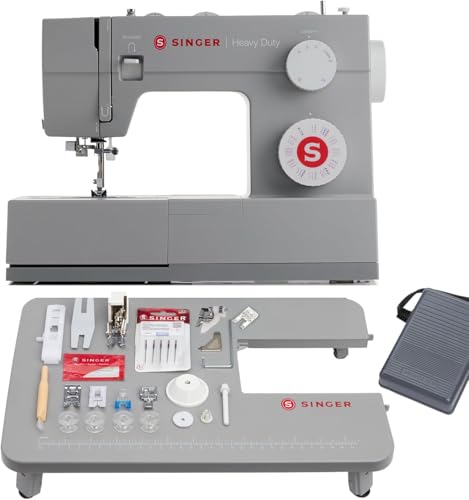
SINGER 4452 Heavy Duty Sewing Machine Holiday Bundle — Beginners who will grow into quilting
The 4452 takes the Heavy Duty formula and dresses it for growth. The core numbers match its sibling’s philosophy — thirty-two built-in stitches delivering one hundred and ten applications, fifty percent more power for thick fabrics — and the bundle adds the two inclusions that change a beginner’s trajectory: an extension table and extra presser feet. The table is the telling piece. It converts the machine from a hemming station into a platform that can support a quilt sandwich, a curtain panel, a table runner — the larger, flatter projects that beginners graduate to in their second season and that separate a machine you keep from a machine you replace.
Because this configuration is sold as a holiday bundle, treat its contents as the specification: the extension table and the two presser feet named in the listing are the value, and buyers comparing it against the plainer 4452 listings should compare box contents, not just model numbers. For a gift buyer, that bundling is a kindness — the recipient opens a machine that is already equipped for the projects the giver hopes they will attempt. For a self-buyer, it is the Heavy Duty brief with the quilting door left open. Beginners who know their sewing will stay garment-and-repair shaped can save the difference with the 4423; beginners who suspect a quilt is in their future should take the table now, because retrofitting support later is always more awkward than receiving it in the box.
- Stitch library: 32 built-in stitches delivering 110 applications, as set out in the listing title
- Power: 50% more power for thick fabrics, as stated in the listing title
- Bundle contents named in the title: extension table and 2 presser feet, plus accessory kit
- Configuration note: sold as a Holiday Bundle — contents, not just model number, define this listing
- Choosing the 4452 Holiday Bundle: check price on Amazon and confirm the extension table appears in the bundle summary
Strengths
- Extension table opens the door to quilting and large panels
- Heavy-duty power covers the thick end of a beginner’s ambitions
- Bundle completeness makes it the natural gift configuration
Trade-offs
- Bundle pricing buys a table some beginners will rarely use
- Heavier commitment than the M3500 for pure mending households
- Seasonal bundle contents can vary; verify before ordering
Best for: beginners with quilting or large-project ambitions, and gift buyers. Not suited for: beginners certain their sewing is repairs and simple garments only.

SINGER Smart HD 9120 Sewing Machine (App-Control) — Beginners who learn by phone
The Smart HD 9120 is SINGER speaking to a generation that learns everything from a screen. Its listing announces a new launch built around app control through the free CREATIVATE app, over two hundred stitches, beginner-friendly positioning, and heavy-duty power — a combination no previous beginner SINGER has offered. The app’s promise for a new sewer is guidance at the elbow: control and instruction delivered through the device the beginner already trusts, rather than through a manual that will be lost by March. Whether that promise suits you depends on your learning style, and there is no wrong answer — dial-learners should take the M3500 or the Heavy Duty pair without a backward glance.
The embroidery add-on, described in the listing as optional, is the machine’s second act: a beginner can start with sewing, grow confident, and extend into embroidery without replacing the machine. That growth path, plus the two-hundred-stitch library, makes the 9120 the pick for beginners who suspect sewing will become a serious hobby rather than a household utility. Two cautions keep the recommendation honest. An app-controlled machine ties part of the experience to a phone and an account, which some beginners will love and others will find between them and the fabric. And a new launch carries a new model’s unknowns; the listing’s claims are what we report, and early buyers should keep their documentation and expectations in proportion. For the connected beginner, though, this is the most interesting first SINGER in years — and households whose sewing leans toward fixing and altering rather than creating may also want our alterations-focused guide to Best Sewing Machines for Alterations for the repair bench’s perspective.
- Control: app control with the free CREATIVATE app, as given in the listing title
- Stitch library: 200+ stitches, as stated in the listing title
- Growth path: optional embroidery add-on, per the listing title
- Positioning: beginner-friendly with heavy-duty power, per the listing title
- For the Smart HD 9120: check price on Amazon — as a new launch, confirm the app and add-on details on the listing
Strengths
- App guidance matches how many beginners actually learn
- Largest stitch library of any pick here, by far
- Optional embroidery path protects the purchase as skills grow
Trade-offs
- App dependence will not suit screen-weary sewers
- New-launch model without a long track record yet
- Heavy-duty power plus 200 stitches may exceed a mending-only brief
Best for: connected beginners planning a serious, growing hobby. Not suited for: beginners who want dials, simplicity, and no accounts involved.
What about the SINGER Simple and Tradition lines?
They deserve their paragraph, because for years the Simple and Tradition ranges were the default answer to “which SINGER should a beginner buy?” — and in shops and classrooms they still are. Teachers recommend them because a roomful of students can be taught on them in unison; shops stock them because a first machine should not require a finance discussion; families pass them down because they keep working. A beginner who starts on one of these lines is starting inside a tradition in the literal sense — skills, supplies, and advice handed along from one sewer to the next — and that inheritance has launched more sewing lives than any feature list ever printed. As ranges, their philosophy is restraint: a curated set of essential stitches, straightforward controls, and a price and manner that make a first machine feel like a household appliance rather than a commitment. Generations of sewers learned their threading, their first hems, and their first garments on machines from these lines, and the secondhand market is full of them still sewing — which tells you something real about their adequacy for learning.
We discuss them in prose, without links, for a simple reason: this guide links only to the four listings we present in full, and we will not attach purchase links to models we are not reviewing in depth. If you meet a Simple or Tradition machine in a store, judge it by the same tests this guide applies elsewhere — Does its stitch set cover your first six months? Does the buttonhole process suit your patience? Does it feel composed on two layers of the fabric you actually wear? A yes to those questions has launched a great many sewing lives. Where the four linked picks pull ahead is in their specific, current propositions: the M3500’s portability and kit, the Heavy Duty pair’s stated power for thick fabrics, the 4452 bundle’s table, and the 9120’s app-guided modernity. The older lines are the tradition; these four are the present tense of the same idea.
There is a family resemblance worth naming for the beginner comparing across the whole brand. SINGER’s beginner machines, from the prose-discussed lines to the four linked models, share a design language of approachability — clear stitch selection, forgiving threading paths, and accessories that use the brand’s common fitting conventions, so feet and bobbins bought for one beginner SINGER often serve the next. That continuity is part of what a single-brand start buys you: skills and supplies that transfer as you grow, rather than a drawer of orphaned accessories from a machine you outgrew and a brand you left.
The four linked Singers, compared honestly
| Model | Stitches per its listing | Defining inclusion | Beginner it fits |
|---|---|---|---|
| M3500 | 32, for 110 applications | Accessory kit; LED light | The gentle, portable start |
| 4423 Meltwater Blue | 23, for 97 applications | Metal frame; 1100 stitches per minute | The rugged-project beginner |
| 4452 Holiday Bundle | 32, for 110 applications | Extension table; 2 extra feet | The beginner growing toward quilts |
| Smart HD 9120 | 200+ | CREATIVATE app control; embroidery add-on option | The connected, ambitious beginner |
What should a beginner sew first on a new Singer?
Something finishable, in fabric that forgives. A drawstring bag or a pillowcase teaches threading, straight seams, and pressing without a single fitting problem. A simple tote adds straps and the reverse lock that keeps handles attached to bags. Only then should the first garment appear — an elastic-waist skirt or pajama trousers in cotton — because garments add fit to the lesson list, and fit is a second subject that deserves the machine’s operation to be automatic first. The M3500 and the Simple-style philosophy suit this curriculum perfectly; the Heavy Duty pair will simply wait, unbothered, for the curtain and denim chapters; the 9120’s app guidance was designed for exactly these early weeks.
Keep every early project, even the wobbly ones. The first hem you sew will embarrass you by Christmas and delight you by the following Christmas, when the same job takes four minutes and lies flat. Beginners quit sewing when their second project is harder than their skills; they continue when projects grow at the pace of their hands. All four picks support that pacing — what differs is only the direction of the road beyond the first season. Kitchens, incidentally, are where many first sewing corners live, and the counter that holds the machine by day often holds something slower and more manual by morning — readers setting up a first home may enjoy our look at Best Manual Coffee Machines for that corner’s other ritual.
How do you keep a first machine sewing like new?
Three habits, none of them technical. First, change the needle far more often than feels necessary — at the start of each significant project — because most beginner “machine faults” are a tired needle announcing itself through skipped stitches and pulled threads. Second, keep the bobbin area brushed clean; household sewing generates lint from exactly the cotton fabrics beginners favor, and a felted bobbin case manufactures tension problems out of nothing. Third, rethread completely when anything misbehaves, with the presser foot raised so the thread seats in the tension discs — the single most effective troubleshooting step in all of beginner sewing, on every model in this guide.
Beyond those, treat the machine like the long-term household member it can become. Cover it against dust, store its feet and bobbins together, keep the manual where the machine lives rather than where manuals go to be lost, and sew something small every few weeks even in busy seasons so the skill — yours and the machine’s smoothness — never fully cools. SINGERs in particular reward this treatment with decades; the brand’s beginner machines fill repair shops’ “still going strong” stories precisely because their owners kept them clean, needled, and threaded correctly.
Beginner errors that make a good Singer look bad
Sewing over pins heads the list — a struck pin can bend a needle, chip a foot, and frighten a beginner out of a project that was going well. Pulling fabric through from behind is next; the feed dogs set the pace, and hands that haul create the puckers beginners then blame on tension. Third is the untouched needle: months of sewing on the needle the machine arrived with, through denim and cotton alike, until stitch quality quietly collapses. Fourth is skipping the practice scrap — every new fabric, thread, or stitch deserves thirty seconds on an offcut, and the beginners who build that habit look talented within a month. None of these errors belongs to any model; all four picks forgive them more readily than they deserve, but the sewer who avoids them will think any of these machines is wonderful, and will be right.
How long should a beginner expect the learning curve to be?
Shorter than fear suggests, longer than the first afternoon promises. Threading becomes automatic within the first week of regular use — the hands learn the path the way they learn a shoelace. Straight seams on cotton behave within the first few projects. The honest milestones after that arrive in a predictable order: the first hem that lies flat, the first buttonhole that does not require unpicking, the first garment worn outside the house, the first repair nobody can find. Each of the four picks supports that sequence; they differ in which later milestones they make easier, with the Heavy Duty pair forgiving thicker fabrics and the 9120’s app shortening the distance between a question and its answer.
What stalls beginners is rarely the machine. It is project selection — a second project chosen for glamour rather than growth, in a fabric that fights, with a technique not yet met. The curriculum in this guide’s earlier section exists to prevent exactly that stall. Follow a gentle sequence and a beginner SINGER will feel, within a season, less like equipment and more like a household skill on the order of cooking rice: mysterious in prospect, mundane in practice, and quietly life-changing in aggregate. The machines are ready when you are; sequence is the whole secret.
Teachers add one more observation worth passing on: beginners improve fastest in short, frequent sessions. Twenty minutes of sewing three evenings a week builds more fluency than a monthly marathon, because the threading path and the pedal’s feel stay warm in the hands. A portable pick like the M3500 supports that rhythm by being fetchable in a minute; a machine that lives set up supports it even better. Arrange your space so that starting is easy, and the learning curve largely climbs itself.
What fabrics should a beginner start with, and which should wait?
Start with the honest fabrics: medium-weight cotton, linen that has been washed, light denim in single layers, fleece for forgiving practice. These feed evenly, show stitches clearly, press beautifully, and reveal mistakes at a scale a beginner can diagnose. The first quilt, the first tote, the first pajama trousers all live happily in this territory, and every machine in this guide — including the lightest — handles it without complaint. Keep a bag of offcuts from these early projects; they become the test scraps for every new technique, needle, and thread that follows.
Let the slippery, the stretchy, and the very thick wait a season. Silk and satin slide against themselves and punish hesitant feeding; jersey curls and stretches under an unpracticed hand; multi-layer canvas assemblies ask for the Heavy Duty brief and a confident needle choice. None of these fabrics is forbidden — beginners sew them successfully every day — but each adds a variable to lessons that are simpler one variable at a time. When you do graduate to them, the picks sort themselves again: the 4423 and 4452 were specified for the thick end, while the M3500 and 9120 ask only that you slow down, test on scraps, and let the machine’s feeding do its work.
There is a budget wisdom here too. Beginner fabric should be inexpensive enough that a ruined seam is a lesson rather than a loss. Save the beautiful length of cloth for the third project, not the first; by then your hands will do it justice, and the machine — whichever of these four stands on your table — will simply be the reliable instrument it was bought to be.
How does a beginner choose between dials and an app?
By knowing how they actually learn everything else. The dial learner likes a control that stays where it was put, a manual with diagrams, and the feeling that the machine is a tool in the hand-tool tradition. For that learner, the M3500’s easy selection and the Heavy Duty pair’s directness are not old-fashioned; they are the interface that will still make sense in twenty years, and the skills transfer to nearly every machine ever made. There is a reason sewing classes still teach on dial machines: cause and effect are visible, and a teacher can diagnose a setting from across the room.
The app learner likes guidance that talks back — a phone that shows the next step, remembers preferences, and turns the machine into part of a connected craft life. For that learner, the Smart HD 9120’s CREATIVATE control is not a gimmick but the difference between a machine that gets used and a machine that gets admired. Neither learner is more serious than the other; they are serious differently. The only genuine mistake is buying against your own learning style to please someone else’s idea of a proper machine — a gift-giver’s trap this guide exists to disarm. Choose the interface your hands and habits will enjoy at ten o’clock on an ordinary evening, because that is when sewing actually happens.
What does a beginner need besides the machine itself?
Less than shops suggest, more than the box contains. The non-negotiables are few: fabric scissors that cut cleanly and are defended from paper duty, a seam ripper owned without shame, pins or clips, a measuring tape, and needles in the sizes your fabrics will ask for. The accessory kits bundled with the M3500 and the 4452 cover much of the small-notion territory, which is part of their beginner value. An iron — already in most homes — matters more than any of it, because pressing is half of sewing and the half beginners most often skip.
Everything else should be bought by the project, not by the catalogue. The quilter discovers the ruler and the rotary cutter; the garment maker discovers the tailor’s ham and the good pins; the repair specialist discovers the darning mushroom and the thread colors of a household’s actual wardrobe. Buying by project keeps the sewing corner small, the spending honest, and the skills ahead of the supplies — the correct order, since a beginner with ten projects of experience and a short notion list will out-sew a beginner with a fully stocked studio and three projects, every time. Let the machine arrive, sew the first season, and allow your own work to write the shopping list.
Why do so many sewing lives start with this particular brand?
Habit, availability, and a century of muscle memory. SINGER machines taught sewing in schools, filled the corners of family homes, and became the default secondhand purchase for people who wanted to try the craft without committing to new-equipment money. That history produces a practical benefit no specification sheet can match: help is everywhere. A beginner stuck at midnight can find a threading video for a SINGER, a neighbor who has owned one, a teacher who learned on one, a shop that stocks its bobbins without a special order. First machines are bought as much for that support ecology as for their stitches, and it is a rational thing to buy.
The brand’s beginner philosophy has also stayed unusually consistent across generations, which is why this guide could discuss the Simple and Tradition lines and the four current picks in one breath. The through-line is approachability: controls that explain themselves, libraries sized for real household sewing rather than brochure drama, and prices that treat a first machine as an experiment a household can afford to run. Beginners do not need a brand to be exciting; they need it to be present, understandable, and forgiving. On those three measures, the four machines reviewed here — and the older lines behind them — earn the recommendation this guide gives them.
How should a gift buyer choose among these four?
By the recipient’s life, not by the giver’s budget alone. For the young person leaving home, the M3500’s portability and kit make a complete, unintimidating start that will hem their curtains and mend their clothes in a first flat. For the practical recipient whose home needs curtains, cushions, and repairs in sturdy fabrics, the 4423’s power is the thoughtful choice, and its blue finish turns a tool into a present. For the recipient who talks about quilting, the 4452 bundle is the gift that arrives already believing in them, table included. For the recipient who lives happily through their phone and talks about making decorated things, the 9120 is the modern, ambitious present.
Two courtesies complete a machine gift. Include the consumables the first month will eat — needles, a spool or two of decent thread in household colors, fabric scissors if the kit lacks them — so the first project starts on the day, not after a shopping trip. And include time: an afternoon offered to set up together, thread the machine, and sew the first wobbly seam is worth more than any accessory. Machines given with company get used; machines given as objects sometimes become objects. Every pick in this guide has been chosen to reward that first afternoon with an early success, because a beginner who finishes something in week one is a sewer for life.
What happens when a beginner outgrows a first Singer?
Usually, nothing dramatic — the first machine changes jobs rather than leaving. It becomes the mending machine, the travel machine, the machine lent to a teenager or kept threaded for quick repairs while a larger, more specialized machine takes over quilts or garments. This second career is where beginner SINGERs quietly accumulate their decades, and it is why buying a well-matched first machine is never wasted money even when ambitions grow: the household still needs hems, and the old machine still sews them beautifully. The skills transfer completely, too — threading logic, tension sense, needle judgment — because they were learned on a machine designed to teach them clearly.
When the upgrade conversation does come, let it be specific. Outgrowing a machine means a named limitation encountered in real work: quilts too large for the bed, fabrics beyond the feed’s authority, a hunger for embroidery or decorative range. Each of the four picks answers one of those futures differently — the 4452’s table delays the size limit, the Heavy Duty pair delay the fabric limit, the 9120’s embroidery option answers the decoration hunger in advance — which is why this guide pressed the direction question so early. A beginner who chose their direction honestly often finds that “outgrowing” arrives years later than feared, and arrives as an addition to the sewing corner rather than a verdict on the machine that started everything.
How do you set up a first sewing corner that invites use?
With light, a stable surface, and everything within one reach. A beginner machine on a wobbling card table under a dim bulb manufactures frustration that gets blamed on sewing itself; the same machine on a firm table with light falling on the needle feels like a craft waiting to happen. Keep the machine’s feet, bobbins, needles, and the seam ripper in one small box beside it, the manual underneath, and a waste thread snippet bowl within flicking distance. If the machine must be packed away between sessions — the M3500’s natural life — give it a dedicated shelf and a tote for its kit, so setup takes two minutes rather than a household excavation.
Ergonomics matter sooner than beginners expect. Chair height should let forearms rest roughly level with the machine bed; shoulders that creep toward ears are announcing a setup problem, not a sewing problem. Take the machine’s pedal placement seriously too — a pedal that wanders under the table teaches the foot to chase it, and the sewing suffers in ways that look like inattention. None of this requires a dedicated sewing room. It requires one corner arranged with the same care as a reading chair, and the reward is a machine that gets used on weeknights, which is where sewing lives are actually built.
What should the first month of practice include?
A page of straight lines on scrap cotton, sewn without thread-count anxiety, until the lines run parallel and calm. A set of seams — straight, zigzag-finished, French if ambition stirs — pressed and examined. The drawstring bag. The tote. A repair performed on a real garment, however humble, because repairing something you own teaches more respect for construction than any sampler. And one deliberate mistake recovered: a seam ripped and resewn, a buttonhole unpicked and repeated, so that error stops being catastrophe and becomes procedure. Beginners who have recovered from a mistake own their machines; beginners who have not are still renting them from their fears.
End the month by sewing something for someone else. A gift project — a cushion, a bag, a hemmed set of napkins — concentrates the mind wonderfully, because an audience of one beloved person raises care without raising fear. It also converts the machine, in the household’s eyes and the sewer’s, from an experiment into a capability. That conversion is the real graduation of the first month, and all four Singers in this guide were chosen to make it likely: kitted, forgiving, and sized to the sewing a new life actually contains.
Can a beginner machine handle a household’s real repair load?
Yes — and measuring a first machine against the repair pile is one of the sanest buying methods available. Walk to wherever the mending waits in your home and inventory it honestly: hems down, seams split, buttons’ worth of buttonholes, a curtain to shorten, a school uniform to patch. That pile, not a catalogue, is the beginner machine’s first job description. The M3500 covers its lighter half with ease; the Heavy Duty pair cover the denim and canvas entries too; the 9120 covers it while teaching its owner a connected way of working. A machine that clears the existing pile in its first month has paid its first dividend, and the beginner who cleared it has learned threading, feeding, pressing, and patience on work that mattered.
Repairs also teach the economics that keep people sewing. A single professional alteration can cost a noticeable fraction of a beginner machine’s price; a season of home repairs can quietly repay the purchase while producing a wardrobe that fits better than the one that was bought. None of that requires the machine to be anything more than it is. It requires the machine to be present, threaded, and unintimidating at the moment a hem fails — which is, in the end, the whole design brief behind every model in this guide, from the prose-honored starter lines to the app-guided newcomer.
What separates beginners who keep sewing from those who stop?
Almost never the machine. The sewers who continue share three traits that any of these four picks can support. They sew regularly in small doses, so the skill stays warm. They choose projects at the edge of their ability rather than beyond it, so most sessions end in a finished thing. And they treat faults — the nest of thread, the wandering seam, the buttonhole that must be unpicked — as information rather than verdicts, because every experienced sewer alive has produced all three this year. The machine’s contribution to that psychology is to be ready, threaded, and forgiving at the moment motivation flickers; a machine that needs an hour of setup negotiation loses to the sofa every time.
There is a corollary for the people around a beginner. Households that admire the first wobbly tote as the achievement it is, that bring their hems to the new machine with genuine respect for the repair, create the audience every craft needs in its first season. SINGER’s beginner range has launched more sewing lives than any statistic could capture, not because the machines are magic, but because they are present in the homes where those lives happen — on the table, in the family, threaded and waiting. Choose any of the four with your direction clear, arrange the corner kindly, sew the gentle sequence, and the odds are overwhelming that a year from now the machine will not be the thing you bought. It will be one of the things you can do.
Final Recommendation
Pick your direction and take the SINGER that points that way. The M3500 is the first machine we would hand a nervous beginner: light, kitted, kind. The 4423 in its blue edition serves the beginner whose sewing is curtains, denim, and repairs from day one; the 4452 bundle serves the one who can already see a quilt on the horizon and wants the table waiting when it arrives. The Smart HD 9120 is the choice for the beginner who learns by phone and plans to keep growing, with embroidery held in reserve as a second act. And if a Simple or Tradition machine is what your local shop puts in your hands, receive it kindly — it carries the same philosophy in an older form. A first machine’s job is not to be the best machine; it is to be the machine that gets used on an ordinary evening, and every SINGER in this guide, linked or lovingly described, was chosen because it passes that test — the rest of a sewing life is just evenings like that, accumulating into skill.
Frequently Asked Questions
Which Singer is best for an absolute beginner?
For most, the M3500: it is lightweight, arrives with an accessory kit, selects stitches easily, and makes its buttonhole in one step. Beginners whose projects are rugged from the start should consider the 4423 instead, and those who learn best with app guidance should look at the Smart HD 9120. The best first machine is the one matched to your projects and learning style, not the one with the longest feature list.
Are Heavy Duty Singers too much machine for a beginner?
No — they are beginner-appropriate machines with stronger briefs. The 4423’s twenty-three stitches are actually a simpler library than the M3500’s, and its extra power simply means denim and canvas do not end the lesson early. Use the speed thoughtfully while your steering develops, and a Heavy Duty model can be a first machine for life.
What does “stitch applications” mean in these listings?
SINGER expresses its libraries two ways: the number of built-in stitches, and the larger number of applications those stitches can perform when varied by length, width, and technique. The M3500’s thirty-two stitches delivering one hundred and ten applications is the brand’s own arithmetic, quoted here as the listing states it. Judge the machine by whether its stitches cover your projects, not by the larger number’s size.
Should I buy the 4452 bundle or the plain machine?
Buy the bundle if the extension table will be used — quilting, curtains, large flat projects — because the table is the bundle’s substance, along with its extra feet. If your sewing is garments and repairs, the table will spend its life in a cupboard, and the 4423 or M3500 serves the same sewing for less commitment. Compare contents, not just prices, between listings.
Is the app on the Smart HD 9120 required to sew?
The listing presents app control through the free CREATIVATE app as the machine’s control concept, and positions the model as beginner-friendly with that guidance. Beginners who want a machine entirely free of phones and accounts should choose one of the other three picks, whose dial-based operation needs nothing but the machine itself. Choose the control style you will enjoy living with.
Can a beginner Singer handle quilting?
Smaller quilts and quilted projects, yes — especially on the 4452 bundle, whose extension table supports the work. Full-size bed quilts will eventually argue for a larger machine, but many quilters piece and quilt their first several projects on beginner machines exactly like these. Start with lap quilts and runners, and let the machine’s limits, not your enthusiasm, set the timetable for upgrading. Quilted small goods — placemats, table runners, baby quilts, cushion tops — are also the ideal practice ground for a new sewer, because the pieces are flat, the seams are straight, and the finished objects furnish a home while the skills accumulate toward garments and larger quilts.
What if my new Singer jams or nests thread in week one?
Do not panic, and do not blame the machine yet. Stop, cut the work free gently, remove the bobbin, and rethread the entire machine from the spool pin with the presser foot raised, then replace the needle with a fresh one and test on a scrap. That ritual cures the overwhelming majority of first-week faults on every model here, because most early jams are threading or needle events rather than machine defects. If a fault survives a careful rethread, a fresh needle, and a cleaned bobbin area, then it is a conversation for the seller — and it is a conversation worth having in week one, while every remedy is easy.
Related Guides
Brand loyalty is a starting strategy, not a life sentence, and the natural companion read is Best Easy to Use Sewing Machines, which gathers the most approachable machines across brands in one place. Beginners who began with SINGER often end up fluent in several brands; the first machine’s job is simply to make that fluency imaginable. Keep this guide’s four directions in mind as you read it — portable, rugged, growing, connected — because the direction you chose inside one brand will still be your direction when the whole market opens up, and knowing it is the real souvenir a first machine gives its owner.


