What's inside
- Key Takeaways
- Quick Picks
- How Did We Choose Washers for Real Apartment Constraints?
- How Do the Six Apartment Machines Compare?
- What Makes a Washer an Apartment Washer?
- How Do You Connect a Portable Washer to a Sink Without Drama?
- What Should You Check in Your Lease and Building First?
- Automatic or Twin Tub: Which Suits Flat Life Better?
- How Much Capacity Does an Apartment Household Really Need?
- How Do You Store and Live Around a Machine in a Small Flat?
- How Do You Run Laundry Day in a Flat With No Laundry Space?
- What About Drying, the Other Half of Apartment Laundry?
- How Do These Machines Handle the Loads Flats Actually Generate?
- How Do You Keep an Apartment Washer Smelling Clean?
- What Is the True Cost of Apartment Laundry at Home?
- How Do You Move an Apartment Washer Between Homes?
- How Do You Decide Between the Two COMFEE’ and BLACK+DECKER Sizes?
- Which Pick Should a First-Time Renter Buy Without Overthinking?
- Which Apartment Laundry Mistakes Do Renters Regret?
- Final Recommendation
- Frequently Asked Questions
- Related Guides
As an Amazon Associate I earn from qualifying purchases. This post may contain affiliate links at no extra cost to you.
cottageverdict.com is reader-supported. When you buy through links on our site, we may earn an affiliate commission.
Where to buy: all six washers below are sold on Amazon, and the linked names in the Quick Picks table and the detailed sections lead to the matching listing, where you can check price on Amazon and confirm dimensions, hose arrangements, and capacities before ordering. Apartment laundry is a negotiation with space, plumbing, and neighbours, and the best apartment washing machines are the ones that understand all three. None of the six picks here needs a dedicated laundry room or a permanent hookup to justify itself. Each connects where an apartment allows, most often at a sink, stores in the footprint an apartment can spare, and washes at a scale an apartment household actually generates.
The line-up divides by philosophy. Three picks are full-automatic single-drum portables from COMFEE’ and BLACK+DECKER, in ascending sizes, which behave like small versions of ordinary washers: load, choose a program, and let the machine manage everything including the spin. One is a larger automatic from ROVSUN with a stainless drum. Two are twin tubs, the semi-automatic format that trades your labour for lower complexity and fierce spin drying. Every one of them can be the right answer, depending on your floor, your sink, and your tolerance for moving wet laundry between tubs.
Before the picks, a practical word. Apartment machines live under lease rules as well as physics, so the sections below cover checking what your building allows, connecting to a sink without drama, keeping the spin quiet enough for the flat below, and storing a machine in homes where a laundry cupboard is a fantasy. The right machine in the wrong arrangement will still fail you; the right arrangement makes almost any of these six feel like the correct purchase.
Key Takeaways
- Every pick connects without permanent plumbing, most at a sink with a quick-connect adapter, which is what makes them apartment machines at all.
- Full-automatic portables suit renters who want ordinary washer behaviour; twin tubs suit those who trade labour for simplicity and spin power.
- Wheels, rollers, and compact footprints matter daily in a flat, because the machine will be moved or squeezed past regularly.
- Capacity between 1.6 and 2.0 cubic feet covers most one and two-person households without hogging the room.
- Check the lease and the floor before the listing: building rules and thin floors decide more apartment laundry than any specification.
Quick Picks
| Pick | Badge | Why it earns its place |
|---|---|---|
| COMFEE’ 1.6 Portable | Best All-Round Apartment Pick | COMFEE’s 1.6 cubic foot fully automatic portable has six programs, wheels, and a drain pump in a magnetic gray body made for apartments. |
| BLACK+DECKER BPWM16W 1.7 | Best Compact Brand Pick | BLACK+DECKER’s 1.7 cubic foot portable offers six cycles, a quick-connect sink adapter, and hot and cold water use. |
| BLACK+DECKER BPWM20W 2.0 | Best Step-Up Automatic | The 2.0 cubic foot BLACK+DECKER portable raises capacity to 15.4 lb with six cycles and a transparent lid. |
| Auertech Twin Tub 28 lbs | Best Twin Tub for Apartments | Auertech’s 28-pound twin tub combines an 18-pound washer, a 10-pound spinner, and a drain pump for dorms and apartments. |
| ROVSUN 17.8LBS Automatic | Best Stainless-Drum Automatic | ROVSUN’s 17.8-pound automatic brings a stainless steel drum, eight modes, five water levels, and a drain pump with sink adapter. |
| COSTWAY Twin Tub 20 lbs | Best Smallest Footprint | COSTWAY’s twin tub washes 12 pounds and spins 8 in a durable compact body with timer control, for the tightest spaces. |
How Did We Choose Washers for Real Apartment Constraints?
We started with the constraints that end apartment purchases: connection, footprint, and floor. Each pick had to work without a permanent laundry hookup, using a sink adapter or an equally temporary arrangement, because that is the situation most renters actually face. Each had to fit through ordinary doors and live in a bathroom, kitchen corner, or cupboard. And each had to be the kind of machine whose spin a person could plausibly keep neighbourly with levelling and sensible loads, a theme this site’s anti-vibration guide treats in depth.
Within those gates we wanted the format argument represented fairly, because apartment shoppers genuinely divide. The automatics here span 1.6 to 2.0 cubic feet plus a larger stainless-drum model, so a household can size itself honestly. The twin tubs represent the manual alternative at two sizes, with their labour requirement stated rather than hidden. Capacity claims were read against real loads, a week of one person’s clothing, a couple’s towels, in the sections that follow.

COMFEE’ 1.6 cu ft Portable Washing Machine — Best All-Round Apartment Pick
The COMFEE’ 1.6 is the apartment washer in its most considered form. It is fully automatic, so a load is a program choice rather than a project, and it is built around the realities of rented space: wheels for moving it between its storage spot and its working spot, a drain pump that pushes water up into a sink rather than demanding a floor drain, and six wash programs that cover the week without pretending a flat generates ballgowns. The magnetic gray finish tolerates the knocks of a machine that will be repositioned often.
At 1.6 cubic feet and eleven pounds of capacity, the drum matches the arithmetic of one or two people who wash twice a week. Daily clothes, gym kit, towels in a sensible batch, bedding in sequence: the rhythm is steady rather than heroic, and the machine’s automatic spin management keeps that rhythm quiet enough for flat life when it is levelled with care. Its listing aims it at apartments, RVs, and camping, and the apartment case is the strongest of the three.
If your household is larger or your laundry is a weekly mountain, this drum will feel like a treadmill, and the bigger automatics below exist for you. But as the default recommendation for the typical renter, one machine that rolls to the sink, washes unattended, pumps itself empty, and rolls away again, the COMFEE’ is the pick the rest of the guide is measured against.
- Capacity: 1.6 cu ft, 11 lbs rated load
- Programs: 6 wash programs, fully automatic
- Mobility: wheels fitted for moving between spots
- Drainage: laundry drain pump for sink emptying
- Finish: magnetic gray, scuff-tolerant for rented life
Strengths
- Wheels and pump solve the two classic renter problems
- Fully automatic cycles need no attendance
- Size matches one and two-person laundry honestly
Trade-offs
- Bedding washes in sequence, not all at once
- Weekly family laundry would outrun it
- Sink is occupied while the machine runs
Best for: renters in one and two-person flats who want unattended, movable laundry.
Not suited for: larger households, who should take the bigger drums below.

BLACK+DECKER 1.7 cu ft Portable Washer BPWM16W — Best Compact Brand Pick
The BPWM16W is the slightly larger, brand-backed alternative to the guide’s headline pick: 1.7 cubic feet, eleven pounds of capacity, six cycles, and the quick-connect sink adapter and drain hose that define this class. Its distinguishing detail is hot and cold water use, which gives the machine a say in wash temperature that single-temperature portables surrender to the tap. For whites and towels in a flat without a laundry room, that control is a small luxury with weekly value.
Six cycles at this size is a well-judged list, and the machine’s behaviour is the full-automatic pattern apartment buyers usually want: connect, load, choose, and return to dry-ish laundry that has been spun without your supervision. The maker’s documentation and parts support matter in rentals more than owners expect, because a machine that moves house with you across leases accumulates years in different bathrooms, and the brand that still lists its hoses and adapters in year four is the brand that keeps it working.
Choose between this and the COMFEE’ on the details of your life: wheels and a pump against hot-and-cold control and a familiar badge. Either is a sound centre to an apartment laundry. What this machine will not do is grow; 1.7 cubic feet is a couple’s ceiling, stated now so that nobody is surprised in month six.
- Capacity: 1.7 cu ft, 11 lb rated load
- Cycles: 6 wash cycles, fully automatic
- Connection: quick-connect sink adapter and drain hose included
- Water: cold and hot water use supported
- Form: compact portable for homes and apartments
Strengths
- Hot and cold capability adds real wash control
- Established maker with parts and documentation
- Automatic cycles suit unattended flat laundry
Trade-offs
- No wheels mentioned, so moving is a lift
- Couple-scale drum with a firm ceiling
- Occupies the sink for the cycle’s duration
Best for: couples in flats who value brand support and temperature control.
Not suited for: solo renters who need wheels to move the machine daily.
BLACK+DECKER 2.0 cu ft Portable Washer BPWM20W — Best Step-Up Automatic
At 2.0 cubic feet and 15.4 pounds, the BPWM20W is the step up for apartment households whose laundry has outgrown the 1.6 class: the second person’s full wardrobe, the weekly towel output of a shared bathroom, the bedding of a double bed taken in two comfortable loads rather than three reluctant ones. It keeps the format’s essentials, six cycles, a quick-connect sink adapter, and full-automatic operation, and adds a transparent lid, which sounds like a styling note and behaves like an instrument.
Watching a load through the lid teaches balanced loading faster than any manual. You see the drum’s contents settle, you see the single heavy item that will trouble the spin, and you correct your habits within a fortnight of ownership. In a flat, where spin behaviour is a neighbourly duty, that education has value beyond its novelty, and it is a large part of why this machine anchors the guide’s upper end.
The step up costs floor space and a little of the smaller machines’ tuck-away charm, and it remains a portable: it connects by hand, it occupies the sink, and its mass will never match a plumbed machine’s planted calm. For the household that needs the capacity, those are fair trades, and this is the largest automatic here that still behaves like an apartment appliance rather than a small household install.
- Capacity: 2.0 cu ft, 15.4 lb rated load
- Cycles: 6 wash cycles, fully automatic
- Hookup: fits a sink with the supplied quick-connect adapter and hose
- Lid: transparent, for watching loads settle
- Form: the largest apartment automatic in this guide
Strengths
- Capacity covers shared-flat laundry properly
- Transparent lid builds good loading habits
- Same simple connection as its smaller siblings
Trade-offs
- Bigger footprint to store in a small flat
- Still ties up the sink while running
- Portable mass needs levelling for a calm spin
Best for: shared flats and couples whose laundry exceeds the 1.6 cubic foot class.
Not suited for: studio dwellers for whom every stored inch is contested.
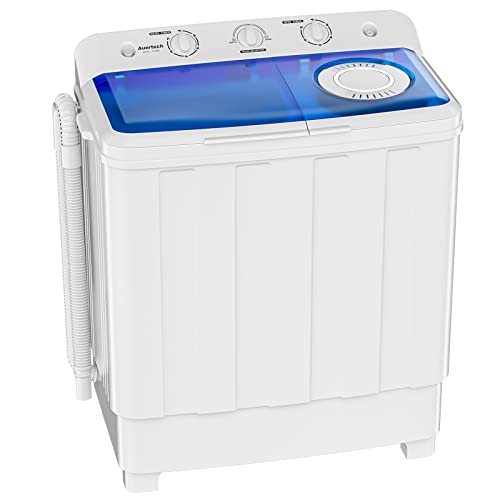
Auertech Portable Twin Tub Washing Machine — Best Twin Tub for Apartments
The Auertech is the twin tub argument at its most complete: eighteen pounds of washing capacity beside a ten-pound spinner, twenty-eight pounds combined, with a drain pump to empty the wash tub into a sink. For apartment dwellers who choose the manual format, and many do for its price, speed, and independence from electronics, this is the version with the fewest compromises. A full small load washes while the previous one spins, and the pipeline rhythm can clear a week’s laundry for one person in a single focused session.
The labour is the price and it should be counted honestly. You fill, you time, you move wet clothes from one tub to the other, and you pack the spinner in even layers because its high-speed tub punishes a careless pack with a shaking that the whole flat will hear about. Our anti-vibration guidance applies here with full force: level the machine, pack flat, and stay nearby for the spin. Owners who accept that discipline get spin drying dry enough to shorten air-drying on a rack by hours, which in a flat without outdoor space is a benefit that compounds every week.
Choose the Auertech if you are present-tense about laundry, happy to run a session rather than start a program. Choose any automatic above if your evenings are spoken for. The machine itself is a strong example of its format, aimed at dorms, apartments, and RVs, and it does not pretend to be anything else.
- Capacity: 28 lbs total, 18 lbs washer and 10 lbs spinner
- Format: twin tub, semi-automatic with timer habits
- Drainage: drain pump fitted for sink emptying
- Spin: separate spinner tub, pack in even layers
- Use: dorms, apartments, and RVs
Strengths
- Pipeline washing clears a week’s laundry in one session
- Spin drying dramatically shortens rack-drying time
- Drain pump removes the bucket work of the format
Trade-offs
- You move every load between tubs by hand
- Spinner demands careful packing to stay calm
- Semi-automatic means attendance throughout
Best for: hands-on renters who run a weekly laundry session and value dry spinning.
Not suited for: anyone who wants to press start and leave the flat.

ROVSUN 17.8LBS Portable Washing Machine — Best Stainless-Drum Automatic
The ROVSUN 17.8LBS is the specification-rich automatic of the guide: a stainless steel drum at 1.5 cubic feet, eight wash modes, five water levels, and a drain pump, supplied with a quick-connect sink adapter. The stainless drum is its headline in a class where plastic tubs are common, because a rental machine that moves, knocks, and works in steamy bathrooms benefits from a tub that cannot chip or rust at a scuff, and because its smooth wall helps loads distribute as the spin builds.
Eight modes and five water levels give the owner unusual say over small-load economics. Apartment laundry is full of half-loads, a uniform, a gym bag, a spill’s worth of towels, and a machine that lets you match water to load rather than filling a drum for three shirts saves water, time, and the spin’s composure all at once. The five levels are the kind of unglamorous feature that owners end up using weekly while forgetting to mention.
It sits between the guide’s sizes, larger in rating than the 1.6 class by weight yet compact in footprint, which makes measuring your space and your loads the deciding act. For the renter who reads specifications closely and wants the drum material and the water control, it is the connoisseur’s portable, and its adapter-included completeness means it arrives ready for the sink it will live by.
- Capacity: 17.8 lbs, 1.5 cu ft rated
- Modes: 8 wash modes with 5 water levels
- Drum: stainless steel inner drum
- Drainage: drain pump with quick-connect sink adapter included
- Format: full-automatic washer and spinner combo
Strengths
- Stainless drum outlasts plastic tubs in rental life
- Water levels match small loads economically
- Adapter and pump included for immediate setup
Trade-offs
- Specification richness means more settings to learn
- Rating sits between classes, so measure your loads
- Brand support is thinner than the biggest names here
Best for: detail-minded renters who wash many small, varied loads.
Not suited for: buyers who want the fewest possible controls between them and clean clothes.
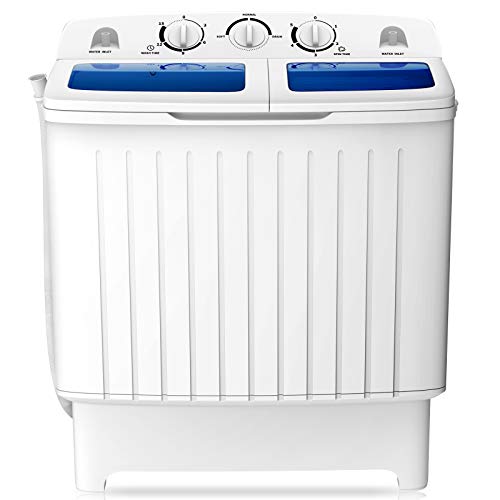
COSTWAY Portable Twin Tub Washing Machine — Best Smallest Footprint
The COSTWAY closes the guide at the smallest scale that still counts as a laundry solution: twelve pounds of washing and eight of spinning in a compact twin tub body with timer control. It is the machine for the studio where the bathroom door argues with the kitchen, the RV where every appliance earns its volume, and the dorm room where the alternative is a bag carried down three flights. At this size the question is not whether it beats a full machine but whether it beats the laundrette, and it does, weekly.
Everything about the format is manual and everything about the manual format is amplified at this size. The spinner tub is small and therefore fussy about packing, the body is light and therefore honest about levelling, and the loads are small and therefore frequent. Owners who settle into its rhythm, little and often, packed flat, spun while the kettle boils, find it less a chore than a routine, closer to washing up than to laundry day.
Set expectations at purchase and it will meet them for years. It will not take a duvet, it will not run unattended, and it will not forgive a heaped spinner. It will wash a single person’s clothes in the corner of a tiny home for a fraction of a laundrette habit’s cost and time, and for the flats it was designed for, that is not a compromise at all. It is the entire point.
- Capacity: 20 lbs total, 12 lbs washer and 8 lbs spinner
- Format: twin tub with timer control
- Design: durable compact body, blue and white
- Use: RVs, apartments, and dorms with minimal space
- Spin: separate spinner, pack evenly and stay nearby
Strengths
- Fits spaces no automatic here can enter
- Fast small-load turnaround
- Simple mechanics, nothing to configure
Trade-offs
- Most labour-intensive pick in the guide
- Small spinner is sensitive to uneven packing
- No bedding capacity beyond the smallest items
Best for: studios, dorms, and RVs where space is the whole argument.
Not suited for: anyone washing for more than one person regularly.
How Do the Six Apartment Machines Compare?
| Pick | Format | Headline trait | Watch out for |
|---|---|---|---|
| COMFEE’ 1.6 Portable | Full-automatic, 1.6 cu ft | Wheels, drain pump, 6 programs | Bedding in sequence only |
| BLACK+DECKER BPWM16W 1.7 | Full-automatic, 1.7 cu ft | Hot and cold use, brand support | Moving it is a lift |
| BLACK+DECKER BPWM20W 2.0 | Full-automatic, 2.0 cu ft | Largest apartment automatic, clear lid | Bigger storage footprint |
| Auertech Twin Tub 28 lbs | Twin tub, 28 lbs total | Pipeline speed, pump, strong spin | Manual transfer and packing discipline |
| ROVSUN 17.8LBS Automatic | Full-automatic, 17.8 lbs | Stainless drum, 5 water levels | More settings to learn |
| COSTWAY Twin Tub 20 lbs | Twin tub, 20 lbs total | Smallest footprint of all | Most labour per load |
What Makes a Washer an Apartment Washer?
Three properties, and capacity is only the third. The first is connection: an apartment washer must work where the water is, which usually means a kitchen or bathroom sink, a quick-connect adapter, and a drain hose or pump that returns the water to the same sink. No landlord approval for plumbing work, no permanent alteration, nothing to make good when the lease ends. Every pick here is built on that principle, which is why the category exists separately from compact plumbed machines.
The second property is footprint in motion, not just at rest. An apartment machine is carried through doors, turned in hallways, rolled from cupboard to sink, and squeezed past the bath. Wheels, manageable weight, and a body without fragile projections decide whether that weekly journey is a shrug or an ordeal. Measure your storage spot and your working spot and the route between them with the same care you would give a sofa, because the machine will travel it hundreds of times.
Only then comes capacity, and the honest news is that apartment households generate apartment-sized laundry. One or two people, washing twice a week, live comfortably inside 1.6 to 2.0 cubic feet, and the renter who buys beyond that is usually buying storage problems to solve a bedding problem that occurs monthly. The sections below take each property in turn, because getting all three right is what makes a machine disappear into a flat’s life.
How Do You Connect a Portable Washer to a Sink Without Drama?
The ritual is simpler than its reputation. The quick-connect adapter replaces or fits over the tap’s aerator, the inlet hose clicks on, the drain hose hooks into the sink, and the machine does the rest. Five minutes at the start of laundry, two at the end. The failures people report are almost all in the details: an adapter cross-threaded in a hurry, a drain hose that slipped its hook and emptied onto the floor, a tap left under pressure for a week because disconnecting felt like effort.
Build the safe version of the ritual. Connect by hand and snug, never with tools that can crack a fitting. Seat the drain hose deep in the sink and check it after the first drain, when the pump’s enthusiasm is at its peak. Turn the tap off and disconnect when the session ends, both to rest the fittings and because a hose under permanent pressure in a rented flat is a risk nobody’s deposit should carry. Drained, disconnected, and stored dry, the system lasts for years.
Water temperature deserves one note. Machines here that accept hot and cold, or that draw from a mixer tap, give you warm washes when the load wants them. Single-hose machines on a cold tap wash cold, which modern detergents handle well for everyday laundry. Know which arrangement your chosen pick uses and set your expectations, and your detergent shelf, accordingly before the first load rather than after it.
What Should You Check in Your Lease and Building First?
Before any specification, read the lease. Some buildings restrict portable washers, some restrict any in-unit laundry, and a few older buildings have plumbing that genuinely cannot take a machine’s drain surge. A conversation with the landlord or building manager, armed with the machine’s size and its sink-connection method, resolves most cases in the renter’s favour, because a small portable on a supervised sink is a different proposition from the plumbed installation landlords picture when they say no.
Then check the floor and the flat below. A machine on a ground floor or over a bathroom’s tiled, tanked floor is a low-risk neighbour. The same machine mid-room on wooden boards above a stranger’s bedroom needs the anti-vibration discipline our companion guide describes: levelling, a dense mat, balanced loads, and civilised hours. None of that is onerous, but it is part of the purchase, and buying the mat with the machine rather than after the first complaint is the mark of the considerate renter.
Finally, confirm the mundane logistics: a socket within reach that is not already serving a kettle and a heater, a sink whose tap accepts an adapter, and a storage spot the machine can reach without being carried up stairs. Apartments forgive small machines almost everything except being in the way, and the picks here were chosen to stay out of it.
Automatic or Twin Tub: Which Suits Flat Life Better?
The automatic case is about time and absence. A full-automatic portable behaves like a small ordinary washer: you load it, choose among its programs, and it washes, rinses, and spins while you do something else, managing its own spin distribution as it goes. For renters whose evenings are work, study, or rest, that absence is the product. The automatics here span the useful sizes, and their shared demand is merely a level floor and a balanced load.
The twin tub case is about control, cost, and spin. You are the program: you set the wash time, move the load, and pack the spinner, and in exchange the machine is mechanically simple, quick in session, and capable of spin drying that leaves clothes nearly ready for the rack. For a renter who does laundry as a single weekly session, the format’s labour is concentrated and its rewards, especially the dry spin in a flat with no outdoor line, are weekly and tangible.
Decide by your temperament and your floor. The absent-minded and the busy belong to the automatics. The methodical, the budget-minded, and the rack-dryers belong to the twin tubs, provided they accept the packing discipline the spinner charges. Both formats are honest; the only dishonest purchase is the one that assumes you are the other kind of person.
How Much Capacity Does an Apartment Household Really Need?
Count in loads you recognise. One person’s week of clothes is roughly a 1.6 cubic foot drum filled once or twice. A couple sharing a bathroom produces that plus a towel load, which is why the 2.0 cubic foot step up exists and why it is the guide’s ceiling for automatics: beyond it, an apartment machine starts solving problems its household does not have while creating a storage problem it definitely does.
Bedding is the exception that sells oversized machines, so face it squarely. A double duvet cover fits the larger automatics here alone; a full duvet generally does not fit any portable and belongs to a laundrette’s big drum a few times a year. Budget those trips honestly and they cost less than the extra machine size you would store for 360 days to avoid them. Sheets, pillowcases, and duvet covers, the weekly bedding, are apartment-machine work on every pick in this guide.
Twin tubs count differently, in pounds per tub and loads per session. Their combined ratings flatter them slightly, since washing and spinning capacities differ, but their pipeline rhythm means a session’s total throughput is higher than one load suggests. Judge a twin tub by whether you will run the session, and an automatic by whether the drum matches your twice-weekly pile, and both judgements will serve you better than any headline number.
How Do You Store and Live Around a Machine in a Small Flat?
The stored machine is the apartment machine’s second life, and it deserves planning. Wheels turn a cupboard-to-sink journey into a roll; a machine without them needs a home within hose reach of its sink, permanently stationed, which argues for a bathroom corner with a cover or a kitchen spot under a counter lip. Decide which life your machine will lead before choosing, because the COMFEE’s wheels and the BLACK+DECKER’s station-keeping are answers to different flats.
Drainage after the session is the storage habit that matters. A machine put away wet grows the smells its owner then blames on its washing, so run the drain fully, leave the lid open for an hour before the cupboard, and coil hoses loosely rather than kinked. In winter, an unheated storage spot argues for a complete drain-down, a minute’s work that frozen water will otherwise do destructively on your behalf.
Living around it is mostly about the session’s footprint: a rack for the washed load, a basket for the waiting one, and a route between them that does not cross the flat’s main traffic. Small homes run on such micro-logistics, and an hour spent arranging them when the machine arrives pays itself back every laundry day for years.
How Do You Run Laundry Day in a Flat With No Laundry Space?
The session is the unit of apartment laundry, and a good session has a shape. Begin with the machine’s journey: roll or carry it to its working spot, connect water and drain, and level it if it has travelled. Sort the waiting laundry into machine-sized loads before the first one starts, heaviest and most urgent first, so the machine never idles while you deliberate and the clean loads emerge in the order the rack can take them. In a small flat the rack is the bottleneck nobody plans for, and a session that produces four wet loads and one rack’s worth of space has merely moved the problem from the basket to the floor.
Sequence for drying as much as for washing. Fast-drying items first means the rack turns over; heavy towels last means they get the rack’s overnight shift. Twin tub owners have the pipeline version of the same logic, washing the next load while the current one spins, and their sessions are shorter and more attended in equal measure. Automatic owners should use the cycle’s hour for the flat’s other work, because the machine’s independence is the feature they paid for.
End the session as deliberately as it began: final drain, a wipe of the drum, lid open to air, hoses coiled, machine home. Ten unglamorous minutes that keep the machine sweet, the cupboard dry, and the next session’s start effortless. Apartment laundry succeeds as a routine or fails as an event, and the households that thrive with these machines are the ones who made it boring.
What About Drying, the Other Half of Apartment Laundry?
A washer in a flat implies a drying arrangement, and the two should be planned together because the washer’s spin decides the dryer’s workload. This is where the twin tubs quietly shine: their separate spinners extract water with an enthusiasm that leaves clothes merely damp, and a load that reaches the rack in that state dries in hours rather than a day. Automatic portables spin respectably too, and choosing the highest spin the fabric tolerates is the single kindest thing you can do for a small flat’s air.
The rack itself deserves the same thought as the machine. A winged rack near a window or a dehumidifier’s path dries a load without perfuming the whole flat with damp, and in winter a small dehumidifier in the laundry corner protects walls and windows from the condensation that indoor drying otherwise deposits. Landlords who hesitate about washers often fear exactly that moisture, and a tenant who can describe the drying plan has answered the strongest objection before it is raised.
Timing completes the system. Wash early in the day and the rack gets the flat’s warmest hours; wash late and loads sit damp overnight, which is how the sour smell that haunts small homes is manufactured. The machine’s timer habits, the rack’s placement, and the day’s shape are one system, and the picks in this guide all serve it equally once the owner treats them that way.
How Do These Machines Handle the Loads Flats Actually Generate?
Apartment laundry has a signature: frequent small loads of daily clothes, gym kit that cannot wait for a weekly session, towels in twos and threes, and bedding in rotation. The automatics here are shaped for exactly that signature, with drums that fill properly at that scale and programs for the quick, small, urgent wash. The ROVSUN’s water levels deserve a second mention in this light, because matching water to a half load is the difference between a small wash being economical and being a small version of a big waste.
Gym kit and synthetics reward the gentle programs and punish neglect, since a sports bag left sealed until laundry day will test any machine’s freshness. A rinse-and-spin on arrival, or simply leaving the bag open, does more than any scented product. Delicates in a flat often share the drum with everything else for want of a second machine, which is what mesh laundry bags are for: they let one load contain two levels of care, and every pick here will treat a bagged load kindly.
Guests are the stress test. A friend on the sofa bed doubles the towel output and adds a bedding rotation, and the household discovers whether its machine was sized with any slack. The 2.0 cubic foot automatic absorbs a guest week without changing its rhythm; the 1.6 class works a little harder; the twin tubs run an extra session. None of them fails, which is the real finding: apartment machines sized to the household bend under visitors rather than breaking, provided the household’s ordinary week was honestly measured in the first place.
How Do You Keep an Apartment Washer Smelling Clean?
A portable washer lives a harder olfactory life than a plumbed one, because it is disconnected, drained imperfectly by hurried hands, and stored in warm cupboards between sessions. The smell that results is not a property of the format but of stored moisture meeting soap residue in the dark, and it yields to a routine so simple it feels insulting: drain fully, spin the empty drum for a moment if the program allows, wipe the drum and the lid seal, and leave the lid open until the machine is dry to the touch before it goes away.
Monthly, run the hottest empty cycle the machine offers with a machine cleaner or the descale the manual recommends, because the films that form in cool-water machines are the smell’s root system and they do not respond to wiping. In hard-water districts that cycle does double duty against scale, and in all districts it returns the drum to the neutrality that makes the next load smell of its own detergent rather than of the machine’s history.
The hoses belong to the routine too. A drain hose stored with water standing in its loop will perfume the first minute of the next session, so lift it, drain it, and coil it dry. These are two-minute disciplines attached to a task you are already doing, and the households that keep them never learn the smell they prevent, which is the usual reward of preventive habits: an absence, mistaken for luck.
What Is the True Cost of Apartment Laundry at Home?
The honest comparison is not machine price against laundrette price per load, though that arithmetic usually favours the machine within a year or two of weekly use. It is time against money in both directions. A laundrette load costs coins and an afternoon’s logistics: the bag, the journey, the wait or the return trip, the folding among strangers. A home session costs the machine’s attention in small instalments and returns the afternoon to its owner, and for most renters that exchange, rather than the coin count, is the real purchase being made.
Running costs at home are modest and mostly water, power, and detergent at domestic rates, with the small machines here using less of each per load than a full-size install. Against them stand the format’s honest overheads: the sink’s occupation, the rack’s footprint, the session’s planning. Households that count only money will still usually find the machine ahead; households that count evenings will find it ahead by more, and both are entitled to their arithmetic.
The cost that decides renewals, though, is the deposit. A renter who connects carefully, disconnects faithfully, and keeps the floor dry returns the flat as it was found, and the machine leaves with them to the next home, where it starts earning again on the first evening. A machine that travels across three leases has long since stopped being an appliance purchase and become household infrastructure, and that, in the end, is what the best apartment washing machines are for.
How Do You Move an Apartment Washer Between Homes?
These machines will likely outlast the lease they were bought under, so moving them well is part of owning them. Drain everything before the move, including the pump’s residue, by running the drain cycle into the sink one last time and tipping the machine gently as the manual allows. Coil the hoses inside the drum with the adapter, tape the lid, and keep the machine upright in transit; a portable washer travels like the appliance it is, not like furniture, and a car journey on its side invites the leaks that appear mysteriously in the new flat’s first week.
At the new home, resist the urge to wash immediately. Level the machine in its new spot with fresh patience, because no two floors agree, run a plain-water cycle to flush the journey out of it, and check every fitting after that cycle rather than during a real load. The first wash in a new flat is a small ceremony of competence, and households that perform it start their tenancy with a machine they trust instead of one they are monitoring.
Keep the paperwork travelling with the machine: manual, receipt, and the adapter’s spare washers in one envelope taped inside the lid or stored with the hoses. Apartment life scatters documents across addresses, and the machine that arrives at its third home with its instructions intact is a machine whose owner understood from the start that portability is a system, not a size.
How Do You Decide Between the Two COMFEE’ and BLACK+DECKER Sizes?
Shoppers often narrow this guide to a pair of near-twins and then stall, so here is the deciding method rather than another opinion. Write down your three commonest loads with rough weights: the daily clothes load, the towel load, the bedding load. If all three sit comfortably inside eleven pounds, the smaller machines will serve you and store more kindly. If the towel load or the shared-flat clothes load regularly passes that mark, the 2.0 cubic foot step up is not a luxury but the correct drum, and buying the smaller one would mean splitting loads you could have washed whole, which is a weekly tax paid to save a one-time difference.
Then decide the secondary question, which is how the machine will live. A machine that rolls from a cupboard argues for wheels; a machine that stations beside a bathroom sink argues for the strongest fittings and the least daily handling. Brand support, temperature control, a transparent lid, and water levels all matter after those two decisions, in roughly that order, because they are used weekly while the drum and the journey are used every single load. Decide in that sequence and the near-twin problem dissolves, because the two machines were never rivals; they were answers to different flats waiting to be told apart.
Which Pick Should a First-Time Renter Buy Without Overthinking?
If the analysis has stopped being useful, take the short answer this guide has been building toward. A first-time renter in an ordinary one or two-person flat, with an ordinary sink and an ordinary landlord, should buy the headline automatic, connect it carefully, level it on the best floor in the bathroom, and get on with the rest of furnishing a home. The decision paralysis in this category comes from treating a portable washer like a permanent installation, when its whole virtue is reversibility: it alters nothing, it moves when you do, and if the household outgrows it, the larger automatics in this same guide will be waiting, understood now rather than guessed at.
Overthinking has one more cost worth naming, which is the laundrette months spent while deciding. Every week of deliberation is a week of bags carried and coins fed, and a good-enough machine bought this month beats a perfect machine bought next season by exactly those months. Buy the size that matches the loads you counted, keep the paperwork, and let the machine start paying you back in evenings immediately.
Which Apartment Laundry Mistakes Do Renters Regret?
- Buying before reading the lease. A machine the building forbids is an expensive ornament; one conversation with the landlord protects the whole purchase.
- Leaving hoses connected and pressurised all week. Fittings are made for sessions, not for permanent duty, and the flat below pays for the difference.
- Oversizing for the duvet. A few laundrette trips a year are cheaper than storing a drum bought for them; size for the weekly loads instead.
- Ignoring the flat below. An unlevelled machine on bare boards at midnight ends tenancies of goodwill; level it, mat it, and wash at social hours.
- Storing the machine wet and sealed. A drained, aired machine smells of nothing; a wet, closed one perfumes the next load, and no detergent fixes a storage habit.
Final Recommendation
Most renters should start where this guide starts, with the COMFEE’ 1.6 Portable: it rolls to the sink, pumps itself dry, washes unattended through six programs, and rolls away again, which is the whole apartment brief in one machine. Households whose laundry has outgrown that class should step up to the BLACK+DECKER BPWM20W 2.0, keeping the same simple connection while gaining the drum a shared flat actually fills. And the methodical should consider the Auertech Twin Tub 28 lbs with respect, because a twin tub’s fierce spin and simple bones have kept small homes in clean clothes for decades.
Whichever you choose, read the lease, level the feet, and size the drum to your week rather than your imagination. An apartment washer chosen that way stops being a compromise with the laundrette and becomes what it should have been all along: laundry, at home, on your schedule.
Frequently Asked Questions
Will my landlord allow a portable washing machine?
Many do, especially for sink-connected models that alter nothing permanently, but leases vary and some buildings restrict in-unit laundry outright. Ask before buying, describe the machine accurately as a small portable that connects to a tap and drains into the sink, and get the answer in writing if the lease is silent.
Do these machines need a special tap or plumbing?
No plumbing work is involved. The automatics here use quick-connect adapters on an ordinary sink tap, and drain hoses or pumps return water to the same sink. Check that your tap has a removable aerator or accepts the adapter style supplied, and that a socket is within reach.
Can an apartment washer handle bedding?
Sheets, pillowcases, and duvet covers, yes, in sensible loads on the larger picks. A full thick duvet is beyond every portable here and belongs to a laundrette’s large drum a few times a year. Planning those rare trips honestly beats storing an oversized machine for them. A duvet cover, notably, is not a duvet: covers, sheets, and pillowcases are weekly bedding and every pick here handles them in rotation. Only the filled duvet itself, with its bulk and its appetite for water, exceeds the portable class, and it does so honestly rather than by a small margin.
How loud will the neighbours find it?
Managed well, unremarkable: level the machine, use a mat on wooden floors, balance loads, and run spins at social hours. Twin tubs need the most care because their spinners depend on your packing. Our anti-vibration guide covers the full discipline in detail.
What is the real difference between the automatic and twin tub picks?
Attention. An automatic washes, rinses, and spins while you do something else. A twin tub asks you to time the wash, move the load, and pack the spinner, and repays you with speed, simplicity, and drier spinning. Choose by whether your laundry time is scarce or your budget is.
How do I stop the machine smelling between uses?
Drain it fully after each session, leave the lid open to air before storing, and wipe the drum dry if it will sit for a while. The smell renters blame on portable washers is almost always stored moisture, and it is entirely preventable with a two-minute routine.
Related Guides
The small-home theme continues in these guides, from the tiniest laundry of all to the other machines a flat must find room for: Best Baby Washing Machines Best Affordable Sewing Machines Best Affordable Heavy Duty Sewing Machines



[…] with the apartment guide that follows it, and with the other hard-working machines gathered here: Best Apartment Washing Machines Best Philips Automatic Pasta Makers Best Affordable Embroidery […]