What's inside
- Key Takeaways
- Quick Picks
- How Did We Choose Machines for a Job This Small and Specific?
- How Do the Six Compare at a Glance?
- Why Do Parents Wash Baby Clothes Separately at All?
- What Size of Mini Washer Actually Fits a Baby’s Laundry?
- How Should You Set Up a Portable Washer in a Rental or Small Flat?
- How Do You Keep a Small Washer Clean Enough for Infant Laundry?
- Which Detergent and Cycle Habits Suit Newborn Clothes?
- When Does a Twin Tub Make More Sense Than an Automatic Portable?
- How Much Water and Energy Does a Small-Load Habit Save?
- What Should You Check Before Ordering Any Portable Washer?
- Will a Portable Washer Disturb a Sleeping Baby Nearby?
- What Changes When You Are Washing for Twins or Multiples?
- How Do You Dry All These Tiny Clothes Once They Are Washed?
- Does a Mini Washer Make Sense for Travel, Grandparents and Second Homes?
- Should You Buy a Second-Hand Portable Washer for the Nursery?
- How Do You Store a Baby Washer Between Children?
- How Long Will a Baby Washer Stay Useful After the Baby Stage?
- What Does a Sensible First Week With a New Baby Washer Look Like?
- How Do You Judge Wash Quality in a Machine This Small?
- What Mistakes Do Baby-Washer Buyers Keep Making?
- Final Recommendation
- Frequently Asked Questions
- Related Guides
As an Amazon Associate I earn from qualifying purchases. This post may contain affiliate links at no extra cost to you.
cottageverdict.com is reader-supported. When you buy through links on our site, we may earn an affiliate commission.
Where to buy: all six machines below are sold through Amazon, and the pick names in the Quick Picks table, the detailed sections and the comparison table link straight to their listings so you can check price on Amazon before you commit — a sensible habit when shopping for the best baby washing machines, because this corner of the laundry market changes fast and small portable models come and go with the seasons.
Start with an honest definition, because the phrase misleads many new parents. There is no separate category of washing machine designed and built by the big laundry brands exclusively for infant clothing. What actually exists — and what this guide rounds up — is a group of mini and portable washers whose small drums suit the reality of baby laundry: tiny garments, washed often, in loads far too small to justify heating and filling a full-size family machine several times a week.
That smallness is the whole point. A newborn can work through multiple outfits, bibs, muslins and sleepsuits in a single day, and waiting until a family-size drum is full means either a permanent pile of milk-stained cotton or a full machine run for six small things. A compact second washer lets you run a little load the same evening, in a nursery corner, a bathroom, a utility cupboard or beside a kitchen sink, and get on with the rest of the evening.
The six picks divide into three families. One folds flat when the laundry is done. Two are neat 0.9 cu ft fully automatic portables from established compact-appliance names. Three are larger fully automatic portables that blur into general small-home duty. All six are judged here on baby-specific work — frequent small loads, gentle handling of small garments, straightforward cleaning of the drum between washes — and not on how they would cope with a household’s bedding.
Key Takeaways
- A baby washer is really a mini or portable washer: no major brand sells a dedicated infant-only laundry line, so judge these as small machines doing small loads well.
- The JUJOJB folds away between washes, which suits homes where floor space disappears once the cot, pram and changing station arrive.
- COMFEE’ and BLACK+DECKER both offer 0.9 cu ft fully automatic portables at almost identical footprints, differing mainly in cycles, rollers and display style.
- Winado, INTERGREAT and ROVSUN step capacity up for families washing baby clothes alongside light adult laundry in rentals, dorms or RVs.
- Drum hygiene for infant laundry is ordinary good practice — empty promptly, wipe seals, leave the lid open, run an empty hot wash now and then — not a special sterilising regime.
Quick Picks
| Pick | Badge | Why it earns its place |
|---|---|---|
| JUJOJB Portable Folding Mini Washer 20L | Best Truly Fold-Away Option | A 20-litre folding mini washer and spin dryer with three modes, built for small clothes and delicates and for homes with nowhere to park a permanent appliance. |
| COMFEE’ 0.9 cu ft Portable Washing Machine | Best Set-and-Forget Compact | A compact fully automatic washer of 0.9 cu ft with an LED display, five wash cycles and two built-in rollers for moving it around a small home. |
| BLACK+DECKER 0.9 cu ft Portable Washer BPWM09W | Best Sink-Adapter Simplicity | The other contender at this size: 6.6 lb capacity, 0.9 cu ft, five wash cycles and a quick-connect sink adapter in the box for faucet-fed washing. |
| Winado 15.6LBS Full Automatic Portable Washer | Best Programme Choice for Baby Loads | A 15.6 lb fully automatic portable with ten wash programs, a stainless steel drum and a drain pump for a more set-and-forget baby laundry routine. |
| INTERGREAT Portable Washing Machine 25lbs | Best Manual Twin-Tub Capacity | The biggest twin tub here at 25 lb combined, with timer knobs and a separate spinner — manual, but generous for a household washing more than baby clothes. |
| ROVSUN 17.8LBS Portable Washing Machine | Best Water-Level Control | A 17.8 lb fully automatic machine with eight wash modes, five water levels and a stainless drum, bridging baby loads and general portable duty. |
How Did We Choose Machines for a Job This Small and Specific?
We began by throwing out anything that needed permanent plumbing, a dedicated laundry room or a doorway wider than a typical flat offers. A washer bought for baby clothes usually has to live somewhere improvised — a bathroom corner, a kitchen alcove, beside a utility sink — and often has to connect to a faucet and drain into a tub or sink. Every pick below can work that way, and most arrive with the adapter or drain hose that arrangement requires.
Next we weighted cycle choice and automation against the rhythm of life with a baby. Fully automatic machines earn their place because a parent holding an infant cannot keep returning to move laundry between tubs on a timer. That said, the one manual twin tub in the group stays because its capacity and separate spinner genuinely suit a larger household’s mixed small laundry, and its trade-off is stated plainly rather than hidden.
Finally, we read each listing for what it actually claims about small loads and delicates, and we ignored marketing that implied medical-grade cleanliness. Washing baby clothes well is about suitable water, suitable detergent, thorough rinsing and a drum kept clean by ordinary habits. No pick below was credited with sanitising powers its listing does not state, and none was penalised for lacking a feature that matters far less than prompt, regular washing.

JUJOJB Portable Folding Mini Washer 20L — Best Truly Fold-Away Option
Twenty litres is a genuinely small wash — a day’s worth of sleepsuits, vests, bibs and muslins rather than a week’s family laundry — and the JUJOJB leans into that scale instead of apologising for it. The tub folds down when the load is finished, so the machine can live in a cupboard, under a changing table or in the gap beside a washing machine that a rigid cabinet could never use. For flats where the nursery has absorbed every spare corner, that disappearing act is the feature that matters most.
The listing describes three modes with deep cleaning and a spin-dry function, aimed squarely at small clothes and delicates. In baby terms that means frequent little washes: the spit-up vest washed tonight instead of festering until Sunday, the favourite comfort blanket turned around the same day. Loads this small also rinse easily, which parents of babies with reactive skin tend to appreciate, provided detergent is measured for the tiny volume rather than poured as if for a family drum.
Be clear-eyed about the ceiling, though. Towels, bedding and adult clothing overwhelm a 20-litre folding tub quickly, and folding mechanisms reward gentle handling rather than being hauled around by one corner. Treat this as a dedicated small-load companion to whatever main laundry arrangement you already have, and it does that narrow job with a charm none of the rigid machines can match.
The deciding question for this one is where it will sleep at night. If the answer is a cupboard, a shelf or the boot of a car, nothing else in this group competes; if the answer is a permanent corner beside a sink, a rigid automatic will feel less like camping equipment across a year of daily use. Foldables reward households whose space problem is real and permanent, not occasional.
- Listed capacity: 20 litres, folding mini format
- Modes: 3 modes with deep cleaning, per the listing
- Drying help: built-in spin-dryer function
- Suggested duty in listing: small clothes and delicates
- Homes named in listing: apartments, dorms, home, RV and travel
Strengths
- Folds down for storage in homes with no spare floor space.
- Right-sized for daily baby micro-loads rather than weekly bulk.
- Spin-dry function shortens air-drying time for small garments.
Trade-offs
- Far too small for towels, bedding or adult wardrobes.
- Folding tub needs gentler handling than a rigid cabinet.
- Small loads mean more frequent sessions across a busy week.
Best for: parents in small flats who want a dedicated baby-load washer that vanishes into a cupboard between uses.
Not suited for: anyone hoping one machine will absorb a whole household’s laundry.

COMFEE’ 0.9 cu ft Portable Washing Machine — Best Set-and-Forget Compact
The COMFEE’ takes the opposite approach to the folding JUJOJB: a small but conventional fully automatic cabinet that you connect, level and then largely ignore. Its drum, at 0.9 cu ft, is still firmly in baby-load territory — think several days of infant clothes, or a daily load with room for a parent’s lighter items — yet the machine behaves like a shrunken version of a standard washer, with an LED display and five wash cycles chosen from a panel rather than managed by hand.
That automation is the real baby feature. A fully automatic cycle fills, washes, rinses and spins without anyone transferring soggy sleepsuits between tubs, which matters at 9 p.m. when one adult is feeding and the other is finally sitting down. Two built-in rollers answer the other reality of compact living: the machine can be rolled to the sink for washing day and rolled back to its corner afterwards, instead of demanding a permanent plumbed position.
Five cycles give enough range for the baby wardrobe — everyday cotton, a gentler pass for delicate knits, a quicker freshen for lightly worn items — without a menu so deep it needs a manual at midnight. Keep detergent doses small, because a drum this small foams up fast, and leave the lid open between washes so the interior dries. As a first portable for a nursery routine, this is the calm, unremarkable-in-a-good-way choice.
Ownership of this COMFEE’ settles into a pleasing boredom: same corner, same tap, same evening cycle, clean baby clothes by morning. That predictability is worth money during the first year of a child’s life, when every other system in the house is being reinvented weekly. Buyers who value a routine that disappears into the background will understand this machine immediately.
- Listed capacity: 0.9 cubic feet, fully automatic
- Cycles: 5 wash cycles with LED display
- Mobility: 2 built-in rollers
- Format: space-saving compact cabinet
- Connections: portable hookup for sink-fed use
Strengths
- Fully automatic cycles suit hands-full parenting evenings.
- Rollers make sink-side washing practical in small homes.
- Display and cycle panel feel familiar to standard-washer users.
Trade-offs
- Drum still only suits small loads despite the grown-up format.
- Needs a level spot near water and drainage to shine.
- Rolling it out and back adds a ritual some will tire of.
Best for: parents who want push-button automatic washing for baby loads in an apartment, dorm or small house.
Not suited for: shoppers needing to wash bulky family items in the same machine.
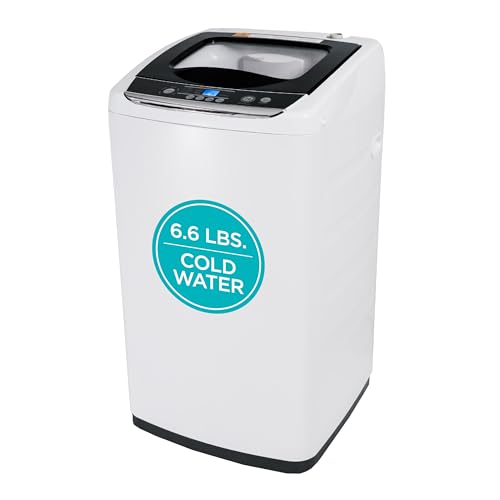
BLACK+DECKER 0.9 cu ft Portable Washer BPWM09W — Best Sink-Adapter Simplicity
BLACK+DECKER’s BPWM09W matches the COMFEE’ almost dimension for talking point — 0.9 cu ft, portable cabinet, small-home brief — but its listing leads with plumbing practicality: a quick-connect sink adapter and drain hose are included, so the machine arrives ready for the faucet-fed arrangement most portable washers end up using. Rated capacity is 6.6 lb, which in nursery terms is a respectable pile of baby clothes or a couple of days of lighter family washing.
Five wash cycles cover the rotation a baby generates, from everyday cottons to gentler loads for the clothes you would rather not batter. The value of a familiar appliance name here is not magic cleaning power; it is documentation, replacement hoses and a control layout that a sleep-deprived grandparent can operate without a tutorial when they come to help for the weekend.
Choosing between this and the COMFEE’ comes down to details you can verify on the listings: display style, how each machine moves, and which control panel your household prefers. Neither will wash a duvet. Both will quietly remove the specific misery of hand-washing baby clothes in a bathroom sink or running a giant family drum for six vests — and for many households that narrow victory is worth the cupboard space on its own.
There is a quiet confidence in choosing the appliance from a name your family has already owned in another category. Support pages exist, the manual reads clearly, and a replacement adapter in three years is a realistic hope rather than a gamble. For a machine bought in the fog of late pregnancy, that administrative calm is a genuine feature, even if it never appears on a specification sheet.
- Listed capacity: 6.6 lb in a 0.9 cu ft cabinet
- Cycles: 5 wash cycles
- In the box: quick connect sink adapter and drain hose
- Model: BPWM09W, white finish
- Intended homes per listing: homes and apartments
Strengths
- Sink adapter included, so setup needs no extra parts hunt.
- Recognisable brand support and documentation for a first portable.
- Compact footprint suits bathroom or kitchen-corner placement.
Trade-offs
- 6.6 lb ceiling fills quickly once adult clothes join in.
- No rollers headline the listing, so moving it is a lift.
- White cabinet shows nursery-room scuffs and marks readily.
Best for: renters and first-time portable buyers who want an included sink adapter and a familiar name on the door.
Not suited for: households planning to wash bedding or heavy items regularly.

Winado 15.6LBS Full Automatic Portable Washer — Best Programme Choice for Baby Loads
Winado’s portable steps the baby-washer idea up a size. At 15.6 lb with a stainless steel drum, ten wash programs and a built-in drain pump, it is still compact enough for an apartment, dorm or small home, but it stops feeling like a novelty mini and starts behaving like the only washer a small household owns. Baby clothes remain an ideal load — frequent, small, benefit from prompt washing — yet there is headroom for parents’ everyday clothes on the same day.
Ten programs is the headline for parents who separate laundry by fabric: a gentle program for delicate baby knits, standard cycles for cotton sleepsuits and muslins, and quicker options for the lightly worn pile. The drain pump matters more than it sounds, because it lets the machine empty into a sink or drain that sits higher than the machine’s base, widening the rooms where it can realistically live.
Stainless steel is a sensible drum material for a machine washing at baby frequency: smooth for small garments, easy to wipe down, and resistant to the rust spots that can mark pale infant clothes. Run it with the lid open between sessions, wipe the rim, and the ordinary hygiene routine this guide recommends elsewhere will keep it fresh without any special products or rituals.
Ten programs will mostly go unused, and that is fine — the three you settle on will carry the year. What the Winado really sells is the feeling of a proper washer scaled down, not a gadget scaled up, and households graduating from hand-washing in the bath will feel the difference in their shoulders within the first week of ownership.
- Listed capacity: 15.6 lb, full automatic
- Programs: 10 wash programs
- Drum: stainless steel
- Drainage: built-in drain pump
- Format: washer and spin dryer combo for apartment, dorm, home
Strengths
- Ten programs separate delicate baby items from everyday cottons.
- Drain pump widens placement options in awkward rooms.
- Capacity also covers light adult laundry between baby loads.
Trade-offs
- Larger footprint than the 0.9 cu ft pair it sits above.
- More programs than some parents will ever actually use.
- Still a portable: bulky bedding remains out of scope.
Best for: small households wanting one automatic portable that handles baby laundry plus their own lighter washing.
Not suited for: buyers whose priority is the smallest possible stored size.

INTERGREAT Portable Washing Machine 25lbs — Best Manual Twin-Tub Capacity
The INTERGREAT is the manual labourer of this group: a twin tub with a combined 25 lb rating, timer knobs, a wash tub on one side and a spinner on the other. Nothing about it is automatic. You fill it, time the wash, move the load to the spinner yourself, and drain it when you are done. For a parent already short on free hands, that sounds like a disqualification — yet households with more laundry than baby clothes keep choosing twin tubs, and the reasons are visible in the numbers.
A separate spinner extracts a great deal of water, so baby clothes and household smalls come out ready to dry quickly on a rack rather than dripping for a day. The wash side takes loads the mini machines would refuse, which suits a dorm, RV or apartment household washing its own clothes alongside the baby’s. Timer knobs are crude but honest controls: nothing to programme, nothing to update, very little to go wrong electronically.
Just go in with open eyes. Every load asks for your presence at least twice, the machine wants a spot where filling and draining are easy, and delicate baby knits deserve the gentlest timing you can give them rather than a full-power churn. Households that accept that rhythm get the most wash capacity in this guide; households that know they will not, should buy one of the automatics above and never look back.
Budget the chore honestly before choosing the twin tub: filling, timing, transferring, spinning and draining add up to several short visits per load. Some households fold that time into kitchen work and barely notice it. Others will abandon the routine within a month and wish they had bought automation. The machine is not the variable in that story — the household’s available minutes are.
- Listed capacity: 25 lb combined twin tub
- Layout: separate wash tub and spinner
- Controls: timer knobs, semi-manual operation
- Homes named in listing: apartments, dorm, RV, camping
- Finish: grey compact laundry cabinet
Strengths
- Largest capacity here for mixed baby and household loads.
- Separate spinner leaves clothes notably drier for rack drying.
- Simple knob controls with minimal electronics to fail.
Trade-offs
- Requires hands-on transfers between wash and spin tubs.
- Filling and draining are manual chores at every session.
- Bulkiest routine of the six despite the portable label.
Best for: dorm, RV and apartment households washing their own clothes as well as the baby’s, who accept a manual routine.
Not suited for: parents who need laundry to run unattended while they care for the baby.

ROVSUN 17.8LBS Portable Washing Machine — Best Water-Level Control
ROVSUN’s 17.8 lb fully automatic portable, listed at 1.5 cu ft, closes the group with the control freak’s favourite feature: five water levels alongside eight wash modes. Water level sounds like a specification-sheet detail until you wash baby clothes daily, at which point it becomes the difference between a drum filled for a king-size sheet washing six muslins, and a small, quick, economical fill matched to the tiny load actually in front of you.
The stainless steel drum, drain pump and included quick-connect sink adapter repeat the practical pattern of the Winado, while the mode count gives enough variety for the weekly rotation: delicates, everyday baby cotton, parents’ gym kit, a quick freshen. Fully automatic running keeps the whole cycle hands-off once the lid closes, which remains the single most valuable trait in any machine bought during the baby years.
Against the Winado, the ROVSUN trades two programs for those five water levels and a little more capacity. Neither trade is wrong; they suit different temperaments. If your loads vary wildly in size — and with a baby, a visiting toddler and two adults, they will — matching water to load several times a week is the quieter, thriftier habit, and it is the habit this machine is built around.
Water-level control also protects the clothes themselves. Small loads sloshing in an overfilled drum tangle and stretch; the same load in water matched to its size moves gently and rinses clean. Parents washing the same beloved sleepsuit two hundred times in a year will see that difference in the garment’s condition long before they notice it on a utility bill.
- Listed capacity: 17.8 lb / 1.5 cu ft, fully automatic
- Modes: 8 wash modes
- Water control: 5 water levels
- Drum and drainage: stainless steel drum, drain pump
- Included: quick connect sink adapter
Strengths
- Five water levels match tiny baby loads without waste.
- Fully automatic cycle with pump drainage for flexible rooms.
- Capacity bridges baby laundry and general portable duty.
Trade-offs
- Bigger cabinet than the smallest models for tight bathrooms.
- Eight modes still demand small-load detergent discipline.
- Too small for family bedding despite the larger rating.
Best for: households whose load sizes swing from six muslins to a full day of family smalls, and who value water-level control.
Not suited for: shoppers wanting the absolute smallest machine for storage.
How Do the Six Compare at a Glance?
| Pick | Badge | Key specification | Watch out for |
|---|---|---|---|
| JUJOJB Folding Mini | Best Truly Fold-Away Option | 20 litres, folding | Folds for storage; needs gentle handling and tiny loads only. |
| COMFEE’ 0.9 cu ft | Best Set-and-Forget Compact | 0.9 cu ft, 5 cycles, rollers | Roll-to-sink routine; drum still limited to small loads. |
| BLACK+DECKER BPWM09W | Best Sink-Adapter Simplicity | 0.9 cu ft, 6.6 lb, adapter included | No headline rollers; capacity fills fast with adult clothes. |
| Winado 15.6 lb | Best Programme Choice for Baby Loads | 15.6 lb, 10 programs, drain pump | Larger footprint than the smallest portables. |
| INTERGREAT 25 lb Twin Tub | Best Manual Twin-Tub Capacity | 25 lb combined, manual twin tub | Hands-on transfers; not a set-and-forget machine. |
| ROVSUN 17.8 lb | Best Water-Level Control | 17.8 lb, 8 modes, 5 water levels | Bigger cabinet; bedding still out of scope. |
Why Do Parents Wash Baby Clothes Separately at All?
Partly it is volume arithmetic. Baby clothes are small but relentless, and a separate little machine lets a household wash a day’s worth tonight instead of choosing between a wasteful half-empty family load and a growing pile beside the cot. Partly it is detergent control: many families use a milder detergent, or simply less of it, for the clothes that sit against newborn skin for twelve hours at a stretch, and a separate machine makes that separation effortless rather than a sorting project.
There is also a timing argument that parents recognise instantly. The garment a baby needs again soonest — the one sleep sack that settles them, the comforter, the last clean vest — is always the one at the bottom of a shared laundry basket. A dedicated small washer turns that item around in an evening. None of this requires medical claims or alarm; it is household logistics, and it is the honest reason this product category exists at all.
What Size of Mini Washer Actually Fits a Baby’s Laundry?
Think in days, not in kilograms. A newborn’s daily output is typically a handful of vests, sleepsuits, bibs and cloths — a bundle one adult can carry in two hands. A 20-litre folding washer or a compact 0.9 cu ft machine swallows that bundle comfortably, which is why the smallest machines here are not toys; they are correctly sized for the stated job. Trouble starts when buyers quietly expect the same machine to absorb adult jeans, towels and bedding, duties its listing never promised.
If your household plan is baby-only loads, the compact end is enough and its smallness becomes a storage blessing. If the machine must double as the home’s only washer — common in studios, dorms and RVs — step up to the Winado, INTERGREAT or ROVSUN sizes and accept the larger cabinet. The most common disappointment in this category is not weak washing; it is a buyer discovering on day three that their definition of the job was bigger than the drum they ordered.
How Should You Set Up a Portable Washer in a Rental or Small Flat?
Start at the sink. Most of these machines fill from a faucet using a quick-connect adapter and drain through a hose hooked over a sink or into a bathtub, so measure that arrangement before ordering: tap shape, distance from the machine’s parking spot, and whether the drain hose can rest securely where it cannot slip out mid-cycle and redecorate the floor. Machines with drain pumps, like the Winado and ROVSUN, forgive higher drain points; gravity-drain models need the hose run downhill.
Protect the floor and the neighbours. A level surface stops a portable from walking during the spin, a simple mat underneath deadens vibration on hard floors, and running the spin cycle at sociable hours keeps thin-walled flats friendly. Rollers and compact cabinets exist precisely because the machine may live in a hallway and work in a bathroom. Build that little routine — roll, connect, wash, drain, roll back — and a portable stops feeling like an improvisation and becomes simply how laundry happens.
How Do You Keep a Small Washer Clean Enough for Infant Laundry?
With ordinary habits, honestly applied. The most important one is also the simplest: take washed clothes out promptly, because damp laundry left sitting in a sealed drum is what makes any washer — at any price — smell stale. Wipe the lid seal and the rim where residue collects, leave the lid or door open between wash days so the interior can dry, and clear the lint filter if your model has one, since baby clothes shed fibres generously.
Every few weeks, run the machine empty on its hottest, longest setting with your usual detergent or a washer-cleaning product used exactly as its own label directs. That is the whole regime. Listings in this category occasionally dress basic cleaning cycles in grand language, and parents are sometimes sold special products on the back of anxiety; resist both. A promptly emptied, regularly aired, occasionally hot-washed drum is clean laundry practice for any household, babies emphatically included, and no pick in this guide needs anything more exotic than that.
Which Detergent and Cycle Habits Suit Newborn Clothes?
Measure for the load you actually have. The persistent error with mini washers is pouring a full-size dose into a fifth-size drum, which leaves detergent residue in small garments and foam where foam should not be. Use a small measured dose of your household detergent, or a mild formula if your family prefers one for the baby’s things, and let the rinse do its work. If clothes feel stiff or soapy when dry, the dose — not the machine — is the first suspect.
Cycle choice follows fabric, not fear. Everyday cotton sleepsuits and muslins thrive on a standard cycle; knitted cardigans, delicate lace-trimmed gifts and anything with loose fastenings belong on the gentlest program your machine offers, ideally inside a mesh bag so tiny socks stop migrating into seals and filters. Fasten poppers and turn printed garments inside out. These small courtesies, repeated daily, are what keep a baby wardrobe soft and intact far more than any premium machine feature.
When Does a Twin Tub Make More Sense Than an Automatic Portable?
When the laundry is bigger than the baby. A twin tub like the INTERGREAT asks for your time and repays it with capacity, a genuinely effective separate spinner and controls a child could understand. Households in dorms, RVs or rentals who wash their own clothes in the same machine often prefer that bargain, especially where water use is watched and a wash load’s water can be judged by eye rather than by an automatic sensor’s opinion.
The automatic portables win the opposite argument: the load that must wash itself while dinner cooks, a feed happens or a parent grabs twenty minutes of sleep. That is why this guide contains both shapes without crowning one universally. Read your own evenings honestly. If someone is reliably free to move laundry between tubs, the twin tub’s capacity is real value. If nobody is reliably free for anything, automation is not a luxury — it is the entire product.
How Much Water and Energy Does a Small-Load Habit Save?
The saving is structural rather than magical. A small drum filled appropriately uses a fraction of the water and heating energy of a family machine run for the same six garments, and machines with selectable water levels, like the ROVSUN, let you press that advantage load by load. Multiplied by the near-daily washing rhythm of a baby’s first year, the arithmetic becomes meaningful for both utility bills and households on metered or tank-limited water, such as RVs and some rentals.
The saving evaporates, however, if the small machine’s existence doubles total laundry — baby loads in the mini, then the same items rewashed in the big machine out of habit — or if every load is run on the longest, hottest program regardless of need. Match program to soil, fill the little drum properly rather than running it for a single bib, and the small-load habit pays. Treat it as a second machine doing duplicate work and it will cost, not save.
What Should You Check Before Ordering Any Portable Washer?
Four checks prevent nearly every return in this category. First, the doorway and the parking spot: measure both, including the turn the machine must make, because portable describes the plumbing, not the weight. Second, the tap: confirm your faucet can accept a quick-connect adapter, or budget for the fitting that makes it so. Third, drainage: know exactly where the water will go at full flow, and whether your model drains by pump or by gravity.
Fourth, read the capacity in the unit your household thinks in, and translate it into actual garments before buying — a pile of your own baby clothes on the bed is a better measuring tool than any number. Do those four things and the machine that arrives will fit the room, fit the sink and fit the job. Skip them, and even the best pick in this guide becomes an obstacle with a power cord.
Will a Portable Washer Disturb a Sleeping Baby Nearby?
In small homes the washer often works within a few metres of the cot, so noise deserves a thought before purchase rather than after. The wash phase of any machine here is gentle background sound; the spin is the loud moment, and its character depends less on the model than on the floor beneath it and the balance of the load inside. A machine standing level on a mat, loaded evenly, spins with a hum. The same machine rocking on an uneven board with all the wet clothes on one side will thump like it is trying to leave.
Practical households adapt quickly: run the wash while the baby is awake and fed, pause life there, or simply close the nursery door for the ten loudest minutes. Twin tubs give you manual control of exactly when the spinner runs, which some parents prefer. None of these machines is industrial, and none should share a wall cavity with a light sleeper if another corner exists — but with level placement and a balanced load, laundry noise rarely becomes the problem buyers feared it would be.
What Changes When You Are Washing for Twins or Multiples?
Twins do not double the baby laundry problem so much as square its urgency: two of everything, soiled in rotation, with no slack day in the system. At that point the smallest folding machines become a supplement rather than the main tool, useful for the emergency turnaround of specific items, while the larger automatics and the twin tub earn their cabinet space by processing load after load without complaint.
Routine matters more than machinery at this scale. A wash every day at a fixed point — after the morning feed, during the evening bath — stops the pile from ever becoming a mountain, and a second mesh bag for the truly grim items keeps sorting instant. Families of multiples who thrive with small washers treat them as a rhythm, not an event, and choose the machine whose cycle they can start one-handed at the same time every day.
How Do You Dry All These Tiny Clothes Once They Are Washed?
A baby washer produces small, frequent, dripping output, so the drying arrangement deserves as much thought as the machine. The spin stage — strongest in the twin tub’s separate spinner, gentlest in the folding mini — decides how long garments occupy the airer. Clothes spun well dry overnight on a folding rack in a warm room; clothes merely drained can take a full day in a cool flat, which is why spinner strength quietly matters in this category.
Small garments dry best given small-garment treatment: socks and bibs clipped to a multi-peg hanger, sleepsuits over two rails rather than folded over one so air reaches both layers, knits laid flatter to keep their shape. In winter, placing the rack where household air already moves — near, not on, a heat source — keeps the rotation flowing. The goal is a wardrobe that cycles daily, and a drying corner set up once, properly, is what makes that cycle effortless.
Does a Mini Washer Make Sense for Travel, Grandparents and Second Homes?
For the folding JUJOJB, travel is written into its listing, and the logic holds: a machine that folds into a cupboard at home also rides in a car boot to a holiday rental, a caravan or a grandparent’s house, turning a week away from a laundry negotiation into a nightly ten-minute routine. Babies generate laundry at the same rate on holiday as at home, a fact every parent learns exactly once, usually beside a suitcase of clean clothes that lasted two days.
At grandparents’ houses a small portable solves a diplomatic problem too: the visiting baby’s washing gets done without commandeering the hosts’ machine, detergent and schedule. The rigid portables are less portable in practice despite the name — they travel between homes when a baby moves in for a season, not for a weekend — so match the machine to the journey honestly, and let the folding design do the job it was shaped for.
Should You Buy a Second-Hand Portable Washer for the Nursery?
Second-hand portables are tempting because babies use them intensely and briefly, so the used market is full of nearly new machines. The savings can be real, but inspect like a sceptic: run a full cycle before money changes hands if you possibly can, check the drum and seals for the stale smell that betrays a machine stored damp and shut, and confirm every hose, adapter and filter that the listing originally included is present, because missing fittings are where the bargain quietly evaporates.
A used machine also deserves a proper fresh start in your home: an empty hot wash, a wiped seal, a cleaned filter, and its first loads given to household items rather than the newborn’s first week of clothes, simply as ordinary prudence. Buy the machine whose previous owner can describe its storage and habits, and walk away from one that smells wrong no matter how new it looks — your nose is reporting the previous household’s laundry discipline, and it rarely lies.
How Do You Store a Baby Washer Between Children?
Many of these machines will be packed away after the first baby and resurrected for a sibling, and storage done well is the difference between a helpful hand-me-down and a musty disappointment. Before storing, run an empty hot cycle, drain every hose completely, clean the filter, wipe the drum and seals dry, and leave the lid open for a full day so the interior is genuinely dry rather than merely dry-looking.
Store it open or ajar if the space allows, with hoses loosely coiled rather than kinked, and the folding JUJOJB folded only once it is bone dry inside. When the machine comes back out, one more empty hot wash returns it to service. Ten minutes of care at each end of storage protects the whole investment — and with small portables, that simple routine is most of what ownership ever asks of you.
How Long Will a Baby Washer Stay Useful After the Baby Stage?
The honest answer is longer than the name suggests. A small portable that starts life washing sleepsuits graduates naturally to delicates, swimwear, gym kit, pet blankets and the overflow loads of a household whose main machine is busy or broken. In dorms and RVs it simply becomes the washer, full stop, and the baby chapter reads in hindsight like a demanding first assignment it passed.
That second life is worth remembering at purchase time. A machine chosen only for the cheapest possible price may not survive to enjoy it, while the sturdier automatics here can serve a family for years in changing roles. Buy for the baby year, certainly — but let the machine’s build and support suggest it will still be earning its corner when the baby is at school and the laundry is football kit instead.
What Does a Sensible First Week With a New Baby Washer Look Like?
Day one belongs to plumbing, not laundry: connect the adapter, run an empty cycle, watch every joint through a full fill and drain, and only then trust the machine with clothes. Day two can take a load of household items — tea towels, your own t-shirts — while you learn the controls and the sounds a healthy cycle makes, so that any odd noise later is recognisable as new rather than merely unfamiliar.
By the end of the first week, settle the permanent routine: where the machine parks, where the hose lives, which detergent dose your drum actually needs, and which program handles the everyday sleepsuit load. Write nothing down if you remember it, but make the decisions once. A baby washer earns its keep as a system, and systems are built in the first week or improvised forever.
How Do You Judge Wash Quality in a Machine This Small?
By the clothes, over a fortnight, not by the drama of the cycle. Small drums wash with gentler motion than family machines, which suits small garments; the test is whether everyday soil — milk, food, the general tide of babyhood — comes out clean on a standard program with a sensible dose, and whether whites stay bright without heroic measures. Judge after ten loads, not one, because water, dose and sorting all settle during the first week.
Rinsing deserves equal billing with washing. Clothes that emerge clean but stiff were rinsed in their own detergent, and the fix is dose and program choice rather than a different machine. When a small washer is loaded sensibly, dosed modestly and given a full cycle, its results on baby-sized laundry are genuinely hard to distinguish from a family machine’s — which is, in the end, the entire case for owning one.
What Mistakes Do Baby-Washer Buyers Keep Making?
Expecting a brand-name baby-only machine is the first. Parents search for a dedicated infant line from the big laundry names, find none, and then either give up or buy a general portable while feeling it is a compromise. It is not a compromise; the portable is the category. Judged as small machines for small loads, the picks here are exactly the right tools.
Overloading is the second, and it is cruel to small drums. A mini washer crammed past its stated capacity washes badly, rinses worse and strains its motor and suspension doing it. Baby clothes tempt overloading because each item is tiny, but twenty sleepsuits still displace water the load needs to move. Wash a sensible bundle, then wash another.
Third comes detergent overdose, covered above but worth repeating in the mistakes list because it causes more complaints than any mechanical fault: stiff, irritating-feeling garments blamed on a machine that was simply given five times the soap its drum could rinse away. Small drum, small dose, thorough rinse — that order fixes most of it.
Finally, buyers neglect the boring placement details: an unlevel floor that makes the spin cycle wander, a drain hose resting where it can slip free, a machine stored damp with its lid shut for a month between babies. Ten minutes of setup care and the open-lid habit prevent nearly all of it, and cost nothing at all.
Final Recommendation
Match the machine to the household’s real shape. If floor space is the scarcest thing you own, the folding JUJOJB or one of the compact automatics will quietly transform the baby-laundry week without annexing a corner forever. If the washer must serve adults too, the Winado and ROVSUN automatics and the manual INTERGREAT twin tub step up honestly, each with its compromise stated in daylight.
Whichever you choose, keep the expectations this guide opened with: these are small portable machines doing a small, frequent, genuinely valuable job. None of them replaces a family washer, and none of them needs to. The right one simply makes the pile of tiny clothes stop being a daily problem.
For most nurseries we would start with the COMFEE’ portable washer for set-and-forget ease, keep the JUJOJB folding mini washer in mind where storage is desperate, and step up to the ROVSUN 17.8 lb portable when adult laundry joins the rotation.
Buy the smallest machine that honestly fits your laundry, and the baby clothes will take care of themselves one little load at a time.
Frequently Asked Questions
Are there washing machines made specifically for baby clothes?
Not as a dedicated product line from the major laundry brands. What parents actually buy — and what this guide rounds up — are mini and portable washers whose small drums suit frequent small loads of infant clothing. Judge them as small machines, not as a separate medical or specialist category.
Can a portable washer handle cloth nappies?
Yes, within its stated capacity, and the small drum suits the frequent washing rhythm cloth nappies demand. Rinse or soak according to your nappy system’s own guidance, wash on a thorough cycle, and avoid overloading, since nappies are bulky once wet. Check your nappy maker’s washing instructions first, as they take priority.
How do I stop a small washer smelling stale?
Empty it promptly, wipe the seal and rim, leave the lid open between washes so the drum dries, clean any lint filter, and run an empty hot wash every few weeks. That ordinary routine prevents the stale smell far more reliably than any special product.
Is a twin tub or a fully automatic portable better with a newborn?
For most newborn households, the automatic, because it washes unattended while your hands are occupied. A twin tub suits households washing larger mixed loads who have someone free to move laundry between the wash and spin tubs.
What detergent should I use for baby clothes in a mini washer?
A small, measured dose of your usual detergent, or a mild formula if your family prefers one, with a thorough rinse. The commonest problem is overdosing a tiny drum, which leaves residue in the clothes; if garments feel stiff when dry, reduce the dose before changing products.
Where can a portable baby washer drain in a flat?
Usually into a sink or bathtub via its drain hose, with pump models like the Winado and ROVSUN able to push water up to a higher drain point. Secure the hose so it cannot slip out mid-cycle, and confirm the arrangement before the first wash rather than during it.
Related Guides
Once the laundry corner is sorted, the rest of the nursery and the household sewing pile deserve the same practical treatment, and these companion guides cover the neighbouring decisions: Best Baby Sound Machines Best Basic Sewing Machines Best Automatic Threading Sewing Machines



[…] Embroidery projects lead onward to heavy-duty sewing, affordable coffee for long stitching sessions and gentle washing for finished work: Best Affordable Heavy Duty Sewing Machines Best Affordable Coffee Machines Best Baby Washing Machines […]
[…] in these guides, from the tiniest laundry of all to the other machines a flat must find room for: Best Baby Washing Machines Best Affordable Sewing Machines Best Affordable Heavy Duty Sewing […]