What's inside
- Key Takeaways
- Quick Picks
- How Did We Choose These Picks for the Best Captain’s Chairs for Vans?
- Comparison Table
- What Actually Changes When a Van Seat Swivels?
- How Do You Measure Your Van Before Ordering a Base?
- How Do You Install a Swivel Base Safely?
- What Mistakes Do Van Owners Make with Swivel Bases?
- Which Vans Take to Swivelling Most Naturally?
- What Happens to Seatbelts and Airbags When You Add a Base?
- How Do You Live with a Swivel Seat Day to Day?
- What Should a Swivel Base Cost You in Total?
- One Swivel or Two? Planning the Cab as a Pair
- How Do You Read a Swivel Base Listing Like an Engineer?
- Can You Remove a Swivel Base and Return the Van to Stock?
- Final Recommendation
- Frequently Asked Questions
- Related Guides
As an Amazon Associate I earn from qualifying purchases. This post may contain affiliate links at no extra cost to you.
cottageverdict.com is reader-supported. When you buy through links on our site, we may earn an affiliate commission.
Where to buy: every linked pick below leads to its Amazon listing, where you can check price on Amazon and confirm the bolt pattern, model-year fitment and rotation direction before ordering. One pick near the end is discussed in prose only, because a complete replacement captain’s chair is a freight purchase that deserves a specialist conversation rather than a one-click decision.
Here is the honest starting point for anyone shopping for the best captain’s chairs for vans: on Amazon, this search mostly returns swivel bases, not complete chairs. That is not a bait-and-switch so much as a reflection of how van conversions actually work. Most owners keep the factory seat — the one already crash-tested, already wired for its airbag and seatbelt sensors, already matched to the cab — and add a rotating base underneath it so the seat can turn around and face the living space when parked. The swivel base is the part that transforms a driving cab into part of the camper, and it is the part this guide reviews in depth.
Once you accept that framing, the buying questions become refreshingly concrete. Does the base fit your exact van and model years? Does it swivel the passenger seat, the driver seat, or either? How much height does it add, because an extra inch or two under the seat changes your relationship with the pedals, the steering wheel and the headliner all at once? Does it lock positively in the forward position, and how many locking points does it offer around the circle? And is the steel thick enough, and the weld honest enough, that you trust it on a motorway rather than just in a campsite photograph?
We have also been careful about a distinction some listings blur. A swivel base sold for a specific van, with a model-specific top plate and bolt pattern, is a different purchase from a universal plate that expects you to drill, shim and improvise. Both appear below, labelled plainly. The universal plates have a genuine role in older conversions, boat seating crossovers and custom builds, but they ask more of the installer, and this guide says so wherever it matters.
Key Takeaways
- Most products in this category are swivel bases that rotate your existing seat, not complete replacement chairs.
- Model-specific fitment beats universal plates for modern vans, because airbag wiring, seatbelt buckles and bolt patterns are all vehicle-specific.
- Every base adds seat height; measure your current driving position before choosing, not after.
- The HWHongRV universal plate suits older and custom builds, while the Ford-specific bases below remove the guesswork for Transit and Econoline owners.
- A slider-equipped base solves the classic problem of the seat catching the door pillar or centre console mid-rotation.
- Forward-facing lock quality matters more than the number of intermediate locking positions.
Quick Picks
| Pick | Badge | Why it earns its place |
|---|---|---|
| HWHongRV Heavy Duty Seat Swivel Base | Best Universal Plate | A thick steel 360-degree plate for conversions where no model-specific base exists. |
| CCNLHZM Swivel Seat Base Ford Transit | Best for Transit Passenger Side | Purpose-built for 2014–2021 Transit vans, so the bolt pattern question is already answered. |
| Passenger Seat Swivel Base Ford Econoline | Best for Econoline Owners | Covers an unusually wide run of E-Series years, which suits the vans still working as campers. |
| HECASA Swivel Seat Base Transit | Best Transit Custom Option | Passenger-side base spanning Transit and Transit Custom production from 2013 onward. |
| Seat Swivel Base with Slider for RV Van | Best with Sliding Travel | Fore-aft slide plus four locking positions, aimed at Sprinter, Transit and Promaster conversions. |
| A Complete Aftermarket Captain’s Chair, Discussed Generically | Prose-Only Alternative | For builds replacing the seat itself; a premium-tier freight purchase to arrange with a specialist supplier. |
How Did We Choose These Picks for the Best Captain’s Chairs for Vans?
We started by separating true van swivel bases from the wider sea of boat pedestals, gaming-chair discs and generic turntable hardware that floods this search term. A boat pedestal is built for a helm seat that never carries a seatbelt load in a collision; a van base sits underneath an occupant in a moving vehicle, and it should be judged by a sterner standard. Listings that could not state their vehicle fitment, steel construction or locking behaviour clearly were set aside, however polished their photographs looked.
Fitment honesty came next. The strongest listings name the van, the side of the vehicle and the model years in plain language, because those three facts decide whether an installation is an afternoon of bolting or a weekend of fabrication. We favoured bases whose stated capacity and plate thickness suggested they were engineered for the weight of a modern seat — which includes not just foam and frame but motors, airbags and belt hardware on many current vans.
Finally, we weighted the lived experience of the swivel itself: how the release lever is reached from the seated position, whether rotation is a smooth swing or a graunching scrape, and whether the base rattles once locked. A swivel that annoys you will stay facing forward forever, which defeats the entire purchase. The five linked bases below each answer a recognisable van-life scenario; the prose-only sixth pick covers the different road of replacing the seat outright.

HWHongRV Heavy Duty Seat Swivel Base — Best Universal Plate
The HWHongRV base is the generalist of this group: a heavy steel swivel plate, built from 3.0mm steel plate per its listing, that rotates a full 360 degrees and is marketed across RV, van, camper, boat, truck and bus seating. That breadth is both its appeal and its warning label. If you run an older van, a Japanese import, a one-off coachbuild or a seat transplant from another vehicle entirely, a model-specific base may simply not exist for your combination, and a stout universal plate like this one becomes the realistic route.
What you are really buying here is a strong rotating joint and a pair of flat mounting faces. The top face must meet your seat rails and the bottom face your floor or pedestal, and on many installations that means drilling the plate to match, adding spacers, or fabricating an intermediate adaptor. None of that is exotic work for a conversion shop, but it does mean this pick rewards mechanical confidence. Measure the rail spacing on your seat twice before ordering; universal refers to the concept, not to a promise that every hole will line up untouched.
It is also the pick most likely to serve double duty outside the van world, which tells you something about its design priorities. The same plate appears under workshop stools, in small fishing boats and beneath truck seats in farm vehicles, anywhere a heavy seat needs to turn on a budget. That versatility keeps its price class honest and its spare parts concept simple — there is nothing proprietary to wear out — but it also explains the absence of van-specific refinements like offset rotation or tailored locking positions. You are trading the last ten percent of integration for the first ninety percent of function, and for the right build that is a perfectly rational trade.
In use, a plate of this type lives or dies on bearing smoothness and lock behaviour. Expect to grease the race during installation and to check the central hardware for play after the first few hundred miles, because universal plates settle. The payoff for that diligence is freedom: full rotation lets a driver seat swing right around to a rear table in a way that some offset, vehicle-specific bases restrict. For a bespoke build where the layout is still evolving on graph paper, that freedom can be worth more than a perfect bolt pattern.
- Mounting: universal flat plate, drilling or adaptors commonly required
- Rotation: full 360 degrees
- Construction: steel plate, stated 3.0mm thickness
- Fitment: RV, van, camper, boat, truck and bus seating
Strengths
- Works where no model-specific base exists for your seat and van pairing.
- Full-circle rotation suits flexible layouts still being designed.
- Heavy steel construction inspires more confidence than thin pressed plates.
Trade-offs
- Installation is a fabrication task, not a simple bolt-in swap.
- No vehicle-specific guidance on airbag wiring or belt routing is provided.
- Added height and final driving position depend entirely on your build.
Best for: experienced converters and owners of older or unusual vans who are comfortable drilling, shimming and test-fitting. Not suited for: anyone wanting a guaranteed same-day bolt-in on a modern van with seat airbags.
Check price on Amazon.
CCNLHZM Swivel Seat Base Ford Transit — Best for Transit Passenger Side
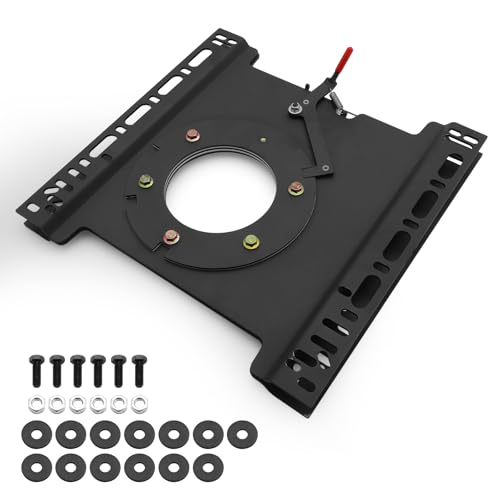
The Ford Transit is the default North American conversion platform, and this CCNLHZM base (model FTP004 in the listing) is built for the passenger side of Transit 150, 250 and 350 vans from 2014 to 2021. That specificity is the entire point. The top plate is shaped and drilled for the Transit seat, so the installation conversation shifts from fabrication to procedure: unbolt the seat, manage the wiring connectors underneath with care, set the base, re-torque everything, and confirm the swivel clears the B-pillar and door card through its arc.
Passenger side is where most Transit conversions start, and for good reason. The passenger seat carries fewer driving-position compromises, and rotating it creates the classic lounge layout — one seat facing the sliding door for morning coffee, or turned fully rearward to join a dinette. The driver seat usually stays fixed in single-swivel builds, which also keeps the handbrake and pedal geometry out of the discussion entirely. If your layout plan shows two swivels, budget for the driver side separately and read its fitment notes with extra care, because steering-wheel clearance enters the picture.
Model-year boundaries deserve respect here. The stated range ends at 2021, and Transit seat hardware has evolved across the generation, so owners of later vans should confirm against the listing’s current fitment notes rather than assuming continuity. Within its range, though, a dedicated base like this one is the calmest route onto a Transit: fewer drilled holes, fewer surprises, and a resale story you can explain to the next owner in one sentence.
- Mounting: model-specific plate for Ford Transit seat rails
- Position: right-hand passenger side
- Stated fitment: Transit 150, 250 and 350, 2014–2021
- Rotation: swivel base for parked lounge use
Strengths
- Transit-specific drilling removes the universal-plate guesswork.
- Passenger-side focus matches how most conversions are actually laid out.
- Keeps the factory seat, its airbag and its belt hardware intact.
Trade-offs
- One side only; a matching driver-side solution is a separate purchase.
- Fitment stops at 2021, so newer Transits need verification first.
- Seat height still rises by the depth of the base mechanism.
Best for: Transit camper converters who want the passenger seat to join the living space with minimal fabrication. Not suited for: Sprinter or Promaster owners, or Transit owners outside the stated years who have not confirmed fitment.
Check price on Amazon.

Passenger Seat Swivel Base Ford Econoline — Best for Econoline Owners
The Econoline finished production years ago, yet E-Series vans remain the backbone of budget camper conversions, Class B motorhomes and surf-trip rigs across North America. This base is a passenger-seat swivel listed as a replacement fit for the E150, E250, E350 and E450 from 1997 through 2024 — a span that reflects how long the platform’s seat hardware stayed in service across van and cutaway applications. For an Econoline owner, finding any new, platform-specific hardware at all is the headline.
Older vans change the installation calculus in the converter’s favour. Many E-Series seats predate in-seat airbags and complex occupancy sensors, so the wiring under the seat is simpler, and the seat itself is often a true captain’s chair already — armrests, recline, generous padding — that simply never rotated. Adding a swivel underneath wakes the whole interior up: the passenger chair turns to face the rear bench, a small table appears between them, and a van that felt like a corridor starts behaving like a room.
Age cuts the other way on hardware condition. Before fitting any base to a decades-old van, inspect the floor pan around the seat mounts for corrosion and confirm the original bolts come out without drama; penetrating oil and patience are part of this job. Also check what your seat sits on today — some Econolines use a tall factory pedestal, and stacking a swivel on top can push the seating position higher than the windshield header comfortably allows. In those cases the swivel may replace part of the pedestal stack rather than simply adding to it, a judgement call worth making with a tape measure before the parts arrive.
- Mounting: passenger-seat base for Ford E-Series seat hardware
- Stated fitment: E150, E250, E350 and E450, 1997–2024
- Position: passenger side
- Application: camper conversions and Class B interiors
Strengths
- Rare platform-specific support for a discontinued but beloved van line.
- Transforms existing armrest captain’s chairs without replacing them.
- Simpler under-seat wiring on many model years eases installation.
Trade-offs
- Floor corrosion and seized bolts are realistic hurdles on older vans.
- Factory pedestal height on some E-Series seats complicates stacking.
- Fitment across such a long span still deserves a pre-order measurement.
Best for: Econoline camper and Class B owners modernising a trusted older van. Not suited for: Transit or Sprinter owners, or anyone whose floor pan needs rust repair before hardware is added.
Check price on Amazon.

HECASA Swivel Seat Base Transit — Best Transit Custom Option
HECASA’s entry widens the Transit story in two directions at once: its stated compatibility runs from 2013 to 2023 and covers both the full-size Transit and the smaller Transit Custom. That second nameplate matters more than it might appear. Transit Custom conversions are common in markets where the compact van is the daily driver as well as the camper, and hardware for it is noticeably scarcer than for its big brother. A base that honestly spans both platforms gives Custom owners a route that does not begin with a fabricator’s hourly rate.
Like the CCNLHZM above, this is a right-side passenger base, and the same installation virtues apply: the factory seat stays, the belt and airbag systems stay as the manufacturer arranged them, and the work is unbolting, positioning and re-torquing rather than cutting. Where the two Transit bases differ is chiefly the breadth of their claimed range, so the practical advice is to shop by your exact van and year, then compare the two listings’ current fitment notes side by side before choosing. Fitment tables get revised; your van’s build date does not.
One Transit-specific wrinkle deserves a paragraph of its own: the under-seat real estate. Many Transits house a battery, a jack, or aftermarket leisure-battery and heater installations beneath the passenger seat, and a swivel base changes how that space is accessed and how cables flex when the seat rotates. Route any wiring with enough slack for a full swing, keep connectors clear of the rotating plate’s edge, and do a slow, full rotation by hand before the first drive to listen for pinches or tugs. Ten patient minutes here prevent the category’s most common electrical gremlin.
- Mounting: passenger-side base for Transit seat hardware
- Stated fitment: Transit and Transit Custom, 2013–2023
- Position: right-hand passenger side
- Application: camper conversions on both Transit platforms
Strengths
- Transit Custom coverage serves a platform most bases ignore.
- Long stated year range suits vans bought used at various ages.
- Keeps factory seat safety systems undisturbed.
Trade-offs
- Under-seat batteries and heaters complicate cable routing on many Transits.
- Passenger side only, like most model-specific offerings.
- Wide fitment claims still require checking your exact build year.
Best for: Transit Custom converters and Transit owners whose year falls outside narrower fitment ranges. Not suited for: driver-side installations or vans with heavily customised under-seat electrical systems left unexamined.
Check price on Amazon.

Seat Swivel Base with Slider for RV Van — Best with Sliding Travel
Anyone who has watched a swivelling seat clip the door pillar halfway round understands why this base exists. By combining the rotating plate with a fore-aft slider, it lets you shift the seat away from the obstruction, swing it through its arc, then slide it into its parked position — a small choreography that turns a two-handed wrestle into a one-handed routine. The listing states a capacity of 130kg (286lbs), four locking positions, 3mm cold-rolled steel construction and fitment aimed at Sprinter, Ford Transit, Promaster and commercial vehicles.
Four locking positions is a specification worth interpreting honestly. You do not need a lock every fifteen degrees; you need an unshakeable lock facing forward for driving, and useful locks at the angles your layout actually uses — typically fully rearward for a dinette, and perhaps sideways toward the sliding door. Four well-placed detents cover those real positions for most layouts, and the slider adds the fine adjustment that fixed bases leave to luck. Judge this base on whether its detents match your floor plan, not on an abstract count.
There is a comfort dividend hiding in the slider as well. Because the seat can travel fore and aft on its rails independently of the van’s own seat adjustment, two drivers of different heights can each find a workable position more easily, and the parked seat can be pushed closer to a dinette table than a fixed base allows. In daily-driver conversions that swap between school run and campsite, that small flexibility gets used constantly, long after the novelty of the rotation itself has faded into routine.
The multi-platform fitment claim cuts both ways. Covering three major van families suggests a more universal mounting philosophy than the dedicated Ford bases above, so expect to verify hole patterns against your seat rails and to spend longer on first fitment. In exchange, this is the only pick here that speaks directly to Promaster owners, whose swivel options are thinner on the ground, and the only one that treats the rotation-clearance problem as a headline feature rather than an installation-day discovery.
- Mounting: swivel plate with integrated fore-aft slider
- Stated capacity: 130kg / 286lbs per listing
- Locking: four positions around the rotation
- Stated fitment: Sprinter, Transit, Promaster and commercial vehicles
Strengths
- Slider travel solves pillar and console clearance elegantly.
- Promaster coverage fills a genuine gap in the market.
- Stated capacity and steel specification are published plainly.
Trade-offs
- Multi-platform design means more measuring before it bolts down.
- Slider mechanism adds a second set of rails to keep clean and grit-free.
- Stacked height of slider plus swivel is the tallest arrangement here.
Best for: converters whose seat arc is blocked by pillars or consoles, and Promaster owners short on alternatives. Not suited for: minimalists who want the lowest possible seat height and have clear rotation space already.
Check price on Amazon.
A Complete Aftermarket Captain’s Chair, Discussed Generically — Prose-Only Alternative
There remains one legitimate reason to bypass swivel bases entirely: the factory seat itself is the problem. In older vans the foam may be collapsed, the upholstery split, the armrests gone, or the seat may be a plain commercial bench-style unit that no base can civilise. In that situation the purchase becomes a complete aftermarket captain’s chair — a full seat with its own frame, recline mechanism, armrests and often an integrated swivel — and it sits in the premium tier of van spending, typically arriving by freight rather than in a courier’s van.
We discuss it in prose because the decision hinges on variables a listing cannot settle for you: whether the new seat’s belt arrangement matches your van’s certification, whether its mounting footprint suits your floor, and whether its extra width clears your cab. Treat it as a consultation purchase with a conversion specialist, and keep the swivel-base route as the default unless the seat itself has truly earned replacement.
- Form: complete replacement seat, often with integrated swivel
- Tier: premium, usually freight-delivered
- Key checks: belt arrangement, floor footprint, cab width
- Sourcing: conversion specialists rather than one-click checkout
Strengths
- Replaces worn foam, tired upholstery and missing armrests in one step.
- Integrated design avoids stacking separate base and seat hardware.
- Fresh seating comfort transforms long driving days, not just parked evenings.
Trade-offs
- By far the most expensive route in this guide.
- Certification and belt compatibility need professional confirmation.
- Freight delivery and two-person handling complicate the logistics.
Best for: full restorations where the original seats are beyond saving. Not suited for: owners whose factory seats are sound and who simply want them to rotate.
Comparison Table
| Pick | Type | Stated fitment | Defining feature |
|---|---|---|---|
| HWHongRV Heavy Duty Seat Swivel Base | Universal plate | RV, van, truck, boat seating | Full 360-degree rotation, fabrication-friendly |
| CCNLHZM Swivel Seat Base Ford Transit | Model-specific base | Transit 150/250/350, 2014–2021 | Passenger-side bolt pattern resolved |
| Passenger Seat Swivel Base Ford Econoline | Model-specific base | E-Series, 1997–2024 | Support for a discontinued platform |
| HECASA Swivel Seat Base Transit | Model-specific base | Transit and Transit Custom, 2013–2023 | Compact Transit Custom coverage |
| Seat Swivel Base with Slider for RV Van | Swivel with slider | Sprinter, Transit, Promaster | Slide-then-swing clearance solution |
| Complete Aftermarket Captain’s Chair (prose-only) | Replacement seat | Varies by supplier | New seat and swivel in one unit |
What Actually Changes When a Van Seat Swivels?
Layout is the obvious answer, but the subtler change is social. A fixed cab seats two people shoulder to shoulder, both facing the windscreen, in a space that belongs to driving. Rotate the passenger seat and the van gains a chair that can face a companion, a table, a view through the sliding door, or a child in the back who needs attention at a rest stop. Meals move from laps to a table. Board games, laptops and maps all find a natural seat. In small vans especially, the swivel does the work of an extra room without adding a single inch to the vehicle’s footprint.
There is a workspace dimension, too, that converters increasingly plan around. A rotated passenger seat with a small folding table becomes a respectable mobile office: laptop at a sane height, feet flat, daylight through the side door instead of a windscreen glare. Remote workers who live in their vans part-time consistently rank the swivel among the upgrades that made the lifestyle sustainable, because it separates the driving place from the working place psychologically as much as physically. If that is your plan, think about power early — a socket or USB outlet reachable from the rotated position, and cable routing that survives the swing — because the seat’s new favourite angle deserves services planned around it, not an extension lead trailed hopefully across the cab.
The change has a daily rhythm to it as well. Arriving at a site, the swivel is part of the parking ritual — handbrake, engine off, seat swung round, kettle on. Leaving is the reverse, and the forward lock becomes part of the pre-drive check alongside mirrors and seatbelts. Owners consistently report that the ritual takes under a minute once the motion is practised, provided the rotation path is clear; a seat that needs bags moved and doors opened before it will turn is a seat that gradually stops being turned at all. When you plan your layout, design the swing path as carefully as the seating plan itself: keep the arc free of fixed cabinetry, tall storage and anything else the seat back would meet mid-rotation.
How Do You Measure Your Van Before Ordering a Base?
Start with the seat rails. Record the distance between the front and rear mounting bolts and between the left and right rails, then photograph the underside of the seat so wiring connectors, motors and belt anchor points are documented before anything moves. Compare those measurements with the base listing’s plate dimensions and hole pattern; where a listing is silent on a dimension you need, treat that silence as a question to resolve before ordering, not a detail to discover on the driveway.
Next, measure the swing. With the seat in its normal position, note the distance from the seat’s rear corners to the B-pillar, the door card and any console or cabinet behind it, remembering that a rotating seat sweeps a circle wider than its static footprint — the corners travel furthest. Then measure height: the vertical distance from the seat cushion to the headliner, and from your seated eye line to the top of the windscreen, because the base will lift you by its stack height and some drivers, particularly in low-roof vans, have little altitude to spare. Finally, check the floor itself — factory threaded inserts, flat mounting surfaces and the absence of underfloor tanks or heater ducts exactly where new bolts would land.
How Do You Install a Swivel Base Safely?
Disconnect the battery before touching under-seat connectors, and give airbag systems the waiting period your van’s manual specifies; seat wiring is not the place for improvisation. Unbolt the seat with the correct sockets — seat bolts are frequently thread-locked and torqued firmly — and lift the seat out with a second person, because a modern van seat is heavier and more awkward than it looks. Keep every factory bolt accounted for; where the base supplies its own hardware, confirm its grade markings match or exceed what came out.
With the base set on the floor mounts and the seat on the base, torque in stages and test the full rotation slowly by hand before reconnecting anything electrical. The seat should swing without grazing trim, wiring should flex without tension at any angle, and the forward lock should engage with a positive, audible certainty. Reconnect, restore battery power, and confirm that no airbag warning light stays lit on the dash; if one does, stop and have the system read rather than driving on hope. A short test drive over imperfect roads will reveal any rattle while it is still easy to trace.
What Mistakes Do Van Owners Make with Swivel Bases?
The classic error is ordering by van model alone, without the year, the side and the seat type — three variables that each quietly change the hardware. Close behind is ignoring stack height until the first drive, when a taller seating position meets a low headliner and a steering wheel that no longer adjusts far enough. A third mistake is treating the forward lock casually: a seat that is almost locked is not locked, and the habit of confirming the detent before every drive is worth forming from day one.
Another frequent misstep is buying the base before the layout exists. The swivel is a means to a seating arrangement, and owners who order hardware first sometimes discover that their planned dinette sits too far from the rotated seat, or that a kitchen pod has claimed the swing path, or that the bed platform leaves the turned chair facing a cupboard door. Cardboard is the converter’s best friend here: mock the rotated seat’s position with boxes and tape, sit in the arrangement for an actual meal, and only then commit to hardware. An hour of theatre in the driveway has saved more conversions than any tool in the workshop.
Electrical shortcuts cause the most expensive regrets. Stretching a wiring loom to reach through the rotation, trapping a connector under the plate, or bridging an occupancy sensor to silence a warning light all trade a small convenience for a safety system that no longer does its job. And the quietest mistake of all is layout amnesia — building a beautiful cabinet exactly where the seat’s rear corner needs to travel, discovered only when the finished interior meets its first swivel.
Which Vans Take to Swivelling Most Naturally?
Some platforms feel designed for the conversion from the start. The Transit’s flat cab floor, upright seating and generous door aperture let a passenger seat swing through a clean arc, and the sheer number of Transits in service means bases, fitting videos and forum knowledge are plentiful. The Econoline earns its place differently: its seats were generous armchair-style units long before camper conversion was fashionable, so a swivel simply unlocks a chair that was always meant to lounge. Older E-Series cabs are wide, the pillars sit far apart, and the seat usually clears its surroundings without the slide-and-shuffle newer vans sometimes demand.
Compact vans ask for more care. In a Transit Custom or any low-roof daily-driver conversion, headroom is the currency everything is paid in: the base’s stack height, the cushion’s thickness and the occupant’s height all draw from the same small account. Sliding-door layouts in smaller vans also place cabinetry closer to the seat’s swing path, so the measuring sections of this guide matter twice over. None of this makes a small van a poor candidate — a rotated seat in a compact camper is arguably more valuable, because space is scarcer — but it does mean the tape measure, not the catalogue, should lead the decision.
High-roof vans sit at the forgiving end of the spectrum. With altitude to spare, stack height fades as a concern, and the choice turns on lock quality, swing clearance and how the rotated seat relates to the living area behind it. In a long-wheelbase build, consider whether the swivelled seat will serve a dinette, a desk or simply a reading chair by the door, because that destination decides which locking positions actually earn their keep. A base whose detents land at your layout’s real angles is worth more than one offering twice the positions at angles nobody uses.
What Happens to Seatbelts and Airbags When You Add a Base?
This is the section to read twice. On most modern vans the seatbelt’s lower anchorage, the buckle stalk and sometimes the belt itself are mounted to the seat, so the belt travels with the seat when it rotates — which is exactly why the seat must be locked forward before driving, restoring the geometry the system was designed around. Seat-mounted airbags, where fitted, live in the seat back and connect through the under-seat loom; occupancy sensors in the cushion tell the vehicle whether someone is sitting there. A properly chosen base disturbs none of this: the seat, complete with its safety equipment, simply gains a rotating joint beneath it.
Problems begin when installation treats that loom as an inconvenience. The harness needs enough free length to flex through the full swing without tension at any point, and its connectors must stay clear of the rotating plate’s edge, where a trapped cable can chafe over a season of rotations. Never extend, bridge or delete a sensor to make a warning light go away; the light is reporting that a safety system has lost a signal it needs. If your van’s seats carry airbags and you are not fully confident with the procedure, a conversion shop’s labour charge is small next to the systems involved, and reputable fitters will refuse the shortcuts that should worry you.
There is also an insurance and inspection dimension worth a quiet mention. Rules differ by jurisdiction, and this guide is not the place for legal advice, but keeping the factory seat and its unmodified safety systems — rather than substituting an uncertified seat — is the approach most likely to keep conversations with inspectors and insurers straightforward. Keep the base’s paperwork, your receipts and a few installation photographs with the van’s documents; future owners and examiners both appreciate a modification that can explain itself.
How Do You Live with a Swivel Seat Day to Day?
The honeymoon version is simple: park, swing, relax. The long-term version adds small habits that keep the mechanism sweet. Keep the rotating race and the slider rails free of the grit that van life generates in industrial quantities — beach sand and campsite gravel migrate under seats with determination — and a vacuum plus a light re-grease on the schedule the maker suggests will keep the swing smooth and silent. A base that begins to graunch is usually asking for cleaning, not replacement.
Rattles deserve prompt detective work. A faint knock over rough roads often traces to the locking pin’s engagement or to a bolt that has settled a fraction since installation; re-checking torque after the first few hundred miles, and again at service intervals, is the standing cure. Learn also the geography of your own swing: which bags must move, whether the door needs to be open, how far the seat slides before it turns. In a well-sorted van this becomes a fifteen-second ritual performed without thought, and visiting passengers will perform the small theatre of being impressed every single time.
Think, finally, about who else uses the seat. Children find a rotating chair irresistible, so set the house rule early: swivels are operated by adults, and never while the van is moving. Passengers with limited mobility, on the other hand, sometimes find a rotated seat genuinely easier to enter — the seat can meet them at the door rather than demanding the usual twist-and-drop into a forward-facing chair. Mention that possibility to any converter you work with, because detent positions and grab handles can be planned around it when it is raised before, rather than after, the build.
What Should a Swivel Base Cost You in Total?
Without naming figures — listings change, and this guide does not print prices — it helps to budget the whole job rather than the headline item. The base itself is the largest single element for model-specific units, while universal plates shift spending toward the installation: adaptor material, hardware of the correct grade, and either a fabricator’s time or your own weekend. Professional fitting, where you choose it, buys torque discipline, wiring care and a second pair of eyes on the swing clearance, and for airbag-equipped seats it is the line item we would cut last.
Set a little aside for the finishing touches that separate a conversion from a compromise: edge trim where the plate meets the floor covering, a mat cut to the new footprint, and perhaps matching upholstery attention if the newly prominent seat back now faces the living area full-time. A swivelled seat displays its rear face to the cabin, and owners are often surprised how much that changes the interior’s look — in a good build, it becomes a feature; in a rushed one, it is the first thing guests notice. Total the job honestly at the planning stage and the category holds no financial surprises.
One Swivel or Two? Planning the Cab as a Pair
Brochures love symmetry, but most vans live happier with a single swivel. Rotating only the passenger seat keeps the driver’s station permanently ready — no morning ritual of swinging back, locking down and re-checking before departure — and it halves the hardware cost and installation time. The single rotated chair, paired with a fixed rear bench or a second row, already creates the conversational layout that makes camper interiors feel generous. For couples who travel as a pair, one swivel plus the bench is a complete social arrangement; the second swivel would mostly rotate for photographs.
Two swivels earn their money in specific floor plans. A front dinette, where both cab seats turn to face a table and each other, is the classic case, and it suits longer vans where the cab is the dining room by design. Families sometimes prefer both seats turning so two adults can face children belted in the rear during stops. And in the smallest vans, where no rear bench exists at all, the second swivel may be the difference between two usable lounge seats and one. The honest test is to sit in your van, in both front seats, and act out an evening: where does each person sit, what do they face, and which rotations actually get used? Buy for the evening you acted out, not the catalogue spread.
If you do choose two, sequence the work intelligently. Fit the passenger side first, live with it for a trip, and let that experience teach you the swing clearances, the height change and the locking habits before committing to the driver side, where steering-wheel clearance and pedal reach enter the calculation. Some owners discover at that point that one was enough, and the unspent budget migrates happily to insulation, a heater or better mattresses — upgrades nobody ever regrets.
How Do You Read a Swivel Base Listing Like an Engineer?
Product pages in this category mix genuine specification with scenery, so develop a filter. The facts that matter are few and concrete: the vehicles and years named, the side of the vehicle, the plate material and its thickness, the stated load capacity, the number and nature of locking positions, and whether the rotation is a full circle or an offset arc. When a listing publishes those plainly — as the slider-equipped pick above does with its capacity and steel figures — it is signalling that the maker expects engineering questions. When a listing offers paragraphs of lifestyle prose and none of those numbers, let your eyebrows do the appropriate work.
Photographs repay scrutiny too. Look for the locking lever’s size and position: you will operate it by reach and feel, often with the seat occupied, so a small hidden tab is a daily annoyance in the making. Look at the welds where the plate meets its central structure, and at whether the bearing race appears sealed or open to the gritty world beneath a van seat. Check whether the mounting holes are slotted — slots forgive small measurement differences but demand correct washer and torque discipline — and whether the listing shows the base under an actual seat in an actual van, rather than floating in a white void.
Finally, read the questions-and-answers history on the listing with a detective’s eye. The most useful sentences in this entire category are usually written by owners: which year of van the base truly fitted, how much height it added on their floor, whether the seat clears a particular console. One owner’s measured answer outweighs a page of the seller’s adjectives, and the picks in this guide were favoured partly because their listings accumulate that kind of verifiable, vehicle-specific testimony rather than generic praise.
Can You Remove a Swivel Base and Return the Van to Stock?
Yes, and reversibility is one of the swivel route’s quiet virtues. A bolt-in base uses the van’s existing mounting points, so unbolting the base and refitting the seat directly restores the factory arrangement — keep every original bolt, spacer and trim piece in a labelled bag when you do the installation, because the day you want them back they will otherwise be unfindable. This matters for leased vans, for work vehicles that moonlight as campers, and for resale, where some buyers want a camper and others want an untouched cab; a reversible modification lets the same van be both, in sequence.
The exceptions are the installations that stopped being bolt-in along the way: drilled universal plates, trimmed carpets and relocated under-seat equipment all leave traces. None are fatal, but each narrows the “return to stock” promise a little, which is another argument for model-specific bases on vans you may sell. Photograph the cab before you begin, and the photograph becomes the restoration manual. Owners who plan to keep the van for a decade can weigh this lightly; owners on a three-year cycle should weigh it heavily, because the difference between a reversible afternoon and a permanent modification shows up in the eventual sale conversation.
A related courtesy concerns the next owner even when you sell the van converted. Leave the base’s documentation, the torque figures you used and a note of any wiring slack you arranged in the glovebox file. A swivel base is a safety-adjacent component, and the person who inherits it deserves to maintain it with knowledge rather than folklore. The best conversions change hands with their reasoning intact, and a folder of honest paperwork is part of the build, not an afterthought.
Final Recommendation
Match the base to the van you actually own, not the van in the listing photograph. Transit drivers are best served by the dedicated passenger bases from CCNLHZM and HECASA, choosing between them on exact year and platform; Econoline owners should be grateful the platform-specific option exists at all and measure their pedestal stack before ordering. If your seat’s swing is obstructed, the slider-equipped base solves the problem at its root, while the HWHongRV universal plate remains the honest choice for unusual builds where nothing dedicated exists. Whichever route you take, measure twice, keep the factory seat’s safety systems intact, and make the forward-lock check part of your driving ritual. Do that, and the first evening you swing the passenger seat around to face a sunset instead of a dashboard, the whole project will feel quietly, completely worth it.
Frequently Asked Questions
Can I drive with the seat facing sideways or rearward?
No. Swivel bases are for parked use; the seat must be locked facing forward, with its belt worn normally, whenever the van is moving. The forward detent is the only driving position, and confirming it belongs in your pre-drive routine.
Will a swivel base trigger my airbag warning light?
It can if under-seat connectors are disturbed, strained or left unplugged, which is why the battery comes off first and wiring gets slack for the full rotation. A persistent warning light after installation means a connector or sensor needs attention, not a bulb that needs ignoring.
How much height does a swivel base add?
Typically a modest amount — roughly the depth of the rotating mechanism and its plates — but the exact figure varies by design, and slider-equipped bases stack tallest. Measure your current headroom and eye line first, especially in low-roof vans, and compare against the listing’s stated dimensions.
Should I swivel the driver seat or the passenger seat?
Most conversions start with the passenger seat: no pedals or steering wheel complicate the swing, and it delivers the lounge layout on its own. Driver-seat swivels are entirely possible but demand extra checks for wheel clearance and handbrake position, and some layouts gain little from rotating both.
Is a universal base safe in a modern van?
A universal plate is only as good as its installation — correct bolt grades, sound mounting surfaces and intact factory safety systems. In a modern van with seat airbags and belt pretensioners, a model-specific base that preserves the manufacturer’s arrangement is the more straightforward route, and professional fitting is money well spent either way.
Can one person install a swivel base?
The bolting is one-person work, but lifting the seat in and out is genuinely a two-person job: seats are heavy, top-heavy and threaded with connectors you do not want to snag. Borrow a friend for twenty minutes rather than your back for a week.
Related Guides
Planning the rest of the van and the wider chairs category? Start with the companion seating decision in Best Car Booster Chairs for Kids if young passengers ride along, keep small projects supplied with Best Beads for Weighted Blankets, take outdoor breaks in the shade of Best Beach Chairs with Canopy and Cup Holders, and warm the cab on cold mornings with the thinking behind Best 12-Volt Heated Blankets.


