What's inside
- Key Takeaways
- Quick Picks
- How We Chose These Picks
- How Do the Six Compare When Smell Is the Whole Point?
- Why Does Carbon Weight Matter More Than Any Other Odour Specification?
- What Should You Fix Before Blaming the Room’s Smell on the Air?
- How Can You Tell When a Carbon Filter Has Quietly Given Up?
- Where Does an Odour Purifier Earn Its Keep Best?
- Which Mistakes Do Smell-Focused Buyers Make Most Often?
- How Do Cooking Habits Change the Machine You Should Buy?
- How Do Pets Change the Odour Equation Beyond Hair and Dander?
- What About New Furniture, Paint and Renovation Smells?
- How Should You Run an Odour Purifier Across a Normal Week?
- Why Do Some Rooms Smell Fine by Day and Stale by Morning?
- How Do You Compare Two Machines When Neither Publishes Carbon Weight?
- What Should Landlords and Shared Houses Think About First?
- How Does Humidity Interact With Odour and Filtration?
- What Is the Right Response to a One-Off Odour Disaster?
- How Will You Know the Machine Has Earned Its Place?
- How Do Restaurants and Home Businesses Bend the Rules?
- Why Does a Room Smell Different to Guests Than to the People Who Live There?
- A Short Word on Scented Products Used Beside a Purifier
- Keep the Spare Filter Where the Machine Can Reach It
- Final Recommendation
- Frequently Asked Questions
- Related Guides
As an Amazon Associate I earn from qualifying purchases. This post may contain affiliate links at no extra cost to you.
cottageverdict.com is reader-supported. When you buy through links on our site, we may earn an affiliate commission.
Where to buy: all six machines below are sold on Amazon, and their names in the Quick Picks table, the review headings and the comparison table link to the matching listings so you can check price on Amazon and read the current filter specification for yourself. Anyone searching for the best air purifiers for bad smells has usually already tried the candles, the sprays and the little hanging bags, and has discovered the same truth this guide is built on: odour is chemistry, and chemistry is not impressed by perfume.
Smell is gas. The particles a HEPA filter traps, dust, pollen, dander, smoke particulate, are solids riding the air, but the molecules that announce burnt toast, litter trays, wet dog and last week’s fish are gases and vapours that pass through HEPA media as if it were a tennis net. Removing them requires a different mechanism entirely: adsorption onto activated carbon, whose internal surface area is so vast that a spoonful can unfold to the size of a sports pitch. Air must be pushed across enough of that carbon, slowly enough to make contact, for the molecules to stick.
That single fact reorganises the whole category. The specification that decides an odour purifier is not its CADR, which measures particle delivery, and not its coverage claim, which manufacturers calculate optimistically at one or two gentle air changes an hour. It is the mass and depth of carbon in the machine. A carbon-dusted sheet the thickness of a credit card holds grams; a proper granular bed holds kilograms. The grams saturate in weeks of kitchen duty, the kilograms keep adsorbing for seasons, and no fan speed can compensate for carbon that was never there.
It is also why the charcoal bags sold to hang in cupboards do not appear among the picks. A passive bag has no fan, moves no air and can only adsorb the molecules that wander into it by chance; it is a cupboard freshener, not an air purifier, and treating it as one is how households end up concluding that carbon does not work. Carbon works when air is driven through enough of it. Every pick below has a fan and a real filter path, and they are ranked largely by how seriously each takes the carbon stage.
One more piece of honesty before the reviews: no purifier outruns a source. A litter tray that needs changing, a bin that needs emptying, damp that needs drying, those are source problems, and the machines here are for the residual odour that lingers after the source has been dealt with, plus the daily tide of cooking and living smells that no housekeeping can prevent. Particle capture, meanwhile, is all these machines claim on the health-adjacent side: they trap airborne debris in filter media, and this guide promises nothing medical beyond that mechanical fact.
Key Takeaways
- Odours are gases, and gases ignore HEPA media; activated carbon is the only stage in these machines that adsorbs them.
- Carbon mass is the deciding specification, measured in kilograms for serious beds versus grams for token sheets.
- CADR rates particle cleaning, not smell removal, so a high CADR alone says little about odour performance.
- Hanging charcoal bags are passive fresheners without fans and are not air purifiers in any useful sense.
- Carbon saturates and cannot be washed back to life; replacement rhythm follows cooking and pet load.
- Source control comes first, and the purifier’s job is the residual smell that good housekeeping cannot reach.
Quick Picks
| Pick | Badge | Why it earns its place |
|---|---|---|
| IQAir GC MultiGas XE Air Purifier | Best Heavy Carbon Bed | Granular activated carbon cartridges in serious quantity, built in Switzerland for gases, chemicals and odours. |
| Medify MA-50 Air Purifier | Best Large-Room All-Rounder | A big HEPA machine with hourly coverage past twenty-six hundred feet for smoke-heavy, smell-heavy homes. |
| WINIX 5530 Air Purifier | Best Mainstream Deodoriser | A high-deodorisation carbon filter with true HEPA and app control at a conventional size and format. |
| Air Purifier AHAM Verified 1092 Sq Ft | Best Verified Compact | AHAM-verified output, a washable pre-filter, carbon stage and a particle display in a black cabinet. |
| HEPA Air Purifier 235 CADR 3600 Sq Ft | Best Honest Budget Reading | An H13 HEPA and carbon pairing whose modest tested CADR teaches buyers to read past the coverage headline. |
| LEVOIT Vital 200S Smart Air Purifier | Best Quiet Everyday Freshness | Verified output and a hushed sleep mode for bedrooms where mild daily odours, not crises, are the brief. |
How We Chose These Picks
Candidates were interrogated about carbon before anything else. Listings were read for the type of carbon stage on offer: granular beds and deep deodorising filters at one end, impregnated sheets at the other. Machines whose odour story amounted to a fragrance feature or an unnamed fresh-air claim were excluded, however impressive their particle numbers looked.
Particle performance still mattered, because most bad-smell homes are also particle homes: smoke, cooking aerosol and pet dander travel with the odours that offend. Every pick therefore carries a genuine HEPA-grade stage as well, and the balance between the two kinds of cleaning is stated for each machine rather than blurred into a single vague promise of purification.
Verification and candour were weighed together. AHAM badges appear on two picks and anchor their particle output in a shared test. The IQAir’s reputation rests on its cartridge engineering rather than a badge. One pick is included partly as a teaching example, a machine whose enormous coverage headline and modest tested CADR show exactly how to read this category’s marketing, and its review says so openly.
Finally, the set spans budgets of effort as well as money: a heavy Swiss unit for chemical sensitivity to smells, mainstream machines for kitchens and pets, and quieter models for bedrooms where the odour problem is ordinary life rather than an ongoing event.
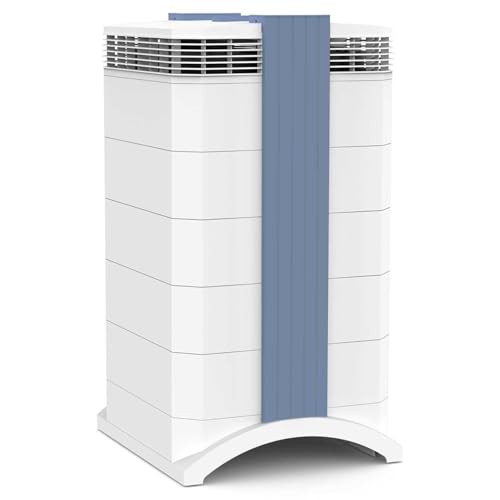
IQAir GC MultiGas XE Air Purifier — Best Heavy Carbon Bed
IQAir builds the GC MultiGas around the component everyone else economises on: granular activated carbon, loaded into refillable cartridges in quantities measured in kilograms rather than grams. The listing describes a machine aimed at VOCs, chemicals, gases and odours across a 1,125 square foot brief, with Wi-Fi control, three-stage filtration and wheels under a cabinet that expects to be moved rarely and serviced deliberately. This is the purifier equivalent of buying the industrial tool.
The engineering logic is contact and capacity. A deep granular bed forces air through a maze of carbon pores, giving gas molecules time and surface to adsorb, and the sheer mass delays saturation far beyond anything a sheet filter can promise. For homes near traffic, keen cooks using gas, hobbyists with solvents and glues, or anyone whose complaint is chemical rather than dusty, that bed is the whole argument, and no rival in this guide attempts the same weight class.
The costs of seriousness are real. The unit is heavy, expensive to buy and expensive to re-cartridge, and its particle-side performance, while competent, is not why anyone chooses it. Buy the MultiGas when odour and gas control is the primary brief and the budget accepts a professional tool; buyers whose problem is mostly dust with a side of cooking smell will get better value from the Winix below and should not let this machine’s reputation bully them upward.
- Carbon: granular activated carbon cartridges, kilogram class
- Stated coverage: 1,125 square feet per the listing
- Filtration: three-stage design including gas-phase media
- Controls: Wi-Fi enabled, onboard panel
- Build: Swiss made, wheeled cabinet
Strengths
- Carbon capacity dwarfs every other pick in this guide.
- Granular bed handles gases and chemical vapours, not just smells.
- Cartridge system is refillable and built for long service life.
Trade-offs
- Purchase and cartridge costs sit in a different league from rivals.
- Cabinet is heavy and visually industrial for a living room.
- Particle cleaning is not its headline talent despite the size.
Best for: homes where gases, chemicals and stubborn odours are the main complaint. Not suited for: buyers whose problem is ordinary dust with light cooking smells.

Medify MA-50 Air Purifier — Best Large-Room All-Rounder
The MA-50 is Medify’s answer for big rooms with mixed problems: a HEPA filter specified to 0.3 microns, an hourly coverage claim of 2,640 square feet, and a listing that names smoke, wildfires, odours, pollen and pets in one breath. Read the coverage as this guide always does, an optimistic one-hour framing, and the useful residue is a machine with enough fan and filter to serve a large living space at tolerable speeds.
For smell duty specifically, the MA-50’s value is dilution plus capture. It will not out-adsorb the IQAir’s carbon bed, and its review should not pretend otherwise. What it does is turn over a large room’s air repeatedly, trapping the smoke and cooking particles that carry much of a smell’s body while its carbon stage takes a share of the gases. In a wildfire week or after a house party, that combination of throughput and filtration restores a room faster than a small carbon specialist working alone.
The tower format keeps the footprint modest for the capacity, and the white cabinet disappears against pale walls better than most big machines. Filter replacements for Medify’s larger models are a real recurring cost, worth pricing before purchase, and the carbon stage will tire ahead of the HEPA media in a heavy-cooking home. As the generalist of this guide, though, the MA-50 covers more kinds of bad air for more kinds of households than any other pick here.
- Filter: HEPA stage with particle capture specified at 0.3 microns
- Stated coverage: 2,640 square feet in one hour per the listing
- Positioning: smoke, wildfire, odour, pollen and pet duty
- Form factor: floor tower, white finish
- Series: Medify V3.0 generation
Strengths
- Throughput restores big rooms quickly after smoke or cooking events.
- Particle capture handles the solid fraction that carries many smells.
- Tower footprint suits large rooms short on spare floor corners.
Trade-offs
- Carbon provision is supporting cast, not the headline act.
- Large-model filters are a significant recurring expense.
- Headline coverage rests on the maker’s own one-hour framing.
Best for: large rooms facing mixed smoke, pet and cooking challenges. Not suited for: chemical odour problems that demand a heavy carbon bed.

WINIX 5530 Air Purifier — Best Mainstream Deodoriser
Winix’s 5530 continues the line of machines built around one honourable idea: that the carbon filter should be a component, not a coating. The listing pairs true HEPA media with a high-deodorisation carbon filter and app control, in the new generation of the long-running 5500 series, with hourly coverage claimed up to 1,882 square feet. For a kitchen-open-plan living room, that carbon emphasis is exactly where money should go.
Deodorisation carbon earns its keep through the ordinary week rather than in a single dramatic test. Monday’s frying, Wednesday’s fish, the litter tray behind the door, the bin the night before collection: each event loads the carbon a little, and a substantial stage absorbs them all without the breakthrough that announces a saturated sheet, when smells start passing through untouched and the machine becomes a fan with delusions.
App control and automatic mode complete the domestic picture, letting the 5530 surge when its sensor notices dinner and settle afterwards without supervision. Its honest limit is the same as every mainstream machine here: the carbon is a consumable with a finite appetite, and households cooking daily with strong spices should plan replacement by nose, when returning smells say the bed is full, rather than by the calendar alone. Within those terms, this is the balanced odour pick for most homes.
- Filter: true HEPA with high-deodorisation carbon stage
- Stated coverage: up to 1,882 square feet in one hour
- Controls: app control and automatic mode
- Monitoring: air quality sensor for event response
- Lineage: new generation of the 5500-2 design
Strengths
- Carbon stage is engineered for deodorising, not decoration.
- Automatic response handles cooking events without babysitting.
- Mainstream size and format fit ordinary living rooms easily.
Trade-offs
- Heavy spice and frying households will saturate carbon early.
- App features add setup that some owners will never use.
- Cannot match a granular-bed machine on chemical vapours.
Best for: open-plan kitchen living where cooking smells are the daily enemy. Not suited for: workshops or hobby rooms with solvent and chemical fumes.

Air Purifier AHAM Verified 1092 Sq Ft — Best Verified Compact
This unbranded machine sells itself on a badge rather than a name: AHAM verification for a room claim of 1,092 square feet, with a HEPA filter, activated carbon stage and washable pre-filter listed plainly in its title, plus a PM2.5 display and a sleep mode published at 20 decibels. In a category addicted to adjectives, a listing that leads with a test protocol deserves a hearing.
The verified rating anchors the particle side: its cleaned-air output has been measured under the shared AHAM method, so the number can be compared with the branded rivals without translation. The carbon stage, by contrast, is described only as activated carbon, with no mass or depth published, and this guide reads that silence honestly: expect everyday odour help for bedrooms and small living rooms, not a deodorising heavyweight. The washable pre-filter is a genuine ownership plus, keeping hair and lint out of the costlier stages.
The black cabinet and particle display suit bedrooms and media rooms where a white tower would glare. For a single room with ordinary smells, a pet sleeping in the corner, a kitchenette down the hall, this compact verified unit covers the brief with unusual transparency about what it is. Households whose odour problem has a capital letter, daily frying, multiple large dogs, a smoker’s porch drifting indoors, should step up to the Winix or the IQAir and spend the difference on carbon.
- Filter: HEPA with activated carbon and washable pre-filter
- Stated coverage: up to 1,092 square feet in one hour
- Verification: AHAM Verified per the listing
- Display: PM2.5 readout on the cabinet
- Noise: sleep mode published at 20 decibels
Strengths
- Verified particle output in a compact, keenly simple package.
- Washable pre-filter trims running costs from the first month.
- Particle display makes the machine’s work visible at a glance.
Trade-offs
- Carbon quantity is unpublished and likely modest in depth.
- Unbranded support and filter sourcing need checking before purchase.
- Single-room scale; whole-flat odour duty exceeds its design.
Best for: single rooms needing verified cleaning and light odour help. Not suited for: homes whose smell problem is heavy, chemical or constant.

HEPA Air Purifier 235 CADR 3600 Sq Ft — Best Honest Budget Reading
Keep this listing’s two numbers side by side and you hold the whole category’s marketing in miniature: a tested CADR of 235, and a coverage claim of 3,600 square feet. Run the arithmetic. At 235 CADR in a 3,600 square foot room with ordinary ceilings, the machine delivers well under one air change an hour, a rate that dilutes a room eventually rather than cleaning it in any timeframe a nose would notice. The claim is not false under its maker’s private assumptions; it is simply answering a question nobody should ask.
In a modest room the same machine becomes respectable. A CADR of 235 in a bedroom of 150 to 250 square feet delivers several air changes an hour, and the H13 true HEPA stage with its carbon filter handles the particle load and mild odours of a sleeping space perfectly competently. The listing adds an air quality display, automatic mode and a published 30-decibel quiet operation, a sensible bedroom specification at a budget position.
So this pick’s role in the guide is double: a fair choice for a small bedroom, and a standing lesson in reading listings. Judge every machine by tested output against your room’s volume, and the fantasy numbers lose their power. Buy this unit for the room its CADR actually fits, replace its carbon-inclusive filter on schedule since a small carbon stage saturates quickly, and it will serve honestly. Buy it for a great room because the box mentioned thousands of feet, and you will join the reviewers who call the whole category a scam.
- Filter: H13 true HEPA with carbon filter
- Tested output: 235 CADR per the listing
- Stated coverage: up to 3,600 square feet, read sceptically
- Controls: air quality display and automatic mode
- Noise: quiet operation published at 30 decibels
Strengths
- Tested CADR is published openly, inviting honest sizing.
- Genuine H13 media covers bedroom particle duty properly.
- Display and auto mode are generous features at this level.
Trade-offs
- Coverage headline overstates real capacity by an order of magnitude.
- Small carbon stage saturates quickly under regular cooking drift.
- Output is bedroom scale despite the great-room marketing.
Best for: bedrooms and small rooms sized by CADR rather than by claims. Not suited for: large living spaces or serious odour problems of any size.

LEVOIT Vital 200S Smart Air Purifier — Best Quiet Everyday Freshness
Not every smelly room is a crisis. The bedroom that smells faintly of laundry left too long, the living room carrying yesterday’s takeaway into this morning: these need steady, quiet air turnover more than they need a carbon fortress. The Vital 200S answers with AHAM-verified output, a HEPA filter, a published sleep noise of 27 decibels and smart controls, in a machine designed to be forgotten about while it works.
Its odour contribution is dilution and light adsorption working together. Repeated air changes through the filter strip out the particles that give stale air its body, while the carbon element in its filter path trims everyday smells at the margin. Set against a frying-heavy kitchen or a litter corner it would be outmatched, and this guide will not pretend otherwise; set in a bedroom or a modest living room with ordinary odour load, its balance of quiet, verification and automation is the most liveable in this line-up.
The scheduling deserves emphasis for this brief. A room cleaned steadily through the evening never accumulates the stale reservoir that greets you at the door, and the Vital’s app makes that steadiness automatic. Owners who run it so rarely describe smell as a problem at all, which is the correct outcome for a machine bought for everyday freshness rather than for warfare against a specific stink.
- Filter: HEPA filter with smart monitoring
- Stated coverage: up to 1,875 square feet per the listing
- Verification: AHAM Verified per the listing
- Noise: sleep mode published at 27 decibels
- Controls: app-connected scheduling and auto mode
Strengths
- Verified output with genuinely quiet overnight running.
- Steady scheduled cleaning prevents stale-air build-up.
- Compact, unobtrusive cabinet suits bedrooms and calm rooms.
Trade-offs
- Carbon capacity is light beside the Winix and IQAir picks.
- Determined odour sources will overwhelm its gentle approach.
- Smart setup is required to unlock its best routines.
Best for: bedrooms and living rooms with mild, everyday odour drift. Not suited for: kitchens, litter corners or chemical smells needing carbon mass.
How Do the Six Compare When Smell Is the Whole Point?
| Model | Carbon approach | Particle side | Standout trait |
|---|---|---|---|
| IQAir GC MultiGas XE Air Purifier | Granular cartridges, kilogram class | Three-stage filtration | Gas and chemical capacity |
| Medify MA-50 Air Purifier | Carbon within a large HEPA tower | HEPA to 0.3 microns | Throughput for big rooms |
| WINIX 5530 Air Purifier | High-deodorisation carbon filter | True HEPA | Mainstream odour balance |
| Air Purifier AHAM Verified 1092 Sq Ft | Activated carbon stage, depth unpublished | AHAM-verified HEPA path | Verified compact with display |
| HEPA Air Purifier 235 CADR 3600 Sq Ft | Carbon filter, small stage | H13 true HEPA, 235 CADR | Bedroom value, honest output |
| LEVOIT Vital 200S Smart Air Purifier | Light carbon within smart filter path | AHAM-verified HEPA | Quiet scheduled freshness |
The ranking hidden in this table is carbon mass, descending from the IQAir’s cartridges to the compact machines’ modest stages. Particle performance runs almost in the opposite order at the budget end, which is why the right question is never which machine is best but which problem you actually have. Gas problems buy carbon; particle problems buy CADR; mixed problems buy balance and accept compromise in both directions.
Why Does Carbon Weight Matter More Than Any Other Odour Specification?
Adsorption is storage. Every gas molecule a carbon bed captures takes up residence in a pore, and when the pores are full the bed is finished, however clean it looks and however freely air still flows through it. Capacity is therefore destiny: a bed holding kilograms of granular carbon offers orders of magnitude more pores than a sheet holding grams, and its working life stretches from weeks into seasons under the same kitchen load.
Depth matters beside mass. Air crossing a thin sheet meets carbon briefly, and fast-moving gas molecules with weak affinity can slip through untouched; air crossing a deep bed zigzags through a long pore maze, colliding and sticking. This is why professional odour control, in laboratories and workshops, is built from canisters and cartridges rather than from impregnated pads, and why the IQAir’s cartridge architecture sits at the top of this guide’s table.
The practical translation for shoppers is to ask a rude question of every listing: how much carbon, in weight, is inside? Makers of serious beds publish the figure because it flatters them. Silence on weight, or a carbon stage described only with adjectives, tells you the quantity would not impress. Judge accordingly, and let price differences between a sheet machine and a bed machine be explained by the kilograms between them.
What Should You Fix Before Blaming the Room’s Smell on the Air?
Sources first, always. Walk the room like an inspector: the bin and what is in it, the sink trap and the cloth beside it, soft furnishings that have absorbed a year of cooking, the litter tray’s actual changing rhythm, the dog’s bed and when it last met a washing machine. Half the odour complaints that arrive at a purifier purchase dissolve under an hour of this unglamorous auditing, and the purifier then handles the remainder beautifully.
Moisture is the source most often missed. A slow leak under a sink, a bathroom that never quite dries, a carpet pad that took a spill in March: each feeds the musty note that owners describe as the house smelling old. Carbon will trim the airborne share of that smell while the damp keeps manufacturing more. Dry the source, ventilate the cupboard, repair the leak, and the same purifier that seemed inadequate becomes sufficient within a week.
Cooking technique is a source too, of the friendliest kind. A lid on the pan, the extractor actually switched on, the splatter wiped while it is warm rather than reheated at tomorrow’s breakfast: these habits cut the odour load at birth. The purifier’s role in a well-run kitchen is the last ten percent, the vapour that escaped every defence, and machines sized for that role last far longer between carbon changes.
How Can You Tell When a Carbon Filter Has Quietly Given Up?
The nose knows before any indicator does. Carbon failure announces itself as breakthrough: the cooking smell that used to fade within the hour now greets you the next morning, and the litter corner reasserts itself despite unchanged housekeeping. Unlike a clogged HEPA filter, which strangles airflow and raises the fan’s note, exhausted carbon lets air pass freely. The machine sounds healthy while doing half its job, which is why odour machines demand calendar discipline rather than symptom watching.
Keep a simple log. Note the date each carbon-bearing filter goes in, and the household’s load: daily frying, occasional roasting, two cats, none. When breakthrough arrives, the log converts a vague disappointment into a lifespan figure for your conditions, and the next replacement can be scheduled a fortnight before it. Rotating the log across a year also reveals seasonality, since summer cooking and closed-window winters load carbon at very different rates.
Beware the folk remedies. Sunlight, baking soda baths and vacuuming are sometimes said to refresh carbon; at household scale they do not restore a saturated bed in any way worth relying on. Proper reactivation is an industrial process involving high heat. A spent bed is a spent bed, and the honest economy is to buy carbon mass upfront so that the spending happens rarely.
Where Does an Odour Purifier Earn Its Keep Best?
Between the source and the people, closer to the source. Air leaving a kitchen carries its smell in a plume, and a machine placed to intercept that plume, at the kitchen’s edge rather than across the room, captures odour while it is still concentrated and before it dilutes into upholstery. Distance is dilution’s ally and the purifier’s enemy: the same machine works measurably harder when the smell must pass it to reach the sofa.
Bedrooms invert the logic. There the source is diffuse, the day’s clothing, bedding, the ensuite, and the goal is a calm, steadily refreshed volume rather than an interception. A quiet machine like the Vital 200S, run on a schedule through the evening, keeps the room’s baseline low so no single event defines it. Litter corners and utility rooms, by contrast, want the strongest carbon you can place near them, accepting noise because nobody sleeps beside the washing machine.
Whatever the room, respect the intake. A purifier backed into a corner behind a curtain adsorbs the curtain’s air and little else. Leave clearance, keep the path from source to intake unobstructed, and resist hiding the machine for tidiness. An odour purifier is a working appliance with a route to patrol; decorate around it, not over it.
Which Mistakes Do Smell-Focused Buyers Make Most Often?
Buying CADR for a gas problem leads the list. A shopper reads that a machine cleans a huge area quickly, imagines smells being cleaned at the same rate, and discovers that particle speed and gas adsorption are different sports. The second mistake is the token-carbon purchase: choosing a machine whose carbon stage is a scented sheet, then concluding within a month that purifiers do not work on smells at all.
Third is the passive-bag detour, months spent hanging charcoal sachets in rooms while the actual source, an unchanged litter routine or a damp cupboard, goes unexamined. Fourth is masking instead of removing: pairing a purifier with plug-in fragrances, so the carbon spends its capacity adsorbing perfume molecules the owner paid to add. The machine and the fragrance are enemies sharing a plug budget.
The last mistake is placement by embarrassment, tucking the unit into the room that smells least because it looks better there. An odour purifier stationed away from odour is decor. Put it where the problem lives, let it be seen working, and move it to a prettier exile only when the room no longer needs it, which, with enough carbon on duty, eventually happens.
How Do Cooking Habits Change the Machine You Should Buy?
Occasional, gentle cooking, a roast on Sunday, pasta through the week, loads carbon slowly, and any pick in this guide will keep a kitchen-adjacent room pleasant for a long filter life. Daily high-heat cooking is a different country. Frying, searing, wok work and spice tempering generate dense vapour events that saturate light carbon stages in weeks and test even the Winix’s deodorising filter across a season.
Gas hobs add a further dimension, since combustion itself produces gases beyond the food’s contribution, and rangehood venting to outside becomes the single most valuable odour tool in the house. A purifier in a gas kitchen is the second line, valuable for the living space the hood cannot reach, and buyers there should weight the IQAir’s gas-phase capacity or the Winix’s carbon depth accordingly rather than shopping by room size alone.
Households that cook communally and often, big family meals, frequent guests, a teenager frying at midnight, should also think in terms of response speed. Automatic modes that detect an event and surge are worth real money in such homes, because the alternative is a smell that has already settled into the curtains before anyone thinks to press a button. Prevention by sensor beats rescue by turbo, every single evening.
How Do Pets Change the Odour Equation Beyond Hair and Dander?
Animals are continuous, low-level odour sources in a way that cooking is not. A pan smells for an evening; a dog smells at a low simmer for a decade, and its bed, blankets and favourite rug corner concentrate the effect. Carbon handles the airborne share well, but the reservoir lives in textiles, which is why the purifier’s best partner in a pet home is a washing machine with a schedule: bedding washed weekly releases a fraction of the odour that bedding washed monthly hoards, and the machine’s carbon lasts correspondingly longer.
Wet animals reset the clock entirely. A rain-soaked dog raises a room’s smell load in minutes beyond anything the everyday settings anticipate, and automatic modes earn their price on exactly those afternoons. Bathing and drying the dog is source control again; the purifier’s job begins once the animal is dry, clearing the vapour that reached the curtains and the far corners while the household was busy with towels.
What About New Furniture, Paint and Renovation Smells?
New materials off-gas. Paints, adhesives, pressed-wood furniture and new carpets release volatile compounds most strongly in their first weeks, and that chemical edge is precisely the territory of gas-phase filtration. Ventilation is the primary remedy, flooding the room with outdoor air whenever weather allows, and carbon is the second line for the hours when windows must stay shut. Among these picks, only the IQAir’s bed is built with this load as its main brief.
Timing helps more than force. The steepest off-gassing happens early, so a purifier borrowed or bought for a renovation month works hardest exactly when it is newest and its carbon freshest. Households planning a nursery refit or a kitchen renovation should sequence the purifier purchase to land with the paint, not months later when the smell has faded to a background note that nobody can quite locate.
How Should You Run an Odour Purifier Across a Normal Week?
Let the machine’s rhythm follow the house’s. Mornings after cooking-heavy evenings benefit from a stronger hour while rooms are empty; occupied evenings want the automatic setting, surging with events and settling between them; nights in bedrooms want the quiet gear maintaining a baseline rather than attempting heroics. A purifier run this way spends its carbon on air people actually breathe, at the times they breathe it.
Weekends deserve their own pattern in homes that entertain or cook large. A pre-emptive boost before guests arrive lowers the baseline so the evening’s additions start from fresh air instead of from Friday’s residue. After the guests leave, an hour at high speed before bed repays the room’s debt while nobody is trying to sleep through the noise. These small choreographies, once habitual, are worth more than a model upgrade.
Why Do Some Rooms Smell Fine by Day and Stale by Morning?
Overnight, a closed bedroom accumulates everything its occupants and materials exhale into still air, with no door openings to dilute it. The purifier that seemed unnecessary at bedtime has eight undisturbed hours of load by morning, and a machine on a quiet overnight setting prevents the accumulation rather than curing it at breakfast. This is the pattern that converts sceptics: not a dramatic rescue, but a morning that simply smells neutral.
Ensuite bathrooms feed the problem in primary bedrooms, contributing moisture and their own odours through a door that rarely seals. Running the bedroom machine with the ensuite door closed, and the bathroom’s own extractor doing its separate duty, divides the problem into two solvable halves. Where the ensuite has no extractor, the purifier works harder and its carbon tires sooner, one more entry for the household log rather than a mystery.
How Do You Compare Two Machines When Neither Publishes Carbon Weight?
Use the evidence that exists. Look at the replacement filter: its price, its physical size in photographs, and whether owners describe it as a sheet, a pad or a canister. A deep, heavy, expensive cartridge is carbon mass announcing itself indirectly; a feather-light, cheap one is a sheet doing the same. Filter lifespan claims help too, since a maker expecting a stage to adsorb for a year is describing more carbon than one promising a season.
Then weigh the machine’s intent. Models whose listings lead with deodorisation, gas or chemical language have usually spent money inside the box to support the claim, because those words attract exactly the buyers who will test them. Models whose listings lead with coverage area and particle percentages, mentioning carbon in a subordinate clause, are particle machines with an odour sideline. Both are legitimate; the skill is buying the one whose intent matches your room.
What Should Landlords and Shared Houses Think About First?
Shared houses multiply sources and divide responsibility, a combination that defeats subtle solutions. The purifier in a shared kitchen or hall needs to be automatic, because no rota survives contact with five people’s schedules, and its carbon needs to be sized for the sum of everyone’s cooking rather than one person’s. A mainstream automatic like the Winix fits that social reality better than a specialist machine that rewards careful manual management nobody will provide.
Landlords face a different version: the smell that outlives a tenancy. Between lets, deep cleaning and repainting do the heavy work, and a carbon machine running in the empty property trims the residual cooking and smoking notes that cling to a vacant flat. It will not erase years of absorbed odour from carpets and walls, and honest expectations matter here as everywhere in this guide, but as a finishing tool across a fortnight of empty-room running it earns its electricity.
How Does Humidity Interact With Odour and Filtration?
Damp air smells stronger than dry air at the same contamination level, because moisture helps volatile molecules reach and register in the nose, and because damp materials release their stored odours more freely. A room can therefore smell worse on a humid evening without anything new having gone wrong. Carbon itself also works slightly differently in humidity, with water vapour competing for pore space, one more reason deep beds outperform thin stages in steamy kitchen climates.
The division of labour is worth stating plainly: a dehumidifier manages moisture, a purifier manages particles and gases, and neither substitutes for the other. Homes with both a damp problem and a smell problem usually discover that drying the air first makes the purifier’s remaining job dramatically easier, and that the musty component of the smell fades with the moisture that was feeding it. Sequence the purchases by cause, not by which appliance is more enjoyable to shop for.
What Is the Right Response to a One-Off Odour Disaster?
Burnt food, a forgotten pan, a pet accident on the rug: disasters have a protocol. First remove the source entirely, out of the house rather than into the bin in the same room. Then ventilate hard if outdoor air is clean, opening windows on opposite sides for a cross-draught that no fan can match. Only then set the purifier to its highest speed in the closed room, where it polishes the residue that ventilation missed and keeps working after the windows shut.
Textiles are the disaster’s second act. Curtains, cushions and the rug hold the smell and re-release it for days, which is why a room can seem cured on Monday and haunted again on Thursday. Wash what can be washed, air what cannot, and let the purifier run steadily through the week to catch the slow release. Judged across that week rather than across the first hour, even a modest carbon stage proves its worth, and a deep bed proves it faster.
How Will You Know the Machine Has Earned Its Place?
The evidence is domestic and unglamorous. Guests stop being greeted by the house’s signature smell because there no longer is one. The cook notices the evening’s frying has left the living room by morning instead of moving in. The litter corner becomes a thing you manage rather than a thing you apologise for. None of these arrive with a display readout, and all of them matter more than one.
Give the verdict a month, across ordinary weeks rather than a single test day, and consult the filter log you started when the machine arrived. If breakthrough comes sooner than the log predicted, the answer is carbon mass or carbon freshness, not a different brand of hope. If the month passes with the smell demoted from a feature of the home to an occasional event, the machine has done precisely the job this guide described, no more and honestly no less.
How Do Restaurants and Home Businesses Bend the Rules?
A home bakery, a dog-grooming studio in the garage, a candle-making hobby that became an income: these semi-commercial lives load a domestic purifier like a small workplace. Flour dust, dander by the bucket and fragrance oils in production quantities all consume filters and carbon at rates the domestic calendar never imagined. Owners in this position should size one class up, keep spare carbon-bearing filters as a business supply rather than a household one, and treat breakthrough as a stock problem to be scheduled, not a surprise to be endured.
The guest-facing side matters too. Clients smell a home business before they see it, and the difference between a studio that smells neutral and one that smells of its materials is, commercially, the difference between a hobby and a brand. A serious carbon machine in the workroom is therefore not an indulgence but equipment, as deductible in spirit as the mixer and the clippers, and it should be bought with the same unsentimental arithmetic.
Why Does a Room Smell Different to Guests Than to the People Who Live There?
Noses adapt. The brain, bombarded by a constant smell, files it as background within the hour and stops reporting it, which is why a household can be genuinely unaware of the note every visitor notices at the front door. This adaptation is the strongest argument for trusting instruments and routines over your own morning impression: the carbon log, the scheduled running and the placement discipline all work whether or not anyone in the house can still smell the problem.
It is also why the guest test is the honest one. Step out for a full day, return through the front door and read the house with a stranger’s nose in the first ten seconds, before adaptation reclaims you. What you smell in those seconds is what the purifier arrangement is truly achieving, and if the answer disappoints, the remedy lies in the familiar places: source, carbon freshness and the machine’s position on the smell’s road through the home.
A Short Word on Scented Products Used Beside a Purifier
Reed diffusers, scented candles and plug-in fragrances all spend the carbon you bought. Every perfume molecule the machine adsorbs is a pore denied to the cooking and pet molecules you actually wanted gone, and candles add soot particles to the bargain. Households serious about odour removal usually retire the masking products within a month, not from puritanism but because the room, finally neutral, smells better than the fragrance ever did.
Keep the Spare Filter Where the Machine Can Reach It
Store the spare beside the purifier, not in the garage. A filter that takes a ladder and a search party to fetch will be fitted next week instead of today, every time.
Final Recommendation
Match the machine to the molecule. For chemical and gas-heavy problems the IQAir GC MultiGas XE Air Purifier stands alone in this guide, and its price buys carbon mass nothing else here attempts. Most households, though, will be best served by the WINIX 5530 Air Purifier, whose deodorising carbon and automatic manners fit the ordinary war against cooking and pet smells, with the Medify MA-50 Air Purifier as the large-room alternative when smoke and scale join the brief.
Whatever arrives at your door, run the source audit first, place the machine on the smell’s road to the sofa, and write the filter’s birthday on its frame. Do those three unglamorous things and the right purifier stops being an appliance you hope works, and becomes the reason guests ask what you cleaned with, when in fact you simply filtered the air they were standing in.
Frequently Asked Questions
Will a HEPA purifier remove cooking smells on its own?
Only the particle share of them. Smoke and vapour particles get trapped, which helps, but the gases that carry most of a smell pass through HEPA media freely. Odour removal needs activated carbon in meaningful quantity, which is why this guide ranks machines by their carbon stage first and their particle numbers second.
Do charcoal bags work as well as a carbon purifier?
No. A hanging bag has no fan, so it can only adsorb molecules that drift into it, a negligible share of a room’s air. Bags freshen a drawer or a shoe cupboard where the air volume is tiny. A purifier drives the room’s air through its carbon repeatedly, which is a categorically different amount of contact.
How long does a carbon filter last in a kitchen?
It depends on mass and load. A light carbon stage under daily frying may fade within a couple of months, while a deep bed in the same kitchen can run for seasons. Watch for breakthrough, smells lingering into the next morning, and keep a dated note on the filter frame so your household’s real interval reveals itself.
Can I wash or bake a carbon filter to restore it?
Not in any way worth trusting. Household tricks may freshen the surface briefly, but the deep pores that do the work stay loaded, and true reactivation is an industrial high-heat process. Plan on replacement, and buy carbon mass upfront so replacements are rare events rather than monthly chores.
Where should the purifier go for litter tray odour?
In the same room, near the tray but not so close that litter dust coats the intake, with a clear path between the tray and the machine. Carbon does the work, so favour the stronger carbon picks, and keep the tray routine itself tight; the purifier handles drift, not neglect.
Does running the purifier faster remove smells faster?
Up to a point. More air changes bring more molecules into contact with the carbon each hour, but extremely fast air can shorten contact time within a thin bed. Deep beds tolerate speed better than sheets. In practice, a strong automatic surge during cooking followed by steady running clears a room more completely than either extreme held all day.
Related Guides
Three neighbouring guides extend the clean-air and clean-home theme: Best High Thread Count King Sheet Sets is for the bedroom the purifier guards, Best Glass Blenders for Smoothies covers a kitchen machine with a very different kind of output, and Best Memory Foam Pillows Cooling Contour finishes the fresher-bedroom project at the pillow.


