Our Top Picks
 Handheld Cordless Lightweight Powerful Car Dryer Air Blower4.13 x 3.34 x 9.05 inches1.43 poundsCheck on Amazon




What's inside
- Water Spots, Minerals, and Why Standing Water Loses
- Volume Versus Velocity: Reading Airflow Numbers
- Filtered Air and the Case Against Borrowed Tools
- Nozzles, Tips, and Where Each One Earns Its Place
- Gentle Heat: Useful Servant, Poor Master
- Hoses, Cords, and Garage Electricity
- Control, Weight, and the Shape of a Session
- Noise in Real Neighbourhoods
- Paint Types and Special Surfaces
- The Hybrid Finish: When a Towel Still Helps
- Maintenance, Filters, and Storage Habits
- Safety: Air Is a Tool, Not a Toy
- Vehicle Size, Shape, and Honest Expectations
- Where Drying Sits Inside the Whole Wash
- Technique in Detail: Panels, Glass, and Wheels
- Weather Windows: Heat, Cold, and Dusty Days
- Troubleshooting Streaks, Late Drips, and Dust That Returns
- Reading the Numbers Like a Sceptic
- Running Costs, Water, and the Wider Ledger
- Beyond Panels: Engine Bays, Jambs, and Other Duties
- The First Month: Mistakes Nearly Everyone Makes
- Handheld or Canister: Settling the Format Question
- Accessories: Worth Having, Worth Skipping
- Drying Together and Teaching the Routine
- No Garage: Driveways, Car Ports, and Shared Spaces
- Check prices on Amazon
- Making the Final Choice
As an Amazon Associate I earn from qualifying purchases. This post may contain affiliate links at no extra cost to you.
This guide rests on manufacturer documentation for motor output, airflow volume, air speed, hose dimensions, and filter design, on paint-care references published within the detailing trade, and on aggregated buyer feedback from owners of everything from city hatchbacks to crew-cab pickups. Where a maker publishes a measured figure, that figure anchors the discussion; where documentation stays vague, repeated owner experience across many listings fills the gap and is flagged as such. Purchases made through links on this page may earn this site a commission, which supports guides of this kind at no additional cost to the reader.
Rinse water is never just water by the time it sheets across a bonnet. It carries dissolved minerals from the supply, dust rinsed out of panel gaps, and whatever the road deposited since the previous wash. Leave it standing and evaporation prints that cargo onto the clear coat as pale spotting. Drag a towel through it and any grit the wash stage missed gets a second chance to scratch. A dedicated car blower dryer attacks the problem from a third direction: a fast, filtered stream of air herds the water off the vehicle entirely, touching nothing, grinding nothing, and leaving minerals no puddle in which to settle.
The machines built for this job look like cousins of the leaf blower, and the family resemblance misleads many first-time buyers. Garden tools move enormous volumes of air slowly through wide tubes, tolerate ingesting leaves and grit, and scream at pitches designed for outdoor distance. Vehicle dryers invert those priorities: narrower nozzles concentrate speed, intake filters scrub the airstream before it reaches paint, rubber-edged tips forgive accidental contact, and motors are tuned for the stop-start, panel-by-panel rhythm of a driveway wash rather than for clearing an autumn lawn.
Water Spots, Minerals, and Why Standing Water Loses
A droplet sitting on paint behaves like a tiny evaporating pan. Its edges dry first, concentrating dissolved calcium and magnesium into a ring, while the centre leaves a fainter disc as the last moisture escapes. Hard-water districts can spot a dark car within twenty minutes of a midday rinse, and the marks resist ordinary washing because the mineral has bonded lightly to the surface. Removing established spots means a dedicated remover or machine polishing, both of which cost more effort than preventing the droplet from drying in place.
Sunlight accelerates the damage while adding a second hazard. A panel warmed by direct sun flashes water off so quickly that even a careful washer loses the race on the roof and bonnet while still rinsing the doors. Heat also bakes shampoo residue into streaks when washing itself runs long. Experienced owners therefore wash in shade or during cooler hours, then treat drying as a timed stage rather than an afterthought, moving around the vehicle in a planned order that keeps every panel ahead of evaporation.
Water behaviour differs sharply by surface protection. On a freshly waxed or ceramic-coated panel, rinse water gathers into beads and loose sheets that a modest airflow pushes around almost gleefully. On neglected paint, water clings in a flat, stubborn film that resists herding and demands either stronger air or a helping pass with a towel. This is why two owners can report wildly different drying times for the same machine: the blower is only half the system, and the coating under the water writes the other half of the story.
Volume Versus Velocity: Reading Airflow Numbers
Two figures compete on every specification sheet, and confusing them leads to mismatched purchases. Volume, measured in cubic feet per minute, describes how much air the machine moves in total. Velocity, quoted in miles per hour or metres per second at the nozzle, describes how fast that air travels when it arrives. Drying a car needs both in balance: velocity lifts and drives droplets, while volume sustains the push across a broad panel instead of merely drilling a narrow, fast hole through the water.
Nozzle choice trades one figure against the other in real time. Pinch the outlet into a slim crevice tip and velocity climbs while volume falls, perfect for blasting water out of a mirror housing and poor for clearing a bonnet. Fit a wide fan nozzle and the reverse happens, producing a broad, gentler sweep that sheets water off doors efficiently. Machines supplying several nozzle shapes effectively offer several tools in one body, and the accessory box deserves as much scrutiny as the motor during comparison shopping.
Distance quietly taxes both numbers. An airstream leaving a nozzle at high speed entrains surrounding air, spreads, and slows, so a dryer that feels violent at fifteen centimetres feels merely brisk at sixty. Technique compensates: working close to the panel, nozzle nearly parallel to the surface, keeps the stream in its energetic zone and uses the panel itself to guide water toward edges and drip points. Owners who complain that a powerful machine underperforms are frequently standing too far back, conducting the water from a distance instead of shepherding it at close range.
Filtered Air and the Case Against Borrowed Tools
Filtration separates a vehicle dryer from every improvised alternative. The intake on a proper machine passes incoming air through foam or pleated media that traps dust, pollen, and the fine grit hanging in garage air after sweeping. That detail sounds fussy until the alternative is pictured clearly: an unfiltered tool inhaling driveway dust and firing it at wet paint at speed turns drying into a light sandblasting session, precisely the outcome the purchase was meant to avoid.
Leaf blowers sit at the centre of this debate because so many households already own one. Their volume figures dwarf dedicated dryers, and on a coated car they undeniably move water. The compromises accumulate elsewhere: no intake filtration worth the name, rigid nozzle tips that chip paint on contact, two-stroke exhaust on petrol models depositing an oily film, and a roar that makes Sunday-morning washing a neighbourhood negotiation. Electric garden models remove the exhaust issue yet keep the hard tips and unfiltered intake. Owners who borrow one occasionally rarely regret it; owners who dry weekly usually graduate to a filtered machine.
Compressed air tempts workshops for similar reasons and carries its own cautions. A shop compressor delivers ferocious, pinpoint velocity that empties seams beautifully, but the stream can carry compressor oil and condensed tank water unless the line filtration is serious, and the narrow jet covers panels so slowly that whole-car drying becomes an endurance event. Moisture traps and oil separators fix the contamination, at which point the setup costs more than the dedicated dryer it was meant to replace.
Interior work shows the filtered philosophy from another angle. The cabin vacuums compared in best 12 volt wet dry car vacuums likewise succeed or fail on filtration and nozzle variety rather than on raw suction claims, and many households sensibly buy both tools as a pair: vacuum for what settles inside, filtered blower for what clings outside. Treating the two as one system keeps grit moving in a single direction, away from the car, instead of relocating it between surfaces.
Nozzles, Tips, and Where Each One Earns Its Place
The flat fan nozzle does the heavy lifting on roofs, bonnets, doors, and boot lids. Its wide, thin sheet of air behaves like a squeegee made of wind, pushing a coherent front of water ahead of it when held at a shallow angle. Working from the highest panel downward lets gravity assist, and overlapping each pass by a third keeps stripes of missed water from surviving between sweeps. On vertical doors, a slight downward tilt prevents the stream from shoving water upward into window seals, where it would simply queue for a later appearance.
Round nozzles concentrate the stream for wheels, grilles, and the sculpted chaos around bumpers. Wheel faces hide water behind every spoke, brake components drip for minutes after the panel work ends, and a focused jet chases those pockets dry before dissolved brake dust can streak the barrel. Grilles and honeycomb trims reward patience: short bursts from several angles empty cells that a single pass leaves half full, and the same approach clears the channels around headlamp lenses where green algae otherwise take residence in damp climates.
Crevice tools finish the places owners actually judge. Mirror housings famously store a cupful of water and release it down a clean door at motorway speed, printing a sorrowful streak. Fuel filler flaps, door handle recesses, badge letters, number plate surrounds, and the seam where a roof meets its rails all behave the same way. A slim nozzle worked slowly along each seam, followed by a pause and a second pass, empties these reservoirs properly. Rubber or silicone-edged tips matter most here, because these are exactly the spots where the nozzle works millimetres from paint and an accidental knock is most likely.
Gentle Heat: Useful Servant, Poor Master
Some dryers warm their airstream modestly, typically raising it a modest margin above ambient rather than approaching anything like a heat gun. The benefit concentrates in cold weather, when rinse water on a near-freezing panel turns sluggish and clings, and a touch of warmth keeps it mobile long enough to leave. Warm air also comforts hands during a January wash and reduces the fogging that blooms across cold glass when icy air blasts it. Used within those limits, heating is a seasonal luxury that earns its electricity.
Excess heat, by contrast, threatens the very surfaces the tool protects. Sustained hot air over one spot can soften fresh wax, stress ageing clear coat, and warp the thin plastic trims scattered across modern bumpers and mirror caps. Quality machines cap their temperature rise deliberately and cycle the element to hold it, while improvised heat sources offer no such governor. A sensible rule treats warmth as background assistance: keep the nozzle moving, never park a heated stream on one badge or seam, and let velocity rather than temperature do the persuading.
Winter introduces a subtler interaction with road salt. Panels washed to remove salt brine need drying that reaches into seams where brine hides, because trapped salty moisture corrodes quietly for weeks. Warm airflow helps evaporate those hidden pockets after the visible water leaves, one of the few cases where running the machine a little longer than appearances require is genuinely protective rather than fussy.
Hoses, Cords, and Garage Electricity
Reach decides whether drying feels fluid or fragmented. Handheld dryers carry their motor in the hand and reach as far as their cord allows, suiting small cars and tight driveways. Canister designs park the motor on the ground and deliver air through a flexible hose, trading a little immediacy for a lighter nozzle hand and a longer working radius. Hose length between roughly two and a half and five metres covers most single-vehicle garages; stretching beyond that invites pressure losses and a hose that behaves like a pet python, forever coiling around ankles and wheelie bins.
Hose behaviour matters beyond length. A supple hose drapes over a shoulder and follows its owner around the car, while a stiff one fights every turn and can drag its own length across a wet panel, undoing the touchless principle with a dirty rubber snake. Crush-proof construction survives being stepped on and occasionally driven over, and swivelling cuffs at both ends stop the slow twisting that otherwise winds the hose into a spiral by the fourth panel. Storage follows the same logic: a hose that coils willingly onto a wall hook gets stored properly, and stored equipment stays clean equipment.
Electrical appetite deserves respect before the first wash. Powerful dryers draw current comparable to a workshop heater, and a garage circuit already feeding a pressure washer, a freezer, and lighting can object by tripping at the least convenient moment. Checking the circuit rating, avoiding shared extension reels that remain tightly coiled under load, and choosing a heavy-gauge extension when one is unavoidable keep the session uninterrupted. Cord length on the machine itself, often five to eight metres on canister models, may remove the extension question entirely in a modest garage.
Control, Weight, and the Shape of a Session
Variable speed transforms a dryer from a blunt instrument into a panel-by-panel tool. Full power clears the roof; half power persuades water off a delicate vinyl roof or around ageing window rubbers without forcing moisture past seals; the gentlest setting dries engine-bay plastics after a careful clean without scattering droplets across every hose. Dial controls adjust mid-pass with a thumb roll, while stepped buttons demand a pause, and that small ergonomic difference compounds across forty minutes of continuous work.
Weight distribution decides how the last panel feels. A two-kilogram handheld feels trivial on the roof and surprisingly negotiable by the rear bumper if its balance sits close to the grip; the same mass hung at the end of a long snout fatigues wrists far sooner. Canister systems move the burden to the floor, leaving a nozzle that weighs almost nothing, which arthritic hands and smaller users consistently praise in feedback. Shoulder straps, padded grips, and lock-on triggers all serve the same master: a dryer that stays comfortable gets used thoroughly, and thoroughness is where the spot-free result actually comes from.
Session rhythm deserves planning on larger vehicles. A sensible order runs roof, glass, bonnet, upper doors, boot or tailgate, lower doors, sills, wheels, and finally the drip seams, because each stage sheds water onto areas not yet dried. Reversing that order guarantees rework. Owners of tall SUVs should settle the roof question early, since a dryer on a step platform changes hose routing and cord safety, and discovering that halfway round the vehicle, with wet hands, is nobody idea of a relaxed Saturday.
Noise in Real Neighbourhoods
Dryer noise spans a wide band depending on motor design and speed, from a strong vacuum-cleaner hum at the civilised end to a leaf-blower-adjacent howl at the other. Enclosed garages amplify everything, reflecting sound off concrete and roller doors until the operator wears the full concert. Hearing protection is a reasonable habit for long sessions, and it doubles as a courtesy signal that the machine deserves respect. Turbine-style motors tend toward a higher, thinner note that carries through fences, while larger, slower fans produce a duller roar that neighbours report as less intrusive at the same measured level.
Timing is the cheapest noise control available. A dryer run at midday Saturday bothers almost nobody; the same session at dawn on a holiday weekend tests friendships. Battery-free electric machines at least keep a constant pitch that the ear habituates to, unlike petrol tools surging with every throttle squeeze. Households washing before a commute should weigh the quieter end of the market heavily, because a machine avoided out of guilt dries nothing, echoing the same logic that governs any appliance bought for regular domestic peace.
Paint Types and Special Surfaces
Ceramic-coated cars are the easiest clients a dryer will ever meet. Their hydrophobic surfaces refuse to hold a film, so water gathers into mobile beads that even moderate airflow herds efficiently, and many owners finish an entire hatchback in minutes. Sealants and traditional waxes sit one rung lower, still shedding water willingly when fresh and growing stubborn as the layer ages, which makes drying time an accidental gauge of when protection needs renewing. Unprotected or oxidised paint presents the hardest case, clinging to its water film and sometimes justifying a hybrid finish with a towel after the blower has done the bulk removal.
Matte and satin finishes change the rules because they cannot be polished and show water spotting cruelly against their flat texture. Touchless drying suits them perfectly, avoiding both the shine-inducing friction of towels and the mineral evidence of standing droplets. Vinyl wraps and paint protection film add edge awareness: a fierce stream aimed directly at a film edge can lift it, so angles should push air across seams rather than into them, and heat settings deserve extra restraint near wrapped panels that were applied with warmth in the first place.
Soft convertible roofs, whether fabric or vinyl, accept only the gentlest treatment. Low speed from a respectful distance clears standing water without driving moisture into seams or stressing stitching, and the blower should never become an excuse to blast a fabric roof at close range. Chrome, plentiful on classics and motorcycles, rewards air drying lavishly because it spots visibly and polishes reluctantly, while black plastic trims benefit simply because air reaches their textured grain where cloth fibres snag and leave lint behind.
The Hybrid Finish: When a Towel Still Helps
Purists preach touchless drying as an absolute, yet the pragmatic majority finish with a light towel pass, and the combination is better than either method alone. The blower removes ninety percent of the water, including every hidden seam reservoir, so the towel that follows glides over a nearly dry panel, picking up a faint residue instead of mopping a flood. A towel used this way stays cleaner, lasts longer, and presents far less scratching risk because it never drags across standing grit-laden water. The plush detailing cloths gathered under best affordable microfiber towels for detailing suit this finishing role, since their deep pile tolerates the light pressure involved and their edging avoids the scratchy stitching found on bargain cloths.
Glass often decides the argument by itself. Blown dry, windows can keep a faint mineral haze in hard-water areas that only a cloth fully clears, while mirrors and rear screens with heating elements dry unevenly under air alone. A thirty-second glass pass at the end costs little and completes the result. Door jambs, boot shuts, and the fuel flap interior likewise accept a quick wipe, and the older workshop cloths filed under best all shop towels absorb those grubby duties happily, sparing the good detailing towels for paint alone.
Maintenance, Filters, and Storage Habits
The intake filter is the whole maintenance story for most owners, and neglecting it quietly strangles performance. Foam filters rinse clean under a tap and should dry fully before refitting, since a damp filter inhales poorly and can grow musty in a closed garage. Pleated cartridges prefer a tap-and-shake cleaning or gentle compressed air from the clean side outward. A monthly rhythm suits dusty districts; households near building work or pollen-heavy trees may double that frequency during the worst weeks, guided by the simple test of whether the machine sounds like it is working harder than it used to.
Cords and hoses age by inspection rather than by calendar. A cord with a nicked sheath, a plug running warm, or a hose cuff cracking at its flex point all announce themselves to anyone who looks while coiling up after a wash. Storing the machine off a damp garage floor, ideally on a shelf or wall mount with its hose looped loosely, prevents the slow moisture damage that kills more garage appliances than dramatic failures ever do. Nozzles kept in a small box rather than rattling loose in a bucket stay smooth at their tips, which matters because a burred rubber edge is precisely the part that might one day meet paint.
Between washes, hang the hose in a wide loop rather than a tight coil, because sharp bends stress the cuff joints and can leave a permanent kink that whistles under load. Check each rubber nozzle tip by thumb for splits or grit embedded in the edge, rinse the tip clean, and let it dry before storage, since a trapped stone defeats the gentle contact those soft edges promise.
Garage air quality loops back into the filtration story in an unexpected way. The dust a dryer ingests comes largely from its own storage environment, so a machine kept beside an uncovered bag of cement mix or under a woodworking bench lives a harder filtering life than one stored in a closed cupboard. Owners who also run filtration indoors, along the lines discussed in best air purifiers car for cabin air, tend to grasp the principle instantly: clean surroundings make for clean airstreams, whatever the appliance.
Safety: Air Is a Tool, Not a Toy
A concentrated airstream deserves the same respect as any power tool. Never aim a dryer at skin at close range, at eyes under any circumstances, or toward children and animals who cannot be expected to respect the stream. Loose gravel on a driveway becomes airborne shrapnel when a nozzle sweeps low across it, so clearing the washing area of stones before starting protects both paint and bystanders. Eye protection during wheel and under-arch work is cheap insurance against the droplet-and-grit mixture that rebounds from those cavities.
Electrical safety around water follows familiar rules that deserve repeating because washing invites complacency. Keep connections off wet ground where a puddle can reach them, route cords so they neither cross the washing area nor dangle against sharp sill edges, and let a tripped breaker end the session until its cause is understood. Machines belong indoors after use rather than under a dripping carport, and a dryer that has been dropped into standing water should be retired to professional inspection rather than trusted to dry itself out by optimism.
Hearing and footing complete the picture. Wet driveways turn treacherous under smooth soles, especially where shampoo has sheeted across concrete, and a user circling a car backwards while watching a roof panel is a fall rehearsing itself. Sensible shoes, deliberate steps, and a hose routed behind rather than ahead of the walking line prevent the most common garage injury associated with an otherwise gentle appliance.
Vehicle Size, Shape, and Honest Expectations
A compact hatchback and a long-wheelbase pickup are different jobs wearing the same name. The hatchback presents perhaps twelve square metres of panel, much of it reachable from one side of the driveway, and a mid-power dryer finishes it briskly. The pickup doubles the area, adds a cargo bed that pools water heroically, and stretches hose and cord to their honest limits. Buyers should size a machine for the largest vehicle it will regularly serve, because an underpowered dryer on a big truck teaches its owner to skip drying altogether, which wastes the entire purchase more thoroughly than overspending ever could.
Motorcycles invert the problem: tiny area, infinite hiding places. Air earns its keep there better than anywhere, emptying cooling fins, switchgear, chain runs, and the undersides of instruments that towels cannot approach. Classic cars add delicacy to the equation, with ageing rubbers, vent windows, and brightwork that all prefer air to friction. Caravans and camper vans, by contrast, test vertical reach and patience, their tall flanks shedding water in quantities that make seam discipline and a step platform non-negotiable.
Time estimates printed on packaging should be read as best-case poetry for a small, coated car in kind weather. Real sessions include moving the machine, managing the cord, emptying the mirror housings twice, and pausing while a neighbour asks what on earth that thing is. None of that makes the tool less worthwhile; it simply relocates its value from raw speed to finish quality, paint preservation, and the quiet satisfaction of watching water leave on your terms rather than evaporating on its own.
Where Drying Sits Inside the Whole Wash
A dryer cannot rescue a poor rinse. Shampoo film left across a panel dries into streaks no airflow pattern can prevent, because the blower merely evaporates the contaminated water faster. The final rinse therefore deserves the same care as the wash itself: flood each panel from the top with a gentle, open flow rather than a pressure jet, letting clean water sheet the suds away and carry loose particles with it. Cars rinsed this way present the blower with honest water, and honest water leaves quietly.
Sequence around the vehicle matters before the dryer even starts. Parking with the nose slightly downhill encourages rinse water to gather toward one end, while a car sitting nose-up keeps its boot seams loaded. Opening and closing each door once after rinsing shakes loose the water hiding in window channels and mirror pivots, releasing it while drying equipment is already in hand rather than across the first mile of driving. Small rituals like these, invisible in any product photograph, separate consistently clean results from occasionally clean ones.
Wheel work should precede panel drying whenever the same session includes tyre dressing or arch scrubbing, because those jobs fling fresh droplets across sills and lower doors. Finishing the messy stages first, then drying from the roof downward in one uninterrupted circuit, protects finished panels from collateral splashes. Owners who wash two household cars in one session often rinse both first and dry them in immediate succession, accepting that the second car waits wet for a few minutes in exchange for handling the dryer only once.
Technique in Detail: Panels, Glass, and Wheels
Panel technique rewards a slow hand more than a powerful motor. Hold the nozzle a hand span from the surface, angled so the stream strikes at perhaps thirty degrees, and walk the water toward the nearest edge in overlapping lanes. Chasing individual droplets wastes minutes; the craft lies in maintaining one moving front of water that gathers stragglers as it travels. Vertical panels shed most willingly when the front moves downward in sections, while horizontal panels prefer a push toward the rear or side, whichever direction the panel shaping already encourages.
Glass exposes lazy technique instantly because every missed patch dries into a visible constellation. Work glass early in the circuit while the airstream is at full enthusiasm, sweeping from the top edge down so water exits onto panels not yet dried. Rear screens with steep rakes hold a stubborn puddle along their lower edge where the boot seal lives; a slow pass at low angle lifts that reservoir out instead of merely rippling it. Side windows benefit from a final downward stroke after the doors are done, catching the bead line that creeps out of the window channel as the session proceeds.
Wheels repay a dedicated minute each. Begin at the top of the barrel and work around, driving water out of the lug recesses and from behind the spokes, then finish the tyre sidewall where droplets cling to lettering and tread blocks. Brake discs flash-rust cosmetically within minutes of washing, an orange bloom that alarms new owners; thorough air drying slows its appearance, and the first application of the brakes wipes whatever forms regardless. Centre caps and valve stems hide the last pockets, and a short blast at each prevents the brown dribble that otherwise crosses a clean rim during the first drive.
Weather Windows: Heat, Cold, and Dusty Days
High summer compresses the whole operation. Panels reach temperatures that evaporate rinse water almost on contact at midday, spotting before the dryer finishes its first circuit, so early morning and evening sessions dominate in hot districts. A dryer with strong volume helps here precisely because the contest is against the clock: clearing each panel seconds after rinsing it, washing and drying in quarters rather than completing a full rinse first, keeps ahead of the sun. Shade from a building or canopy buys the same margin more cheaply than any motor upgrade.
Cold weather reverses every problem. Water stays liquid and cooperative far longer, yet it thickens with viscosity, clings to seams, and threatens to freeze on shaded concrete where the operator stands. Heated airflow earns its keep, hands numb quickly around a vibrating grip, and hoses stiffen into uncooperative hoops unless stored indoors. Salt-season washing adds urgency rather than difficulty, since the goal shifts from cosmetic perfection to removing corrosive brine from seams and arches before it settles in for the season.
Windy and dusty days argue for postponement whenever the calendar allows. A strong crosswind steals the airstream, bends it away from panels, and delivers airborne dust onto wet paint faster than any dryer can clear it, converting a wash into a mild abrasive event. Pollen season presents the same dilemma in miniature: a car dried perfectly at nine can wear a yellow dusting by ten through no fault of technique, and owners in pine districts learn to dry, garaging the car promptly rather than admiring it on the driveway.
Troubleshooting Streaks, Late Drips, and Dust That Returns
Streaks discovered after drying usually map to one of three origins. Vertical streaks below mirrors, handles, and badges announce seam reservoirs that needed a second, slower pass. Broad cloudy bands across a bonnet suggest shampoo residue surviving the rinse, a wash-stage problem wearing a drying-stage disguise. Fine parallel lines visible only at certain angles point to a towel used with too much enthusiasm during a hybrid finish, or to grit trapped in that towel from a previous duty, which is why finishing cloths deserve their own laundry discipline and retirement schedule.
The late drip is the category signature frustration: a car dried to perfection releases a runnel from a mirror or boot seam an hour later, printing a line down clean paint. Prevention lives in the drying circuit itself, specifically in revisiting known reservoirs after the main pass once vibration and gravity have refilled them. Flexing a mirror gently on its pivot, opening each door a few centimetres and closing it, and blipping the boot release all provoke hidden water into showing itself while the machine is still in hand. A two-minute revisit lap at the end of a session eliminates most surprises.
Dust settling on a freshly dried car within the hour tempts owners to blame static from the airstream, and the effect is real enough on plastic panels in dry weather, though usually minor. Grounding the vehicle by touching a metal panel, drying during the more humid part of the day, and garaging promptly all reduce the cling. What rarely helps is re-blowing a dusty dry car at full power, which redistributes grit across paint at speed; a gentle low-speed pass or a proper quick-detail wipe with lubrication is the safer correction.
Reading the Numbers Like a Sceptic
Airflow claims in this category are measured under conditions each maker chooses privately. One brand quotes volume at the motor housing, another at the nozzle, and a third appears to quote a theoretical maximum no accessory configuration achieves. Velocity figures carry the same fog, since a crevice nozzle manufactures spectacular speeds from modest motors. Cross-brand comparisons built on brochure numbers alone therefore mislead, and the honest signals are duller: motor wattage, the nozzle set included, filter design, and the pattern of owner reports describing how many minutes a known vehicle size actually took.
Warranties and accessory ecosystems reveal more about a machine future than launch specifications do. A dryer whose filters, hoses, and nozzle tips remain orderable years later is a dryer its maker expects to survive, while a model with no spares channel is implicitly disposable regardless of its marketing language. Extension hoses, wall mounts, and quieter nozzle options also signal a platform with a future. Buyers planning a decade of weekly washes should weight that ecosystem heavily, because the cheapest machine replaced three times costs more than the durable one bought once.
Running Costs, Water, and the Wider Ledger
Electric drying consumes a modest amount of power per session, measured in fractions of a typical household unit of electricity for a family car, and compares favourably with the hot water and detergent consumed by laundering a stack of large drying towels after every wash. Towels still earn their place in the hybrid finish described earlier, but their laundry burden shrinks dramatically when they merely kiss a nearly dry panel instead of absorbing a full rinse. Over a year of weekly washes, that difference shows up in both the laundry basket and the towel replacement budget.
Water itself is untouched by the choice, since the dryer spends none, yet the behavioural effect runs in the car favour: owners equipped for fast, satisfying drying wash more willingly and more often, which keeps corrosive deposits from accumulating and reduces the aggressive scrubbing that neglected cars eventually demand. The greenest wash remains the one done properly at reasonable intervals with equipment that lasts, and a durable electric dryer fits that philosophy more comfortably than a parade of disposable cloths and aerosol quick-detail products.
Beyond Panels: Engine Bays, Jambs, and Other Duties
The engine bay rewards air drying more quietly than any painted panel. After a careful degrease and gentle rinse, standing water pools on flat castings, hides inside connector housings, and sits in the sound-deadening tray beneath the motor, where it steams and smells for days if left alone. A dryer on a moderate setting, kept moving and never aimed point-blank into alternator vents or open intakes, persuades that water out without the risks of a pressure jet. Owners of older vehicles with distributor ignition learn the value quickly, since a damp cap is the classic cause of a car that washed beautifully and then refused to start.
Door jambs, boot apertures, and sill interiors form the second hidden territory. These areas rarely see a towel, accumulate gritty water that creeps outward after the doors close, and harbour the first rust bubbles on ageing cars precisely because they stay damp longest. Working the crevice nozzle slowly along each jamb after the main circuit, then wiping the loosened residue with a workshop cloth, keeps those channels genuinely dry rather than merely presentable. The fuel filler recess belongs on the same lap, since its drain hole blocks easily and a hidden pool there streaks the rear wing at the first roundabout.
Garage life finds the machine extra employment whether its maker planned for it or not. Drying a bicycle chain after a wet ride, clearing sawdust from a workbench before a varnish job, blowing grass clippings out of a mower deck, and drying washed tools before they return to a cabinet all use the same filtered, controllable stream. Restraint matters in reverse here: a dryer reserved mainly for paint should not spend its weekends ingesting workshop dust through jobs that a broom handles, because every gram of grit in the filter is a gram the next car session must trust that filter to hold.
The First Month: Mistakes Nearly Everyone Makes
Beginners almost universally stand too far away. The instinct to survey the whole car while waving the nozzle from a metre back feels productive and accomplishes little, because the stream arrives spent. The correction, closing to a hand span and shrinking the working area to one panel at a time, transforms results within a single session and usually converts sceptics who had begun composing a return. A close second mistake is chasing the visible water while ignoring seams, producing a car that photographs dry and streaks itself by lunchtime.
Speed selection trips up the next group. Full power everywhere feels efficient until it forces water past a tired window seal, lifts the edge of an ageing sticker, or scatters droplets from a wheel back across a finished door. Learning which panels want gentleness is a two-session education, and most owners settle into a personal map: violence for the roof and glass, diplomacy around rubbers, badges, and any trim old enough to have opinions. Variable-speed machines forgive the learning curve; single-speed owners compensate with distance, backing off to soften the stream where diplomacy is required.
The third lesson concerns the clock. New owners time their first session, compare it unfavourably with a practised towel routine built over years, and conclude the machine is slow. What the comparison hides is trajectory: towel times stay flat forever, while blower times fall steeply across the first half dozen sessions as panel order, nozzle swaps, and seam knowledge automate themselves. Judging the purchase at session six rather than session one is the fairest test, and buyer feedback patterns support it, with early ambivalence frequently maturing into the sort of loyalty usually reserved for a favourite kettle.
Handheld or Canister: Settling the Format Question
The two body plans divide buyers more sharply than any specification. Handheld machines promise immediacy: one object to carry, nothing trailing on the ground, storage on a single hook. Their ceiling is endurance and reach, since the motor weight rides in the hand and the cord defines the world. They suit compact cars, motorcycle households, flats with a shared parking court where setup time matters, and anyone whose drying happens in short, frequent bursts rather than in ceremonial weekend sessions.
Canister machines invert the compromise. The motor sits on the floor as an anchor, the hand carries only a nozzle, and the hose grants a working radius that circles a large vehicle without relocating anything. The costs are storage bulk, a hose to coil, and a setup ritual measured in an extra minute. Garages with a permanent washing corner absorb those costs invisibly, which is why canister owners cluster among enthusiasts with dedicated space, while handheld owners dominate among the space-poor and the time-pressed.
Households running two cars, or one car plus a caravan, motorhome, or boat on a trailer, should count total weekly drying minutes before choosing, because format fatigue scales with fleet size. A nozzle that feels weightless at minute five feels miraculous at minute fifty, and hoses lengthen more gracefully than arms do. Conversely, a single small car washed fortnightly will never repay canister bulk, and the honest recommendation in that driveway is the simpler machine, bought well rather than bought big.
Accessories: Worth Having, Worth Skipping
A longer hose tops the worthwhile list for canister owners whose vehicles outgrow the standard reach, followed closely by a wall mount that lifts the machine out of the damp floor zone and turns storage into a one-motion habit. Spare filters bought alongside the machine, rather than during the first performance crisis, prevent the neglected-filter spiral entirely. A second crevice nozzle costs little and saves the original from being borrowed into household service, while a soft shoulder strap quietly transforms handheld sessions on larger vehicles.
The skip list is longer and more entertaining. Novelty nozzle shapes promising tornado effects deliver neither the volume nor the control of the standard flat and round pair. Aftermarket foam cannon attachments for a drying machine confuse two different stages of the wash and satisfy neither. Extended warranties pitched at checkout for a simple motor-and-fan appliance rarely survive a cost-benefit glance, given that the failure points are filters, hoses, and cords, all cheaper to replace than to insure. Money saved there funds the accessory that genuinely matters and is forever forgotten: a second finishing towel, so the hybrid routine never waits on laundry day.
Drying Together and Teaching the Routine
Two people with one dryer develop a choreography worth describing because so many households wash cars as a pair. The efficient pattern assigns one partner to the blower and the other to follow two panels behind with the finishing towel and the seam cloth, inspecting under garage light as they go. Roles swap at the halfway point to share the vibrating grip, and the whole vehicle takes barely longer than a solo towel session while finishing noticeably drier in its seams. Conversation, it turns out, is the accessory no manufacturer lists, and it shortens sessions more reliably than horsepower.
Teaching a teenager the routine converts a chore into a transferable skill, provided the safety brief comes first: never toward faces, watch the cord, respect the driveway stones, and treat the machine as a tool rather than a lightsabre. New drivers who learn to dry the family car properly tend to wash it more carefully too, and the paint on a first car survives its apprenticeship in better shape than folklore predicts. The dryer, being forgiving of clumsy hands in a way that gritty towels are not, makes an unusually patient teacher.
No Garage: Driveways, Car Ports, and Shared Spaces
Plenty of careful owners wash without a garage, and a dryer adapts to that life with a few adjustments. Power becomes the first puzzle: a weather-protected outdoor socket is the clean answer, while a cord passed through a window demands attention to pinch points and to household members who might close that window mid-session. Battery-free machines still rule this setting because their output never fades, but the cord route should be walked once before the car gets wet, checking for puddle crossings and trip hazards across any shared path.
Shared courtyards and apartment parking add a social layer to the noise question. A brief word with neighbours, a session timed inside reasonable hours, and the quieter end of the speed range near bedroom windows keep the peace more effectively than any specification. Dust behaves worse outdoors as well, since a breeze can undo a panel seconds after drying it; working on the sheltered side of the vehicle first and finishing with the windward panels gives the cleanest panels the shortest exposure to airborne grit.
Storage without a garage favours compact handhelds that live in a hallway cupboard or the car boot itself, inside a bag that keeps the nozzle tips clean. Canister machines stored in a damp shed age faster than their garage-kept twins, mostly through hose cuffs and filter media, so an indoor corner is worth negotiating. None of these compromises disqualifies the tool; they simply shape which format and which habits will still feel convenient in February, which is the honest test of any car-care purchase.
One habit separates satisfied long-term owners from the rest, and it costs nothing: putting the machine away clean. A filter shaken out while the car air-dries its last seams, a hose looped rather than dropped, and a cord coiled without kinks add perhaps ninety seconds to a session. In exchange, the next wash starts with full airflow and untangled equipment instead of a small archaeological dig through the garage corner. Appliances rarely fail from one dramatic event; they fade through accumulated neglect, and ninety seconds of tidiness is the cheapest insurance in this entire guide.
Check prices on Amazon
Live listings for the shortlist in this guide are pulled from Amazon below, so prices and availability are always current at the moment you look.
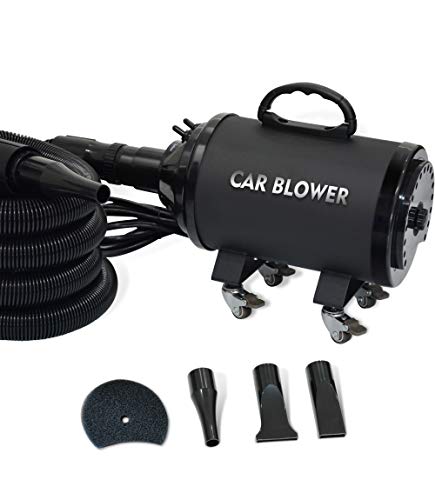


Making the Final Choice
Begin with the vehicle and the space, not with the motor. A filtered canister machine with a generous hose suits a garage-kept family car dried weekly, while a nimble handheld serves a driveway-kept hatchback and a motorcycle sharing the same owner. Confirm the nozzle set covers both broad panels and seams, check that replacement filters are actually sold rather than merely mentioned, and weigh the noise figure against the hour at which washing realistically happens in your household.
Then consider the surface your water will land on. A coated car forgives a modest machine; tired, unprotected paint argues for stronger airflow or an honest hybrid routine with towels. Winter washers gain from gentle heat, summer-only users gain nothing from paying for it, and anyone drying near film edges or matte paint should prize fine speed control over headline velocity. These matches between machine and circumstance, unglamorous as they sound, are what separate a dryer that becomes weekly infrastructure from one that gathers the very dust it was bought to defeat.
Choose accordingly and the reward is a small weekly transformation: a car that leaves the driveway genuinely dry, seams emptied, glass clear, and paint untouched by anything harsher than weather, ready for the road without a single mineral autograph drying across its bonnet.