Our Top Picks
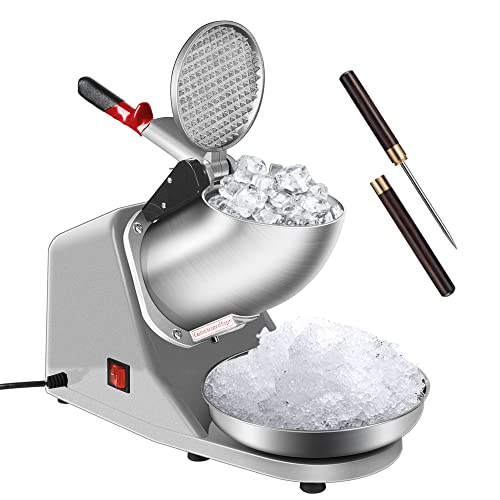 VIVOHOME Electric Ice Shaver Snow Cone Maker MachineSingle Blade - 143lbs/hr14 x 5 x 5.7 inchesCheck on Amazon
 VEVOR Commercial Ice Crusher 661LBS/H 350W Electric Snow661LBS/H-350w18.7 x 14.17 x 22.64 inches23.15 poundsCheck on Amazon
 VIVOHOME Electric Ice Crusher Shaver 4 Blades Silver4 Blades - 210lbs/hr14.3 x 6.2 x 10.6 inches9.2 poundsCheck on Amazon


What's inside
- Snow, pebble, nugget-style and coarse: naming the textures honestly
- How the three crushing mechanisms differ
- Motor power, torque and the cube that stalls a weak machine
- Hopper capacity, bin size and the arithmetic of a party
- The ice itself: cubes, blocks and what feeds best
- Safety interlocks, lids and sensible design around sharp edges
- Noise, vibration and the social life of a loud appliance
- Crushers versus blenders, makers and the manual alternatives
- Cleaning, drying and keeping meltwater from becoming a problem
- Reading specifications without being misled
- Matching the machine to the household that will use it
- Technique: small habits that visibly improve every batch
- Troubleshooting the batches that disappoint
- Buying pouches of thought: cost, longevity and value over summers
- Ice through the year: a household calendar of crushing
- Design details that decide daily satisfaction
- Questions households ask before buying
- A short field guide to serving crushed ice gracefully
- Check prices on Amazon
- The quiet virtues of buying once and buying well
As an Amazon Associate I earn from qualifying purchases. This post may contain affiliate links at no extra cost to you.
This guide draws on published manufacturer specifications, technical sheets for current countertop ice crusher lines, operating manuals dealing with blade care and hopper loading, and aggregated patterns in buyer feedback about texture consistency, noise and durability in home kitchens. Funding note first: a reader who buys through certain links on this page may generate a modest commission for this site, without changing the amount paid, and that support keeps this kind of independent buying research going.
Few small appliances change a household’s drinks as completely as a machine devoted purely to crushing ice. Blended cocktails aside, an enormous family of refreshments depends on ice that has been broken down deliberately: juleps buried under a mound of snow, swizzles, cobblers, tiki drinks layered over pebble ice, granitas, snow cones for children on the hottest afternoon of the year, chilled seafood displays, and the simple glass of lemonade that tastes colder and lasts longer over fine, fast-melting fragments. A countertop crusher turns a tray of ordinary freezer cubes into that material on demand, in the texture the drink actually wants.
Choosing one is less straightforward than the cheerful product photographs suggest. Machines that look nearly identical from across a kitchen produce radically different results, because the hidden geometry of blades, discs and feed chutes decides whether the output is powdery snow, uniform pebbles or a chaotic mixture of dust and boulders. Capacity claims, safety interlocks, cleaning access and noise vary just as widely. The sections that follow translate those differences into household terms, so the crusher you bring home matches the drinks, desserts and gatherings it will actually serve.
Snow, pebble, nugget-style and coarse: naming the textures honestly
Texture is the entire point of this appliance category, and it helps to name the four common outcomes before looking at any machine. Snow is the finest result, a soft powder that packs into moulds, absorbs syrups instantly and melts quickly enough to chill a drink within moments. Pebble ice sits a step coarser: small, irregular nuggets roughly the size of garden peas, which fill a glass completely, chill efficiently and still crunch pleasantly between the teeth. Coarse crushed ice covers the broader middle ground of shards and splinters suited to shaking, blending support and packing around food. Anything larger is simply broken ice, useful for chilling a punch bowl but disappointing in a glass that called for something finer.
Different drinks were designed around different points on that spectrum, and substituting one for another changes dilution as much as appearance. A mint julep depends on snow because the fine mound insulates the drink, frosts the cup and melts at the measured pace the recipe assumes. A cobbler or a swizzle wants pebble ice it can be churned through. Snow cones and shaved desserts live or die by fineness, since coarse shards tear at syrup distribution and leave crunchy pockets where sweetness never reaches. A household that knows its two or three signature uses can shop by texture first and let every other specification fall into line behind that decision.
Consistency within a batch matters almost as much as the headline texture. A crusher that delivers half powder and half stubborn chunks forces the host into sorting, re-feeding or apologising, and the chunks melt at a different rate from the fines, so the drink drifts out of balance as it sits. Even output comes from steady blade geometry, a feed path that presents cubes to the cutting edges at a controlled rate, and enough motor torque to keep that rate from stalling when a large cube arrives sideways.
How the three crushing mechanisms differ
Rotating blade crushers
The most common countertop design spins one or more stainless blades inside a chamber, striking cubes repeatedly until the fragments fall through gaps or reach a collection bin below. Blade machines are compact, comparatively affordable in construction, and quick with standard freezer cubes. Their output tends toward the coarse-to-pebble range, with a natural spread of sizes because each fragment’s fate depends on how often it crosses the blade path. They suit general household duty admirably: chilling drinks, filling coolers, preparing ice for blending support and producing the honest crushed ice most recipes picture.
Shaving discs and snow makers
Shaver designs press a block or a load of cubes against a rotating disc or a fixed blade edge, paring off fine layers the way a plane works wood. This is the mechanism behind true snow: light, dry, packable flakes that mound above the rim of a cup. Shavers ask more of the user — blocks may need tempering, pressure must stay even, output is slower per minute — and they reward that patience with a texture blade crushers cannot imitate. Households whose central ambition is snow cones, kakigori-style desserts or julep-perfect mounds should start their search here rather than hoping a general crusher will somehow powder its output on a fine setting.
Auger and roller systems
A smaller family of machines draws cubes into a toothed roller or auger that cracks them progressively through a narrowing path. The progressive action tends to produce notably uniform pebble-sized pieces with fewer fines than a blade chamber, and the enclosed path keeps stray fragments contained. These designs often appear in sturdier, heavier countertop units aimed at frequent entertaining, and their output flatters drinks built over pebble ice. Their complexity shows up in cleaning, since the cracking path has more surfaces where meltwater and mineral residue can linger if the machine is put away damp.
Motor power, torque and the cube that stalls a weak machine
Wattage figures appear prominently on boxes, yet torque under load is what the operator actually experiences. Crushing ice is a series of small impacts, and a motor that spins freely but bogs down when three cubes arrive together will produce uneven batches and a strained, rising whine that experienced owners learn to dread. Heavier flywheels, geared reductions and honest metal drive components keep the cutting pace steady. Buyer feedback patterns gathered for this guide return repeatedly to the same contrast: machines praised after a year of parties are described as unhurried and unstressed, while disappointing purchases are remembered for hesitation at exactly the moment a queue of guests formed.
Feed rate discipline protects any motor. Cubes should enter the hopper in a loose stream rather than a dumped mass, and the pusher or lid should apply gentle, even pressure instead of force. Jamming a hopper tight and leaning on the lid does not speed production; it packs cubes into a bridge that the blades cannot engage, overloads the motor and occasionally bends a feed component. A crusher treated like a patient mill rather than a compactor rewards its owner with steadier texture and a longer working life.
Duty rhythm deserves the same realism applied to any hard-working countertop motor. Domestic crushers expect bursts: fill the bin, serve the round, let the machine rest while drinks are carried out and conversation happens. Back-to-back bins for a large party are achievable with brief pauses, while continuous commercial-style running belongs to a different class of equipment with heavier cooling and bearings. Planning party ice production in waves, with finished batches resting in the freezer between rounds, keeps a home machine inside the rhythm it was built for.
Hopper capacity, bin size and the arithmetic of a party
Capacity is quoted in two places that shoppers often confuse. Hopper capacity describes how much whole ice the machine accepts at once, which governs how often the operator refills during a batch. Bin capacity describes how much crushed output the collection container holds before it must be emptied, which governs how large a batch can be before the workflow pauses. A generous hopper feeding a small bin still stops frequently; a large bin under a small hopper demands constant topping up. Balanced machines size the two with each other in mind.
Translating capacity into servings keeps expectations grounded. A tall glass of pebble ice for a mixed drink consumes roughly a tray’s worth of cubes once crushing losses and settling are counted, and a snow cone consumes a similar amount in its fluffier form. A machine whose bin serves four to six drinks per batch suits a family dinner comfortably. Entertainers hosting a dozen guests should expect either several batches or a workflow where crushing happens ahead of time and the output waits, loosely bagged, in the freezer — a method discussed further below, with one caution about refreezing into a solid block.
Physical footprint interacts with capacity in the familiar countertop trade. Larger bins and hoppers produce a taller or deeper machine, and the space beneath wall cabinets is finite in most kitchens. Measure the intended parking spot, including the height needed to open a top-loading hopper fully, before falling for a high-capacity design. A crusher that must be dragged out, used on the floor or balanced on a stool will be used less and resented more than a slightly smaller model that lives happily where the drinks are made. Readers furnishing a compact drinks corner may also enjoy our roundup of best counterop ice makers, since a crusher and a cube maker frequently end up sharing the same stretch of counter.
The ice itself: cubes, blocks and what feeds best
A crusher can only work with what it is given, and feedstock shapes the result as surely as blade design does. Standard tray cubes from a home freezer, fully frozen and dry-surfaced, crush cleanly in almost any machine. Cubes from an automatic maker arrive smaller and often wetter, which makes them prone to clumping in a blade chamber and smearing rather than shattering in a shaver. Letting wet cubes rest uncovered in the freezer for a while firms their surfaces and noticeably improves their behaviour through either mechanism.
Temperature matters in a counterintuitive direction. Ice straight from a deep freezer, hardened well below the freezing point, shatters into cleaner, drier fragments than ice that has begun to sweat at room temperature. Tempering is the exception that proves the rule, and it applies mainly to blocks for shaving: a block left briefly at room temperature until its surface just begins to glisten shaves into softer, fluffier snow, while a rock-hard block can skate across a blade and produce coarse, glassy shards. The manuals surveyed for this guide describe that brief rest as a matter of minutes judged by surface appearance, not a long thaw that wastes the block’s edges.
Block ice rewards the organised household. Freezing water in a clean food container produces a dense, clear-ish block free of the hollow centres and trapped air that make tray cubes explode into dust. Dense feedstock gives a shaver long, even strokes of work and gives a roller system something substantial to crack progressively. Households that entertain often sometimes keep two blocks in permanent rotation, one freezing while the other serves, so that a spontaneous gathering never has to wait for water to become ice before the crushing can begin.
Flavoured and coloured ice deserves a caution. Cubes frozen from juice, coffee or coloured drinks crush perfectly well mechanically, but their pigments and sugars coat blades, bins and seals, and they demand immediate, thorough washing to prevent sticky films and lingering flavours in the next batch of plain ice. Machines with fully removable bins and accessible chambers handle this hobby gracefully; sealed designs punish it. Serving flavoured ice at a children’s party is a delight best followed by a prompt, soapy clean-up rather than a postponed one.
Safety interlocks, lids and sensible design around sharp edges
Every powered crusher contains edges that deserve respect, and the safety architecture is therefore a genuine buying criterion rather than a footnote. The near-universal standard is a lid interlock: the motor runs only when the hopper lid or container is fully seated and latched, so the blades cannot spin while a hand is anywhere near the feed opening. Shoppers should confirm that the interlock feels positive and unambiguous, because a lid that almost latches invites the dangerous habit of holding it down by hand during operation, defeating the entire purpose of the switch.
Pusher design tells a similar story. Machines intended to be fed during operation supply a fitted pusher or plunger that keeps fingers at a distance while guiding cubes toward the blades, and that tool should be treated as part of the machine rather than an optional accessory to lose in a drawer. Substituting a spoon, a muddler or fingertips for a missing pusher is precisely the improvisation manuals warn against. When a pusher is lost, replacing it before the next party is a small expense that protects both hands and blades, since improvised tools can strike the cutting edges and chip them.
Stability under load completes the safety picture. Crushing generates vibration, and a lightweight machine on a smooth counter can walk toward the edge during a long batch, trailing its cord behind it. Rubber feet, a low profile and a body weight proportionate to the motor’s enthusiasm keep the unit planted. The collection bin should seat securely enough that vibration cannot creep it out of alignment mid-batch, scattering the last cup of output across the counter at the moment the operator turns away to reach for glasses.
Children change the calculation entirely. Snow cone season draws an audience of small helpers, and the wise household assigns them every job except feeding the machine: choosing syrups, carrying cups, counting servings, drizzling colour over finished mounds. The crusher itself stays an adult-operated appliance, unplugged when idle during a party rather than merely switched off, with its cord kept out of the reach of curious hands that might investigate a silent but still-connected machine between batches.
Noise, vibration and the social life of a loud appliance
Crushing ice is inherently noisy, and no honest guide should pretend otherwise. The sound combines a motor’s whine with the sharp, irregular cracking of cubes, and it carries across an open-plan room with ease. Differences between models are real but relative: geared roller systems tend toward a lower, crunching register, blade chambers produce a brighter rattle, and shavers add a rhythmic scraping note. All of them will interrupt conversation in the same room, and none of them belongs in use beside a sleeping infant or during a quiet dinner’s main course.
Placement softens the social cost. A crusher used on a solid, heavy counter transmits less vibration than one perched on a thin hollow worktop, and a folded towel beneath the base — used only where the manufacturer permits and never blocking vents — can mute the drumming that travels through cabinetry. Many hosts adopt a rhythm that solves the problem socially rather than acoustically: crush in generous batches before guests arrive or between courses, store the output in the freezer, and let the machine stay silent while people are actually gathered around the drinks.
That store-ahead method deserves its technique, because crushed ice left in a sealed bag in the freezer fuses into a single reluctant iceberg. The remedy is to freeze the batch loosely, in a wide container or a bag laid flat and only partly filled, then break the mass apart with a few firm taps through the bag just before serving. Output stored this way for an hour or two loses a little of its dry, distinct texture yet remains entirely serviceable, and the trade is usually worth it for the calm of a quiet room. For drinks where texture is the whole performance, a small fresh batch crushed at the moment of serving still wins, noise and all.
Crushers versus blenders, makers and the manual alternatives
Households understandably ask whether equipment they already own makes a dedicated crusher unnecessary. A sturdy blender does break ice, and our comparison of best blenders for smoothies ice covers models that handle cubes gracefully, yet blending is a wet, batch-bound process that produces a slurry-suited result and ties up the machine needed for the drinks themselves. A dedicated crusher works dry, continuously and in textures a blender cannot hold, which is why serious home bars keep the two appliances in separate roles rather than asking either to impersonate the other.
Ice makers solve the opposite half of the problem. They manufacture cubes; they do not transform them. Pairing a countertop maker with a crusher gives a household an entirely self-sufficient ice station, provided the counter and the budget stretch to both. Readers researching the supply side of that partnership will find the texture question explored from the cube’s perspective in our guide to best clear ice maker machines, where clarity and density are prized for slow-melting cubes — almost the opposite virtues from the fast, generous melt a crusher is bought to deliver.
Manual methods retain a loyal following and honest merits. A canvas ice bag and a wooden mallet produce beautifully irregular crushed ice with no motor, no cord and no noise beyond the thumping, and the method suits a single round of drinks for two people. Hand-cranked crushers occupy the middle ground, offering mechanical advantage without electricity for picnics, boats and cabins. Their limits are throughput and uniformity: when the guest list reaches double figures, the romance of manual crushing fades somewhere around the fourth bag, and an electric machine’s steady output starts to look less like a luxury and more like hospitality infrastructure.
Freezer-door dispensers that promise crushed ice deserve a clear-eyed word in this comparison. Their output is convenient for filling a single glass on a weekday, but the texture is typically coarse and wet, the pace is slow, and the reservoir is small. A household that entertains around crushed-ice drinks will outgrow a door dispenser within one summer party. The dispenser remains a fine everyday convenience; it simply is not a substitute for a machine whose entire design budget was spent on the quality of the crush.
Cleaning, drying and keeping meltwater from becoming a problem
An ice crusher handles only water, yet its cleaning needs are real, because meltwater finds every seam and mineral deposits cloud every surface it dries on. The essential routine is short: empty the bin, rinse removable parts in warm water, wipe the chamber, and leave everything open to dry fully before reassembly. A machine stored with its lid sealed over a damp interior develops the stale, enclosed smell that owners describe with dismay in feedback, and that smell transfers faintly to the next batch of ice, which is the last flavour a carefully built drink needs.
Hard water adds a slow, visible tax. Scale builds on blades, discs and bin walls as a white film that dulls both appearance and, eventually, cutting efficiency. A periodic wipe with a cloth dampened in a mild vinegar solution, followed by a plain-water rinse and thorough drying, keeps the film from establishing itself — always following the specific manual for your model, since a few finishes and seals prefer gentler treatment. Households already managing mineral build-up elsewhere in the kitchen will recognise the routine, and those exploring juicing equipment with similar care needs may appreciate our overview of best juice maker machines as a companion read.
Blade and disc inspection belongs in the cleaning ritual. While parts are out and dry, a glance along the cutting edges reveals nicks from stray hard objects — the occasional freezer-burned cube hiding a twist tie, or a spoon that strayed into the hopper during a busy party. Nicked edges crush less cleanly and strain the motor, and many manufacturers supply replacement blade assemblies for popular models, turning what looks like a fatal injury into a modest repair. Discovering a nick during a calm weekday clean is far better than discovering it through a failing batch as guests arrive.
Exterior care is simpler but not trivial. Syrup splashes from snow cone duty, citrus spray from a nearby garnish station and the general stickiness of a drinks counter all migrate onto the housing, where they bake into a dull film if ignored. A prompt wipe with a damp cloth after each party keeps the machine looking like an appliance rather than an archaeological layer of every summer it has served. The cord and plug deserve a dry-handed check at the same time, since a machine that lives beside sinks and ice buckets spends its life nearer to water than most countertop equipment.
Reading specifications without being misled
Output claims are the first figures to translate sceptically. A rate quoted in weight per hour describes ideal, continuous running with perfectly sized feedstock, not the stop-start reality of a home party with refills, bin swaps and conversation. Halving a headline rate gives a fairer planning figure for domestic use, and households that host large gatherings should size the bin and their schedule around that realistic pace rather than the brochure’s optimism.
Blade material descriptions reward a second look. Stainless steel is the expected standard for food-contact cutting parts, valued for resisting rust in a permanently damp working environment. What separates better implementations is thickness, mounting and whether the blade assembly can be removed for cleaning and eventual replacement. A sealed chamber with a non-removable blade may photograph beautifully, yet it commits the owner to cleaning around a fixed obstacle for the life of the machine and to replacing the whole unit when the edge eventually tires.
Container materials shape both durability and experience. Clear bins let the operator watch the batch build and judge texture without opening the machine, which is a genuine working advantage during a party. Thicker, well-moulded containers survive the knocks of freezer storage and the occasional drop onto a tiled floor, while thin, brittle bins are among the most common replacement parts owners report seeking. A lid that doubles as a scoop rest, a spout that pours without dribbling meltwater down the machine’s front — these unglamorous details are where daily satisfaction actually lives.
Warranty and parts availability close the specification story. A crusher leads a violent life by design, absorbing impacts that gentler appliances never meet, so a maker that stocks bins, pushers, lids and blade assemblies is offering something more valuable than a long promise: repairability. Feedback patterns gathered for this guide consistently favour brands whose replacement parts were easy to find years after purchase, because a cracked bin should retire a five-part component, not an otherwise healthy machine.
Matching the machine to the household that will use it
The cocktail enthusiast with a small home bar
A focused home bartender crushes ice several evenings a week, in modest quantities, for drinks whose recipes assume a particular texture. This pattern rewards a machine with an adjustable or genuinely pebble-leaning output, a compact footprint that can live permanently on the bar counter, and a bin sized for two to four drinks rather than a banquet. Permanent residence matters more than raw capacity here: a crusher that must be fetched from a cupboard for a single Friday drink will quietly stop being used, while one sitting beside the shaker becomes part of the ritual of making the drink properly.
The family that runs on snow cones and summer desserts
Households whose summers revolve around children, gardens and frozen desserts should shop from the shaver end of the market. Fine, dry snow is the product, and no adjustment on a blade crusher manufactures it. A dedicated shaver with a secure lid, a stable base and a bin that doubles as a serving container will work every hot weekend, and its slower pace matters little when the servings are small and the audience is patient. Keeping a spare set of cups, spoons and syrups organised beside the machine turns a hot afternoon into a small family ceremony rather than a scramble through three cupboards.
The frequent host of larger gatherings
Hosts who regularly serve a dozen or more guests need throughput, a generous bin and a workflow more than they need delicacy. A sturdy blade or roller machine with a large hopper, paired with the discipline of crushing ahead and storing batches loosely in the freezer, carries a party without a bottleneck at the drinks table. This household should also value a second bin or a compatible storage container, because the moment one bin is full and waiting, production either pauses or migrates into improvised bowls that melt faster and spill more.
The seafood, buffet and practical-chilling household
Not every crusher is bought for drinks. Coarse crushed ice beds a platter of oysters, chills a buffet bowl of prawns, packs around bottles in a cooler and fills a cold compress after a garden injury. For this utility pattern, fineness is irrelevant and volume, drainage and easy cleaning dominate. A simple, powerful blade machine with a large, washable bin serves best, and a model whose bin tolerates being carried to a sink and scrubbed without ceremony will be appreciated every time the platter comes in smelling of the sea.
Technique: small habits that visibly improve every batch
Start with dry cubes. Shaking loose cubes in a colander or spreading them briefly on a clean tray knocks off the surface frost and melt film that make fragments clump, and the resulting batch emerges looser and more distinct. Operators who adopt this ten-second habit often report the single largest improvement in texture they ever gained from their machine, larger than any adjustment dial offered, because surface moisture is the hidden variable behind most complaints about wet, heavy output.
Feed in rhythm rather than in floods. Adding cubes in modest handfuls, letting the sound of the machine settle between additions, keeps the cutting pace even and the particle size consistent from the first cup to the last. A flooded hopper produces a batch that is fine at the bottom, coarse at the top and stressful throughout. The sound itself becomes the experienced operator’s instrument: a steady crunch signals healthy work, a rising strain suggests overfeeding, and a sudden free-spinning whine means the remaining cubes are bridging above the blades and need the pusher’s gentle encouragement.
Sort by purpose when a batch comes out mixed. Rather than treating uneven output as failure, many hosts sieve a batch quickly through a large strainer or colander: the fines go to the drink that wants snow-adjacent texture, the pebbles go to glasses being built, and the few stubborn chunks return for a second pass or retire to a water pitcher. This small act of grading, borrowed from professional bar practice, turns an ordinary crusher’s natural size spread from a flaw into a modest inventory of textures.
Serve promptly and keep the bin cold. Crushed ice begins melting the moment it lands, and its meltwater glues fragments together and dilutes the first drink poured from a neglected batch. Resting the filled bin in the freezer during a pause, draining any meltwater before serving, and crushing the final round as close to serving as the noise budget allows all protect the texture the machine worked to create. Ice, once crushed, is the most perishable ingredient on the drinks table, and treating it with a cook’s respect for timing is what separates a memorable round from a merely cold one.
Troubleshooting the batches that disappoint
Output that arrives as slush points to wet feedstock, a warm machine room, or a batch left sitting in its own meltwater inside a sealed bin. The corrections are environmental before they are mechanical: colder, drier cubes, a drained bin, a shorter interval between crushing and serving. Output that arrives half boulders points the other way, toward overfeeding, a bridging hopper or blades dulled by long service, and it responds to smaller loads, patient pacing and, eventually, a replacement blade assembly.
A machine that stops mid-batch is usually protecting itself. Thermal cut-outs and jam protection interrupt power when the motor is strained, and the correct response is to switch off, clear the hopper of its packed load, let the unit rest as its manual directs, and restart with a gentler feed. Repeated cut-outs on modest loads tell a different story — of a tired motor, a binding drive or ice far harder than the design expects — and that pattern belongs in a conversation with the manufacturer’s support line rather than in ever more determined retries.
Rattling, grinding or a new metallic note in the machine’s voice should end the session immediately. Loose fragments of a chipped blade, a stray utensil or a cracked feed component can all announce themselves acoustically before they become visible, and continuing to run the machine converts a small repair into a large one. Unplug, empty, inspect by eye with the machine cold and still, and follow the manual’s guidance. Owners who treat unfamiliar sounds as information rather than inconvenience consistently spend less on repairs across the life of the appliance.
Uneven batches that persist after pacing, drying and inspection usually trace back to feedstock variety. A hopper loaded with a mixture of tiny maker cubes and large tray cubes gives any mechanism two different problems at once, and the output faithfully reflects the confusion. Freezing a dedicated supply of uniform cubes for crushing — one tray size, one maker setting, one consistent routine — removes the variable entirely, and it is the unglamorous secret behind the consistency that guests tend to attribute to an expensive machine.
Buying pouches of thought: cost, longevity and value over summers
The purchase price of a crusher is only the opening chapter of its cost story. A machine that serves five summers of parties, family desserts and buffet platters repays a mid-range price many times over in bags of shop-bought crushed ice never purchased and drinks never compromised by a blender’s slush. Conversely, the cheapest machine that cracks its bin in the second season and cannot be repaired is the expensive option wearing a disguise. Durability evidence in buyer feedback — reports measured in years and seasons rather than in first-week impressions — is therefore the most valuable reading a shopper can do.
Running costs are mercifully small. Electricity for a party’s worth of crushing is negligible beside the cost of the drinks themselves, and there are no consumables beyond the ice, which a household freezer produces as a by-product of ordinary life. The realistic recurring expenses are replacement bins, pushers and blade assemblies across the years, plus the freezer space that a standing block or a bag of uniform cubes quietly occupies. Budgeting a small place in the freezer and a small reserve for parts keeps the machine’s economics as pleasant as its output.
Storage between seasons decides whether a crusher greets June as an asset or as a science experiment. The end-of-season ritual mirrors the cleaning guidance given earlier, performed thoroughly and without haste: wash, rinse, dry completely with the lid open, inspect the edges, coil the cord, and store the machine somewhere dry with its pusher and manual kept together. A note tucked into the bin recording anything that seemed amiss — a new sound, a hairline crack, a bin that warped slightly in hot wash water — turns next spring’s first party into a planned success rather than an archaeological dig through last summer’s unresolved problems.
Ice through the year: a household calendar of crushing
Spring introduces the machine gently. The first warm weekends call for lemonade over pebble ice, iced tea for a garden lunch and perhaps a chilled display for an early buffet outdoors. This is the season to rediscover the appliance after its winter rest: inspect the bin for storage cracks, run a small trial batch to confirm the blades still bite cleanly, and note whether any unfamiliar sound has moved in during the quiet months. A machine checked in April, with parts ordered calmly if needed, never embarrasses its owner in front of a July crowd.
Summer is the crusher’s working season and the reason it was bought. Snow cones become an afternoon institution where children are concerned, frozen desserts appear at the end of ordinary weeknight meals simply because the capability exists, and every gathering of friends seems to involve at least one drink built over a mound of something crushed. Hosts learn their machine’s true party capacity in these months, usually discovering that the limit is rarely the motor and almost always the freezer’s supply of cubes, which argues for freezing ahead in the days before a known event rather than hoping the trays will keep pace on the day.
Autumn narrows the repertoire without ending it. Crushed ice moves indoors to cocktail evenings, to chilling oysters and seafood bought for a celebration, and to the practical work of filling coolers for harvest trips and sports days. The shaver, if the household owns one, finds a second life in coffee granitas and spiced frozen desserts that suit the season’s flavours better than summer syrups did. A mid-autumn deep clean, while the summer’s lessons are still fresh, sets the machine up for either continued service or a well-earned rest.
Winter surprises people who assumed the crusher was a fair-weather appliance. Festive drinks lean heavily on pebble and snow textures, from punches served over a sculpted mound to the sparkling cocktails of a New Year gathering, and a buffet’s seafood platter still needs its bed of ice in December. There is also a quieter winter role: crushed ice for a feverish child’s drink, for chilling a bottle quickly in an ice-and-water bath during a dinner party, and for the cook who needs a bowl of ice water to shock vegetables blanched for a holiday table. The machine earns its cupboard space across all four seasons once a household stops thinking of it as a summer novelty.
Design details that decide daily satisfaction
The view into the bin changes how confidently a host works. Clear walls reveal not just quantity but quality — whether the batch is running fine or coarse, whether meltwater is pooling at the bottom — without any need to stop and open the machine. That visibility prevents the two classic errors of blind operation: overfilling until the output jams against the chute, and serving a batch whose bottom third has quietly become slush. When comparing models side by side, the clarity and thickness of the container deserve as much attention as the motor’s specification panel.
Controls reveal a maker’s respect for wet hands. Large, simple switches that can be operated with damp fingers or the heel of a hand suit an appliance used mid-service far better than small touch panels that demand dry, precise taps. A pulse or momentary option gives the operator fine control over the last seconds of a batch, while a locking continuous setting suits long production runs. What matters is that the chosen control scheme matches the household’s dominant pattern, because a control that fights its user will be fought back, usually by holding a lid closed in ways the safety design never intended.
The chute and bin interface is where crushed ice either behaves or escapes. A well-aligned outlet drops output cleanly into the centre of the container, while a careless design dusts the counter with fines at every batch and leaves a meltwater trail toward the machine’s feet. Splash guards, a bin that registers into place with a definite seat, and a lid that contains the inevitable bounce of the first cubes all sound like trivia in a showroom. Across a hundred batches they are the difference between a machine that feels engineered and one that feels assembled.
Finally, consider how the machine meets the freezer it depends on. A crusher whose bin fits neatly through the freezer door, resting flat on a shelf, invites the store-ahead workflow that makes entertaining calm. A bin too tall or awkwardly shaped for the household’s freezer condemns every batch to immediate service and every party to live production. Measuring the freezer shelf is an unglamorous step that no specification sheet will suggest, yet it quietly determines whether the most useful technique in this entire guide is available to you at all.
Questions households ask before buying
Can one machine genuinely produce both snow and pebble ice? A small number of designs attempt the span with interchangeable heads or unusually effective adjustment, and their output at each extreme is respectable rather than perfect. Households devoted to one texture should buy the specialist and enjoy its excellence, while households that dabble across the spectrum — snow cones in July, pebble-ice drinks in December — are exactly the audience those flexible designs serve, provided expectations at each end stay realistic.
How much ice should a household freeze before a party? A useful planning habit is to count the drinks expected, assume roughly a tray of cubes for each generously iced serving, then add a third again for displays, chilling and the inevitable second rounds. Freezing begins two days out for large gatherings, with cubes bagged loosely as trays turn over, so the freezer’s slow production is spread across days instead of demanded in a single panicked afternoon. The crusher itself needs no preparation beyond being clean, dry and already resident on the counter.
Is very hard, deep-frozen ice ever a problem? Ice stored for weeks in a cold freezer can grow hard enough to challenge lighter machines and to dull edges faster than fresh cubes do. Rotating stock — using the oldest cubes first and freezing fresh batches regularly — keeps feedstock in the friendly middle range of hardness, improves flavour by avoiding long-stored ice that has absorbed freezer odours, and reduces the load on every component from blade to motor. Fresh ice is better ice in every respect that matters to a drink.
What should be the first job given to a new machine? Something forgiving and joyful: a round of lemonade, a tray of snow cones, a simple drink whose recipe tolerates a texture still being learned. The first batches teach the operator the machine’s voice, its pace and its preferences in feed rate, and that education is pleasanter over a family lunch than during the opening minutes of a large party. By the third or fourth batch, most owners report in feedback that the machine has stopped feeling like equipment and started feeling like part of the household’s hospitality.
A short field guide to serving crushed ice gracefully
Presentation is the last place where a good batch can be lost. Crushed ice should be served with a scoop or a large spoon rather than by tipping the bin, because tipping pours the accumulated meltwater at the bottom straight into the first glass. A chilled scoop, kept in the freezer beside the stored batches, avoids warming the ice it touches, and a towel stationed under the serving point catches the drips that would otherwise spread across the counter and under every glass that follows. These are the unphotogenic habits of experienced hosts, and they are why some households serve immaculate drinks from modest machines while others serve watery ones from impressive equipment.
Glassware choice interacts with texture more than most people expect. A tall, narrow glass keeps a mound of snow standing proudly and slows the melt by sheltering the ice from warm room air, while a wide, shallow bowl exposes maximum surface and suits drinks designed to open up and dilute as they sit. Metal cups frost dramatically over fine ice and keep their contents cold to the last sip, though they also conduct the room’s warmth to hands and demand a napkin or a holder. Matching the vessel to the crush is a small act of respect for both the drink and the machine that prepared its foundation.
Garnish and syrup timing complete the picture. Syrups poured over snow in a slow spiral distribute themselves through the mound by gravity, while a hasty pour carves a channel and leaves the lower layers pale. Mint for a julep belongs pressed gently into the top of the mound where its aroma reaches the drinker first, and straws for drinks built over pebble ice should be cut or chosen short enough that the glass can be drunk from close to the surface, where the chilling effect of the ice is strongest. None of these details appears on a specification sheet, yet together they decide whether guests remember the drink or merely the evening.
When the last round has been served and the bin holds only meltwater and a few stubborn fragments, the graceful household resists the temptation to leave the machine for the morning. A rinse while the parts are still cold-wet, a shake of water from the chamber, and a lid left ajar overnight take less time than the final conversation of the evening, and they guarantee that the next gathering begins with a machine that smells of nothing but its own clean readiness — the quiet signature of a home bar that takes its pleasures seriously and its equipment lightly enough to enjoy both for years.
Check prices on Amazon
Live listings for the shortlist in this guide are pulled from Amazon below, so prices and availability are always current at the moment you look.


The quiet virtues of buying once and buying well
There is a particular satisfaction in an appliance that asks little and delivers faithfully, and a good crusher belongs to that honourable family. It has one job, performed in the open, with results the operator can see, hear and judge immediately. No software updates will ever arrive to improve it, no subscription will ever be proposed for its continued operation, and its entire maintenance regime fits on an index card. In a kitchen steadily filling with devices that demand attention, accounts and firmware, a machine that simply turns cubes into snow, season after season, carries a charm that grows rather than fades with familiarity.
That charm is earned at the moment of purchase, by choosing honest capacity over headline numbers, replaceable parts over sealed mystery, and a texture matched to the drinks a household truly loves over a dial full of settings nobody will use. The buyers who report the deepest satisfaction in the feedback gathered for this guide share a recognisable profile: they knew their signature drink before they shopped, they measured their counter and their freezer, and they treated safety interlocks and cleaning access as features rather than fine print. Their machines did not merely perform well; they fitted, in the fullest sense of the word, the homes they entered.
So the final advice of this guide is deliberately unglamorous. Decide your texture, count your servings, measure your spaces, and choose the machine whose daily habits you can live with happily — because the best ice crusher is never the one with the loudest claims, but the one still standing ready on your counter, clean and willing, on the hottest evening of a summer several years from now.
Keep one small accessory within reach and the whole routine grows smoother still: a dedicated scoop that lives in the freezer, marked for ice duty alone, so that no hand ever needs to enter the bin and no kitchen spoon migrates into the hopper by mistake during a busy round. Pair that scoop with a folded towel reserved for the drinks counter, a spare bag for storing a loosely frozen batch, and a note inside the cupboard door recording the freezer tray rotation that produced the household’s most reliable cubes, and the machine’s supporting cast is complete — humble items, deliberately chosen, quietly doing for crushed ice what good organisation does for every other corner of a well-run kitchen.