What's inside
- Key Takeaways
- Quick Picks
- How Did We Choose the Best Batting for Bed Quilts?
- Comparison Table
- Cotton or 80/20 Blend: Which Batting Belongs in Your Bed Quilt?
- How Much Loft Does a Bed Quilt Actually Need?
- How Do You Handle, Cut and Store Batting Without Ruining It?
- Roll or Pre-Cut Package: Which Format Fits the Way You Quilt?
- How Does Batting Behave Differently Under Hand and Machine Quilting?
- How Should You Plan Batting for Gifts, Guests and the Linen Cupboard?
- What Do Scrim, Bonding and Needle-Punching Mean on a Batting Label?
- How Does Batting Choice Change a Quilt’s Warmth Across the Year?
- How Do You Test a Batting Before Committing a Finished Top to It?
- What Mistakes Do Quilters Make When Buying Batting?
- Final Recommendation
- How Long Does Batting Last Inside a Finished Quilt?
- Frequently Asked Questions
- Related Guides
As an Amazon Associate I earn from qualifying purchases. This post may contain affiliate links at no extra cost to you.
cottageverdict.com is reader-supported. When you buy through links on our site, we may earn an affiliate commission.
Where to buy: every linked name below leads to its Amazon listing, where you can check price on Amazon and confirm roll dimensions, fibre content and package size before ordering. The best batting for bed quilts is the layer nobody will ever see and everybody will feel. Batting is the soft filling sandwiched between a quilt top and its backing, and it decides whether the finished bed quilt drapes like a heirloom or stands stiff as a placemat, whether it breathes through a summer night or swelters, and how the stitching across its surface puffs, puckers or lies flat.
Unlike most craft supplies, batting is bought in serious quantities and regretted in serious quantities too. A queen bed quilt consumes a package measuring ninety by a hundred and eight inches, and discovering halfway through a basting afternoon that your batting shrinks oddly, beards through dark fabrics or feels like a bath towel is an expensive education. This guide exists so that the education happens here, on the page, instead of at your sewing table with the pins already in.
The six products below divide along three honest axes. The first is fibre: pure cotton battings against 80/20 cotton-polyester blends. The second is format: continuous rolls you cut yourself against pre-cut queen packages that open ready to use. The third is temperament: how much loft each batting carries, how it behaves in the wash, and whether it rewards hand quilting, machine quilting or tying. Every quilter’s project sits somewhere on those three axes, and the right batting is simply the one whose coordinates match.
If you are new to all of this, a reassuring fact first: batting is one of the most forgiving purchases in the sewing room. The six products here are all legitimate bed-quilt materials from established supply names, and the differences between them are differences of taste, format and habit rather than cliffs of quality. A beginner who picks any of them, measures honestly and bastes carefully will finish with a warm, washable quilt. The pages that follow are about matching the material to the maker, not about rescuing anyone from a catastrophic wrong choice.
A word about expectations before the picks. Batting is a material, not a finished good, so this guide judges it the way a buying guide for flour would judge flour: by consistency, by how it behaves in the process, and by whether the finished thing on the bed is what the maker intended. Shrinkage figures, loft descriptions and fibre percentages quoted here come from the makers’ own listings, and your own wash test on a sample square remains the final authority for any quilt that matters.
Key Takeaways
- Pure cotton batting shrinks a little in the wash, and that shrinkage is what gives a finished quilt its soft, crinkled, antique drape.
- An 80/20 cotton-polyester blend resists shrinking, holds a touch more loft and behaves more forgivingly for first-time quilters.
- Rolls reward makers who sew several quilts a year; pre-cut queen packages suit one quilt at a time with zero leftover storage.
- The Hobbs Heirloom roll at 96 inches by 30 yards is the bulk option for clubs, classes and very committed households.
- Always match batting width to your quilt top with a few inches of overhang on every side before basting.
- Pre-washing is optional and changes the result: wash the batting only if you also accept a flatter, pre-shrunk finish.
Quick Picks
| Pick | Badge | Why it stands out |
|---|---|---|
| Fairfield Toasty Cotton Quilt Batting | Best All-Cotton Roll | A pure cotton roll, 90 inches by 20 yards by its listing, for quilters who want the traditional crinkle. |
| RRKTP 100% Cotton Quilt Batting By The Roll | Widest Cotton Roll | Ninety-six inches of width in pure cotton, the extra span king-size tops quietly demand. |
| RRKTP 80/20 Cotton Poly Batting By The Roll | Best Blend Roll | The 80/20 recipe on a 20-yard roll, for steady production without pre-cut waste. |
| Hobbs Heirloom 80/20 Batting Queen 90×108 | Best Pre-Cut Queen | The classic heirloom blend in a single queen package that opens flat and bastes the same afternoon. |
| Fairfield Quilters 80/20 Quilt Batting | Best Everyday Pre-Cut | Fairfield’s take on the 80/20 queen package, an easy-handling staple for routine bed quilts. |
| Hobbs Heirloom 80/20 Batting Roll 96in x 30yd | Best Bulk Roll | Thirty yards of the heirloom blend for guilds, teachers and anyone quilting at volume. |
How Did We Choose the Best Batting for Bed Quilts?
We began with fibre, because fibre is destiny in a batting. Pure cotton produces the flat, breathable, slightly shrinking layer behind most traditional bed quilts; it is the batting that makes a finished quilt look gently lived-in after its first wash. The 80/20 blends add a minority of polyester, and that minority changes the personality: a little more loft, a little more resistance to shrinkage, easier handling on the roll and through the machine, and a surface that forgives the minor tension inconsistencies every real quilter produces.
Format came next. A roll is an economy and a commitment at once. Twenty yards of batting serves quilt after quilt at a lower cost per project, but it needs storage that stays dry and clean, and it asks you to cut accurately. A pre-cut queen package costs more per quilt and stores like a pillow until the day it becomes one, and for a maker producing a single wedding gift that trade is obviously correct. We included both formats in both fibre families so the choice stays yours rather than ours.
We also weighed how each batting behaves under the needle. Bed quilts are large, heavy and dragged through a domestic machine’s throat by the metre, so a batting that resists stretching, tearing at the edges and shifting inside the sandwich saves real frustration. Hand quilters need the opposite virtue in part: a batting soft enough to needle through for hours without wrecking wrists. The listings’ own descriptions of loft and handling guided the notes under each pick, and where a maker says little, we have said little rather than inventing a personality for a roll of fibre.
Availability shaped the final list as well. Batting is bulky freight, and a wonderful product that cannot be reliably reordered is a poor staple for a sewing room. Every product here is a standing catalogue item from its maker rather than a seasonal curiosity, so the roll or package you fall in love with this year can be bought again for the matching quilt you will inevitably make next year.
Finally, we kept the guide to bed quilts deliberately. Craft batting for stuffing, upholstery foam and ultra-loft polyester for trapunto are different materials wearing a similar name. Everything here is a flat quilting batting in bed sizes, because that is the purchase this page exists to inform.

Fairfield Toasty Cotton Quilt Batting — Best All-Cotton Roll
Fairfield’s Toasty Cotton is the traditionalist’s roll: premium cotton batting, in the maker’s words, supplied as a continuous roll listed at 90 inches wide by 20 yards long. That format suits a maker with a rhythm — a quilt for the spare bed this spring, a grandchild’s quilt by autumn, a charity quilt in between — because the batting is simply there, unrolled across the table and cut to whatever the current top demands, with the remainder going back into storage instead of into a remnant bin of almost-right sizes.
Cotton’s character is the argument for this roll. It breathes, which matters in a bed quilt more than in any wall hanging; it lies relatively flat, so the finished quilt drapes over the corners of a mattress instead of hovering; and it shrinks modestly at the first wash, pulling the stitching into that soft crinkle that makes a new quilt look like it has been loved for a decade. Makers chasing a crisp, puffy, show-flat finish should read that sentence as a warning rather than a promise, because crinkle is this material’s whole aesthetic.
There is a rhythm argument for keeping this roll in a cotton-only sewing room. Makers who piece with cotton, back with cotton and bind with cotton often prefer the middle layer to share the family’s behaviour in the wash, so the whole quilt ages as one material rather than three. A quilt built that way softens uniformly, wash after wash, and takes on the particular suppleness that makes old cotton quilts so pleasant to fold. Blends age gracefully too, but they age as themselves, and the difference is one traditionalists can feel with their eyes closed.
Working with it is calm work. Cotton batting has enough natural grab to stay put between top and backing while you baste, and it feeds under a walking foot without the creeping and bunching that slick synthetics can produce. Hand quilters appreciate that a needle passes through cotton without the springy resistance of high-loft blends. The roll format does ask for one discipline: store it somewhere dry and off the floor, because twenty yards of absorbent fibre will faithfully absorb whatever a damp cupboard offers it.
- Fibre: cotton, per the maker
- Format: roll, listed at 90 inches by 20 yards
- Loft character: low, flat, traditional drape
- Wash behaviour: modest shrinkage producing a crinkled finish
- Suits: machine quilting and hand quilting alike
Strengths
- Pure cotton breathability makes bed quilts comfortable across seasons.
- The roll format cuts any bed size without piecing batting scraps together.
- Natural fibre grip keeps the quilt sandwich calm during basting.
Trade-offs
- Shrinkage surprises makers who skip a test square and expect show-flat results.
- Low loft will not give a puffy, high-relief stitched look.
- A 20-yard roll needs real storage space kept dry year-round.
Best for: traditional bed-quilt makers who sew several quilts a year and love the crinkled finish. Not suited for: quilters who want maximum puff or a strictly no-shrink result.

RRKTP 100% Cotton Quilt Batting By The Roll — Widest Cotton Roll
The headline on this RRKTP roll is width: 96 inches of 100% cotton batting, by the listing, on a 20-yard roll. Six extra inches over the standard 90 sounds like a footnote until you have basted a generous queen top with overhang and discovered your batting ends flush with the fabric on one side, leaving nothing for the quilting to hold and nothing to trim. Width is insurance, and this roll sells insurance in bulk.
King makers will notice it first. A true king top with drop on both sides can push past what a 90-inch batting covers gracefully, forcing seams in the batting itself — doable, but one more variable in a project that already has hundreds. The 96-inch span covers those tops in a single piece, and for queen work it simply means overhang everywhere and a calmer basting session, with the trimmings wide enough to become mug rugs and table runners rather than waste.
The fibre story matches the Fairfield above in kind: pure cotton, with the breathability, flat drape and gentle first-wash shrinkage that define the category. Where the two rolls differ is emphasis. This one courts the maker of large quilts specifically, and its listing speaks to sewing, stuffing and handmade projects broadly, so bed-quilt buyers should confirm the loft suits them by starting with a smaller quilt or a test sandwich before committing a king top to it. Cotton batting forgives much, but a test square remains the cheapest insurance in all of quilting.
- Fibre: 100% cotton, per the listing
- Format: roll, listed at 96 inches by 20 yards
- Loft character: natural cotton hand, low and drapey
- Coverage: single-piece batting for wide queen and king tops
- Wash behaviour: expect the usual cotton settling after laundering
Strengths
- Ninety-six inches of width removes batting seams from large bed quilts.
- Pure cotton keeps the finished quilt breathable and traditionally flat.
- Generous overhang makes basting big tops measurably less stressful.
Trade-offs
- The widest roll is also the bulkiest object in your storage cupboard.
- Broad project positioning means loft is worth a personal test first.
- Cotton’s shrinkage still applies, crinkle and all, after washing.
Best for: king-size quilt makers and anyone tired of piecing batting widths together. Not suited for: small-project crafters who need only a crib quilt’s worth of material.
RRKTP 80/20 Cotton Poly Batting By The Roll — Best Blend Roll
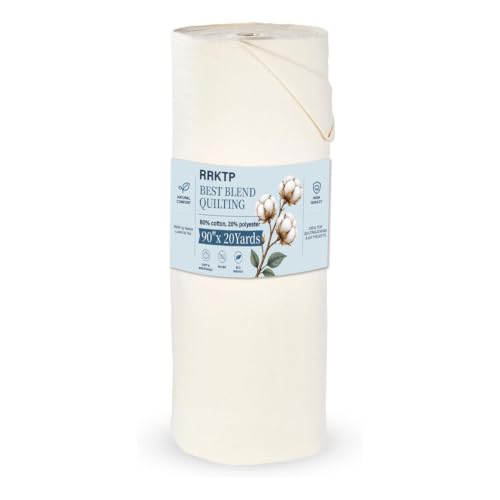
This RRKTP roll takes the 80/20 recipe — eighty percent cotton, twenty percent polyester, per its listing — and stretches it across 90 inches by 20 yards. The blend is the pragmatic centre of the batting world, and putting it on a roll is the pragmatic format, so this product is best understood as the workhorse choice: the batting a steady maker keeps in stock because it behaves predictably in quilt after quilt.
What does the twenty percent polyester actually do? It steadies the cotton. The batting resists the shrinkage that defines pure cotton, so a quilt washed for the first time keeps dimensions close to the ones you quilted. It carries a whisper more loft, enough to let stitching read with gentle relief without turning the bed into a duvet landscape. And it tends to be kinder to beginners, because the sandwich holds together with a bit more structural confidence while being wrestled through a machine.
The roll format amplifies the steadiness into economy. Charity quilting groups, Etsy sellers with a repeat product, and grandparents with a production schedule all live on rolls like this, cutting each project’s batting fresh and watching the cost per quilt settle to its floor. Store it standing in a clean corner, keep the cut edge noted, and the roll becomes infrastructure rather than a purchase you reconsider each time.
- Fibre: 80/20 cotton-polyester blend, per the listing
- Format: roll, listed at 90 inches by 20 yards
- Loft character: low to medium, slightly fuller than pure cotton
- Wash behaviour: reduced shrinkage compared with all-cotton batting
- Suits: production quilting and repeat projects
Strengths
- The blend’s stability makes first-wash results easy to predict.
- Roll length spreads cost evenly across many bed quilts.
- A touch of extra loft helps quilting stitches show their pattern.
Trade-offs
- Purists chasing the antique crinkle will find this finish too composed.
- Polyester content slightly reduces the all-natural breathability story.
- Like any roll, it demands dry, upright, out-of-the-way storage.
Best for: regular quilters who want one dependable batting in stock at all times. Not suited for: makers committed to one hundred percent natural fibres throughout.
Hobbs Heirloom 80/20 Batting Queen 90×108 — Best Pre-Cut Queen
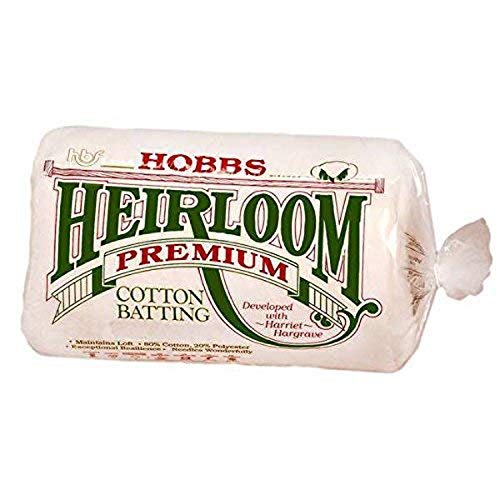
The Hobbs Heirloom name carries weight in quilting rooms, and this package is the reason boiled down to one object: an 80/20 cotton-poly batting, cut to a queen’s 90 by 108 inches, that you open, spread, and baste the same afternoon you finish the top. No measuring a roll across a floor. No storing the other seventeen yards. For the one-quilt-at-a-time maker, the pre-cut format is not a convenience; it is the difference between a project that starts and a project that waits.
Heirloom’s blend is tuned for the needle. The batting is known among hand quilters for needling smoothly, and machine quilters lean on it for the way it holds a sandwich together without fighting back. Its loft sits in the gentle middle: enough body for stitch definition, not so much that a queen quilt becomes a wrestling opponent at the machine. The finished drape lands between cotton’s flat tradition and polyester’s puff, which is exactly where most bed quilts want to live.
One habit matters with any pre-cut package, this one included: open it a day early and let it relax. Batting folded into retail packaging carries creases, and a night spread over the bed — or a brief, gentle tumble with a damp cloth if the maker’s instructions allow — lets those folds release before they are basted permanently into your quilt’s geography. Ten patient hours at the start saves visible ridges at the end.
- Fibre: 80/20 cotton-polyester blend
- Format: pre-cut queen package, 90 by 108 inches
- Loft character: medium-low, balanced drape
- Needle behaviour: regarded as friendly to hand and machine work
- Wash behaviour: blend stability keeps shrinkage modest
Strengths
- Pre-cut queen sizing removes measuring, cutting and storage entirely.
- The heirloom blend balances stitch definition with a natural drape.
- Consistent quality makes repeat purchases behave like the last one.
Trade-offs
- One package makes one quilt; the per-project cost beats no roll.
- Packaging creases need relaxing time before basting begins.
- Oversized king tops will outgrow this package’s dimensions.
Best for: one-at-a-time quilters making a queen bed quilt to a deadline. Not suited for: production makers who cut batting weekly and buy by the roll.

Fairfield Quilters 80/20 Quilt Batting — Best Everyday Pre-Cut
Fairfield’s Quilter’s 80/20 is the same sensible recipe as the Hobbs above — eighty percent cotton, twenty percent polyester, cut to 90 by 108 inches — from the other big name in the batting aisle. Having two staple brands in this guide is deliberate. Batting is a repeat purchase, availability fluctuates, and quilters develop loyalties the way bakers do with flour: both staples work, and the one in your cupboard is the right one.
Fairfield describes this batting across quilts, clothing, crafts and wall hangings, and that breadth reflects its handling: an agreeable, middle-of-the-road loft that behaves in a bed quilt without demanding specialist technique. It bastes without drama, quilts without stretching into waves, and washes into a gently settled finish that suits everyday bedding — the quilts that live on beds and sofas rather than in show cabinets.
Everyday is the operative word and it is a compliment. Most bed quilts are not heirlooms-in-waiting; they are warm, washable, much-loved objects that get dragged to forts, washed after illnesses and folded over the foot of the bed for a decade. A batting that is consistent, available and forgiving serves that life better than a finicky premium product, and this package has been serving it, in sewing rooms everywhere, for a very long time.
- Fibre: 80/20 cotton and polyester, per the maker
- Format: pre-cut package, listed at 90 by 108 inches
- Loft character: everyday medium-low loft
- Handling: cooperative under basting pins and spray alike
- Suits: routine bed quilts, throws and gift quilts
Strengths
- A familiar staple whose behaviour surprises nobody, in the good way.
- Pre-cut sizing fits a queen top straight from the package.
- The blend washes into a soft, settled finish for daily-use bedding.
Trade-offs
- It aims for dependable rather than distinctive, loft included.
- Creases from packaging still need relaxing before you baste.
- Serious hand quilters may prefer a batting tuned solely to the needle.
Best for: everyday bed quilts and gift quilts made on a normal household schedule. Not suited for: show quilts chasing a very specific loft or drape.

Hobbs Heirloom 80/20 Batting Roll 96in x 30yd — Best Bulk Roll
Thirty yards. Ninety-six inches wide. This Hobbs roll is the heirloom blend bought at institutional scale, and it changes the economics and the logistics of quilting everywhere it lands. Guilds keep one for charity quilts. Teachers keep one for classes. A longarm quilter with a home studio keeps one because clients’ quilts arrive in every size and the batting must always simply be there, wide enough for anything, long enough for the season.
The width deserves its own paragraph, because 96 inches quietly solves the large-quilt problem that haunts the other rolls. King tops, oversized queens with deep drops, and quilts destined for tall mattresses all fit inside a single cut, and the offcuts from a roll this wide are themselves usable pieces rather than ribbons. Waste falls, seams in batting vanish, and the per-quilt cost across thirty yards drops to the lowest figure this category offers.
There is also a teaching dividend to a roll like this that individual packages cannot pay. A class of beginners all quilting on the same batting learns one material’s behaviour together, and the instructor’s advice about needle, spacing and washing applies to every sandwich in the room. Guilds discovered this long ago, which is why the big roll lives in so many community sewing rooms: uniformity is a feature when twelve quilts are being finished against a charity deadline.
Commitment is the price of admission. A 30-yard roll is furniture: it needs a corner, a stand or a horizontal home where it stays clean and dry, and a household agreement that it belongs there. Buy it when your quilting output is a fact rather than an aspiration — three or more bed quilts a year, a class schedule, a guild commitment — and it will feel like the smartest purchase in the sewing room. Buy it for one quilt and it will feel like a very soft monument to optimism.
- Fibre: 80/20 cotton-polyester heirloom blend
- Format: roll, listed at 96 inches by 30 yards
- Loft character: the familiar heirloom medium-low body
- Scale: dozens of bed quilts per roll
- Audience: guilds, teachers, longarm studios, prolific makers
Strengths
- Lowest cost per quilt of any format in this guide.
- Ninety-six inches of width covers king projects in one cut.
- The heirloom blend’s behaviour stays consistent across the whole roll.
Trade-offs
- Storage is a genuine furniture decision, not a cupboard afterthought.
- The upfront commitment only pays off across many quilts.
- Cutting from a roll this size wants a table, a friend, or both.
Best for: guilds, quilting teachers and makers producing bed quilts all year. Not suited for: anyone making a single quilt in a small flat.
Comparison Table
| Pick | Fibre | Format | Listed size |
|---|---|---|---|
| Fairfield Toasty Cotton Quilt Batting | Cotton | Roll | 90 in x 20 yd |
| RRKTP 100% Cotton Quilt Batting By The Roll | 100% cotton | Roll | 96 in x 20 yd |
| RRKTP 80/20 Cotton Poly Batting By The Roll | 80/20 blend | Roll | 90 in x 20 yd |
| Hobbs Heirloom 80/20 Batting Queen 90×108 | 80/20 blend | Pre-cut | 90 x 108 in |
| Fairfield Quilters 80/20 Quilt Batting | 80/20 blend | Pre-cut | 90 x 108 in |
| Hobbs Heirloom 80/20 Batting Roll 96in x 30yd | 80/20 blend | Roll | 96 in x 30 yd |
Cotton or 80/20 Blend: Which Batting Belongs in Your Bed Quilt?
Decide by imagining the quilt’s first wash, because that is where the two fibre families part company. Pure cotton will shrink a few percent, the top and backing will draw in with it, and the surface will settle into soft wrinkles around every stitch line. Generations of quilters have loved that finish precisely because it forgives: minor tension wobbles and slightly uneven stitching melt into the crinkle and read as handmade charm. If your taste runs to antique quilts and farmhouse beds, cotton is not a compromise; it is the point.
The 80/20 blend was engineered for makers who want the quilt to keep the geometry they quilted. Its shrinkage is modest, its surface stays smoother, and appliqué and precise piecing keep their crisp edges through the wash. Modern quilting, with its negative space and long straight stitch lines, often looks better for that composure. The blend also handles a little more like a manufactured material in the best sense: uniform, predictable, repeatable from package to package.
Warmth and breathability split the difference rather than declaring a winner. Cotton breathes beautifully and feels cool-handed, suiting warm sleepers and summer-weight bed quilts. The blend’s polyester fraction traps a touch more still air for its thickness, which cold sleepers appreciate in winter quilts. Neither family will sabotage a bed; they simply lean toward different sleepers, different aesthetics and different relationships with the washing machine.
Price per quilt follows the same split personality. Cotton rolls and blend rolls cost what they cost for reasons of fibre and freight, and the pre-cut packages charge for the cutting and the convenience. None of the six here is extravagant for what it is, because batting remains one of the cheaper layers of a quilt relative to the fabric and the hours above it. Skimping on the middle layer to save a little, after spending a season on the top, is the one economy experienced quilters unanimously warn against.
When in doubt, let the recipient decide. A quilt for your own bed can follow your taste. A quilt for a recipient who will machine-wash it monthly and expect it to look unchanged is a blend quilt, and a quilt for a recipient who keeps family quilts for forty years is very often a cotton one, because cotton’s ageing is graceful in a way that suits objects meant to be inherited.
How Much Loft Does a Bed Quilt Actually Need?
Loft is the batting’s thickness, and bed quilts are almost always happier at the low end of it. A low-loft batting drapes: it folds over the edge of the bed, tucks around a sleeper and layers under a duvet without turning the bed into a topography project. It also quilts kindly, because the sandwich stays thin enough for a domestic machine’s throat and a walking foot’s patience. Every batting in this guide lives in that low-to-medium band, and that is not a limitation of the list; it is the correct engineering for bedding.
High loft has its place — trapunto, whole-cloth show quilts, tied comforters that aim for duvet plushness — but it fights the bed at every turn. It resists folding, overwhelms the machine, and makes a quilt that sleeps hot and stores badly. Makers seduced by a lofty sample in the shop should ask whether they want a quilt to sleep under or a sculpture that resembles one.
Judge loft with your hands and a test sandwich rather than with numbers, because makers describe loft in their own vocabularies. Baste a twelve-inch square of your actual top fabric, the candidate batting and your backing, quilt it the way you plan to quilt the bed quilt, wash it the way the finished quilt will be washed, and live with the square for a day. That small ritual, done once, teaches more about loft, drape and crinkle than any product page can, and it costs an afternoon at most.
How Do You Handle, Cut and Store Batting Without Ruining It?
Unroll or unfold batting in the room where you will baste, and give it time. Rolls carry a gentle curl memory; packages carry creases. A few hours spread flat — overnight is better — lets both relax, and stubborn package creases usually surrender to gravity and a warm room long before they need steam or pressing, neither of which batting particularly enjoys.
Cut with the same respect you give fabric. Measure the top, add at least three to four inches of batting on every side, and cut once, generously. Batting that ends flush with the top invites the backing to shift during quilting and leaves the edge of the sandwich starved; overhang is trimmed after quilting, when it has done its job of keeping everything honest under the needle.
Storage decides how the batting ages between projects. Keep rolls upright or suspended in a dry room, out of direct sun, away from the garage’s humidity and the attic’s heat. Keep pre-cut packages flat and sealed until their day comes. And label your offcuts with fibre and loft while you still remember them, because three anonymous white rectangles in a bin are a future afternoon of guesswork, and batting scraps are genuinely useful for cushions, pot holders and test sandwiches when you know what they are.
Roll or Pre-Cut Package: Which Format Fits the Way You Quilt?
The format question is really a question about your quilting calendar. A roll is inventory. It suits the maker whose projects arrive in a steady stream, because the batting is already home when inspiration or obligation strikes, and because the cost per quilt across twenty yards undercuts any sequence of individual packages. It also suits makers whose quilts refuse standard sizes: a roll cuts a cot quilt on Monday and a California king on Saturday without a shopping trip in between.
A pre-cut package is an event purchase. It suits the maker with one quilt in progress and no wish to store the other nineteen yards of anything. It suits small homes, where a batting roll would need its own chair at the table. And it suits beginners, for whom one less measurement is one less way for a first quilt to go wrong. The two pre-cut queens in this guide exist because that profile describes most bed quilts actually made.
There is a middle habit worth copying from experienced quilters: keep one package of your staple batting on the shelf even if you mostly buy rolls. Packages travel to classes, retreats and a sister’s house for a weekend of sewing in a way rolls never will, and a spare package rescues the Sunday afternoon when the roll turns out to be two yards shorter than memory claimed.
Whichever format you choose, buy it before the top is finished rather than after. Batting that is already relaxing on the spare bed creates momentum; a finished top waiting on a delivery creates a drawer it may live in for a year. Quilting folklore is unanimous on this point, and for once the folklore is simply project management.
How Does Batting Behave Differently Under Hand and Machine Quilting?
Hand quilting is a conversation between needle and fibre repeated ten thousand times, so batting choice is felt in the wrists by the second evening. Cotton and the heirloom-style blends are the traditional choices because a needle slides through them with modest, even resistance, and the stitches can rock into the small, regular rhythm hand quilters prize. Very lofty or densely bonded battings fight that rhythm, and a quilt meant for hand work should be test-needled before the sandwich is basted, not discovered at hour six.
Machine quilting asks different questions. The sandwich must feed evenly, survive being rolled and folded through the machine’s throat, and hold its layers in register while gravity pulls the unsewn half toward the floor. Blends with a little polyester confidence, and battings with a light bond or scrim, tend to behave best in that environment, which is one reason the 80/20 family dominates machine-quilted bedding. Longarm machines, with the quilt tensioned on a frame, forgive almost any batting, and longarm quilters often choose purely by the finished hand they want.
Tied quilts sit at the far end of the spectrum: with no stitching to hold the layers, the batting must resist bunching and migrating between ties spaced a hand’s width apart. Low-loft bed battings like these can be tied successfully if the ties are close and the batting is handled gently in the wash, but a maker planning a tied comforter should say so at purchase time and favour the most cohesive batting available rather than the softest.
How Should You Plan Batting for Gifts, Guests and the Linen Cupboard?
Bed quilts multiply. A maker who finishes one usually finishes six, and they distribute themselves across spare beds, children’s rooms, sofas and the linen cupboard’s optimistic top shelf. Planning batting with that future in mind saves money and mismatched quilts: standardise on one or two battings you trust, as this guide’s six options invite, and every quilt you make will wash, drape and age in family resemblance to the others.
Gift quilts argue for the blend. Recipients wash quilts the way they wash everything else, in warm water with enthusiasm, and an 80/20 batting keeps its dimensions and its composure through that treatment while still feeling like a real quilt rather than a duvet cover with ambitions. Include a care note with the gift, not as a scold but as a kindness: cool wash, gentle dry, and the quilt will outlast the occasion it celebrates.
Guest-bed quilts argue for cotton. A spare bed dressed in a cotton-batted quilt breathes through a summer guest’s stay and layers happily under a blanket in winter, and the gentle crinkle reads as welcome rather than wear. Keep one pre-cut queen package in reserve and the guest quilt stops being a project that competes with your own bed’s needs.
Finally, keep a batting diary, however informal: a note in the roll’s end or the package’s fold recording fibre, loft and the quilt it went into. Two years later, when a repair or a matching pillow sham comes up, that note is the difference between continuity and archaeology, and it costs eleven seconds to write.
What Do Scrim, Bonding and Needle-Punching Mean on a Batting Label?
Batting labels carry a small vocabulary worth decoding before you buy, because those words describe how the loose fibres were persuaded to become a sheet. Needle-punched batting has been driven full of tiny barbed needles that tangle the fibres into a stable felt. It tends to be denser, flatter and strong for its weight, and it is the construction behind many cotton battings that drape so well on a bed.
A scrim is a whisper-thin stabilising net bonded to one or both faces of the batting. It exists to stop stretching: a scrimmed batting can be handled, basted and quilted at wider stitch spacing without the fibres drifting apart, and it resists the beard-through that plagues dark tops. The cost is a faint stiffness some hand quilters notice and dislike, which is why scrim is a machine quilter’s friend more often than a hand quilter’s.
Bonding, whether by resin or by heat, glues the fibre web lightly to itself. Bonded battings handle like fabric, cut cleanly and forgive beginners, but heavy bonding can leave a papery hand if the maker overdoes it. The battings in this guide sit at the gentle end of all three technologies, which is where bed quilts live: stable enough to survive the machine and the wash, soft enough to forget entirely once the quilt is on the bed.
None of these constructions is a quality grade. They are tools aimed at different sewing styles, and the label’s job is to tell you which style the maker had in mind. Read the listing for those words the way you would read a fabric’s weave, and half the mystery of why two white rolls behave differently evaporates.
How Does Batting Choice Change a Quilt’s Warmth Across the Year?
A bed quilt is rarely a bed’s only layer, and batting choice should be made inside that system rather than in isolation. A low-loft cotton quilt over cotton sheets is a summer arrangement that breathes; the same quilt over flannel sheets with a blanket beneath becomes a winter arrangement without changing the quilt at all. Makers who quilt for their own bed should choose the batting for the shoulder seasons and let sheets and blankets handle the extremes, because the shoulder seasons are when the quilt is the main event.
Where the quilt must do the heavy lifting alone — a student bed, a camper, a spare room kept cool — the blend’s extra loft earns its place, and doubling is an old, honourable option: two thin battings quilted as one produce warmth with drape that a single thick batting cannot match. If you experiment with doubling, test the sandwich’s thickness at your machine first, because two layers plus top and backing approach the limit of many domestic throats.
Children’s beds add a washing calculation to the warmth one. A child’s quilt is washed at a frequency adult bedding never sees, and the batting that survives that regime with its loft and dimensions intact is the blend, washed gently and dried without haste. Cotton survives too, ageing into softness, but it will look more changed by the same childhood, which some families count as the entire point.
How Do You Test a Batting Before Committing a Finished Top to It?
The test sandwich is the quilter’s insurance policy, and it deserves a method rather than a shrug. Cut a square of batting at least twelve inches across. Sandwich it between the actual fabrics of your quilt — the lightest and the darkest from the top, if you can spare both — because bearding, shadowing and crinkle all declare themselves differently against different colours. Baste it the way you baste, quilt it at the spacing you plan, bind it if you are feeling thorough, and then wash it exactly as the finished quilt will be washed, at the same temperature, with the same detergent, dried the same way.
Then measure it, because feelings lie and tape measures do not. Compare the square’s dimensions before and after, and you have your batting’s true shrinkage in your water, your machine and your habits, which is the only shrinkage figure that will ever apply to your quilt. Drape the washed square over the back of a chair overnight and look at it in morning light: that is the hand and the surface your bed quilt will have for years, in miniature, before you have committed a hundred hours to it.
Keep the square. Labelled test squares accumulate into a personal reference library that no shop sample can replace, because every square was tested in your conditions. The next time a new batting tempts you, its square joins the shelf, and the comparison takes an afternoon rather than a quilt.
What Mistakes Do Quilters Make When Buying Batting?
The most common mistake is buying by the quilt’s name rather than its measurements: a package labelled queen that is smaller than a top someone made generously, or a roll too narrow for a king with a deep drop. Measure the finished top, then buy for the tape measure. The second mistake is falling for loft in the shop and fighting it at the machine for a month. The third is forgetting shrinkage until the first wash redraws the quilt’s proportions in public.
A fourth mistake is piecing batting scraps with overlapping edges, which quilts into a visible ridge down the middle of the bed. Butt the edges and join them with a wide zigzag or a fusible strip instead, and the seam disappears. A fifth is storing the good roll somewhere damp over a winter and discovering the smell in spring. Batting absorbs its environment faithfully, in fibre as in life, so store it like the bedding it intends to become.
Final Recommendation
For a first bed quilt, or any quilt whose maker wants the fewest surprises, take the Hobbs Heirloom 80/20 queen package: it opens flat, bastes calmly, quilts kindly and washes into the composed finish most people picture when they picture a quilt. For the traditionalist who sews often and loves the antique crinkle, the Fairfield Toasty Cotton roll is the honest material, and the RRKTP 96-inch cotton roll extends that same honesty to king-size ambitions.
Production makers should skip deliberation and buy infrastructure: the RRKTP 80/20 roll for steady everyday output, or the Hobbs 30-yard roll when the output is measured in dozens. Whichever you choose, cut a test square, wash it the way the quilt will be washed, and let that small square cast the deciding vote — batting rewards makers who test, and it has never once rewarded makers who guess.
How Long Does Batting Last Inside a Finished Quilt?
Longer than most makers expect. A bed quilt in ordinary rotation, washed gently a handful of times a year, keeps a sound batting for decades; the fabrics at its faces usually surrender first, which is why antique quilts so often show worn tops over intact middles. The batting’s enemies are not years but habits: hot washes, aggressive drying, and storage in damp or sunlit places, all of which break fibres down far faster than sleeping under them ever will.
When a beloved quilt does go thin, the honest repair is a new batting and a requilting, major surgery that quilters reserve for genuine heirlooms. For everyday quilts, the better plan is the one this guide keeps returning to: choose a batting whose ageing style you like, because you and it are entering a long arrangement, and most of the quilts in this world end not with a failure of batting but with a failure of the cupboard to hold one more.
Frequently Asked Questions
Should I pre-wash batting before quilting?
Only if you want the shrinkage finished before the quilt is assembled, and only if you also pre-wash the top fabrics to match. Most makers quilt first and let the first wash produce the crinkle, which is the traditional finish. Pre-washing batting alone, in an unshrunk top, can pucker the sandwich oddly, so treat the three layers as one decision.
What size batting do I need for a queen bed quilt?
Measure your finished top and add at least three to four inches on every side. For most queen tops that lands on the standard 90 by 108 inch package size sold by both Hobbs and Fairfield in this guide. Mattress depth and desired drop change the top’s size, so the tape measure outranks the label on the pattern envelope.
Can I join two pieces of batting to make a larger one?
Yes, and quilters do it constantly. Butt the cut edges together without overlapping and join them with a wide, loose zigzag stitch or a strip of lightweight fusible designed for batting. Overlapped joins telegraph through the quilt as a ridge; butted joins vanish. Keep the join away from the quilt’s centre if the stitching pattern there is sparse.
Is cotton batting warm enough for winter?
For most bedrooms, yes, especially layered over sheets and under or over a blanket as your household prefers. Cotton’s warmth is honest rather than extreme. Cold sleepers in unheated rooms may prefer the slight extra loft of an 80/20 blend, or simply a second quilt, which is the oldest heating technology bedding knows.
How far apart can my quilting lines be?
Each maker states a recommended stitch distance on its packaging, and that figure governs, because it reflects how firmly the fibres hold together. Follow the listing or package guidance for the batting you bought, and when a design tempts you toward wider spacing, choose a batting whose stated distance allows it rather than hoping the fibres will cooperate.
How do I keep batting from bearding through dark fabric?
Bearding is fibre migrating through the weave, and it shows worst on dark tops. A well-bonded or scrim-supported batting resists it, as does choosing a batting whose colour is closer to your fabrics. Test sandwiches earn their keep here too: quilt and wash a square against your darkest fabric before the full top is committed.
Related Guides
Once the batting is chosen, the layers around it deserve the same care, and our guide to the Best Affordable Down Blankets covers the ready-made alternative for nights when the quilt goes to the wash. Makers furnishing the room around the sewing table may enjoy the Best 2×4 Modern and Transitional Rugs for the floor beside the bed, and the Best 9×7 Rugs for larger rooms where a quilt’s colours need grounding. And if the sewing room doubles as a guest room, the Best Affordable Outdoor Rugs will seem off-topic until the first garden-party overflow needs floor protection.


